Riff Raff on the Riff Raff Halloween Costume (or, What Does It Mean To Be Riff Raff?)

riff

Riff Raff talks a bit about Spring Breakers in this interview. About midway through:

[Riff Raff talks about a store he is going to open that does not sell middle of the mall shit and then]

…but what we’re doing is also selling, through Neff (shoutout to Neff), is Riff Raff Halloween costumes. So now fuck it, James Franco. James Franco, you want it, fuck it everybody can have it, everybody can look like Riff Raff. Riff Raff Halloween costumes.

What comes in that costume?

You’re gonna get like a washable pen to draw on your zig zag beard. You’re gonna get some pretty fly glasses in there. You can get the exclusive pack where its like some more expensive glasses or you can get the cheap pack, you know what I mean, if you’re just trying to use it for one night and get fucked up drunk, break your glasses and all that shit, rip your clothes off, it don’t matter.

. . .

You can also get…swim trunks, get a Neff tanktop, Neff shorts, you can get the earrings, rings, you know what I mean? Some rings. I mean, a durag with braids on it with beads on the end. It is a distinct look to look like Riff Raff for Halloween. And James Franco, I gave him his a year early, and I didn’t know he was going to use it for a movie.

Riff Raff is doing a couple interesting things in the interview. In a previous section that I didn’t transcribe, Riff says that some of the lines are straight lifted from things he has said, but those things were from “like five years ago.” He isn’t just Riff Raff anymore; he is now Jodi Highroller, a kind of Riff 2.0. In this way, Franco isn’t mimicking him; he’s mimicking a chrysalis version of the current Riff Raff.

This distinction leads into the second, much more interesting, thing that is going on in the interview. When Riff Raff says “fuck it, you can have it, everybody can look like Riff Raff,” he is acknowledging that he is purely an aesthetic category. A reformulation: “You want to wear the mask? Wear the mask. You can be me too.”

Riff Raff is making an razor-thin argument here, but it deserves to be pointed out: Riff Raff is acknowledging that he, as an existing personality, is purely aesthetic. It isn’t that you can look like Riff Raff for Halloween; you can be Riff Raff for Halloween. More than that, by the time you’re Riff Raff, he will be someone else.

Riff Raff is a series of aesthetic categories arranged on a flat surface. You can mix and match them; zig zag beard and a chain. Destroy it all, who cares? Riff Raff embodies the aesthetic of late capitalism in the same way that Subway makes sandwiches–put it together any way you want, take it or leave it, the choice is all yours.

[PREVIOUS RIFF RAFF POSTS]

Posted in Critical Riff Raff Studies, Theory | Tagged , , | Comments Off on Riff Raff on the Riff Raff Halloween Costume (or, What Does It Mean To Be Riff Raff?)

Rasmussen and Architecture

A painter’s sketch is a purely personal document; his brush stroke is as individual as his handwriting; an imitation of it is a forgery. This is not true of architecture. The architect remains anonymously in the background. Here again he resembles the theatrical producer. His drawings are not an end in themselves, a work of art, but simple a set of instructions, an aid to the craftsmen who construct his buildings. He delivers a number of completely impersonal plan drawings and typewritten specifications. They must be so unequivocal that there will be no doubt about the construction  he composes the music which others will play. Furthermore, in order to understand architecture fully, it must be remembered that the people who play it are not sensitive musicians interpreting another’s score–giving it special phrasing, accentuating one thing or another in the work. On the contrary, they are a multitude of ordinary people who, like ants toiling together to build an ant-hill, quite impersonally contribute their particular skills to the whole, often without understanding that which they are helping to create. Behind them is the architect who organizes the work, and architecture might well be called an art of organization. The building is produced like a motion picture without star performers, a sort of documentary film with ordinary people playing all the parts.

Compared with other branches of art, all this may seem quite negative; architecture is incapable of communicating an intimate, personal message from one person to another; it entirely lacks emotional sensitivity. But this very fact leads to something positive. The architect is forced to seek a form which is more explicit and finished than a sketch or personal study. Therefore, architecture has a special quality of its own and great clarity. The fact that rhythm and harmony have appeared at all in architecture–whether a medieval cathedral or the most modern steel-frame building–must be attributed to the organization which is the underlying idea of the art.

– Steen Eiler Rasmussen, Experiencing Architecture pps. 12-14

Posted in Quote Time, Theory | Tagged , , | 5 Comments

I Am In The New Five Out of Ten

The newest Five Out of Ten Magazine is out today.

Edited by Alan Williamson, Five Out of Ten is a magazine of video game criticism written for a general audience of people who, you know, care about that thing. Important to note is that the writing in the magazine isn’t geared toward “gamers” as a specialized audience. All of the essays in the magazine use games as a touchstone for social or personal issues; video games are merely a gate for writers to access personal experiences and stories.

I mention all of this because I am in this issue of Five Out of Ten.

I have two essays–the first is about “second gaming” and how having my most significant gaming experiences come from thrift store purchases as a kid really altered the way I view video games as a medium.

The second is about my ethical vegetarianism and how my politics altered my play habits in Minecraft and other games that take violence towards animals as an integral part of their gameplay.

I’m a fan of Five Out of Ten for a number of reasons, but in particular is the way that profits are shared among the contributors: for every purchase of this issue of Five Out of Ten, I make something around $1. That might not sound like a big deal, but a couple hundred purchases would really help me out. If you like the writing I do here on this blog, or you like my twitter, or you hate me but want to make me rich, consider purchasing the issue.

It comes out to around $5.60 USD, which is somewhere slightly north of a cup of coffee.

Posted in Video Games | Tagged , , , | 2 Comments

Sam Biddle on Google Glass Evangelism

There’s no clear answer as to why Scoble has hundreds of thousands of followers across Twitter and Facebook, given that he’s just a guy who works for a data hosting company. This isn’t one of the great minds of our time putting Google Glass over under a critical lens—Scoble is a loud, rambling man, with enthusiasm for tech toys usually only seen in children. But, habitual blabber that he is, Scoble took to Google+ to explain why Rackspace pays him a salary to travel the world making an ass of himself, wearing a tiny camera into public bathrooms, and writing about it without any break: money. Surprise. “Google Glass is going to need a new kind of cloud computing and Google won’t be able to satisfy all the demand,” Scoble says, and predicts “this will have huge impacts on Rackspace’s business in 2015.”

Glass isn’t just the newest status bauble of Scoble and his buzz-crazed ilk: it’s a future moneymaker, and this is marketing.

– Sam Biddle
Oh God Robert Scoble is Wearing His Google Glasses in the Shower

Posted in General Features, Quote Time | Tagged , | Comments Off on Sam Biddle on Google Glass Evangelism

You Buy It I Write It: Rogue Warrior

Is there a game you think I should write about? If you purchase a game for me on Steam, I will play it. Check out the information here. You can check out other games I have played against my will here.

22310_2013-04-26_00014

Rogue Warrior is a game based on the Cold War exploitations of a man named Richard “Dick” Marcinko. This is his website. This is the book that kicked off a series of semifictional books about his titled, of course, Rogue Warrior

I just struggled to write that opening for about ten minutes before settling with some basic factual information that isn’t aesthetically pleasing at all. There’s a reason for this: Dick Marcinko knows that he is the most badass motherfucker to ever live on the planet and he wants you to know it so hard. Every piece of information about him is sharpened to such a fine edge that I honestly can’t decide if the whole thing is supposed to be a joke or not. For the rest of this post, assume that everything I write about Marcinko is deadly serious, despite the fact that it will be on-face profoundly silly. That’s the way Dick would want it.

If you’re familiar with Rogue Warrior in any way, you probably know about this Giant Bomb Quick Look video where the first level of the game is demonstrated with as many “fucks” by the players as possible. On some level, I think that any writing about the game has to address this video first and foremost–yes, the game is just as absurd as that video demonstrates, but at the same time, the mode of presentation by the LPers presents the game as if it is qualitatively more ridiculous than any other military first person shooter of the time period.

22310_2013-04-26_00017

I’ll get this video game blasphemy out of the way: except for being short (and by short I mean two hours long), I don’t see Rogue Warrior‘s mechanics or narrative being any more or less shitty than the other FPS military bro-em-ups that sell millions of copies every single time a development studio shits one out. CODBLOPS2 is just Rogue Warrior with a bigger advertising budget and a solid QA team; mechanically, it is all one murky blob of arbitrary mission points and people who don’t look like the protagonist shooting at the protagonist.

The significant difference here is Marcinko himself, or rather his voice surrogate Mickey Rourke. Everything he says is punctuated by lots and lots of cursing (NWS and trigger warning for basically everything), but it never seems to amount to anything. At the thirty minute mark I was fully immune to any of the absolutely ridiculous things that Rourke was yelling into my ears–the process of playing the game is basically the process of listening to a middle schooler prove that they are very cool with the word “assholes.”

At the same time, it is fascinating. The writing behind the character is very clearly developed from the Eminem school of language and masculinity–if you say you’re a badass motherfucker enough times, you will be a badass motherfucker. This isn’t limited to the game, however. It seems to exist in everything attached to Marcinko, from his website to the Amazon blurb for his book, which reads

Marcinko was almost inhumanly tough, and proved it on hair-raising missions across Vietnam and a war-torn world: blowing up supply junks, charging through minefields, jumping at 19,000 feet with a chute that wouldn’t open, fighting hand-to-hand in a hellhole jungle. For the Pentagon, he organized the Navy’s first counterterrorist unit: the legendary SEAL TEAM SIX, which went on classified missions from Central America to the Middle East, the North Sea, Africa and beyond.

This is the narrative version of the dialogue in the game–“I am a badass because I tell you that I have all of the narrative trappings of a badass!”

Rogue Warrior is fascinating, though, because there is a profound gap between the mechanical trappings of the game and the presentation of the lead character. You will hear Rourke spit out a “better dead than red, assholes!” right as you are shot for the second time in two seconds and fall to the ground, dead. The gun combat in the game is terrible, but not in a traditional, bullet-sponge enemy way. Rather, the game presents the player with an “tough” lead character who is actually made out of some paper mache combination of butter and wet cardboard. The most successful form of combat is the use of the autokill melee button that merely requires the player to be sort of close to the enemy–a cutscene happens, you get a quip, and you hide behind a box so that you’re not torn in two by a single bullet.

22310_2013-04-26_00002

There’s a tension in Rogue Warrior between presentation and reality. The one-liners present a powerful body, but there isn’t one. The constant aggression isn’t matched by a Schwarzenegger-style machine gun assault; it is better to dart and hide, to punch and run.

I can’t help but think through the grand plot of the game through this mechanical/masculine tension. The broad strokes of the game are “North Koreans are doing something bad, you follow the trail to Russia, who have developed the Star Wars missile defense system.” The game is set during 1986, arguably the height of Reagan’s power, and there’s an unadulterated patriotism that (maybe ironically) permeates the entirety of the game. “President Reagan sends his regards” is muttered as something blows up in the distance, and I have to wonder if Rogue Warrior might be the best analysis of American foreign policy that has ever been crafted into art.

Rogue Warrior ends with the destruction of the Russian missile defense system. In essence, Marcinko infiltrates the USSR in order to make sure that the world would be enmired in the Cold War indefinitely. No change of the status quo; we’re knee-deep in a deadlock, and how dare we ever try to break out. Do I even need to point out that the plot of the game is basically the story of the contemporary FPS?

Rogue Warrior is about playing a (videogame) role of a man playing a (masculine) role in a (international) game. It is about presentation, illusions, and cursing. I thought it was okay.

Posted in Video Games, You Buy It I Write It | Tagged , , , | Comments Off on You Buy It I Write It: Rogue Warrior

Riff Raff on Representation in His Work

1:17 into the video Riff Raff says this:

Maybe he got spiritual after he heard my songs. I mean my music ain’t just like music (mumbles) there’s a lot to it. If you picture it and you write out the things I say or you go through my lyrics and you draw a picture for every one of my punchlines you can draw a picture for everything I say. Every other music, rapper, you can’t do that shit. You can’t go to somebody’s shit and just they say something and you can draw a picture. Naw, it’s just like a saying or they might of have something that they done heard somebody else say or somebody else in their camp said. I say shit that’s like motion pictures.

Lyrical portraits. Let’s just go with rap game Picasso.

Once again, Riff Raff asserts the representational flatness of his work. It isn’t about references or depth or cleverness. Riff’s work is about presenting pure representation that is paradoxically re-presenting nothing at all. It is a radical ontological flatness of words.

They sit on the surface of things, signifying nothing.

Posted in Critical Riff Raff Studies, Theory | Tagged , , , , | 2 Comments

Parikka on Complicity With Anonymous Media

The archaeological method of  Negarestani’s Cyclonopedia represents a theory-fiction alternative for media archaeology too. What if we employ the same hallucinatory, inspiring way of investigating the subterranean, the secret, the ground that is not defined by stability but dynamic flux of sediments alive, burrowed by rats, worms and archaeologists? We can call this investigation new materialist because it believes in agency of matter, and multiplicity of things both organic and non-organic. What does this multiplicity mean? It means a microworld that unravels when you zoom close: close enough, and the skin is not a unity, but porous folding, layered, and filled with bacteria. The soil is not stable, but a constantly slowly pulsating topology, with its own affordances, and indeed, again, bacteria and other forms of life. Same applies to everything, even metal, or as Deleuze and Guattari would say, especiallyto metal. In their metallurgical thinking, it is the body without organs, here better understood through the idea of what flows through everything – metallurgical cosmology. This is why they insist on the relatedness of machinic phylum and metal – and why they say that everything is a machine (not because it would be modelled on any already existing machine or technology!)

– Jussi Parikka, “Complicity With Anonymous Media

Posted in Quote Time, Theory | Tagged , , , | Comments Off on Parikka on Complicity With Anonymous Media

On Loss of First Person Control

This is just a quick thing because I’m not sure what I really have to to say about this.

17410_2013-04-22_00005

I’ve been playing Mirror’s Edge in very small chunks recently. I’m generally a marathon player–I will take a Saturday and power through a game because I think games really work best for me when I get the experience in as few sittings as possible. Mirror’s Edge is a little different, though, because I have an intense amount of anxiety while I’m playing it.

Part of the reason for this purely technological. I have a new pair of surround sound headphones that I’ve been wearing while playing the game, and they have made me hypersensitive to sound and vibration while playing. Because of that, for some reason I can’t really fathom, sudden changes in sound are really having a profound effect on me.

Another part, and the operative part that I want to talk about here, is that the way violence is communicated to me in Mirror’s Edge is very, and I hate the word but it is on point here, visceral.

Being shot by a cop and falling to the ground creates a sickening thud.

The wind racing past your ears as you fall to the ground from far too high is followed by a crunch.

17410_2013-04-22_00017

I say you here, and me here, because I don’t feel any identification between myself and Faith (the protagonist of the story). She is around in cutscenes, and her voice comes from somewhere behind me. But I am performing the actions. My button presses are mapped to the body that I’m controlling, and when I fail to grab at the right moment, causing me to die, there is no displacing that onto Faith or a back control scheme. That is purely me. In much the same way that Dark Souls is about the development of the player’s ability to play the game more than it is about accruing new abilities, skills, powers, or “leveling up” in any significant way, Mirror’s Edge is about learning the best way to inhabit a particular kind of body.

What can a body do?

So if the game is about efficiently inhabiting a body, controlling that body to the best of your ability, what does it mean when a game purposefully takes away your ability to control that body?[1]

17410_2013-04-22_00003

I’ve written previously about how Bulletstorm pulled a similar trick during its climax; the player-as-manipulator is morphed into the player-as-manipulated, functionally making the player an NPC to be whipped around and beaten as a spectacle.

Mirror’s Edge isn’t saving the abuse of the player for the end of the game; it isn’t mere reversal. Instead, the game provides us with moments of very focused failure constantly. Mistiming an altercation with a hostile police officer often ends with the player being pistol-whipped and shot dead. Not moving fast enough, or not dodging behind enough objects, means that you’re picked off from far too far away.

What can a player do with a body?

Denying the player control of the body in Mirror’s Edge, via death (or being surprise attacked by an NPC) is shockingly effective for me. Most of it is how well it counterbalances how the game functions–during the running and puzzle solving, you are free, absolutely free, with a number of ways to contort and fling your body. I experience Mirror’s Edge as a kind of absolute fantasy of bodily liberation; it is an exercise power fantasy. When that is taken from me, even for a moment, it unnerves me.

17410_2013-04-22_00015

In a slightly unrelated way, this could be why I didn’t attach myself to Spec Ops: The Line or find it to be saying much of worth. It was about a body that couldn’t do very much–it was able to walk in a line and shoot. When the game finally stood up, winked at the camera, and said “THE FACT THAT YOU COULD ONLY WALK IN A LINE AND SHOOT THE WHOLE TIME WAS THE POINT!” I was powerfully underwhelmed.

Give me nothing and tell me I have nothing and I’ll accept it. Give me liberation for miles and take away an inch of it, just for a second, and you’ve got me fighting to keep it all.

+++++++++++++++++++++++++++++++++++++++++++++++++++++++++++++++

[1] Note: this game is about the control of a woman’s body in a very particular way; the fact that I think the mechanics and design of the game generally is geared toward the elimination of the character as someone in control of herself is operative here.

Posted in Video Games | Tagged , , , , | 3 Comments

Released: Slavoj Žižek Makes A Twine Game

If you care about nothing else, I have a new game. You can play it here.

Ian Bogost once made a tweet that looked like this:

https://twitter.com/ibogost/status/314198079807041536

In the ensuing conversation, I agreed to do it. My first game, after all, was a Twine game–more than that, it was based on thoughts that I had after reading Bogost’s Alien Phenomenology.

Working in Twine, and I mean “working” in that I fiddled with CSS, inserting photographs, and other basic Twine stuff, gave me a new appreciation for the work that I see in the medium. I’ve played quite a few Twine games (mostly thanks to TwineHub‘s amazing cataloging). The content of those games, whether they are personally-oriented or not, is sometimes incredibly powerful, and the fact that we have an accessible tool that lets those stories run free in the world in an accessible format is nothing short of breathtaking in the context of our painfully masculine shootydude games and general AAA ennui.

My proper, more-than-two-minutes foray into Twine, “Slavoj Žižek Makes A Twine Game,” has given me a very intense appreciation for projects like Depression Quest or anything that Porpentine has ever touched. I don’t have a programming background, and my command of HTML and CSS is limited to vague customization of Livejournal pages ten years ago. Making Twine bend a little was hard for me; the ways in which other creators are taking it to its absolute limit is humbling.

Of course, I’m not even close to the first person to say these kinds of things, and you should really be reading people like Anna Anthropy or Andrew Vanden Bossche on the subject.

In any case, Twine is a tool for revolt in story–anyone can turn anything they think into a game with the most basic knowledge of how to click, drag, and type. It works in a similar register for aesthetics–if you can draw it, photograph it, ASCII it, hack it together from glue and scraps and scan it, sculpt it, or anything else, you can put it into a Twine game.

My hope with “Slavoj Žižek Makes A Twine Game” is that I have used these tools to make a game about someone who seems decidedly Twine-unfriendly. I’ve made a game making fun of a strange philosopher who notoriously reframes his politics constantly in order to be a vanguard of academic production, even when that means that he is doing a 180 from his last political position. His most recent catchphrase is simple: “Don’t Act. Just Think.

Can I out-absurd Žižek? Does Twine give me the tool to out-maneuver him, to Žižek at Žižek as hard as possible? I’ll reformulate:

Don’t Act. Don’t Think. Make Twine Games

…and so on, and so on.

++++++++++++++++++++++++++++++++++++++++++++++++++++++++++

Ian Bogost, who commissioned the game, has also written a wonderful bit about it and how he sees it fitting into the larger scheme of things:

++++++++++++++++++++++++++++++++++++++++++++++++++++++++++

Today’s ‘Twine Revolution’ is allowing new and unheard voices to express themselves in game form. But amidst this welcome breath of fresh air, a question rears its head, ass-like: what about the voices that everyone was tired of hearing from in the first place? Is it still possible for a white man to commission another white man to create a Twine game about yet another, massively overexposed white man? Cameron Kunzelman and I tested this challenge, and emerged victorious (for certain, massively dubious values of victory). The results can be found below:

Slavoj Žižek Makes a Twine Game

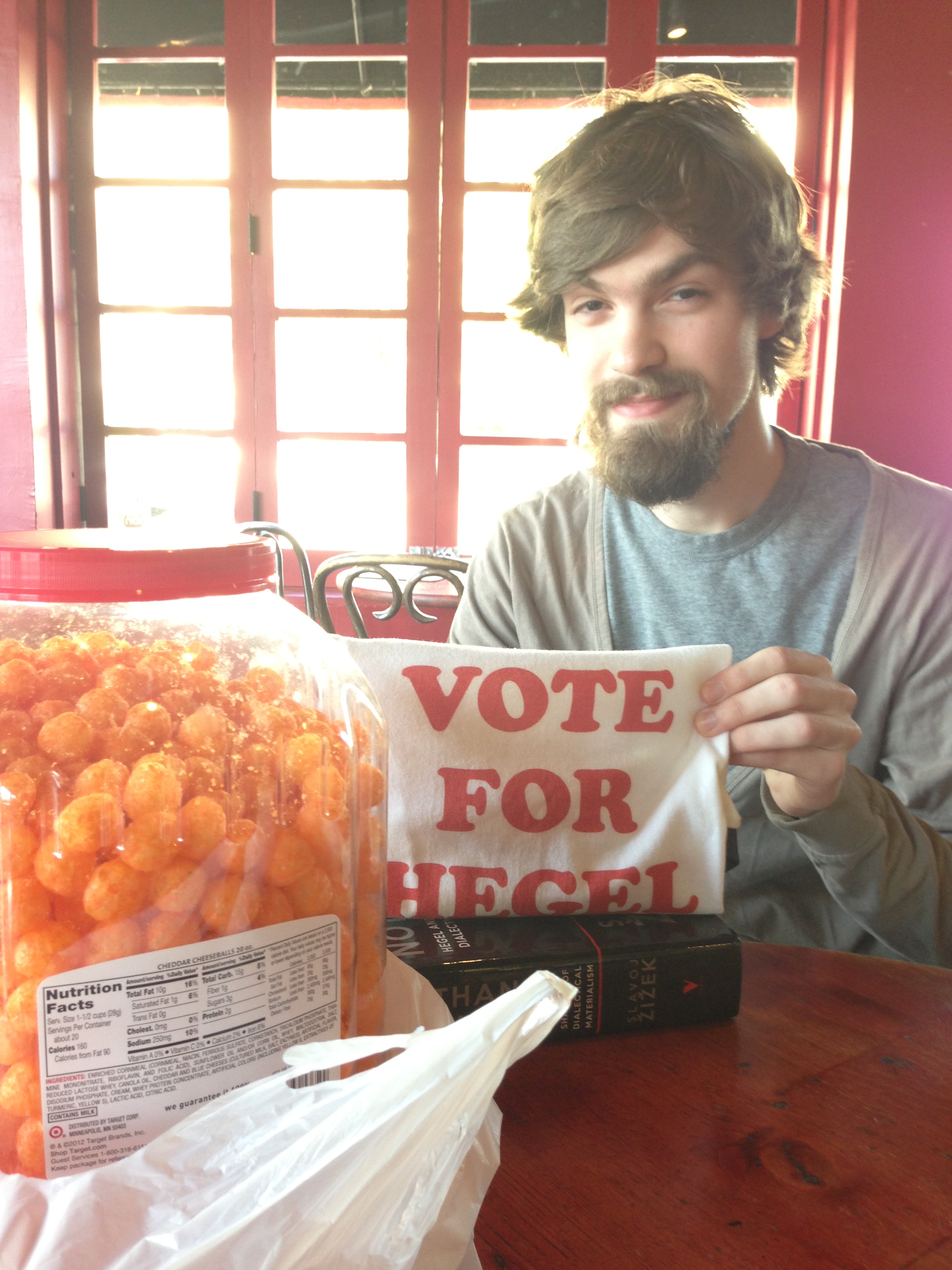
I know what you’re thinking. What mountain of generosity must one strip-mine to facilitate such questionable benefit, and how can I stop it from happening again? Well, securing my station as ‘patron of the arts’ only cost me: a copy of Žižek’s Less than Nothing, which I ran over repeatedly with my car; a t-shirt of my design; and five pounds of cheese balls. Here I proved less successful than Cameron. It turns out to be impossible even to scuff Less than Nothing, despite multiple passes under my car tire. And when I saw how large a quantity just one pound of cheese balls represents, I couldn’t in good conscience subject him to five times that quantity. I have agreed to be indebted to Cameron in this regard, an arrears I shall also allow him to transfer on my behalf and at my own peril. As for the t-shirt, I asked myself the obvious question: what would Žižek wear (besides his standard-issue dark tee). Like healthcare or Marxism, the result can be shared by everyone — for a price.

As Žižek says, if you have a good theory, forget about the reality.

—Ian Bogost
Atlanta, April 2013

++++++++++++++++++++++++++++++++++++++++++++++++++++++++++

Finally, a picture to prove that loot was delivered in fulfillment of the agreement. I am also very open to suggestions about what I should take in place of the other 4 pounds of cheese balls.

photo

Posted in A Game I Made, Video Games | Tagged , , , | Comments Off on Released: Slavoj Žižek Makes A Twine Game

Olof Dreijer on Ally Responsibility

We’ve been talking about the importance of making your privileges transparent in order to be able to say something political. It’s something I learned from reading about intersectionality, which is a way to analyze power by looking at its different categories– gender, race, class, sexuality– and how they interact. Before we started making this album, after not having worked together for a long time, we were interested in getting deeper into feminist and queer theory. So we read post-colonial feminist and anti-racist theory, and with this comes intersectionality. It’s important to see your own position on the scale.

Being brought up in a white wealthy family in a Western country, we were privileged. And we have a privileged position as people being able to make music and study and get asked about what we think about the general political situation. This brings responsibility. When we see people listen to what we have to say, it makes us think about how we can use this attention in the best political way and how we can change our own working process by thinking norm-critically when making choices about who we employ, how we work, what salaries we pay.

Olof Dreijer of The Knife in an Pitchfork interview

Posted in Quote Time, Theory | Tagged , , , | Comments Off on Olof Dreijer on Ally Responsibility