I Have Feelings About Handheld Video Games

I purchased a DSi.

The last time that I had a handheld system was probably in middle school and elementary school. I played my Pokemon Red and Blue, my Dragon Warriors, my Dragon Warrior Monsters. A Link to the Past got a lot of screen time on my tiny purple GameBoy color.

But somewhere around middle school, that stopped. I discovered Jackass and that was where all my time went. The fond memories that I have of wailing on chickens or breeding crazy monsters together to get disappointing results were replaced by throwing footballs at other people’s crotches and drinking the most disgusting thing I could create from the things in my fridge. The times were good and bad.

But the nostalgia dog didn’t just wander up and bite me. I didn’t buy this game system out of the blue. No. Actually, I polled Twitter a while back and asked for some recommendations on RPGs to play. I figured that I was missing some from the PS3, 360, or PC arena that I hadn’t play.

Long story short, not really. I don’t think I am a particularly fast or prolific game player. I don’t blow through the industry too quickly, and I will be honest, I think that home console JRPGs are mindnumbingly boring (most of the time.) And so that meant that my options were limited.

I’m tired and overworked, so let me cut this word adventure short. I feel like I was pressured into buying a DSi because all of the interesting, pick-up-and-play, fun RPGs are on that system. I would be eternally happy if someone would just release a new Dragon Quest game for a bloody home console.

I just want to play games that are designed like handheld games on my console.

Posted in Video Games | Tagged , , , | 1 Comment

Kill Screen Interviews Ken Levine

I am going to see Jacques Ranciere later today, so I don’t have time to make a well thought-out post, but I did happen to see this fascinating interview with Ken Levine that Kill Screen posted the other day.

I recommend reading the entire thing, especially because it is pretty short, but the highlight for me is the first question, which broaches the question of the role that aesthetics have in video games:

There’s an increased emphasis today on player agency and ownership over the story that evolves into these incredibly complex, self-authored branching narratives. Do you think this has changed Irrational’s relationship to the rest of the industry over the years?

I think what’s different about our games is we’re very focused on place-environments like Rapture in Bioshock, the Van Braun in System Shock 2, even a place like The City for Thief. That’s the biggest tool you have to tell a story unless you want to do cutscenes, and I never really liked doing cutscenes. Coming up with a consistent aesthetic is how you tell your story, right? Imagine Bioshock not in an underwater city. A Call of Duty story could be put in a lot of different kinds of places- whether it’s in Afghanistan or in Baghdad. I’m not diminishing it, because it’s a more universal story they’re telling. But we tend to tell very particular stories. Place is usually where we start, even before character.

I fully believe that creating aesthetic standards is the key way that our experience of reality is constructed, with the good and the bad that comes with that, and I am glad to see that Levine feels the same way.

That said, I would also count the audio elements of the game as a way of establishing an aesthetic space and experience, which Levine doesn’t go into. The first step to creating a great, immersive fiction is to engage in some phenomenological trickeryand all of the senses are involved with that.

Anyway, read the interview.

Posted in Video Games | Tagged , , , , | Comments Off on Kill Screen Interviews Ken Levine

Is the Aura the Same as Affect? A Response to a Lingering Question

I have a friend who has been asking Benjamin scholars, for a few years now, if affect and the aura are the same thing. It is a fair question, and there isn’t a hard answer to it, but I am going to attempt to put my answer down here.

The aura as concept is developed by Walter Benjamin in his seminal “The Work of Art in the Age of its Technological Reproducibility” or “Mechanical Reproduction,” depending on your translation. Here is the Marxists.org link to the essay, which is close the translation that I am working from.

To begin, I am going to set up a few points that Benjamin makes clear about the aura and how it functions.

1. The aura is attached to a historical and material presence of a work of art. The original art object (lets call it ART223) stands in opposition to its reproduction because ART223 has a particular physical presence that attaches it to times and spaces, whereas the reproduction does not. ART223 survived burning at Agincourt; Tom the Freshman’s mother trashed his poster of ART223 during winter break because it smelled funny. She would never do that to ART223 because it is precious, has meaning, etc. That is the aura.

2. “The unique value of the work of the “authentic” work of art always has its basis in ritual.” Benjamin claims that reproducibility means that art is removed from its “parasitic” relationship with ritual, which is true; the religious iconic nature of art goes away.

3. The aura is always attached to time and place, and if that time and place is attached to the eternal, all the better. The reason that ritual icons work the way they do is that the viewer is able to enter a spacial relationship with ART223, a masterful painting passed down through years of struggle, pain, and creation. The aura is an envelopment of the viewer in history.

Benjamin turns to material reality to explain the destruction of the aura. The physicality of the film camera as an apparatus that contains an “eye” (lens) and the photographic machine mean that what is captured is really merely being reproduced at 24 frames per second. Thousands of tiny portraits arranged in time.

This is where the prime difference between aura and affect comes into play. The aura depends of history, and the film camera necessarily destroys history. Benjamin claims that time is constructed in a camera through a process of montage, of combining disparate time together into a cohesive narrative that displaces the physical reality it reproduced. He is clear on this point:

For the aura is bound to the presence in the here and now. There is no facsimile of the aura. The aura surrounding Macbeth on the stage cannot be divorced from the aura which, for the living spectators, surrounds the actor who plays him. What distinguishes the shot in the film studio, however, is that the camera is substituted for the audience. As a result, the aura surrounding the actor is dispelled–and, with it, the aura of the figure he portrays.

The aura is destroyed when the organic space of audience/art relations is disrupted. Affect and aura cannot be the same, because affect needs none of these local or organic attachments in order to survive and thrive; in fact, I would go so far as to say that the aura has to die in order to affect to thrive.

The aura’s attachment to a ritualistic sense, and the religions that go with those religions, means that the aura only appears to a select group of people. Iconoclasm becomes possible in a world in which the aura has tentacles that grab the select few.

Affective connections thrive in the post-aura world because they use aesthetics as a method for creating assemblages out of films, posters, people, placards, volcanoes, and anything else. The aura creates hierarchic relationships between the people who view the art, ART223, and the keepers of the art. Affect ignores all of that, though that isn’t to say that it isn’t attached to the ebb and flow of capitalism (and also Ranciere’s “distribution of the sensible”).

So the aura and affect are not the same thing.

Posted in General Features | Tagged , , , | Comments Off on Is the Aura the Same as Affect? A Response to a Lingering Question

A Quick Bit on Ellis’ Supergod

I am really busy. The semester is ending. I have books about feminism and science fiction to read, as well as some fairy tales. It has been that kind of year.

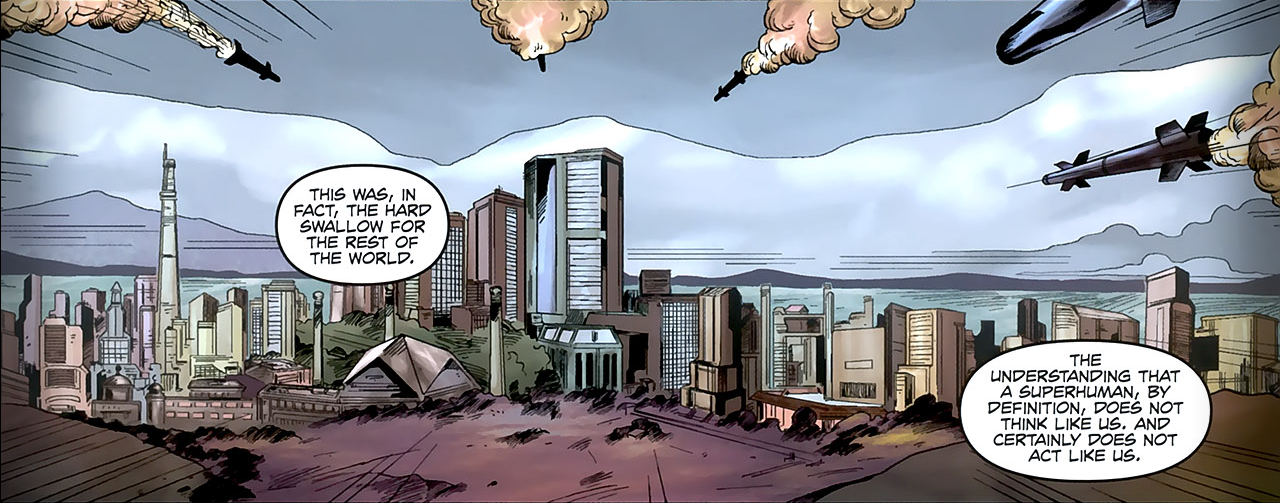
Anyway, I read Warren Ellis’ Supergod this past weekend. If you want the short version, I liked it. It was over the top, high concept stuff, which Ellis excels at. I’m just going to go over five quick points about the five issue series. Follow along if you want.

1. Ellis doesn’t spend a lot of time delving into the superhuman mind. It reads like a direct response to internal monologue and history that we get from Dr. Manhattan in Watchmen–the supers in Ellis’ series do not have complex backstories. They were not the daughters and sons of watchmakers. They were the product of cold calculation, of intent and ethics gone awry. That is a much more interesting story, and frankly more realistic. It is also more haunting. The supers are absolutely opaque to the narrator character and the reader.

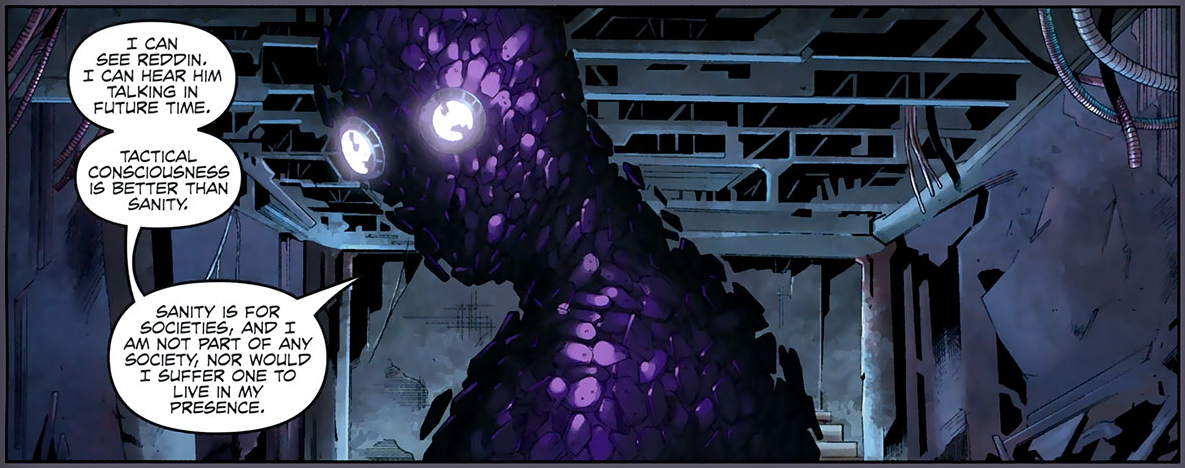
2. A time-displaced being has “tactical sanity,” which means that it can see all possible branching paths in science. I think it was Larry Niven who wrote the “disproving God” article where he suggested that a God would have to know all possible time paths in order to exist, and that that knowledge is impossible, so no god could exist. This god, too, is a response.

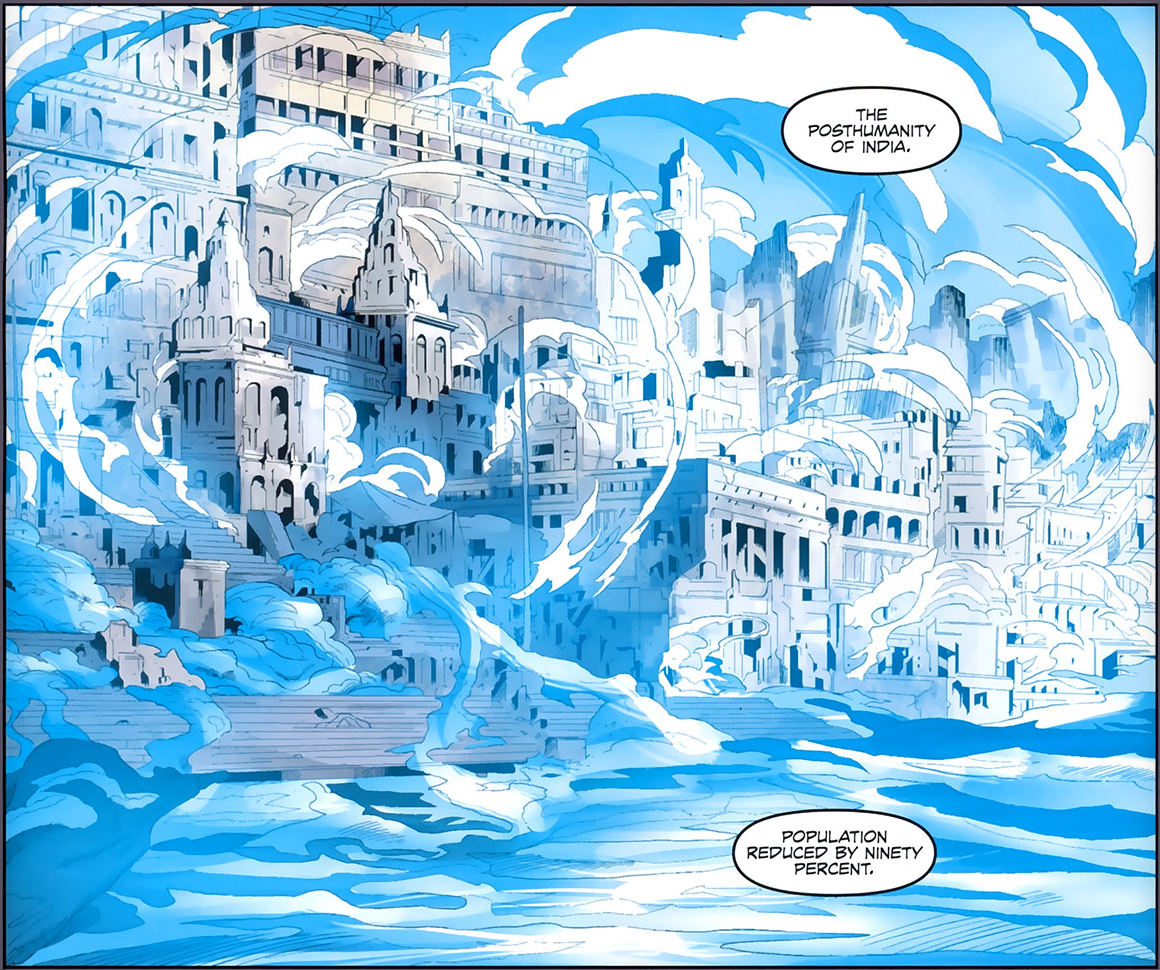
3. The superbeing that opens the series is created by India. Its mission is to safeguard India and to usher in a new golden age for the country. It did that, and the scenes of destruction are beautiful. The destruction, like the gods, is opaque. We can only see an external, beautiful force. Of course, the reader gets the full on crushed-skull reality of the whole ordeal, but the scenes of destruction can’t be understood; they have a purpose outside of the human range of understanding.

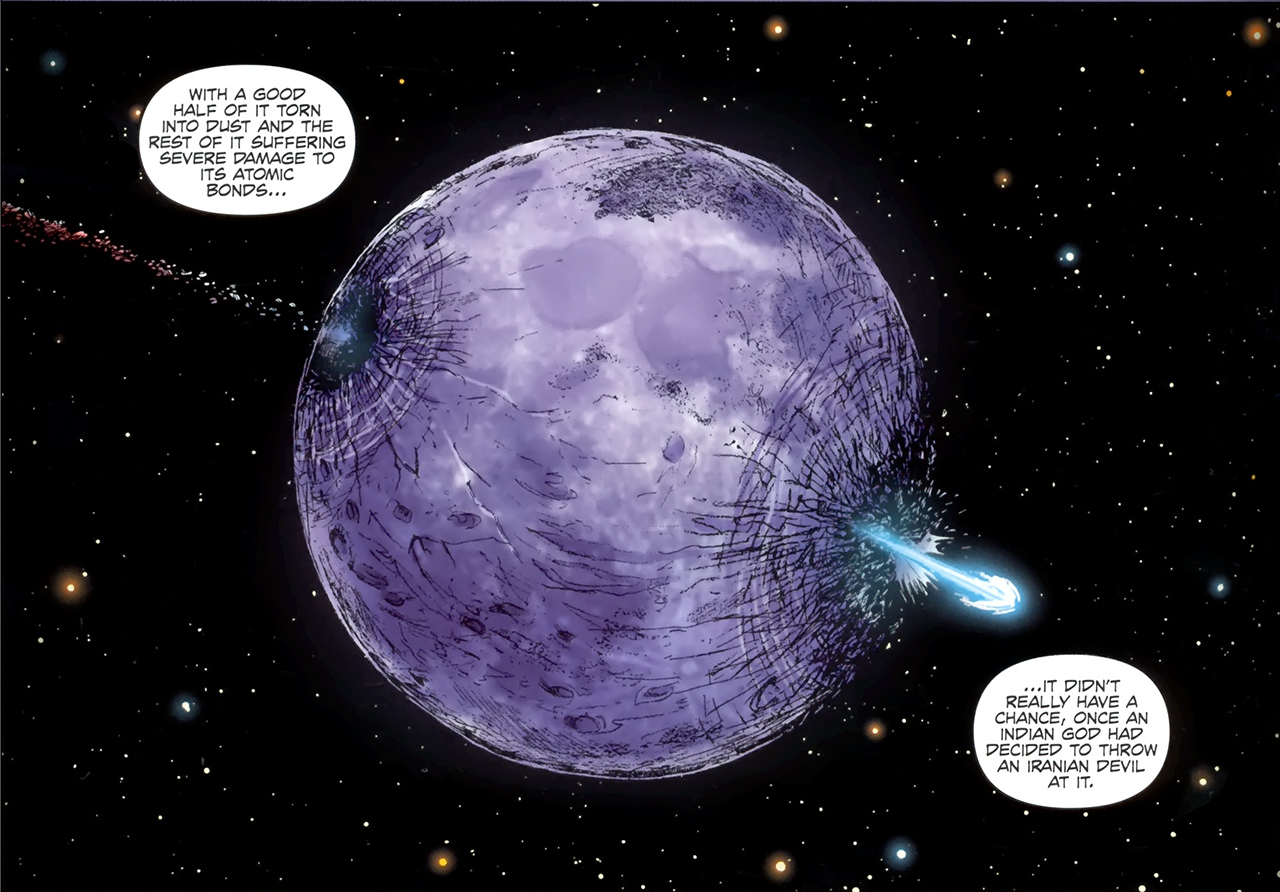
4. This also becomes extraterrestrial. Watching the moon get swallowed by particle-disrupting forces is unspeakably horrifying and beautiful.

5. What I felt when reading Supergod wasn’t awe at storytelling. It is a by-the-numbers Ellis works, by all means. But there is something extra that started with Planetary that Ellis has gotten progressively better and better at (I will write on this at length one day.) Ellis is presenting us with a history. In this case, the history didn’t happen, but I think the overarching point might be “who gives a shit?” The history/histoire is merely a fiction. The only difference is that some fictions happen.

Posted in Comics | Tagged , , , , | Comments Off on A Quick Bit on Ellis’ Supergod

Ten Disjointed Thoughts About American Vampire

American Vampire is Scott Snyder and Rafael Albequerque’s interpretation of vampire mythology in comics form. I read the first twenty five issues yesterday in one go. Here are some disjointed, but numbered, thoughts that I had about the comic so far. These are not meant to be a comprehensive review or a judgement on the soul of the comic, but instead just some jumping-off points for additional thinking about the series.

This is the synopsis of the series from Wikipedia:

The series imagines vampires as a population made up of many different secret species, and charts moments of vampire evolution and inter-species conflict throughout history. The focus of the series is a new American bloodline of vampires, born in the American West in the late 1800s. The first of this new species is a notorious outlaw named Skinner Sweet, who wakes from death, after being infected, to find he has become a new kind of vampire, something stronger and faster than what came before, impervious to sunlight, with a new set of strengths and weaknesses. The series goes on to track his movements through various decades of American history – along with the movements of his first and only known progeny: Pearl Jones, a young woman working as a struggling actress in the 1920s silent film industry when she is attacked by a coven of European vampires hiding in Hollywood. Sweet saves her (uncharacteristically) by giving her his blood, thereby turning her into an American vampire like him, at which point she seeks revenge on the classic vampires who attacked her in life. The complicated and charged relationship Jones has with Sweet is another focus of the series.

1. I don’t really like American Vampire. Scott Snyder’s writing feels a lot like Stephen King’s, and it makes sense that the backup story that told Skinner Sweet’s story was written by King. I can feel him everywhere in the series.

2. Speaking of Skinner Sweet: he is the only interesting character.

3. Skinner Sweet being the only interesting character is strange because I am pretty sure that the audience is supposed to feel the exact opposite. Pearl and Henry, the former an American vampire and the latter her ageing human husband, seem to be the intended focus of the audience’s empathy. They are trying to have a relationship in which one member will live forever and we are supposed to feel sad and the panels of them driving down the highway with the top down are supposed to poignant. They aren’t. At best, they are kitschy moments about the pain of having the be a vampire. Didn’t Anne Rice already do that bit?

4. But anyway, Skinner Sweet is compelling precisely because he isn’t trying to live his life. In fact, he actively attempts to maintain the status quo of the Old West. He fails time and time again, and from the information we have gained in the last few issues, Skinner is now an agent for the Vassals of the Morning Star, a vampire hunting group. His inability to adapt, shown in shocking clarity by his being wounded over and over again during World War 2, has culminated in his having to join a group dedicated to his elimination.

5. Stories about fallen characters are good.

6. But all of that said, I still want to read the series. It is like Burn Notice. Have you ever watched that show? Horrible characters, pure cheese and production, but goddamn if it doesn’t suck you in. It is like some profoundly modern art form that has figured out the perfect formula for dragging viewers in. I feel that way about American Vampire, which is to say that Snyder is a damn fine writer in some kind of weird, addicted, witchcraft way.

7. It probably has a lot to do with Albequerque’s art. Oh, I haven’t shown you any? Well it is goddamn beautiful. The panel below contains one of the tricks that Albuquerque uses pretty often, which is splitting a larger image up into several panels. I always enjoy this trick, and it does something particularly unnerving here. It is almost like the vampires are too much for one panel, that the horror Pearl is experiencing is too big to see, too terrible to take in all at once. The comparative between the top three panels and the bottom three is great, too. She is presented as a more disjointed, fearful subject who is made continually more uncomfortable and cramped by the panels. The vampires are comfortable, even shattered. It is good storytelling.
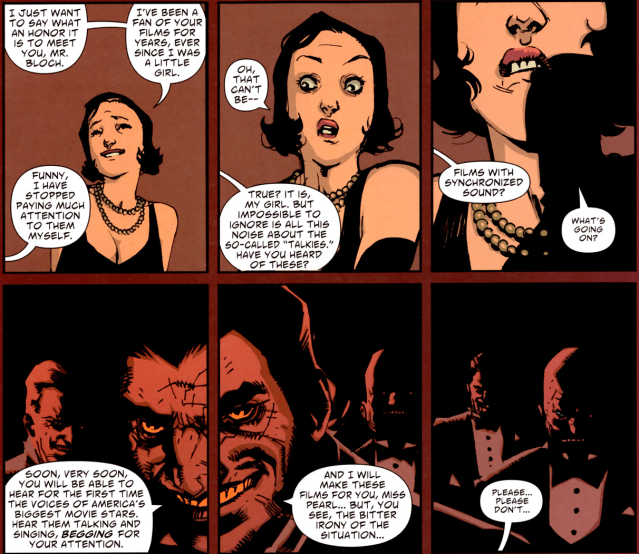
8. The Vassals of the Morning Star are lead by some guy who looks and acts way too much like Agent Graves from 100 Bullets. Also, Skinner Sweet is way too much like Lono from the same series. The comparison is really, really apparent if you have read both series, and I imagine the levels of fuck-overy that occur in the later chapters of 100 Bullets will be replicated toward the end of American Vampire.

9. There is another storyline about Cash McCogan, a sheriff in Las Vegas during the construction of the Hoover Dam. Skinner Sweet injects McCogan’s pregnant wife with with his blood, which means that the baby is born a crazy vampire thing. That storyline seemed cool until Cash McCogan died fighting Nazi vampires. One of the best, most complex characters was killed fighting the tropiest goddamn trope in Tropeland: Nazi-fucking-vampires.

10. I could not care less about any other character in the series. The comic sometimes takes turns toward the misogynistic with the way it portrays women (not to mention the ways that violence is done to women in the series; you saw those panels up there, right?). I hope that doesn’t continue, but otherwise I want to see what happens. The writing has gotten stronger after a rough start, and I think that Snyder could become a really great comic writer. Albuquerque is already a fantastic craftsman.

Posted in Comics | Tagged , , , | Comments Off on Ten Disjointed Thoughts About American Vampire

On The Republia Times

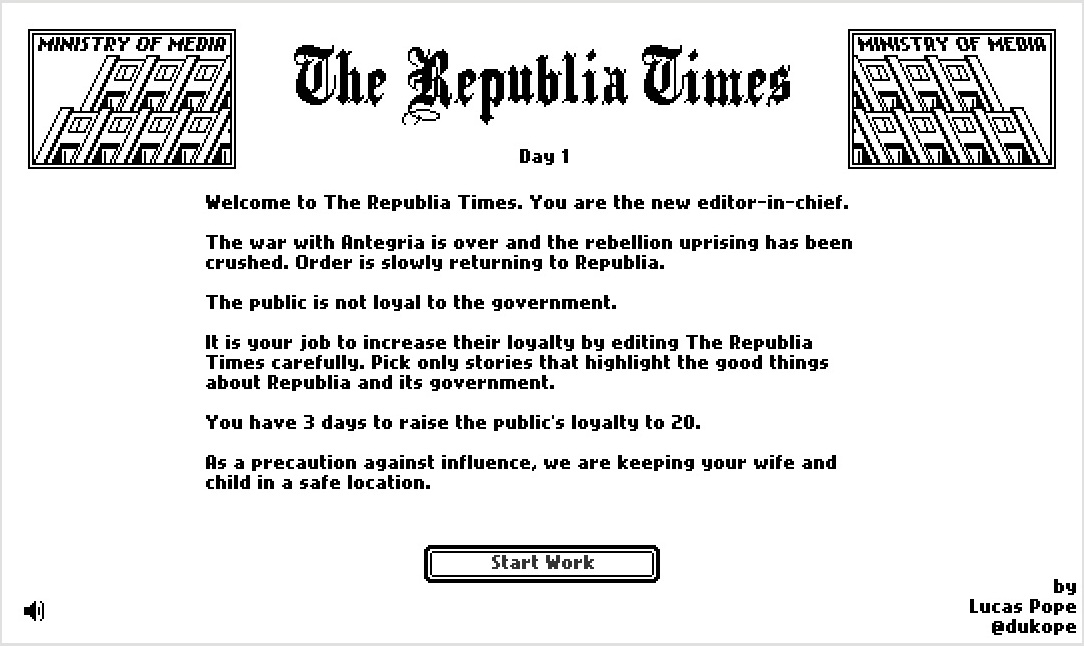
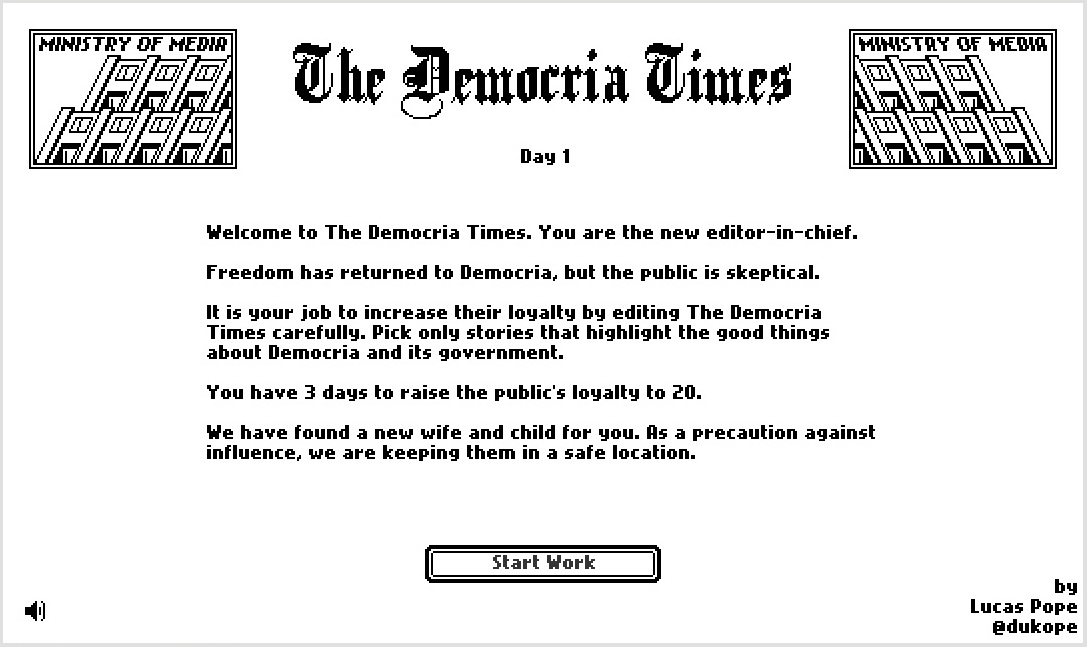
So somewhere on the internet I found a link to this game called The Republia Times (or just Republia) by Lucas Pope. The basic idea is that you are a newspaper editor in an oppressive regime whose family is being “taken care of” by the government. You are supposed to make citizens read the paper and make them very loyal to the government. That isn’t so hard, is it?

I am going to do a little bit of a Lets Play here. The game plays quickly, so I encourage you to go do it right now. But if you don’t want to, follow me along on my adventure.

So this is the opening screen. This gives you all pertinent information about the game.

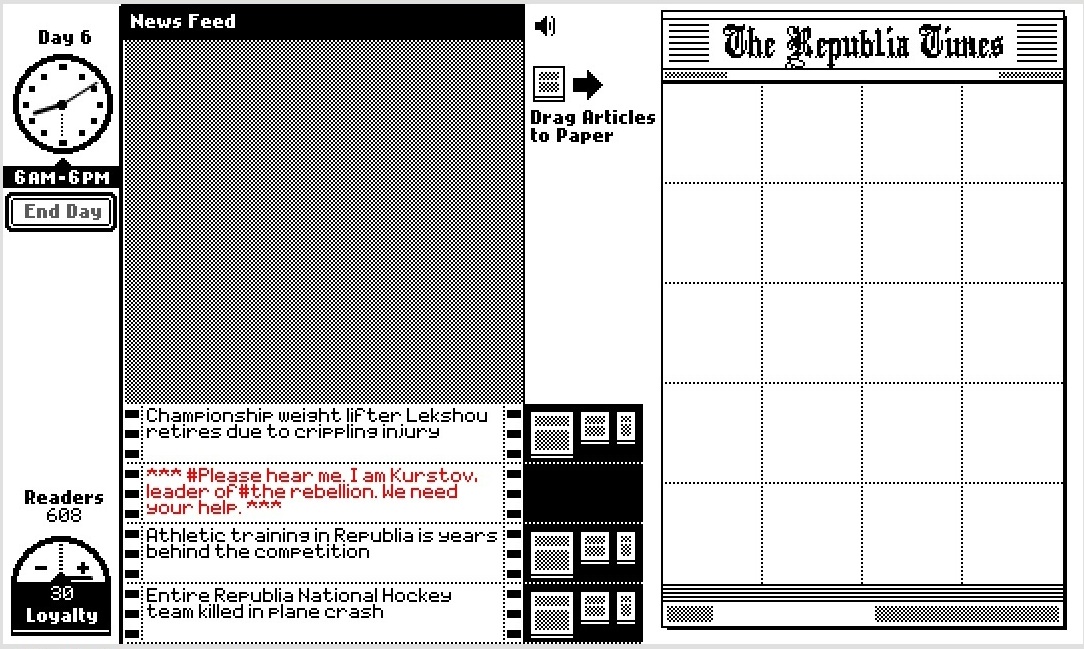
After being a successful editor of the most oppressive paper in the world, I started getting weird little red lines and messages that showed up in my “feed” of stories. I just assumed they were redacted stories that the government didn’t need to see, but then this part popped up. “Please hear me. I am Kurstov, leader of the rebellion. We need your help.” I’m going to be honest: up until this point I had no investment in the game. My family, which I assumed was supposed to be my emotional connection to the diegetic world, just didn’t resonate with me. I didn’t care if they had privileges. But the rebels speaking directly to me actually gave me pause. I continued my job as I was supposed to, but I knew immediately that I wanted to do whatever I could to help the rebels.

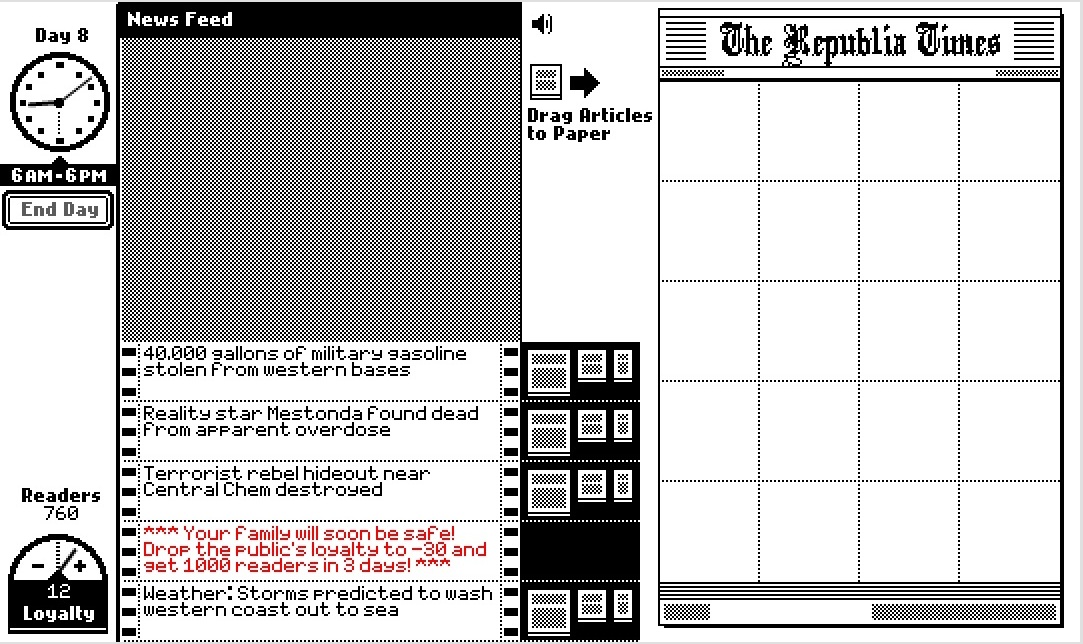
The rebels eventually contacted me again and told me what I had to do: gotta make people hate the government. I immediately changed what I was doing. I didn’t have big stories about celebrity weddings; I had huge hunks of page dedicated to revealing the political reeducation of teachers and professors in labor camps. After the first day, my family began to lose privileges. They didn’t matter to me. They were faceless and did not speak to me directly. They didn’t have the color red to tantalize me. My family was the subject of objective statements told to me by my overlords, and besides, they were going to be safe when the rebels won anyway.

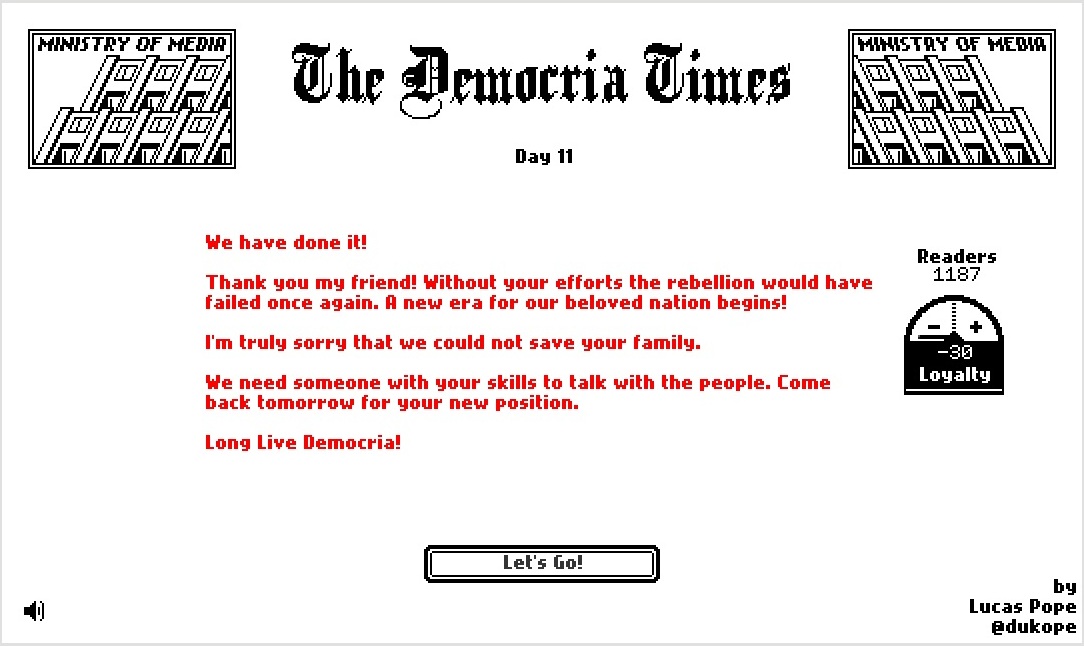
The rebels won. My family was killed. I am offered a new job. I don’t really know what I feel, but I understand the point that the designer, Lucas Pope, is making here. Here’s the new boss, same as the old boss. And I can get behind that. A radical change in the ideology of a structure isn’t necessarily going to change the experience of people on the ground. Think of it like the American democratic process. After I got to this screen, I smiled and thought about the Emma Goldman quote where she explains that women gaining access to voting rights is really only women making sure that they are enslaved.

And now it is The Democria Times. Democracy reigns. The job stays the same.

Go play the game for yourself. It looks like there are a couple ways that the game can play out, and you should go try to experience them all! Also, follow Lucas Pope on Twitter.

Posted in Video Games | Tagged , , | Comments Off on On The Republia Times

Suikoden vs Mass Effect

I am feeling brain sluggish today, so I don’t have anything super smart to tell you. The end of the semester is coming up, as some of you might be aware of, and that is a draining, horrific time for everyone in the world.

That said, Krystian Majewski wrote a cool bit about Suikoden versus the Mass Effect franchise at Game Design Scrapbook. He is 100% correct in all ways, and I really think he is on to something when he mentions the large cast of characters and how they play out with one another in the story:

Clustering – With 108 characters, one would assume it’s easy to lose track of them all. After all, there is this legend that humans can only remember 7 items at once. And sure, there are some forgettable characters among them. But it’s not as chaotic as the sheer number would suggest. I was actually surprised how meaningful and memorable the characters were. I think one reason for this is that the game used multiple layers of clustering. Characters are not just random items you collect. Certain characters belong together. So for example, some characters have relationships and ties with each others. There are lovers, friends and families. You act out those relationships in the story. Some characters only join you if you bring another character they know with you.

If we are going to be honest, this is really the place where the game shines. The story is impossibly terrible. It strings you along on a strange journey that makes no sense, and beyond the bare narrative (“We are all now rebels!”) it doesn’t make a lot of sense.

But the small stories that you get are amazing. The little dreams of each of the 108 characters, and especially figuring out how to appease them and bring them all together, is a really great feeling. Figuring out how to accomplish that organically is amazing, and I am sure that those who puzzled out the harder recruitments felt really rewarded at the end. My solution was to go through the game with a pen and paper so I could write down all the recruitable members that I met, where they were, and what I thought I would have to do to get them. I think I finished the game with maybe 60 rebels.

Read my post on Suikoden that I made last year if you want.

Oh, and Mass Effect literally does nothing right as far as recruited members go.

Posted in Video Games | Tagged , , , | Comments Off on Suikoden vs Mass Effect

Crossed and the Reduction to Meat

My partner hates when I talk about beings “reduced to meat.” I might have stolen the phrase from someone, but what I am trying to get at with the phrase is that there is a clear dividing line between what we perceive as living flesh (skin, muscle, sinew, etc) and what we consider “mere meat” (cracklins, venison, gristle, etc). That’s a pretty simple argument to make; we have different words for the same thing to demarcate how we experience it.

Crossed is a comic book series about graphically depicting the most horrible things imaginable. I don’t have a better way to introduce it. Avatar, the company that publishes the comic, has made a name for itself by consistently putting forward taboo-breaking comics that do their best to disgust and offend their readers. I am not critiquing them for this. I think there is space for that kind of comic in the same way that I think that American Psycho is a valuable novel.

The basic idea of the comic series is that some people have been infected with a condition called “crossed.” A big red plus sign dominates their face, and more importantly, that condition means that they become purely transgressive–they actively, and violently, violate all taboos. Anything that violates a taboo becomes fair game for the writers and artists to depict. The murder of children, horrifying sexual violence, and massive gore are all depicted with regularity. The original writer, Garth Ennis, used this world in order to tell stories about humans and the things we are capable of doing to one another. The other writers who have done work in the series don’t seem to be as concerned with that, but they are still attempting to talk about those issues in various ways. Ennis said this about the series:

“The Crossed are simply people who’ve turned to evil, utterly dedicated to exploring every foul thought that’s ever occurred to them,” Garth Ennis told CBR News. “Murder, rape, carnage– the more devastating and inventive it is, the better they like it. As such, they’ll exploit every physical and mental resource at their disposal, heedless of any possible harm. So even a five-year-old girl’s going to be dangerous, given that she doesn’t care what happens to her while she’s going all out to chew your eyelids off.”

Anyway, reduction to meat. As a taboo, cannibalism is something that Crossed deals with pretty frequently, and we are often shown images of newly-dead main characters being torn into by crazed nuns (or something like that.) The cannibalism that we see in the comic is not particularly gendered in any way. If cannibalism occurs in the comics, then that cannibalism isn’t gendered or sexed. It is just straight-up people eating.

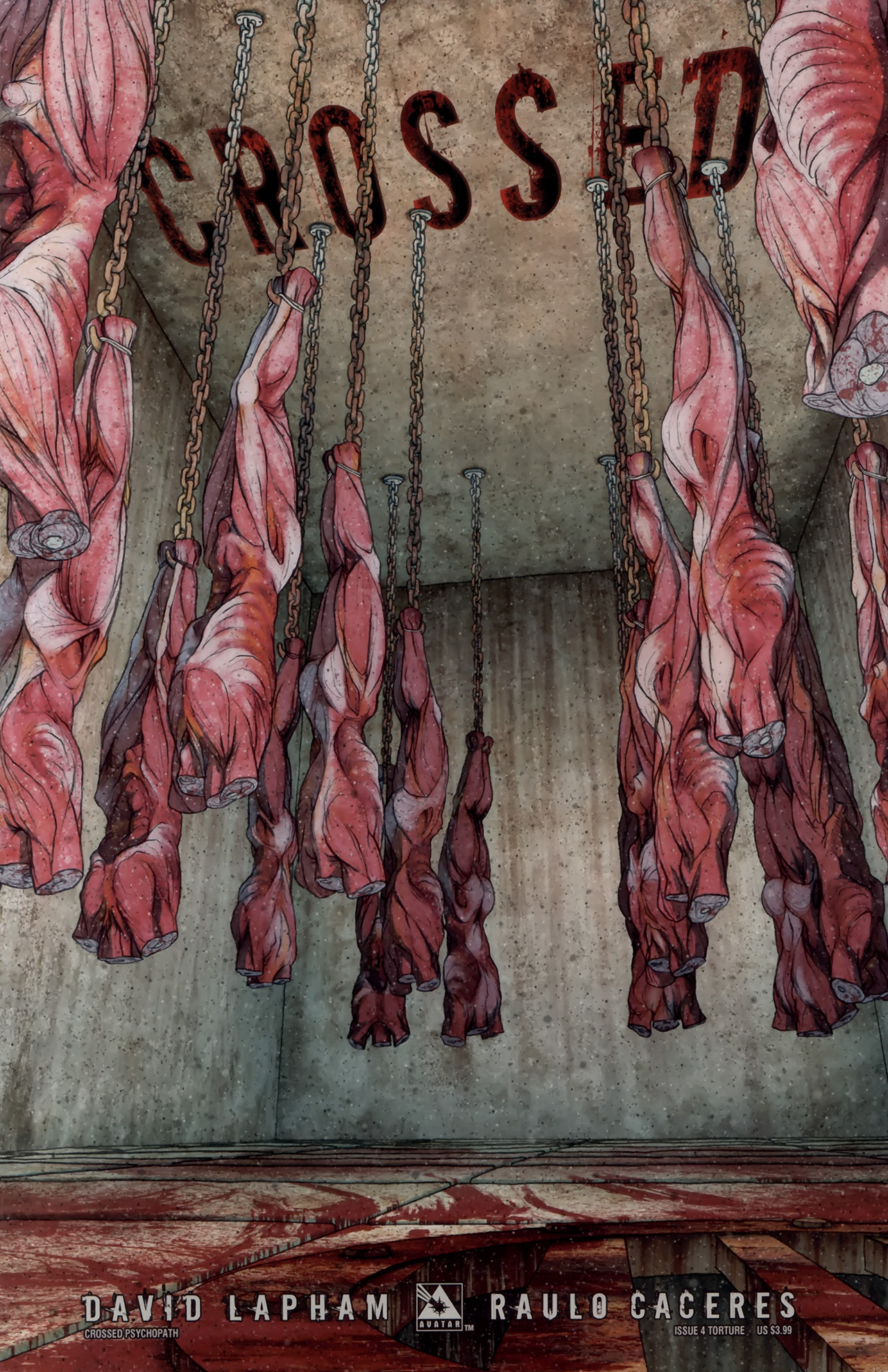
But then there is this cover for Crossed: Family Values #5. I am linking it because it is incredibly graphic and, well, horrifying. For those who don’t want to risk it, it is a picture of a nude woman hanging by a meathook. There is a giant, bruised, open mouth below her. It is oddly symbolic for Crossed, which you might have gathered is not exactly the most high-thinking symbolic enterprise. The artist is Paul Duffield, and isn’t the kind of guy I would associate with Crossed. He also did this one, which is another “butcher shop” image, but without the overt gender commentary.

Both of these images are different from your average Crossed cover. Both are alternate covers, labeled “Torture” covers, presumably because they are more extreme in some way than the normal covers. It could just be a way to easily label variant covers, I don’t really know. Most of the covers are just slightly more horrifying things than you would see on the normal covers–some of them have scenes of brain eating or priest defilement, for example– but these two do something profoundly affective.

I don’t eat meat. Part of the reason that I don’t eat meat is that I can never quite shake the image of the being in the meat, the embodied creature that once was and now isn’t. I cannot reconcile my personal pleasure of eating with the systemic genocide that goes on in the industries that produce meat all over the world. The reason I find these Crossed covers so powerful is that I think they have the ability to bring the genocide of meat production closer to home. I have written extensively about the way that images draw us close to them and force us into thinking–as Ranciere would say, these comic covers disrupt the distribution of the sensible.

When Rocky punches meat in the locker, he is punching the same kind of flesh that exists inside of your mother, your lover, and every religious figure that has ever existed. Gandhi was made of the same kind of flesh that Burger King keeps trying to stuff down your throat with clever ads. And so these images are terrifying, in the sense that Cavarero means “terror,” in that they force us to flee from them; to act.

There is also a politics of the feminine in the first image, too, particularly with that giant mouth underneath, but I will leave the analysis of that up to you.

Posted in Comics | Tagged , , , , , | Comments Off on Crossed and the Reduction to Meat

Some Preliminary Thoughts on Groys’ Art Power

I started reading Boris Groys’ Art Power yesterday. Well, by “started reading” I mean that I slogged through the introduction; I find Groys fascinating but dry, which is probably more of a byproduct of translation than anything else. I enjoyed the opening bit, and I think that his criticism of modern art is both smart and on-face apparent, both of which make for a good argument to get some play.

Groys claims that modern art is characterized by paradox–it constantly folds in on itself and there are infinite counterexamples to any theory of art. From this information, he concludes that the only way out it to accept, and revel in, the paradoxical nature of art. This lies somewhere near the Derridean joussiance in play; things are how they are, the structure isn’t changeable, so take pleasure in the whole enterprise.

The second major claim is that art only becomes politically viable when it is produced from an ideological standpoint divorced from the market. The issue with the free market of art is that art begins to proliferate simply for the sake of accumulation; art gets caught up in an unstoppable process. He takes issue with the idea that art produced outside the market is somehow “perverted” because it is produced from a specific ideological standpoint, and continues:

It is also interesting that even the most severe judgment on the moral dimensions of the free market never leads anybody to conclude that art that was and is produced under those market conditions should be excluded from critical and historical considerations.

The belief that the free market somehow creates art that is more “ethical” than art that comes from regimes or revolutions is wrong. I take a little bit of joy in the fact that this argument about the ethics of art hasn’t really happened in the fields of video games or comic books. There are always people who claim that “real” comics or games only exist outside the publisher system, but those people aren’t even a vocal minority, much less a group that splits the fields.

That isn’t to say that I don’t find indie comics and games to be important. In fact, I think giving people the tools to make those things might be one of the most important ventures in both fields. But I am glad that no one is looked down on for enjoying Capcom games or Marvel comics in the same way that a person would be for authentically enjoying a Thomas Kincaide painting.

Anyway, Groys’ claim for the best kind of art appeals to me. He says that:

Art becomes politically effective only when it is made beyond or outside the art market–in the context of direct political propaganda. Such art was made in the Socialist countries. Current examples include the Islamist videos or posters that are functioning in the context of the international antiglobalist movement. Of course, this kind of are gets economic support from the state or from various political and religious movements. But its production, evaluation, and distribution do not follow the logic of the market. This kind of art is not a commodity.

This is obviously a divisive point, and while I don’t think it is entirely correct, I do think it is worth considering. There is something to be said for art that is politically effective and eternally obscure–shields shaped like books to protect students from the police, posters for OWS, invasive photoshopped ads. While Groys wants to think through state-enforced art, I think that the argument goes the other way. There’s a power in not being able to be bought and sold, to be accessible for free outside of market demands. Anna Anthropy’s points about the absolute necessity of free games ring bells here.

As a sidenote, there is also an interesting debate to be had with Ranciere here. Groys is always going to fall victim to the “distribution of the sensible” arguments that Ranciere makes, but I am not sure that Ranciere’s critique of the political image actually applies to Groys’ conception of the same. Ranciere’s political image is one that exists for a specific purpose, to violently interrupt the distribution of the sensible, and yet it fails because it is too pointed; it can be depowered and radically rejected because it makes its point too bluntly. Groys’s political art allows for spaces of ambiguity, which means that it can draw in affective responses, unlike what Ranciere is critiquing.

Anyway, expect more posts from me in the future regarding this book.

Posted in General Features | Tagged , , , , | Comments Off on Some Preliminary Thoughts on Groys’ Art Power

Bifo’s Ironic Ethics

I am an unabashed fan of Franco “Bifo” Berardi, especially when he is at the peak of his “grumpy older Italian man” kind of writing where he denigrates all technology in the name of a long-forgotten past. Ironic Ethics came to me through the magic of the post today, and so I sat down and read the entire thing in one sitting. That wasn’t really a feat since the whole thing is less than thirty bite-size pages, but nonetheless, I enjoyed it. As a part of the “100 Notes – 100 Thoughts” series from documenta, the text is really invested in being a short work that smacks you about the head and neck with its ideas.

Bifo is putting forward a similar argument as the one he developed in The Soul At Work, but in a much more condensed fashion and certainly more specific to Italy in 2011 [read what I had to say about The Soul At Work].

The essay begins with a short version of his argument about feminine and masculine pleasure, which is that the European project of dominance and ownership is fundamentally based on an anxiety about the potentially infinite sexual pleasure that women can access. To counter this anxiety, males shifted the focal point of pleasure to possession rather than sex. Bifo writes:

If we wish to oppose the materialistic cynicism of power effectively, we need a materialistic ethics of pleasure and sensibility. Moral judgment and indignation are inapt tools with which to counter the kind of mental pathology, commonly named corruption, promoted by the popular media. From the point of view of the social investment of desire, the problem is not one of compliance with universal moral values. The problem is pleasure.

He continues along this line of argument and asserts that what we need are counter-aesthetics to those that are foisted on us by capitalism. It is only through that method that we will be able to solve the psychic pathologies that haunt our culture–suicide, extremism, a desire for fascism, and so on.

What is pleasure? Desire is the creation of a singular universe, the projection of a world of things, people, voices that surround the sensible-sensitive organism as attractors. Pleasure (jouissance) is the collapse of borders between the singular organism and the surrounding world; it is the dissolution of the cultural cuticle separating my body from the body of the universe. The pathology induced by the capitalist acceleration of the Infosphere during the past thirty years has displaced pleasure from the sphere of sensibility to the sphere of mediation: the symbolic ersatz carried by the media spreads as a viral mutation in the Psychosphere. This is why the ethical question needs to be located in the field of aesthetics. Indeed, aesthetics is the sphere of sensibility and sensitivity; it is therefore the place for an ethical politics in the capitalist age.

Bifo argues that there are two ways of thinking about the world, drawing on Sloterdijk’s Critique of Cynical Reason to distinguish between thinking cynically and thinking ironically. The former is a mental dissent and recognition that a system will fail and yet still being on the side of the system. To be a cynic is to always side with power because you are afraid of being crushed.

In contrast, “the ironist simply refuses the game and recreates the world as an effect of linguistic enunciation.” We speak what we want, we represent what we want. There’s a beautiful sentiment there. There is also a danger, though, and the article ends with this paragraph:

In the second part of the 1970s, the Italian autonomous movement practiced irony as a critique of power and dogmatism. A historical catastrophe occurred due to the confusion between the ironic and cynical modes: Autonomia was overwhelmed and erased by the wave of cynicism that coincided with the media dictatorship under which we still labor.

So reject bad aesthetics. Embrace radical images; refuse to play the game. Also, expect to be eradicated for it.

Posted in General Features | Tagged , , , | 1 Comment