Claire Colebrook on the Anthropocene

That notion that one could completely achieve this moment of a completely flat ontology where I speak as if from nowhere seems to be promised by the anthropocene but is also crossed out by it. So it is always going to have this moral quality of doom – unless we do X we will die. And it does seem to have this bet or this strategy. At the same time its necessary then that we think that way, but also completely impossible…because, and this is my last point in this line, here’s the counterfactual. Let’s imagine that there was a world in which the anthropocene did not occur. That is, the human species emerged and did absolutely nothing violent to the planet, that it behaved in a manner that was proper, that its relation to the planet would occur in such a relation of harmony that after the human species ceased to exist a future geologist (should there be one) would not have seen that we existed. I want to ask what that possible species would be. Whether it would be a difference of degree — yes, we can see the fossils of mollusks, so in a way they have done violence to the earth, would we have wanted to exist at that level of degree? Would we then want to erase completely the strata of the anthropocene era such that our relationship to the earth was one of harmony? My question would be A is that desirable? Well for us, no, because we’re parochial and we would have liked a world, I’m imagining we would have liked a world where Shakespeare and the Bhagavad Gita existed, but also impossible. The counteranthropocene is a thought experiment as well.
Claire Colebrook in conversation with Cary Wolfe

Posted in Quote Time, Theory | Tagged , , | Comments Off on Claire Colebrook on the Anthropocene

Daniel Joseph on Grand Theft Auto V

While the creators at Rockstar might not have intended it or really cared to think about it, the characters they created were logical extensions of a hellscape, a world surrounded on all sites by invisible walls, clockwork traffic patterns simultaneously patrolled by police officers whose routines are so predictable that no real human being would be able to survive without becoming a wildly damaged individual. To come to Baudrillard’s assertion of Disney World as the Real America, one might wonder what kind of human would be produced there, if they were born there, if they were to then die there. Now imagine that person living in San Andreas.

So the political critique remains the same: the writers are conservatives. Their world is a hellscape, so the only logical actions in it are amoral ones. This is clearly not how our world works. Life on our planet is indeed awful in a variety of ways, but it is not beyond saving, and an amoral approach due to the domination of his world by amoral forces would be one worth condemning in the most strident way. Yet in a world like the one built in GTA, it makes quite a bit of sense. I don’t think I could ever condemn those living in such a world their actions, because what else would be possible? Nothing. The entire political spectrum is itself meaningless in such a world. So, in a sense then, the game becomes even more interesting for me because it sheds life on an alien planet, a very troubling one. One we should do our best to avoid.

– Daniel Joseph, “Quick Thoughts on Grand Theft Auto

(Dan wrote this months ago and I’ve had it open in a tab since then and now here we are.)

Posted in Video Games | Tagged , , , | Comments Off on Daniel Joseph on Grand Theft Auto V

On Legendary

1.
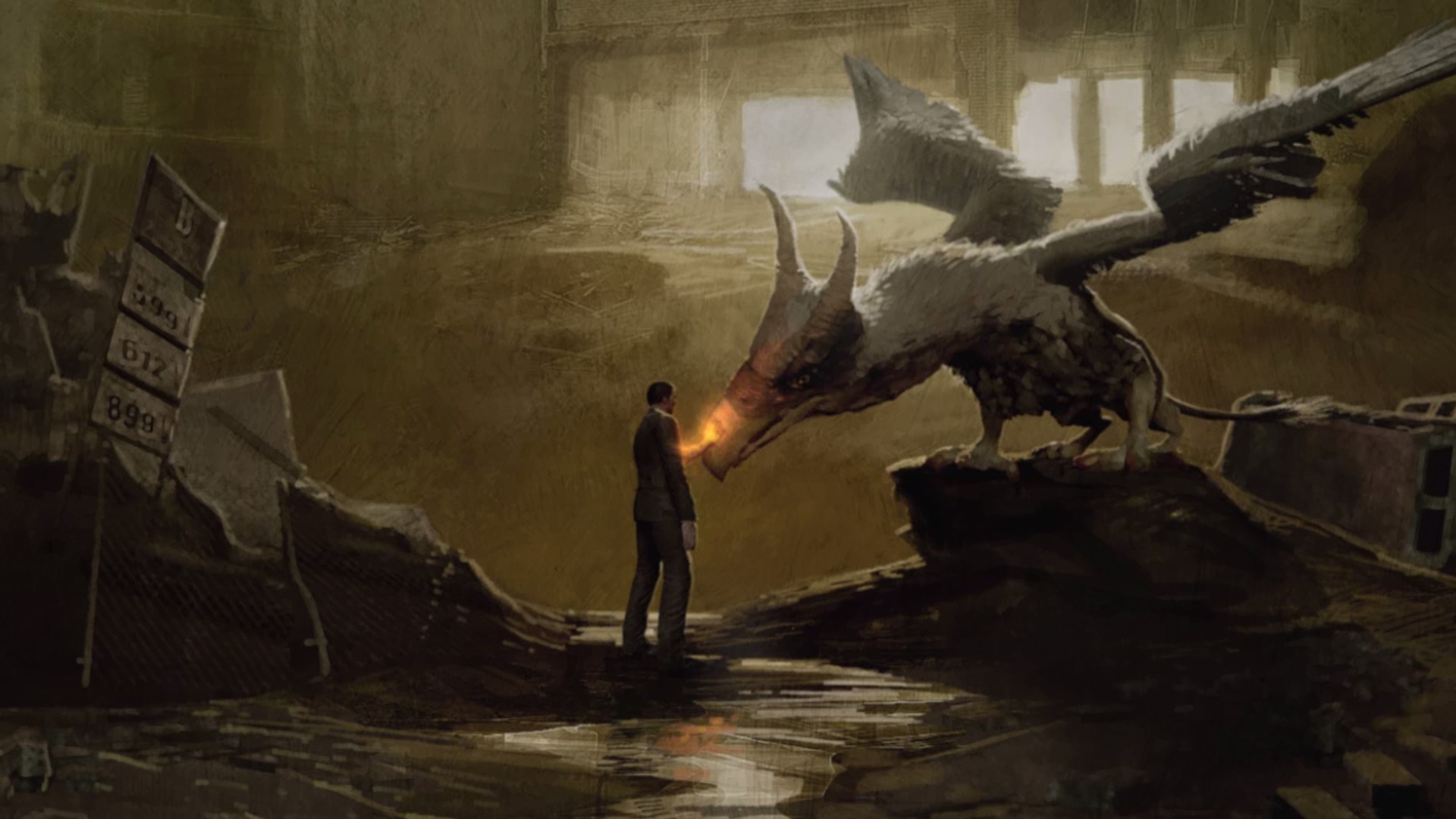
Legendary is a first person shooter where you play as Deckard, a thief who looks a lot of Crispin Glover. In the opening of the game, Deckard breaks into a museum, touches Pandora’s Box (yes, that one), and unleashes some kind of weird nexus that allows for mythical creatures to invade our world. The plot after that is mostly “go here, kill this, go there, pick up this,” which starts as boring and ends as painful.

2.
Legendary is a sad game to play because it lives in the shadow of its contemporaries. You can feel Bioshock creeping in every time you are forced to use the “anima pulse,” a clearly stapled-on mechanic that emanates from a glowing left hand that sometimes flexes for no real reason. Enemies have zero accuracy at beyond fifty yards, but at less than that they’re pinpoint accurate every time; you’re forced to aim down sights in order to deal with them, and Modern Warfare comes calling every time that you do. Sometimes the path forward is blocked by boards over doors, and you have to break out an crowbar–wait, an axe–so you can progress forward.

Legendary is a weird construct pieced together from the first person shooter concepts from the 1990s and a greatest hits of mechanics from the earliest parts of its console generation. Like Frankenstein’s monster, the whole operation is uncanny–using a “hand power” alongside a gun or aiming down sights is something that is familiar in games, but Legendary manages to implement them in a way that makes me regret that they were ever invented.

3.
Dan Whitehead wrote that Legendary is “hilariously bad.” This isn’t true. It is bad in the way that a dead tree is bad. It is bad in the way that time’s arrow is bad. There is nothing you can do. It doesn’t even hate you–it is, at best, totally indifferent. It exists as a machine with no heart.

4.
What is the design core of Legendary? What makes this wheel keep turning? Wasting time.  Legendary is a strange relative of the microtransaction-based game in that it does everything in its power to stretch itself out, to put as much time between events as possible. There are a great many locked doors between the player and her goals in this game, and all of them must be opened in a very specific way:

2013-11-30_00013 2013-11-30_00052 2013-11-30_00053

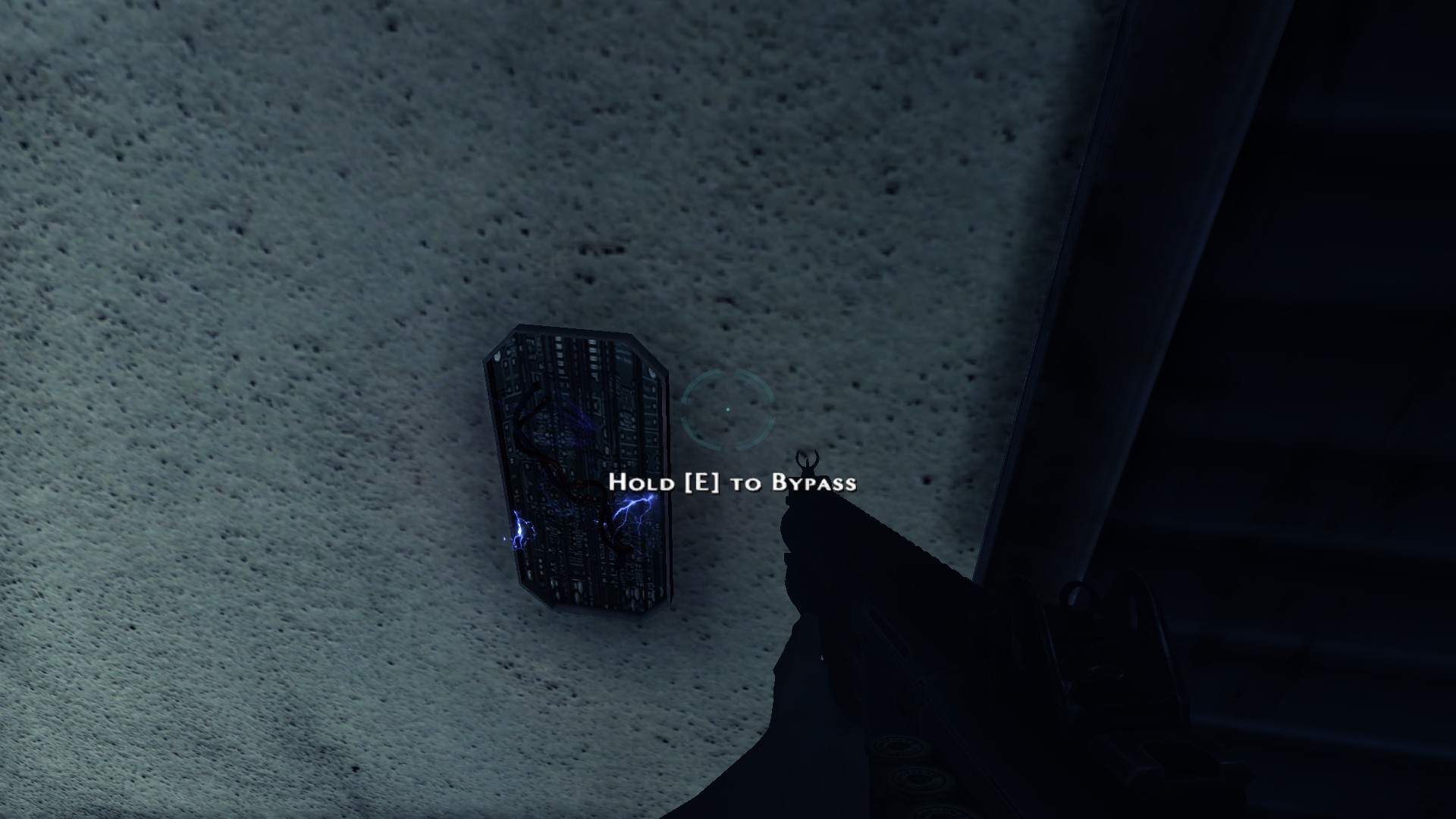
This is how you get through doors. You stand in front of a panel, hold the E key, and just wait. It probably takes a minute or more. There’s no minigame, no skill, just waiting and hoping that the game is over soon.

5.
There are puzzles in Legendary, but they follow the same golden rule of time wasting that the keypads do. At best they give you a small room in which you have to find an arbitrary object that has to be slotted into an arbitrary hole. At worst, you have to walk ten feet to the left to hit a switch, backtrack ten feet, and walk through a door.

I’m not kidding, that is a real “puzzle.”

2013-11-30_00008 2013-11-30_00010

I know these screens are dark, but the first one shows two paths. The left has a switch, the right has a wheel you have to turn to open a gate. You go down the left path, flip the switch, come back, turn the wheel, and walk through the door. The second shot is showing the practical distance between those two objects–there’s a metal bar grate and that’s all. This puzzle takes two minutes to “solve” and impedes progress for maybe three minutes if you went down the wrong hallway first. It doesn’t add to the game. It adds to absolutely horrifying boredom. This is the most perfect encapsulation of Legendary that I can imagine.

6.
Legendary makes a narrative move to be in line with Modern Warfare by hopping around the globe throughout. New York City, London, and some eastern European town all make appearances as levels, but that move is totally pointless because you spend 90% of your time in basements, sewers, and subway tunnels that are all infinitely replaceable for one another. This isn’t helped by the fact that you kill the same few bulletsponge enemies throughout the entire game–werewolves, fairies, fire lizards, gryphons, and enemy troops join human soldiers and a giant kraken as things that will stand in front of you animating while they’re filled full of hot metal.

7.
The most interesting parts of Legendary are the parts that were cut from development. The ending monologue from sidekick/damsel in distress Vivian intimates that she went into hiding and started an underground resistance against the organization that betrayed her, that Deckard was kidnapped and then escaped, and that Deckard used his phaser arm to create an alliance between the mythical beasts and humans. That’s all given in non-animated stills, a la Mass Effect 3 2.0 ending, and so it doesn’t really hit.

2013-11-30_00066

8.
I wasted my time playing Legendary but at least it was a mercifully short four hours.

Posted in Video Games | Tagged , , , , | 1 Comment

Lyotard on the Avant-Garde

Yet there is a kind of collusion between capital and the avant-garde. The force of scepticism and even of destruction that capitalism has brought into play, and that Marx never ceased analyzing and identifying, in some way encourages among artists a mistrust of established rules and a willingness to experiment with means of expression, with styles, with ever-new materials. There is something of the sublime in capitalist economy. It is not academic, it is not physiocratic, it admits no nature. It is, in a sense, an economy regulated by an Idea — infinite wealth or power. It does not manage to present any example from reality to verify this Idea. In making science subordinate to itself through technologies, especially those of language, it only succeeds, on the contrary, in making reality increasingly ungraspable, subject to doubt, unsteady.

Jean-Francois Lyotard, “The Sublime and the Avant-Garde” in The Inhuman p.105

Posted in Theory | Tagged , , , , | Comments Off on Lyotard on the Avant-Garde

State of Decay – The First Two Deaths

Marcus drove his car up to the abandoned church slowly. He was looking for a friend who needed help hunting a Feral. He had never seen a Feral before. There was something in the doorway of the church. Marcus didn’t draw up his gun; Marcus had a wrench. The thing scrambled toward him, skittering sideways, making an awful sound. Marcus swung, it took the hit, a zombie hit him from behind, he didn’t know it was there. The scrabbling thing swung again and again; it vibrated. It grabbed arms and legs and tore.

Maya helped the sheriff clear out some infested houses. She rescued a survivor who was holed up in a supermarket. After building some goodwill with these neighbors, she doubled back to the house she cleared out. It was the perfect place for an outpost. The problem was that she had to search the entire house first, and so she started doing it. She was impatient. She hurried, and something broke, and then a hoard was on her. The zombies crashed through the windows. She moved toward the door, but there were zombies there too, and she was so tired. They jumped on her back and hit her from the side but she stumbled to her car with a literal sliver of health and drove away as fast as she could. She made it over the bridge. She drove along a lonely highway. Things were looking up. She crested a hill too fast. The car tipped slightly, but it was so fast, and she was thrown. She stood up. She was hurt badly, but she could see another car at three hundred meters away. She could make it. She slung her rucksack on her shoulders and began to creep along the side of the road. She heard a horrible sound. There was rushing. Something was too close, beating her, and then she was torn apart.

Posted in Video Games | Tagged , , , | 1 Comment

Mark Fisher Interviewing Burial

Wire: Your music is very visual. I suppose that’s partly the influence of films? You’ve talked about that sound from ‘Alien’ being one of your favourite sounds.

Burial: The motion tracker, yeah, and the dropship, the sentry guns. My big brother would play that sound to me when I was little, and tell me the stories from the film. He recorded it on a tape. He would tell me about that motion tracker sound, and ‘Alien’ and ‘Aliens’ are some of the scariest films. But he would only show me the bit where they were loading up the weapons, but he’d say, ‘you’re too young, I won’t show you the rest, but I’ll tell you about it’. I love the sound of the motion tracker, you can feel the fear of the empty spaces ahead, it’s like sonar. I like Blade Runner but I’m only obsessed with one scene in it, the bit where he’s sitting at those cafes in the rain. I love rain, like being out in it. Sometimes you just go out in the cold, there’s a light in the rain, and you’ve got this little haven, and you’re hanging round like a moth – I love moths too and that’s why I love that scene.

interview between Mark Fisher and Burial, December 2012

Posted in General Features | Tagged , , , , , | Comments Off on Mark Fisher Interviewing Burial

Call of Duty: Ghosts – A Hill

prison-break-multiplayer-map-layout

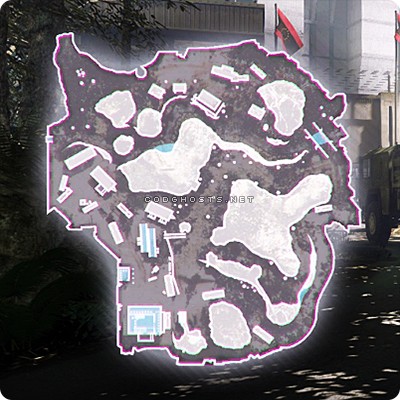
In Call of Duty: Ghosts there is a multiplayer map called Prison Break, and I guess that there’s some reason that it is called that, though I can’t tell you what it might be.

The top-down view doesn’t do the map justice, and by that I mean that the map is utter trash. Sightlines are scattered everywhere, and the map feels like design was thrown to the wind for some kind of “realism” that entails the player always checking behind herself instead of moving forward. I’m biased, of course, because I think Call of Duty multiplayer is best when you’re playing the most arcadey shooter possible–the multiplayer of Modern Warfare 2, with its knives and fast running, might be the pinnacle of my competitive online experience.

I say all of that to intimate that the map definitely isn’t my favorite, but it does have one single great feature.

prison-break-multiplayer-map-layout3

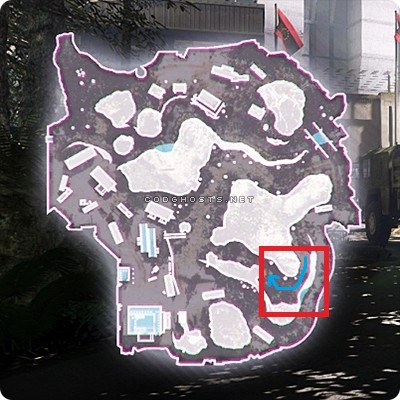
Contained in the red box is what I call “the hill.” It is what is sounds like. The upper right of the box is a pathway that leads up toward the center of the box–the incline is pretty steep. People generally move from the bottom to the top along the blue arrow–you could also move the other way, from the top of the hill to the bottom, but I don’t see it happening as much; the flow of the level doesn’t work that way.

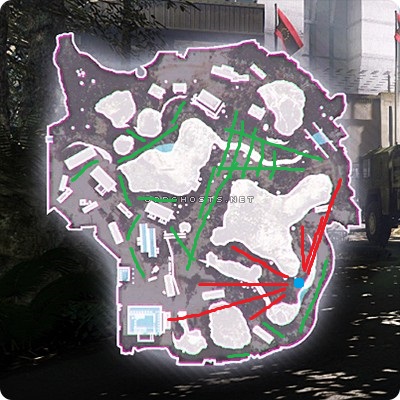
The hill is interesting because of the sightlines that it affords the player. I’ll done a little mock up of what I mean:

prison-break-multiplayer-map-layout2

If you’re standing at the optimal position on the hill (the blue dot), you can cover quite a lot of visual area with your shooty machine. The rest of the map is a nice mixture of medium and short sightlines, but they rarely converge in such an optimal way. To the north and to the west of the hill, you can see there’s a lot of convergence and “lanes” that players can be forced into, and while they also possess a multitude of sightlines in a compact zone, the openness of the area often makes for a killing field scenario where players run in and die over and over again.

As of right now, all I’ve really said is that the hill is optimal in that controlling it (especially with another player) really gives you access to sightlines and therefore some competitive advantage. That doesn’t really make it weird or anything; in fact, it is constructed to be a spot to fight over, a concentration point of struggle in team deathmatches or lone wolf rounds. Not only can you rack up kills by seeing enemies and reacting to them before they see you, but you are controlling one of the key methods of moving east and west on the map.

I find the design of this strategic zone beautiful in particular because of the way that the hill itself operates. What I am talking about specifically is the slope to the north of the blue dot, which you can see here.

BaF_RUbCMAAZsye

Let me use my HD BLU RAY NEXT GEN GRAPHICS to do a little parsing:

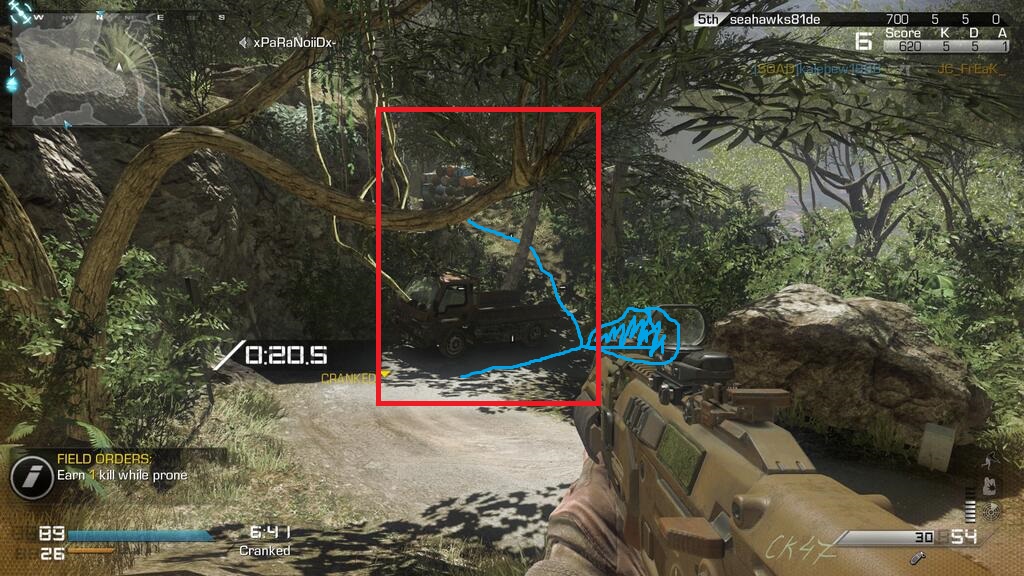
BaF_RUbCMAAZsye2

The blue path is where the other team can run through (the blue bag thing is small side area). As you can see, standing on the slope itself allows you to really control this area and generally get the drop on players who are barreling through there at like mach ten.

BaF_YvyCMAAeqRJ

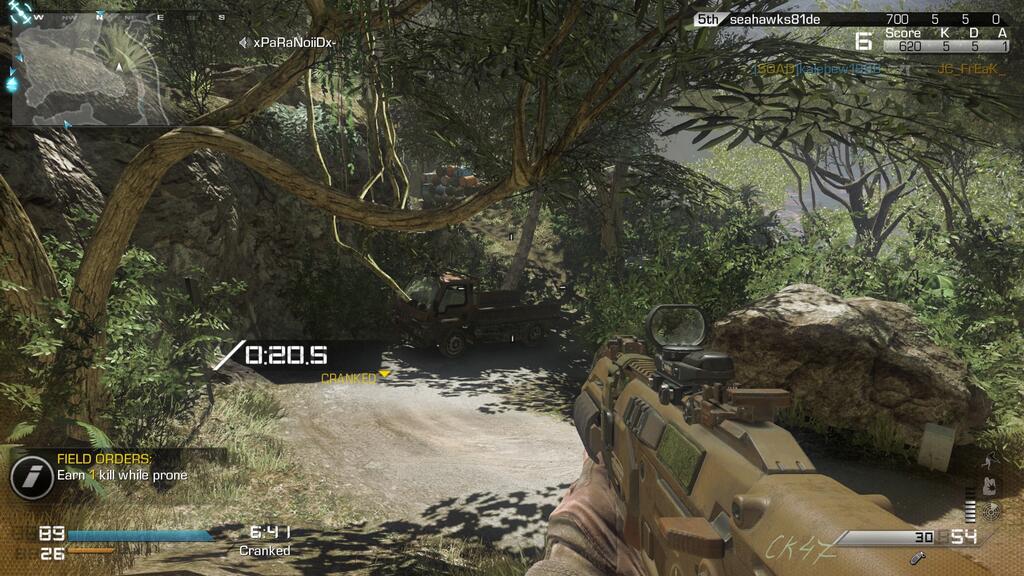
This is me backed up the hill about ten feet from where I was in the previous shot, still in an optimal spot to control that weird little red box that I drew before–notice the position of the brown truck still in the right side of the screen.

So, finally, what I think is beautiful here is the slope of the hill. It is steep, so much that if you’re not angling the camera toward the ground as you’re walking down the hill that you can totally miss enemies that are standing at the base. I think that the base desire of the player is to look out and cover that truck–enemies are going to come from that tight corridor between the back of the vehicle and the edge of the map, after all. There’s an expectation that the action, and therefore the danger, is coming from there, and so you’re going to ignore the bottom of the hill. This also means that you’re keeping your vision parallel to the ground at the top of the hill rather than the ground on the steep slope, fundamentally cutting off vision of the bottom of the hill.

In other words, player expectation and desire is being used to occlude somewhere the player should be looking. Better other words: the player thinks she is making a good decision, but she is really being tricked into making a bad one through the design of the slope.

That’s not all the work the physical design of the slope is doing, though, because it also actively works against the player who is moving up toward the top.

BaF_jHnIIAASz2T

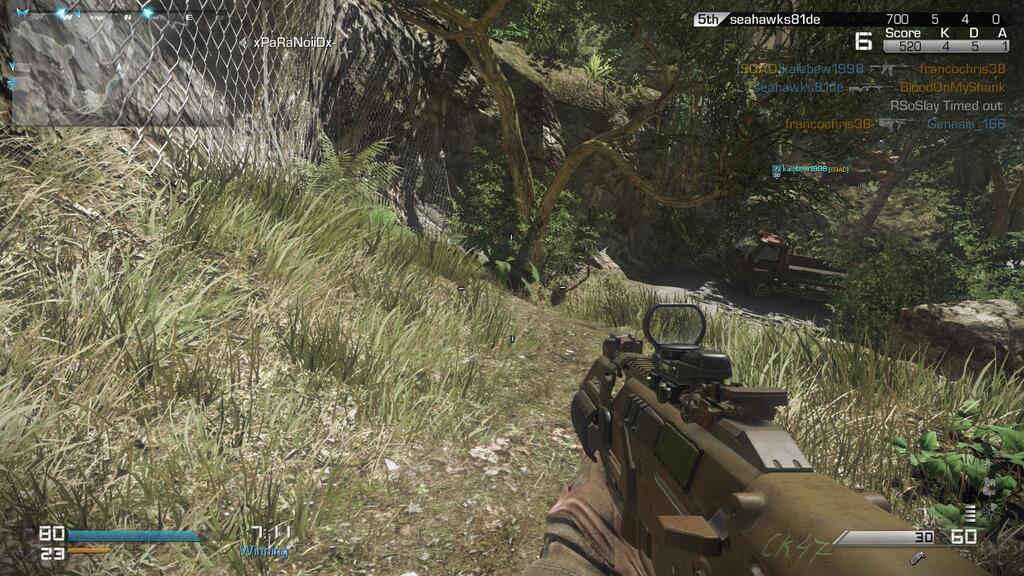
This is the view walking up the slope, looking almost exactly at the position of the last few screencaps. As you can see, the point where the slope evens out to flat ground at the top is obscured by the steepness of the slope itself–there’s a hard, material limit to sight here, and moving “over the top” is very dangerous here, requiring the player to either use a tactical grenade or just move super slowly.

The beauty that I find in the design of this one little piece of the level is based on its materiality and it determines how a player can operate in the world. I snarked about “realism” earlier in this piece, but this is actual, operational realism. It coheres to how the player can interact in this world; it unites the seeing player with her avatar and the meshworld that surround that avatar.

I like that hill.

Posted in Video Games | Tagged , , , | Comments Off on Call of Duty: Ghosts – A Hill

piegiving

20131128-191757.jpg

Posted in General Features | Comments Off on piegiving

McKenzie Wark on the Ludic Century

The twenty-first century – the ludic century – is animated in part by just that fantasy: that the feedback loop can be closed, and action can be modified in realtime depending on data about its immediate effects. Of course in reality it is always rather more imperfect. Google and Facebook never quite tailor the advertising on which their business in part depends to our actual wants or desires. Given what we know about how imperfect those systems are, imagine what its like for the NSA or other security agencies, trying to needle of ‘terrorism’ in the haystack of trillions of bits of data banality. It’s the very impossibility of closing the feedback loop that drives the tendency to total surveillance.

 McKenzie Wark, “A Ludic Century?

Posted in Theory, Video Games | Tagged , | Comments Off on McKenzie Wark on the Ludic Century

The Fake Gamer t-shirt

fake gamer


There’s been an outbreak of a syndrome–fake gamers multiply by the day. They’ve never played A Link To The Past. They can’t hadouken. They don’t know what grue is; they don’t know to be afraid. 

I’ve made a shirt to help identify those people. If you feel like you need to self-identify for the safety and quality of life of those around you, I won’t discourage it.

You can buy the shirt here.

Note: I’m being brutally sarcastic, in case that doesn’t come across, and the very idea of the “fake gamer” is so ridiculous that anyone who says anything of the sort should be publicly laughed out of whatever room they happen to be in at the moment.

Posted in General Features | Tagged , , | Comments Off on The Fake Gamer t-shirt