Donald Rumsfeld Made A Videogame

Known for quips about such things as “known knowns” and “known unknowns,” Mr. Rumsfeld says the game will sharpen the mind and help improve concentration. Whether it counteracts the effects of aging, he won’t precisely say. “It is helpful to know what you know and know what you don’t know, and in this case, I know what I think but I don’t know the answer to your question,” he said.

Julian Barnes, “Former Defense Secretary Marches Into New Territory: Videogames”

Donald Rumsfeld, the man who helped nudge the United States into a global war, has adapted a version of Solitaire that Winston Churchill played for the contemporary gaming crowd. It’s a strange footnote in American tragedy, but it is also a wonderful knot that ties together game playing, Slavoj Zizek, and the wonders of not knowing what we know. Zizek famously read Rumsfeld as a strange interlocutor of psychoanalysis, and now we have that man making a game about making jumps and skips based on known and unknown knowns. Perfect.

Posted in Theory, Video Games | Tagged , , | Comments Off on Donald Rumsfeld Made A Videogame

Let’s Play Rollercoaster Tycoon – Leafy Lake

Leafy Lake is a weird level of Rollercoaster Tycoon, but I think that I really hit my stride in this set of videos. I do some custom rollercoastering, and I think that the designs for the “uncustomizable” rides that I do to give them a little flair and theme are pretty neat.

These videos are supported by my Patreon. If you enjoy this blog, consider becoming a Patron!

Posted in Video, Video Games | Tagged , , | Comments Off on Let’s Play Rollercoaster Tycoon – Leafy Lake

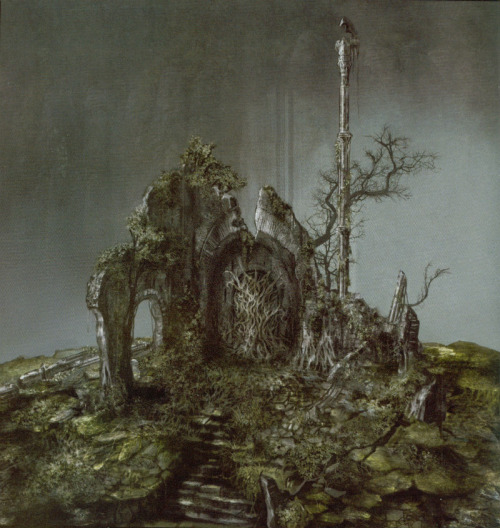
Dark Souls’ Relationship To Its Concept Art

This is a fascinating piece on the concept art of Dark Souls.

tumblr_inline_o0poitRKdu1smmrvr_500

I don’t know if I buy the argument about micro/macro focalization (in that I don’t see to experience the games in the way that the designers clearly intend you to), but the idea that Dark Souls is stapled together around tiny moments is super alluring overall. In any case, this is a really neat piece worth checking out.

Posted in Video Games | Tagged , , , | Comments Off on Dark Souls’ Relationship To Its Concept Art

On Fargo – Season 1

fargo_1

1.
The use of the pastiche or the remix or the mashup in contemporary “prestige television” is everywhere. I can see it working on a couple different levels. On one level, it does the same work that stock plots have always done for sitcoms. In this way, a “someone thinks their partner is cheating on them but it’s really a comical mixup” is the same kind of narrative machinery as a shot in Fargo the tv show that’s reused from No Country For Old Men. Where the narrative plot points are what provide the little trope reused from I Love Lucy to The Big Bang Theory, for Fargo (and Breaking Bad or True Detective or Hannibal) it is the kernels of shot structure, length, and content that provide the transportable thing in prestige television.

2.
Within that paradigm, Fargo is maybe the ultimate expression of its genre of prestige television work. It contains an entire set of classed and aestheticized dependencies around the Fargo film, the Coen Brothers, FX as a channel, and the contemporary media environment in order to constantly wink at the viewer in a thousand ways. I mean, the show is absolutely made for whatever cultural bracket I am in — Malvo the villain is a composite Coen villain, the genre structure of several Coen films get called on, the comedy stylings of critical darlings Key and Peele are used, and we even get Bilbo Baggins doing a William H. Macy impression. The semiotics go deep, and it reminds me quite a bit of the use of Chambers’ and Lovecraft’s works in True Detective. In that case, the discourse around the show was less about the show and more about what it could reveal or hide about its sources at any given moment. True Detective wanted you to talk as much about The King in Yellow as it did the dynamics between the characters; I have the feeling that Fargo really wants me to see the repeated references to White Russians.

3.
I enjoyed Fargo the most when it stuck to a close reproduction of the Coen “feel” or when it went as far out in the weeds as possible. I really felt the direction of this show more than I have felt other prestige television shows. In some episodes, there are these lovely wide shots that really hit “these humans are small in the world” feel that the Coens had in Fargo. In others, it’s like we’re watching an episode of CSI or something. Basically any moment where someone felt like they needed to add to the visual language of this universe felt unnecessary, which probably says something both about a taste culture and how the Coens can create a visually delimited imagination–seeing something in their world outside of the way they would normally frame it feels weird.

[A note: this normally doesn’t bother me, but the CGI of Fargo was actively bad. During a particular scene where fish are falling from the sky, you can see that the “layer” they are on when they are on the ground is about a full foot above the ground in several shots. For a show that seems to committed to a particular aesthetic, that work felt super slap-dash.]

4.
The homage nature of the show to the Coen brothers and their films really points out what techniques of theirs are cinematic and don’t quite make the leap from big screen to small screen. The strange anecdotes and parables of The Big Lebowski or A Serious Man make repeated appearances in Fargo, and they don’t really deliver the same kind of impact as they do in those films. When you hear an anecdote that leads nowhere ten times in ten hours the form loses the effectiveness that it had when you heard it once in an hour and forty five.

5.
Who would have thought that Billy Bob Thornton could be so scary?


Posted in Film | Tagged , , , | Comments Off on On Fargo – Season 1

I Went To The Smite World Championships

It’s disarming and strange, but there’s no artifice to it. There’s production, but I don’t get the feeling that any of the emotions are crafted in a PR laboratory somewhere. You know what I mean; you can tell when a fan world is being forced on a group of people. It’s palpable when people are being told to care versus when they actually care. There’s an intensity of connection here that doesn’t even read as sensible to me, let alone something that I can engage in, and I’m left wondering why.

I couldn’t stay in the theater for long. Hundreds of people screaming is never my thing, and there was something strange and mystical about all of these people surrounding this shrinelike screen. The room was dark, and a blue glow lit their faces. It’s like sitting in a bedroom watching a stream with hundreds of your closest friends. It’s the gamer’s room blown out to its most extreme proportions. I didn’t leave the room because it was unnatural, or “too nerdy,” or too strange; I didn’t like being there because of how natural it all seemed.

Read more at Paste.

Posted in Video Games | Tagged , , , | Comments Off on I Went To The Smite World Championships

Phoenix – “Trying To Be Cool”

I’m sort of fascinated with this video. It’s this weird assemblage of weird things happening, and it leans less into the 1970s Eurocinema look that CANADA’s other work does (I don’t mind it, but I prefer when they do things like Tame Impala’s “The Less I Know The Better“). There’s something about controlled chaos going on here that I find visually and formally fascinating, and the culmination of bodies-as-machines choreography at the end is just beautiful. A good music video.


Posted in Music Video | Tagged , , , | Comments Off on Phoenix – “Trying To Be Cool”

How I Write About Magic: The Gathering

nissa writing

Earlier this week I had the pleasure of previewing some cards from Oath of the Gatewatch for Paste (if you haven’t seen that, it’s here).

If you read the short blurbs I wrote about each card, you’ll notice that they don’t really look much like other previews for Magic cards. I don’t do much analysis of the cards in the context of competitive play, or deckbuilding, or its viability in a fun commander deck. I don’t talk about the upcoming meta or if these cards are even worth looking at.

Instead, I look to see if they’re interesting to me. Being “interesting” is kind of a floating signifier to me, but it has such a distinct feeling that it is unbelievably clear when it exists (as my Paste Interesting Cards” lists might show). The Magic psychographic profiles” might put me somewhere in the Vorthos range, and Tessitore’s extrapolation of the term that blows it out to all possible meanings certainly places me there.

The reason I write about Magic in this particular way is twofold. First, I was doing it anyway and someone suggested that I lean into it rather than replicating the hivemind work that Magic‘s online community is known for. Second, I think that there’s an ethic to it.

The Creative Team for Magic: The Gathering does an immense amount of work to create these amazing and strange worlds that Magic takes place in, and it is such a weird thing to me that 90% of the analysis that I read functionally ignores all of that. If Mark Rosewater’s podcast is to be believed, the Design and Development Teams follow the patterns that Creative lays out, and that leads to this awesome world of conceptual and design coherence that just drops out of so much play (this could be a channel problem on my part, so if you have suggestions on where to see this work, let me know!)

I want to focus on what Magic cards are, not what they do, and I think that makes for a more interesting take on the entire world of Magic.

[I also like dipping my toes into what they do sometimes. Uh oh!]

Posted in Video Games | Tagged , , , , | Comments Off on How I Write About Magic: The Gathering

Let’s Play Rollercoaster Tycoon – Dynamite Dunes

Following up on my playthrough of the Forest Frontiers level of Rollercoaster Tycoon is my weird, mixed-up attempt at Dynamite Dunes. You get to see me work through lots and lots of problems here both mechanically and aesthetically. I make a path that’s too confusing, and I make a lot of rollercoasters that just do not work. It’s rough and tumble, but it’s fun, and this level really prepared me for some of the stuff that’s coming up.

These videos are supported by my Patreon. If you enjoy this blog, consider becoming a Patron!

Posted in Video, Video Games | Tagged , , , , | Comments Off on Let’s Play Rollercoaster Tycoon – Dynamite Dunes

Amy Dentata’s Postmortem for Trigger

trigger

Amy Dentata has posted her postmortem (a kind of “here’s what worked and what didn’t”) for the full development cycle for her game Trigger. It’s a quick read, and the stuff that went well are all things I can get behind as someone who has also kickstarted some games in the past.

If you’re someone who is looking to make a kickstart a game, you’d do well to read the post and think about both what she has to say about pre-production and the mental and physical toll of development itself.

You can buy Trigger here.

Posted in Video Games | Tagged , , , , | Comments Off on Amy Dentata’s Postmortem for Trigger

Jason Read on the Blockbuster Reboot

terminator

If you remember anything about The Road Warrior (Mad Max 2 in the rest of the world) it is the truck chase, so Fury Road offers you the truck chase as a film. It also sprinkles in a few other elements, an shotgun that doesn’t fire, a dwarf, and the car from the original. These callbacks are less attempts to recreate what worked in the original film than to acknowledge that is why we are watching a remake in the first place. Jurassic World even goes so far as to include a souvenir T-shirt from the original film, err…park, in the film itself. Screening its own nostalgia for the original.

– Jason Read, “Genysis of a New Film Form

I’m so fascinated with the past couple years of interesting reboots, and I consistently think that Jason Read might be the only other person I’ve encountered who takes them as seriously as I do.

Posted in Film | Tagged , , , , | Comments Off on Jason Read on the Blockbuster Reboot