Let’s Play Rollercoaster Tycoon – Bumbly Beach

This was the level that I was super excited about playing through in my Let’s Play of Rollercoaster Tycoon. I love the spatial setting of the entire thing–it is right in the middle of some rowhouses and a beach. It’s something like an east coast American time capsule, and while I never play it in that way (there would have to be way too many carousels and ferris wheels), there’s something about that that is really special. This is the high-water mark for this playthrough, and I hope that you enjoy it if you haven’t seen it already.

Posted in Video, Video Games | Tagged , , , | Comments Off on Let’s Play Rollercoaster Tycoon – Bumbly Beach

Gamestop Publishes A Game, Is Not A Publisher

“We are not attempting to be publishers here,” he told MCV. “We are simply taking a great opportunity to collaborate in a non-traditional way, and trust that the combination of all these great ingredients we have put in make for a great experience.”

Christopher Dring, “GameStop: ‘We’re not trying to be a publisher’

I think this is some real bad stuff, and I am actually surprised that there aren’t some kind of business regulations that would prevent vertical integration of the game industry this one. Would Best Buy be able to legally enter the game development industry? I honestly have no idea, but this is super strange to me.

Posted in Video Games | Tagged , , , | Comments Off on Gamestop Publishes A Game, Is Not A Publisher

Animals, Drones, and the Police

hawk

We love when animals destroy drones. The compilation videos and their buzzf’diggification on Facebook has drawn together a very clear contemporary fascination with watching animals of all kinds destroy the most annoying objects of modern life. Animals fighting with flying machines is the new “watch a dad get kicked in the crotch on Christmas Day” in entertainment media.

The most recent story to draw attention around this phenomenon is the Dutch effort to train raptors (the birds not the dinosaurs) to snatch drones out of the sky. It’s worth clicking on the article to watch the short video because it is fascinating.

There’s nothing super complicated about the effort proper. A private, bird-based security firm has been contracted by the Dutch government to make those birds attack the drones that are threatening the privacy of, well, private citizens.

What I find interesting about the logic of the entire operation is the set of assumptions that exist to inform it. While the Guardian article I linked above is light on details from the security firm proper, the additional expert opinion from Geoff LeBaron really informs the majority of the piece:

Often drones lose their flying privileges because local birds feel crowded. “The drones are pretty much the size of a bird of prey, so smaller birds on the ground aren’t likely to mob a bird of prey when it’s flying – but larger birds are, especially when it’s around their nests,” said LeBaron, who’d seen the behavior in barnacle geese as well as raptors like ospreys. “The birds of prey are having an aggressive interaction to defend their territory from another bird of prey.”

LeBaron’s explanation naturalizes the antagonism between the bird and the ‘bot, and at first pass we could see an argument coming from this that would reaffirm some nature vs culture arguments right out of the Enlightenment and its echoes.

However, I think what’s more interesting is that there’s some strange flattening going on around the motivations of the bird in relationship to the drone. The animal psychology reading of the situation holds that the bird perceives a flattened relationship with the drone–when it looks at the drone, it sees a threat on par with other similar-sized flying things and deals with it appropriately.

There’s clearly a set of aviary disciplinary training that is going on here that’s similar to the training of a police officer or a private military corporation member. After all, the group doing this is a security firm. This bird isn’t just acting on instinct, but rather it is acting on training in the same way that a police dog or an assistance dog would be. When a dog helps someone who is visually impaired cross the street, we don’t essentialize that act into the “nature” of the dog. We recognize training.

There’s a politics to flattening out the bird’s relationship to the drone. We’re able to cast private operation of drones as literally “unnatural” and threatening to the order of things. More importantly, we are able to perform an action on humans by naturalizing the surveillance state as part of the instinctually-correct world of instincts available to animals.

Additionally, and this is some of the most interesting stuff for me, we are able to treat both the bird and the drone as equivalent creatures whose combat is an arena for working out what should exist in the world. It’s the choice between being a goddess or a cyborg abstracted out into violence between two inhuman things that we have objectified into combatants for our pleasure. What’s telling is that we can replace the bird with any other animal here–we can find an expert to naturalize the antagonism between the cat and the drone or the crocodile and the drone without any friction.

To end, I think that Greg Borenstein’s “Animal Tech Cop” does a great job of making this argument in a much more concise and entertaining way, so go look at that.


Posted in General Features | Tagged , , , , | Comments Off on Animals, Drones, and the Police

Hauntology and Extinction: The Case of Some Weird Bugs

bugs

NPR posted a story a little while back about these giant insects that went extinct except for a few surviving members that lived under a bush on a giant rock outcropping in the ocean. It sounds like something out of the New Weird, a Vandermeer-esque story in which we find these bugs and they’re telekinetic or something.

While the whole affair is interesting, it’s the ending of the NPR story that really gets me thinking about our relationship with animals that have gone, or are going, extinct. Humans have a thing where we create boundary systems, and whether you prefer the simplistic “in-group/out-group” or the baroque “liberalism generates states of exception for inclusion and exclusion” model, there are not a lot of mechanisms that readily appear to us for bringing “solved” histories back to life.

What I mean: exclusion happens, the excluded disappears through the majority “eating” them or totally eliminating them, and then that horrifying act is relegated to history. We have a lot of theoretical language for dealing with this founding violence, whether you choose Derridean hauntology, a psychoanalytic return of the repressed, or the Marxist materialist approach of the dustbin of history always coming back to bite us in the ass.

The language of that group of historical ass-biting is always centered around something being there but being robbed of capability–like a ghost, it can haunt and have an impact, but it cannot directly topple the forces of exclusion and repair that eliminated it in the first place. The utopian dream of a Williams-esque “long revolution” yearns for that, of course, but I think the steady progress of neoliberalism probably generates cynicism in the face of that model.

In any case, these freaky bugs are this real problem for these theories. The islands that they were eliminated from literally have no desire or space for them. I can’t imagine any suburbanite the world over wanting to wake up bright and early to find one of these giant insects sitting on their marble countertops poised between them and their Keurig machines. And so these bugs exist in a weird limbo, not haunting us like the tragedy of the dodo, but being there as a real material force that no one wants to give an inch for.

Posted in Theory | Tagged , , , , , , | Comments Off on Hauntology and Extinction: The Case of Some Weird Bugs

Player/Knowledge – Myst, Characters, and Environment

Everyone has been stumbling over themselves to compare The Witness to Myst and so I made a video in order to get to the root of how I think Myst functions.

Posted in General Features | Tagged , , , , | Comments Off on Player/Knowledge – Myst, Characters, and Environment

A Universal Critique of All Games

Posted in Video Games | Tagged | Comments Off on A Universal Critique of All Games

A Magic Ad From 1997

I have nothing to say about this wonderful Magic: The Gathering ad other than it is perfect in all ways.

“Like the magic of life, you can’t win if you don’t play.”

Posted in Video Games | Tagged , , | Comments Off on A Magic Ad From 1997

Andrew Pilsch on Pour-Over Coffee

To choose pour-over coffee instead of Keurig, then, isn’t entirely a choice of human craft over machine labor. It’s more an issue of priorities—craft depends on processes that are beholden to people, creating an intimate relationship in which the human producer is valued above the anonymity of mass production, even when both play necessary roles. In the Keurig, the means of making coffee are abstracted and hidden inside an opaque, plastic shell; the human deliberation of the pour-over method makes visible what the Keurig abstracts.

Andrew Pilsch, “When the Coffee Machine Is Just a Human

Posted in Theory | Tagged , , | Comments Off on Andrew Pilsch on Pour-Over Coffee

On The Last Door: Season 1

the last door

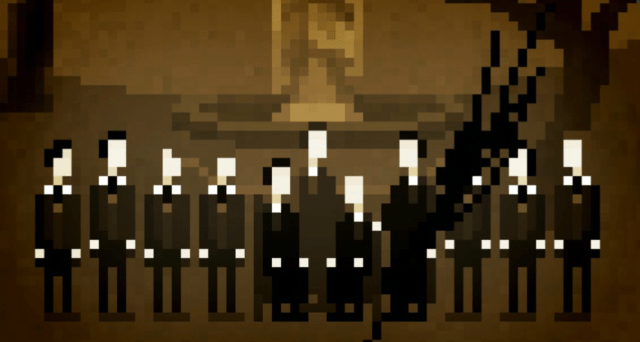
The Last Door is a strange little point and click horror game that is (I believe) going to stretch over two seasons. It has a lot to love in it, and it has a familiar aesthetic for anyone who has played any of my almost-adventure game stuff.

I had played the first episode a couple years ago, but after pressuring a friend into playing the whole thing last year, I thought that I would give the whole thing a shot in one day (I was also coming off of Broken Age, a game almost 100% not what I want in a contemporary adventure, so maybe I was looking for some redemption?).

The Last Door is playing with the 19th century in a lot of different ways, and from its advertising (and some of its content) you would think that it was 100% in the Lovecrafting camp of eldritch horrors from beyond time and space. Surprisingly, the game is much more concerned with hitting an aesthetic space that’s a little more Henry James. Epistolary conversations litter the world, and the horrors that get presented to us are less of the mind-bendingly evil (although they exist) and more of the apparatuses of that time period in Britain.

The church fails to help. Science does not deliver us, but rather runs us aground on new bad things. The urban modern is marked by oil slicks and butcher houses. It is a world that is thoroughly unpleasant, and in the “old weird” tradition that would be because there’s something rotten in things. Although there’s no shortage of ruins and things beyond the pale, I don’t get the sense that The Last Door is really painting the rotten nature of this 19th universe on those things. They just sort of happen to be existing–this would all be gross and disgusting if the evil existed or not.

I’ve spent more than one day of Twitter-time lamenting that we don’t have a game that gets close to Roman Polanski’s The Ninth Gate. That film is long, boring, purposefully fails to give anything, omits any gratification, etc etc etc. It is a punishment. But my god, does that cohere into something shocking. A man falls into a labyrinth of deals with the devil, and despite seeing the worst of what that could entail, chooses to make one himself. It is a document that attests to the banality of evil, and in that way its honestly a very 19th-century text.

The Last Door sells itself as a vehicle for Lovecraftianism, but it hits something very close to the feeling of The Ninth Gate. It’s wonderful, and if you like that, you should check it out.

Posted in Film, Video Games | Tagged , , , , , | Comments Off on On The Last Door: Season 1

Left 4 Dead 2, 7 Years On

2016-01-21_00001

John Walker’s original review of Left 4 Dead 2 goes hard for talking about what that game does that other games don’t. He flags it as being a brand-new experience that does something completely unique, and reading it these many years later I keep nodding my head.

Friend of the blog Danni has missed many games over the past X years, and we’ve been spending the past few weeks playing around with some staples of the online cooperative experience: Risk of RainOrcs Must DieMinecraft, and now Left 4 Dead 2. I’ve never been a fan of the latter, mostly because I’m not into playing games with voice with intensive cooperation. I like multiplayer, but I’m a “sadness and silence” player who dives into the world of pubbies to experience the wrong side of the coin. Left 4 Dead 2 needs a better class of player than I want to be most of the time.

And yet loading it up and playing through a couple missions in a serious way has left me feeling that Left 4 Dead 2 is actually hitting a target that no other game has managed to square since its release. John Walker wasn’t writing in videogame-boosterist hyperbole. It really does things that are unique.

The number of times I have said “where am I supposed to go now?” in a first person shooter made in the past seven years is probably less than ten times. This is across dozens of games (most of these are probably located in Syndicate, actually). Heirs of the Half-Life lighting model of game design communication, the contemporary first-person shooter needs you to know where to go and where to face at all times. If you’re looking the wrong way you might miss the setpiece.

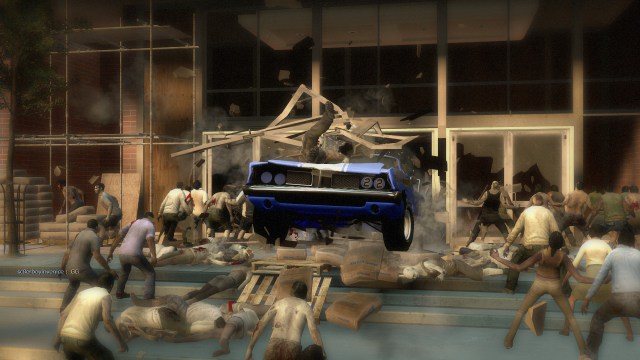
When I’m playing Left 4 Dead 2, I am constantly confused about where I should be going. It generates some real, serious anxietyfear. I know that the zombies and special infected are going to appear, and I know that they can swarm be like the almost-human zerglings that they are. In horror games, you generate anxiety around expectation, and Left 4 Dead 2 manages to do that with excess (here they all come!) rather than absence (a dark, spooooky room).

No one else seems to have taken that banner up and run with it. Give us rat nests teeming with denizens. Did the roguelike take this design space? Is stapling it to the weird world of the team shooter feel too rip-offy for the contemporary game designer. Who knows? The game is scary.

Posted in Video Games | Tagged , , , | 1 Comment