
- This is a blog about video games, comic books, film, and philosophy. It is mostly research-oriented stuff. The art in the current header is from Prophet #29. The blog icon was made by Tara Ogaick.
twerps
Tweets by ckunzelmanCategories!
Archives
- November 2018
- June 2018
- January 2018
- October 2017
- May 2017
- April 2017
- February 2017
- September 2016
- July 2016
- June 2016
- May 2016
- April 2016
- March 2016
- February 2016
- January 2016
- December 2015
- November 2015
- October 2015
- September 2015
- August 2015
- July 2015
- June 2015
- May 2015
- April 2015
- March 2015
- February 2015
- January 2015
- December 2014
- November 2014
- October 2014
- September 2014
- August 2014
- July 2014
- June 2014
- May 2014
- April 2014
- March 2014
- February 2014
- January 2014
- December 2013
- November 2013
- October 2013
- September 2013
- August 2013
- July 2013
- June 2013
- May 2013
- April 2013
- March 2013
- February 2013
- January 2013
- December 2012
- November 2012
- October 2012
- September 2012
- August 2012
- July 2012
- June 2012
- May 2012
- April 2012
- March 2012
- February 2012
- January 2012
- July 2011
- May 2011
- April 2011
- March 2011
- February 2011
- January 2011
- December 2010
- October 2010
- August 2010
- July 2010
RSS
Top Posts & Pages
- Mark Fisher on Nick Land
- Getting Some Clarity on Prometheus
- Some Preliminary Thoughts on Spawn
- Now You're John Hammond: Accelerationism and The Lost World
- On Carson Wells
- In Praise of the Worst Design Moment in Final Fantasy 7
- On Bluebeard
- Vicesimus Knox Did An Objective Book Review in 1786
- On Shank and The Butcher
- On Dear Esteban
Leopold Lambert on Architecture and Occupation
Occupation is a second way that architecture is used to serve military purposes. Of course one could think of the Roman Legion’s settlement and some other temporary military structures; nevertheless, it seems more interesting here to understand the word military as an ensemble of means by which a nation exercises its power over a group of people. In this regard, occupation appears to be even more efficient when it is applied through a civil materialization rather than a strictly military one. 19th and 20th centuries’ European countries understood it perfectly and their bureaucratic administration-architecturally organized and represented-probably acted (and sometimes retroactively still do) more on the colonized country’s biopolitics than the colonizer’s army did.
Leopold Lambert, Weaponized Architecture p.18
Posted in Quote Time, Theory
Tagged architecture, leopold lambert, quote, theory, weaponized architecture
Comments Off on Leopold Lambert on Architecture and Occupation
On The Max Payne Franchise
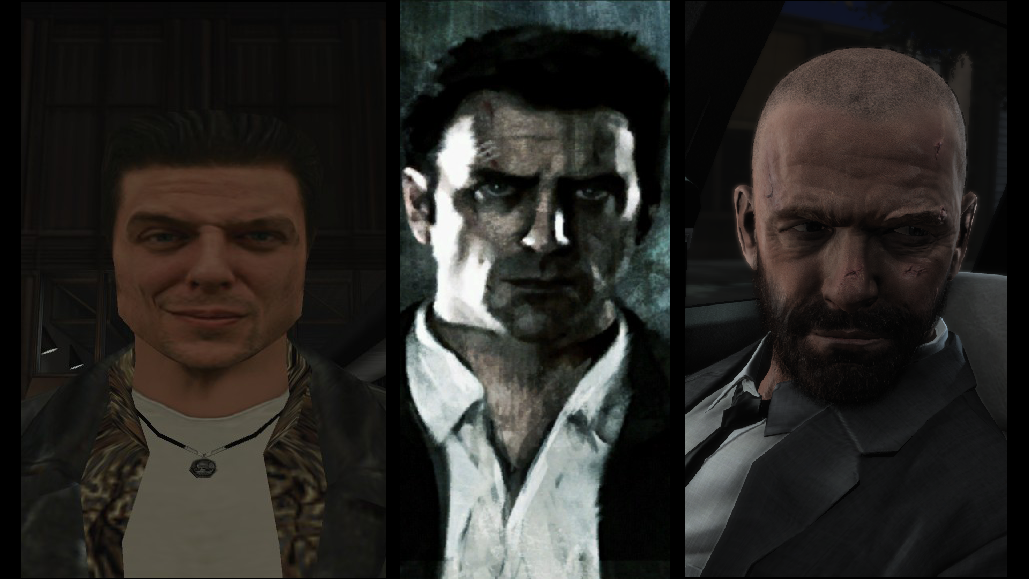
I’m in that weird interstitial period between semesters, and I have somehow managed to keep deadlines at bay enough to do something that I’ve wanted to do since last November: play all of the Max Payne games back-to-back-to-back.
What follows is a few words about each game.
I. Max Payne
The trick in my situation was that there was no trick, no matter what the movies tell you. No rules, no secret mantra, no road map. It wasn’t about how smart or how good you were. It was chaos and luck, and anyone who thought different was a fool. All you could do was hang on madly, as long and as hard as you could.
A list of things that happen in the first thirty minutes of Max Payne: the protagonists wife is killed by horror-film line spouting supermethheads, the couple’s child is murdered, Max Payne drives a train through a wall, and the player dies about five hundred times before she figures out how the combat mechanics actually work.
The narrative of Max Payne sets up the content for the rest of the series: Max begins the game with nothing to lose, becomes embroiled in a gang war that can only be resolved with a gun in each hand, and then realizes that he is involved in a conspiracy so large that it can’t be understood. With that knowledge, Payne decides that all he can do is sacrifice his body so that those benefiting from the conspiracy will pay for their crimes. A few hours later, the game ends.
Those are the broad strokes, and I have to say that Max Payne is merely serviceable in the macro; it is a third person shooter with an interesting story, but nothing special.
Max Payne‘s micro, however, is amazing because it is designed around the enclosed interaction. Because of what I assume has to be technical limitations, the AI of the enemies in Max Payne is not very good. In fact, when they catch sight of Max, they fire, run toward him, fire, and then repeat until they are five feet away going full auto with an uzi. To avoid huge swaths of enemies literally swarming the player, the game is designed in rooms; each one has particular enemy placement and a predictable pattern that the player comes to memorize.
I say this because I quick saved outside of every room and had to replay each and every one of them two or three times in order to not be killed. I developed a set of reflexes and a sense for signal reading–I ducked and dodged and bulletjumped my way through the game. In 2001, Max Payne was a pretty interesting and difficult game that allowed you to pretend you were a hard-boiled Neo from The Matrix; in 2013, it is a third person Hotline Miami without any hammer-shaped questions about our complicity in violence.
Max Payne is a puzzle game that you solve with bullets.
II. Max Payne 2: The Fall of Max Payne
Like always, the dead had all the answers I was missing. It wasn’t that they weren’t eager to talk. Quite the contrary. The dead had plenty to say. And once they started, they would never shut up. Their words keep you awake at night.
This seems to be the most lauded game in the series, but I’m not sure why. It could be that there was enough time between the release of the first game and this one to allow people to remember the cool parts of the first game (bulletdodging, gritty crime stuff, Captain Baseballbatboy) and forget the punishing difficulty and nightmare sequences that featured a screaming infant with the occasional woman’s scream layered over the top of it.
The Fall of Max Payne continues the story. Max starts out doing his job, gets embroiled in a conspiracy, and everything spirals upward from there. I played through the game in (basically) one extended session, and I can’t really explain what happened; Max shot people, justice was had, and yet another woman that Max Payne loved was killed for a plot reason that is dubious to say the least.
I wasn’t so impressed by the second game, but I can say that there are two design choices that I enjoyed:
1. The final boss fight is a torturous encounter where the player has to shoot some super tiny pegs out of ceiling architecture. The first game had something similar–you had to use a sniper rifle to shoot some cables in order to kill a helicopter. This was something you had never had to do before in the game–there had been no precision shooting at any point in the game before that. Max Payne 2 follows this pattern, and just like its predecessor, tells you precisely fuck all about what you are supposed to be doing.
Cue fifteen full minutes of me running in a big circle and shooting my gun and screaming at the top of my lungs. I think that kind of final boss design is neat in retrospect.
2. There is a level where you control another character, Mona, instead of Max. It seems like a lot more care went into the design of those levels, and I thought that her animations were a lot more polished than Max’s. I would rather play a Mona Sax game.
III. Max Payne III
I’m a dumb move guy. ‘Hey Max, we’ll drive out to the runway.’ No thanks, I’ll take the main entrance with a big shit eating grin on my face and let these assholes take turns trying to kill me. That’s my style, and it’s too late in the day to hope for change.
Years after the events of the previous game, Max is a washed up detective and a serious alcoholic. He’s a terrible shell of the man we knew before, who was already basically hollow. Then Max, in a drunken stupor, shot a twenty-something square in the chest. I saw it; shit, I pulled the trigger.
That’s the tone of the third game. It isn’t a strange semi-parody of crime fiction and generic tropes. It is full-on “take this social text seriously,” and playing it directly after the first two games was a shock. Seeing bad thing after bad thing happen to Max and the people who depend on him is supposed to bond the player with him, but toward the end of the game I started to see it as grim humor. You come into contact with Max Payne and your chances of being burned alive or shot to death go up about 1000%.
I also feel like the power of the first two games is that the player has very few tools at your disposal to deal with the problems that the game throws at her. When I play Max Payne, I feel like I am being forced to keep forward momentum. Hanging back just means that more enemies are going to path at me, and I can’t really do much other than run. This forces a particular style of play–Max has a gun in each hand, and you know damn well what you have to do to progress.
I guess what I am saying is that the conversion of the Max Payne games into a cover shooter slows down the pace of the game, and more than that it makes the player feel like there are actual options. You can choose to play defensively, only taking shots that matter, and slowly progress through each room until you hit an inevitable two minute cutscene where Max walks through a door to an aching voice over. In previous games, there were no options, no defensive maneuvers. You dodged and shot and died, or survived on a sliver of health, because that’s all you could do.
The Max Payne of New York City lives on that sliver of health all the time, and the moment of adrenaline where you barely kill three enemies with well-placed bullet time shots is absent in Max Payne 3. Every moment makes you feel like a hero; each set piece is designed to fill the player with a sense of power.
That’s not the Max Payne I know and love. My Max Payne is a paper thin thing that is 85% blood colored. He’s always one door away from being eradicated. The chunky meat man of Max Payne 3 is an entertaining bald version of my paper man; he’s an imitation. He’s boring.
Posted in Video Games
Tagged design, max payne, video games
Comments Off on On The Max Payne Franchise
Frank Castle on Fighting
Fighting for the people who run the world gets you stabbed in the back. You fight the wars they start and feed. You kill the monsters they create. You die from handling depleted uranium while they get rich on oil. I’m not going to war so Colt can sell another million M-16s. I had enough of that in Vietnam.
Frank Castle
written by Garth Ennis
The Punisher MAX vol. 1
Posted in Comics, Quote Time
Tagged comics, the punisher, violence
Comments Off on Frank Castle on Fighting
On Red Dead Redemption
1.
I’m not good at analyzing Rockstar games. I’m not good at breaking them down and showing all of the pieces, holding each one up to my eye, judging it good or bad, and then parsing it all into a good and bad pile. I’m very vocal about never being immersed in games–I think that’s PR speak that the player community has absorbed as a truth–but when I play games developed by Rockstar, I do come away with a profound sense of world and identification with the protagonist character.
There’s a reason for this: it is built for me. The video game critical community spends a lot of time talking about how AAA video games as fantasies for white/straight/cis/able/middle class men, and that’s generally true for the kind of narratives and mechanics that get churned out by the industry. These narratives rarely connect with me; I don’t want to go to war, don’t want to subjugate women, don’t want to accrue capital, don’t want to lead a country, am not very masculine–I can rarely project myself into the fantasy because there’s no hook. It is never a fantasy for me.
Grand Theft Auto IV and now Red Dead Redemption do, though. The hook is in not the characters–although I was drawn to both Niko Bellic and John Marston in different ways–but in the reason that these characters are acting in their respective worlds. Nico Bellic was in America, and he had to get up and get out of the squalor that his cousin put him in from day one; he did some horrible things to make that work. John Marston had to do it for his family, for people he cared about; he was bound to the course of things because over there, somewhere, there were people depending on him. And if he didn’t do anything, everything he could, then those people would be, at best, imprisoned for life.
2.
AAA games since Bioshock have been in love with their own trappings. Being clever means being reflexive about how they are created, why things are structured the way that they are; in other words, why is the world shaped like a game? Bioshock quips “because you had to.” Bioshock Infinite turns it into “because you had to because it is always this way.” Spec Ops: The Line gives it a different inflection with “it is always this way because you expect it to be this way.”
I appreciate RDR because it doesn’t dodge the question of why the main character is doing horrible things like killing fifty citizens and then razing their town. It wasn’t because he was suffering from psychosis or because he was being mind controller or because *finger wag* the plaaaaayer expects it to be this way, you naughty player. It is because the most important thing in his life is the people he cares about and he is both capable of and willing to do anything, anything, in order to make sure that those people are safe.
3.
What would you do to protect the people you love? Not in the advertising copy, “what would you doooooo? Would you play a corridor shooter?!?” way, but in a The Road way. What is the limit of the human in the face of the annihilation of the only people you care about in the world?
4.
Cormac McCarthy’s Blood Meridian, a fairly obvious key source work for Red Dead Redemption, is often cited as an apocalyptic novel; Red Dead Redemption is an apocalyptic game. The destruction of everything is at the center of the game: the wild horses are reigned, the indigenous people are murdered, the buffalo are overhunted, the wildlife and killed for sport, the people are brought under the caul of violent governments. The precise balance of violence is cut down with the destabilizing precision of machine guns and automobiles and the ever-running train.
5.
Everything broken, everything shattering around him, John Marston moves from place to place and does what he has to. John Marston is a hound. John Marston is a walking gun. John Marston has no pretensions about himself. He seems to be religious and resigned to an eternity in hell for the things he has done. John Marston never stops to think that he might already be in hell.
6.
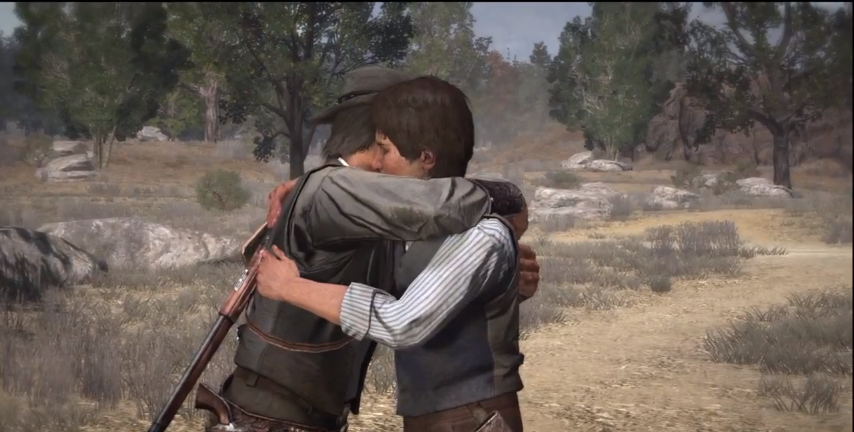
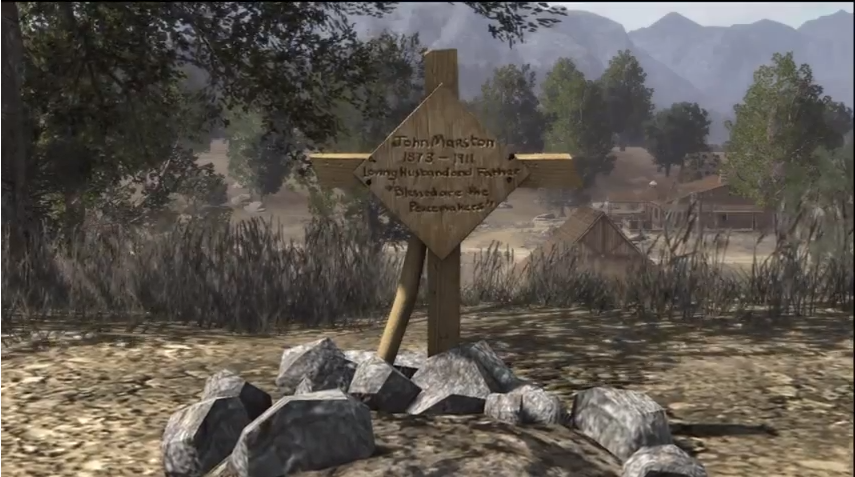
The end of Red Dead Redemption caught me, caught something in my throat. Here we are, at the end of the story, eking out an existence in this land doomed to be destroyed with pavement or with the overriding decay of time. Here we see John Marston herding cattle with his son; here we see him killing men over fifteen cows.
John Marston relates to his son in the most distant way he can. There’s a buffer between them made of time and guilt and the dead, but John pursues his son’s love and trust. The motives of the game remixed: “what would you do for the people you love?” becomes “what would you do to make the people you love return that love?” We watch John Marston try so hard to make sure his son knows that he loves him. What makes it worse, so much worse, is that we know he succeeds.
7.
JACK: Is there anything you don’t like shootin’, Pa?
JOHN: Well I ain’t met the thing yet, but soon as I do I’ll let you know. You can even put it in one of them books you read.
JACK: Maybe I’ll do that–The Day John Marston Stopped Shooting.
JOHN: I ain’t no literary man, but I don’t think that’ll sell. People like shootin’ in them things.
JACK: I think you may be right there, Pa.
[*]
8.
My father was a rancher as a young man. My father is loud. My father can shoot a gun and understands the world as a product and a symptom of guns. My father tells a story about watching a friend die, shot in the head. My father is apart, separated from me by a buffer that I will never understand.
John Marston steps out of that barn and I think about my father, burning.
9.
Red Dead Redemption has its hooks in me, deep.
10.
Posted in Video Games
Tagged Grand theft auto IV, red dead redemption, rockstar games, video games
Comments Off on On Red Dead Redemption
Todd McFarlane’s 1992 Comics Journal Interview
The fairly infamous Gary Groth interview with Todd McFarlane is up at The Comics Journal and it is glorious. Groth pins McFarlane to the wall on taste, culture, and the fact that McFarlane was an amazing force of mediocrity in the 1990s (and still is.) Highlights are below, but please go read the whole thing.
GROTH: But if you respect writing, and you respect your audience, wouldn’t you try to make yourself a better writer?
MCFARLANE: Uh-huh.
GROTH: But you don’t read anything!
MCFARLANE: No, I don’t read anything.
GROTH: So how can you make yourself a better writer if you don’t study writing and read other authors?
MCFARLANE: Maybe there’s my ignorance there, because I don’t think that if I read Shakespeare I’m going to become a good comic-book writer.
GROTH: Well, I don’t either [resigned].
and
MCFARLANE: Let me just tell you something here. Producing comic books is not magical stuff. But they’ve brainwashed us for so long that people actually think they can’t survive without those two companies. They each had their own reaction to it. Marvel’s reaction pretty much was, “The characters will always be more important than the creators.” They stated that in some of the articles. And I know what they’re trying to say by that. I agree with that on a certain level. Say they buy 1,000,000 copies ofSpawn, not because they give a shit about Spawn, but because they like Todd McFarlane. But by issue number 12,1 don’t think the Todd McFarlane name is going to be enough to satisfy the group out there. If I want to maintain some decent sales, what I’ve got to do is give them enough of a story and enough of a cool character that they’re going, “Give me that Spawn book by that, uh, whatever his name guy is.” They’re buying Spawn. On that level I agree that the characters are important, except it’s flesh and blood that gives fucking vision to those characters from day one, and they’ve not acknowledged that. They’ve not acknowledged what Jack Kirby did for those characters, they’ve not acknowledged what Ditko did, they’ve not acknowledged what Don Heck did. Don Heck wasn’t a superstar, but he kept The Avengers going for a long time so that maybe 10 years later John Byrne could become a superstar.
and
GROTH: Did it ever occur to you that a lot of these artists might not know how to write?
MCFARLANE: [Long pause.] You know, uh, that really didn’t occur to me because that never occurred to me, you know what I’m saying? I mean, fuck, I didn’t let some little thing like not being able to write stop me, so I didn’t really see where that should actually be that much of a problem. I just wanted to test to see how much balls people had. Some people had a fear, like “Yeah, you’re right, I can’t write.” Well, OK, that’s fine, then plot the thing and give it to a writer. And that’s one of the reasons why I don’t use a writer on my stuff: I think that’s almost an insult to a writer for me to want to plot it and then just give it to them to put words to it. Even though they do a hell of a lot better job than I would … I’m not going to get Alan Moore to just script my book. I’d have to go through the ranks, so I’d end up getting a guy who maybe was my 57th choice that said, “Yeah, OK, cool, Todd, I’ll do it.” And I knew, because I’m just a fuck, that in three months I would have been frustrated with him and I would’ve gone, “What kind of dialogue is that? I could do something just like that.” I couldn’t see where I was going to get a very good scripter, and that’s all I wanted, was the scripts.
Posted in Comics
Tagged comics, gary groth, interview, the comics journal, todd mcfarlane
Comments Off on Todd McFarlane’s 1992 Comics Journal Interview
Playing Through the No Interaction Mixtape
In light of all the game formalist whatever nonsense that has been flying around the video game internet recently, Line Hollis made another fabulous mixtape. It is called the No Interaction Mixtape, and I encourage you to go look at it here.
Lots of people put lots of time into making video game mixtapes, and I thought this was a prime moment for me to take a mixtape, play through it, and write down some thoughts about the games. When I was a #teen, a mixtape was a kind of love letter (let’s be real, a mixtape is still a love letter.) So this is me taking Line’s love letter, thinking about it, and passing a note to her in class the next day. And yes, that note would DEFINITELY have check boxes.
4 Minutes and 33 Seconds of Uniqueness
The conceit of this game is that if anyone else in the world plays it at the same time as you are your game ends. You cannot complete the game if anyone else is having the same experience you are at that exact moment. So of course as soon as I started it up I was consumed by anxiety–what if someone else plays? What if my time is wasted and I have to start over? What if I get caught in a vicious loop of starting and ending with some random person? Thankfully I made it the whole way through, and I got what I started the game to get: I had a unique experience that no one else in the world was having for four minutes and thirty three seconds. That uniqueness came with an equal amount of anxiety and fear, and I didn’t enjoy the time so much as suffer through it. Was it worth it?
A Mother in Festerwood
I started this game super smugly. I read Line’s small bit of text, read the proverb that opens the game, and started it out. I pushed my child back into the home until he hit his teen years and then I let him start wandering. He went out into the woods and came back home. He went out into the woods, got some treasure, and started coming back home. He was killed by a cyclops. A very effective game.
Six Shots of Whiskey
I didn’t dig this game very much, although I think it is a great example of a zero-player game. No real feels about it, sorry.
Goddammit
Anna Anthropy is the undisputed master of making games that mirror social situations, and sex is no different. I defer to Line on the analysis here–I don’t have anything to add other than I thought the pages of text were going to go on for much longer.
Drill Killer
This game points to the tension of the word interactive in brilliant ways. Most of the game has the player clicking through the game to see facts about the Drill Killer or maybe looking at some up-close drill killings, but a later section features player movement and clicking. There isn’t anything to do other than walk through doors and click on teens to murder them, of course, but I can’t see how that’s functionally different that a CODBLOPZ murder corridor.
Césure
A massive, navigable structure. I wandered around a bit and looked at everything and tried to imagine what it would be for. Like an art museum that takes up your entire imagination; a speculative fiction generator.
Apollo 2
I couldn’t get Unity Web Player to work and I fiddled around with it way longer than I should have so who knows.
Terra Tam: The World Warrior
This is sort of the apex of comedy, but it makes me wonder if the reason that games rarely succeed at comedy, or even attempt it, is because comedy requires the player to go along for a ride. For something to be comedic, it has to be a little unexpected, and if you “interact” your way through a situation, the likelihood of unexpectedness goes way down. Bulletstorm has a wonderful moment where it appears that a boss fight it about to happen, but a pipe falls from the ceiling and makes the monster fall into a radioactive goo pit. You can’t do anything but watch; interactivity has to be taken away for the comedy to work. Something like that is going on here, too.
Queue
This game is about duration and it makes you feel that duration.
Grapefruit
I couldn’t play this because the link was broken! Oh no!
Posted in Video Games
Tagged line hollis, mixtape, video games
Comments Off on Playing Through the No Interaction Mixtape
Rasmussen on Architecture and History
Thus, in the Spanish Steps we can see a petrification of the dancing rhythm of a period of gallantry; it gives us an inkling of something that was, something our generation will never know.
Rasmussen, Experiencing Architecture 136
Posted in Quote Time, Theory
Tagged architecture, quotation, theory
Comments Off on Rasmussen on Architecture and History
A List of Podcasts I Listen To
Podcasts are a thing that come up from time to time in conversation, and I always say something like “I like XYZ podcast, you should check it out!” We all know how that kind of talk goes, though, and without a “here is a link, go here, subscribe while I hawk over your shoulder” thing the chances of someone taking podcast advice is pretty much nil.
Note: I would be very interested in some suggestions of podcasts that are video game/comics/”nerd culture” (ugh!) related and are hosted by women, people of color, or basically anyone who isn’t a group of white dudes.
So here is a list of podcasts that I listen to in no particular order. There aren’t many on this list, but I can say that I listen to them every time an episode is released.
Comedy Bang Bang!
I’ve been listening to this since it was a Comedy Death Ray, and I’ve loved it the whole time. I think the show dropped in quality a bit last fall, but 2013 has made it shine again. Scott Aukerman hosts each episode and features at least two guests. One of the guests is her or himself in a traditional interview format, and the other person plays a character. The podcast is famous for these characters–Paul F. Tompkins playing Cake Boss, for example, or Jessica St. Clair playing the show’s teenage intern. I enjoy the show on the whole, but occasional guests take the show into offensive territory. However, Aukerman does a great job of steering the show away from that kind of comedy, and the show is good for it.
Doug Loves Movies
Comedian Doug Benson travels the country doing shows where he has local and national comedians talk and play games about movies. I like podcasts with a point, and Benson’s games like “The Leonard Maltin Game” or “Bane vs Lincoln” keep me interested from week to week. The guests are generally funny. Once again, a comedy podcast with sort-of random comedian guests can go into offensive territory, but Benson is very quick to step in and say “that’s not okay” for sexist or racist jokes, which I like.
Gayme Bar
This podcast, hosted by Jeremiah and Toupsi and Todd, is the highlight of my week. Everyone is smart and funny, and the guests (when there are guests, it isn’t every episode) are always engaging. Everyone’s tastes run widely enough that it isn’t an agreement-fest, which I enjoy a lot. [Note: I was a guest one time on this podcast and it was wonderful.]
Low Score Podcast
Bobby and Jay host this podcast, and the general gist is that Bobby and Jay are good friends who Skype (I guess?) with each other once every couple weeks to talk about what they have been doing and playing. You get a good sense of progression and iteration–they aren’t afraid to cover a topic more than once if it would make for good conversation. This is another podcast with a “point” in that they have segments they do during each episode: The List where they list off games based on a pre-selected topic (like “Top Five Game Narratives”) and justify their choices, and News, where they run down topical game news stuff. They don’t linger on a topic, they’re both smart guys, and they’re engaging speakers.
Honorable mention goes to Oh No Video Games!, which I listened to one time and did not subscribe to.
That’s it!
Posted in General Features
Tagged podcast, video games
Comments Off on A List of Podcasts I Listen To
 this cage is worms