SOPA and PIPA are bad

SOPA and PIPA are still on the table. They are both acts that attempt to prevent piracy of digital property and attempt to maintain the ability for creators on the internet to assert their intellectual property rights.

Those things are actually bad.

There are all kinds of theoretically suspicious things about the assumptions that the bills make, but none of those things really matter here. What matters is the practical effects of what would occur of the bills are/were passed.

One thing that would happen is that I wouldn’t be able to blog anymore. As you know, it is critical to me to link, show, and talk about visual media. I wouldn’t be able to do that in a SOPA/PIPA world. Comic book companies that don’t agree with my reading or use of their material (read: my opinion) would be able to prevent me from using their images under fair use plus they would be able to prevent my website from loading. While it appears that DNS blocking gone from the bill, Congress edits and creates new portions of bills all the time, and the lobbies for the media industry are wealthy.

The same goes for the video game industry.

So this is important. Coilhouse says everything that I want to say about it, so go read their post and reason for blacking out.

I am not blacking out, but that’s because I wanted to make this post and be visible today. Also, people gotta get their Rise of the Planet of the Apes symbolism searches fulfilled.

Posted in General Features | Tagged , , | Comments Off on SOPA and PIPA are bad

Kids Like Angry Birds

This might seem really obvious, and while I have some sad things to say at the bottom of the post, I want to try to be positive up here.

This is an article written by a teacher in Canada. The teacher teaches young kids. The teacher got the bright idea to ask kids about the games that they play.

Here’s the positive news: kids like to play Angry Birds. They like to play Angry Birds so much that it polled the highest among ninety or so kids. The author doesn’t give us any particular numbers about anything in the article, but I bet that the Angry Birds ratio was standard across girls and boys.

And that is good. I think Angry Birds is a pretty good game. It’s simple and it encourages problem solving, and more importantly, it teaches the player that you have to fail (sometimes eternally, I’m terrible at the game) to succeed in the end. You have to try things over and over. Eventually, you will get it right. I like fostering problem solving in kids through games. I think that’s a great power that video games have–forget big claims. I don’t think video games are going to save the world anymore than Monopoly will make me a millionaire, but I do think that simple lessons learned over and over in a subliminal way can be good.

But you can also learn horrible lessons, and that’s what the article is properly about. I think that it is bad for kids to play Call of Duty in any of its iterations. The game promotes a jingoistic ideology and justifies murder and torture constantly. It also takes a masculine, extremist, war-porn point of view.

So we need to take the author’s final words to heart:

“I don’t doubt your abilities to raise your child,” I begin. “But you and I both are part of the problem. For you, being more engaged in what your son consumes will help you bond with him even more in the time you have together. And for teachers? We need to become better equipped to talk about new technology and the role it plays in shaping our children. Teachers and parents are in this together.”

Posted in General Features, Video Games | Tagged , , | Comments Off on Kids Like Angry Birds

Pigs Playing Games

There is a game that human beings can play with pigs.  (Thanks to Scu for sending me the link.)

So let’s get a few basic things out of the way:

1. I think that humans and animals playing games together is amazing.
2. I think that games might be the first place where we see some real interspecies communication.
3. I think that a person who plays games with an animal might think twice about murdering and consuming it.
4. I could never play a game with a creature and then consume it.

Now that we have those basic things out of the way, I want to say a little about how dangerous I think this game could be. On one hand, you have my points 3 and 4 above–this could legitimately be a liberating relationship between humans and animals. It could do wonders for the ways that your average person thinks about animal agency in the world; it could provoke people to take stronger stances against factory farming.

However, I don’t think that is the case. If you read the article and watch the video, you can see that the game is really played by manipulating the pig with the iPad. You push on the iPad, you try to line up with a pig snout, and then you guide the pig around in shapes that score points. This is really a reduction of the pig to the level of a Kinect–it tracks human movement, creates a “pattern true” statement in the game itself, and the human gets points. That means that the way you get better at the game is learning how to best manipulate a pig–the player learns how to better use her tool to achieve the gameplay goal.

This is really sad for me. I want to see good things, but the very design of the game purposefully creates the pig not as a player but as a method to score points, a real-world NPC helper.

Also, we have to remember that this game is meant to amuse animals before they are going to be slaughtered for their flesh. This is literally a distraction from the reality of their conditions. If you’ve read Reality is Broken, you will remember that this is the exact reason that Jane McGonigal gives for the current desire to play MMOs and games in general: people hate the world they live in, and they want a better one.

But what does that distraction do for an animal destined to die within a year of birth?

Posted in General Features, Video Games | Tagged , , , , | Comments Off on Pigs Playing Games

Real Life Superheroes

So you should read about Chris Kyle in this article.

This is how superheroes are going to appear in the real world. It’s not going to be what Grant Morrison thinks that it will–Superman isn’t going to show up. The Silver Age scientist-hero isn’t going to come save the world.

Instead, we are going to have more efficient killers. We are going to have enhanced soldiers, people built for war, supersoldiers. I mean, isn’t Kyle just a modern day Captain America? A man from simple roots fighting the good fight against the enemy? He even has his own meatphysically-given superpowers:

The son of a Sunday-school teacher and a church deacon, Kyle credits a higher authority for his longest kill. From 2,100 yards away from a village just outside of Sadr City in 2008, he spied a man aiming a rocket launcher at an Army convoy and squeezed off one shot from his .338 Lapua Magnum rifle. Dead. From more than a mile away. “God blew that bullet and hit him,” he said.

And that’s superhuman, right?

That’s the logic of comics. A man with a power and ability above all others. A hero that uses his powers to the maximum (the masculine pronoun is important to comics ideology , as well).

Let’s keep reading:

For Kyle, the enemy is a “savage” — there’s no room for gray, only black or white. His Charlie platoon even adopted the insignia of the comic-book vigilante The Punisher, spray-painting skulls on their body armor, vehicles, helmets and guns.

On some level, this proves a few arguments that I have made right. The character of The Punisher becomes one that can be emulated. It gives a certain justification to vigilante action–but special ops are not vigilantes. They are state-sponsored, efficient murderers. It’s easy to see the world in black and white when you have superiors denoting who the “savages” are for you.

In any case, these are our superheroes, and it should make us shudder.


Posted in Comics, General Features | Tagged , , , , | 1 Comment

On Suikoden

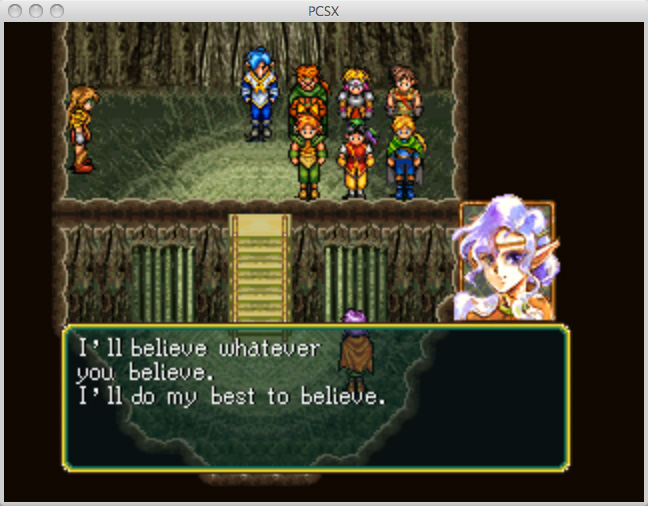
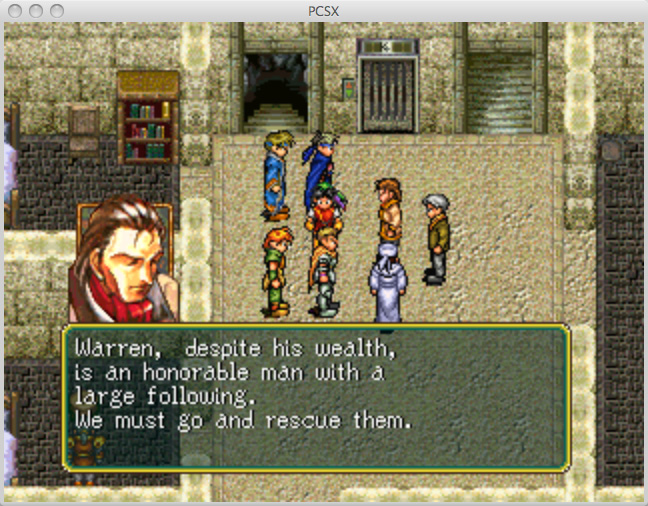
I played Suikoden for a really simple reason: I bought an old Mac Mini that can barely do anything, but it can emulate games. When I realized this, I thought, “Hey, that’s cool, I’ll go back and play all the games I missed during the SNES/PS1 era.”  I initially attempted to play Super Mario World, but it beat my ass continually, so I tried Suikoden. True story.

Luckily, Suikoden is a really great game. I have some theoretical content on the game, so if that’s what you’re concerned about, skip down to the bottom of this post, but I’ll actually give a quick review of the game.

The game does not explain anything to you. The magic system is governed by some kind of rune system, but I really never figured out how it worked, and I didn’t even have a healer in my party until the end of the game. The same goes for the system for weapons upgrade, which is done through adding rune shards to weapons as well as sharpening them. I didn’t figure those things out until the last couple hours, either.

But there’s something liberating in not having your hand held through a game. There is no being over you that tells you where to go. No quest log. Most of the time, NPCs seem to forget the plot-centered discussion you just had with them, which meant that, after not playing the game for a couple days, I would have to routinely go online to figure out the next step in the game. I would just forget. I started writing things down after a while.

The combat is interesting, and if you want to see the three kinds of combat, watch this review by some person on youtube. He shows the three kinds of combat, which consist of traditional RPG fare, a one on one dueling system, and large-scale combat. The latter two are essentially rock paper scissor games, but they add a sense of bigger things going on in the game world, which is refreshing.

This is the beginning of serious thoughts about the video game Suikoden in case you are scrolling down for the meat of this post.

The draw of Suikoden is that, throughout the game, you can recruit people to join the Liberation Army, which is a rebellion against the empire that everyone lives under. What I don’t understand, however, is why any of this matters. The game repeatedly says that the Emperor is evil, and as you progress through the game, several former allies of the Emperor say that he is a “changed man.” However, I never saw a single thing that the Emperor did that was bad. Now, imperial soldiers did a lot of terrible things: kidnapping, genocide of the elves (I’m not kidding), and just generally being autocratic assholes. Those things are super-bad, too, but in the end, all of those assholes become part of the Liberation Army.

Now, this leaves us at an interesting place. I have to wonder why the Emperor is bad, and if the game tells me that he’s bad because he has “changed,” then that’s what I have to go with. In essence, the rules that the Emperor established at the creation of the Empire have somehow been violated. We’re told why the Emperor has changed; a new sorceress, Windy, has come into his court. It is repeatedly, and I mean repeatedly, told to the player that the Emperor only brought Windy into his court because she looks like his dead wife, which is a weird fact to bring up all the time.

In any case, the theory of the world that the game puts forth roughly looks like this:

1. The social contract is formed around the sovereign and, in this case, his relationship with his subjects. If the sovereign appears disingenuous, or “changes” in any way, the subject has both an option and a right to depose that sovereign.
2. The agent of change can be ignored safely, since removing the sovereign removes the problem.
3. Rebellion is the only option.
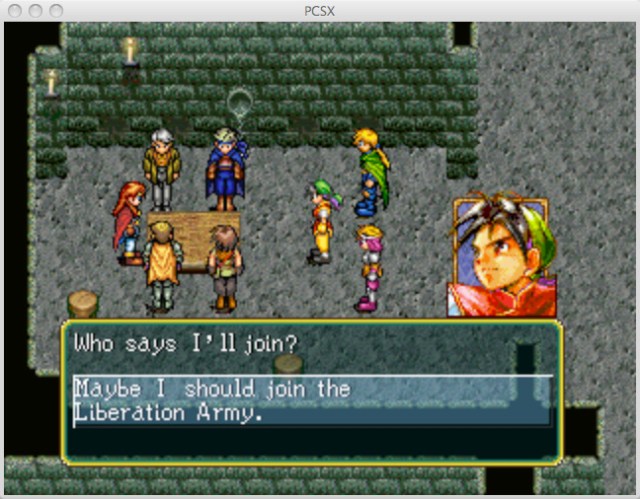
 

Now, I understand that this is ultimately a fantasy video game, and this is quite frankly one of the most interesting ones I have played, but there are some problems here. The philosophy of the game is pretty obviously fucked, as we are shown repeatedly, but I think there’s something we can pull from the game and apply to the “real” world, and it can show us the pitfalls that revolt without a change in ideology can have.
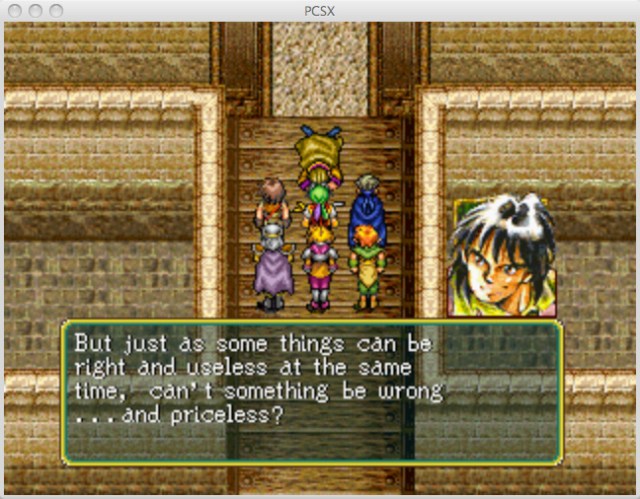
A confusing philosophy.

Right now, we conceive in a liberal social contract, in that we suppress everyone to the same base level in order to “grant” ourselves rights via the sovereign. This is how governments work. Now, in a world where we can see institutional injustice, or perceived injustice, Suikoden would have us believe that we should simply revolt. We go looking for alike minds, we pull them into the political fold, and we rise up against the perceived oppression. We “recruit” in the same way that the Liberation Army would.

The Tea Party, for example, sees the world in the way that Suikoden does. The United States Federal Government, though founded on some kind of beautiful, pure principle, has been taken over by Socialists/Muslims/Terrorists, and only through a complete Liberation Army experience can we get through it–the parallel stretches even further when you consider that, in the game, the Empire is not abolished. Only the sovereign changes. At this point, we’re getting to the point that I want to make; what feels like a revolution is nothing more than an election cycle that’s gotten out of hand. The Suikoden world of betrayal plays on a myth that, somehow, changing the acting power will get rid of the worst parts of the system.

In any case, what I’m getting around to saying is that we need to rethink capitalism. The mantra of growth is the Windy of our world; it is a cruel magician that wears the mask of the sovereign. However, though Suikoden grips us in the hold of normative ideology, it gives a way out: in the end of the game, the Emperor, realizing what has happened, grabs hold of Windy and leaps from the roof of the castle, destroying them both.
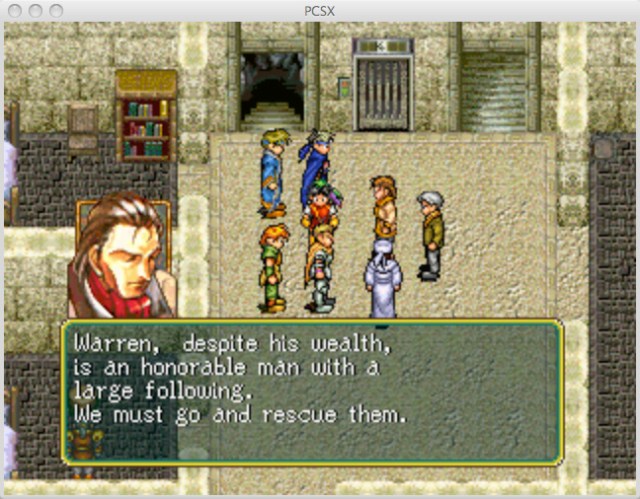
Hegemony. Included just because the reasoning is so strange.


Posted in General Features, Video Games | Tagged , , , | 1 Comment

On Kill Screen #4: The Public Play Issue

As you should know, I love Kill Screen Magazine. I pay a fairly high subscription cost for thoughtful magazine about video games, and I am always happy when it comes in the mail. You can see my review of issue #3 here, if you are so inclined.

The newest issue of the magazine is all about Public Play, and that means that this issue covers nearly everything game related. As Jamin Warren says in the introduction, this issue is concerned with what is “out of reach of the all-seeing eyes of our Xboxes and PS3s.” And that’s super-goddamn interesting. When we talk about games these days, we’re almost always talking about video games. More than that, when I think about multiplayer, I think about performance. For me, that sets up a weird dichotomy between gaming on my 360 and playing something like Minecraft  with a group of friends.

On the 360, my team is an abstract entity outside me. Most often it is a group of 13-40 year old men calling each other “fag.” I really fucking wish that I was kidding. In those instances, I am playing simply to play. I like to play Black Ops multiplayer because it is a nice way to just calm down at night. I have nothing invested in the game. I don’t care if I do well, though I don’t like to do poorly, because I fundamentally don’t give a fuck about any long-term win-loss, kill-death, or whatever ratio. But in Minecraft, I’m partially performing. I’m building things for my friends to come see. I’m knocking my friends to the ground from a great height and laughing maniacally. It’s the same with most PC games where I can talk and play with my friends: I’m performing with them.

But that isn’t really public play. Public play is doing something for the open public, like playing in an arcade or in a park, so I’m going to give a quick run down of the stuff I liked in this issue of Kill Screen.

1. Jon Irwin writes “Seeing Red,” a history of the Virtual Boy, a terribly shitty device that existed for the blink of an eye. I remember playing one in Toys R’ Us one time. In any case, it’s a wonderful little piece about the nature of optimism and the creation of video games. It’s strange to see that the tech behind the Virtual Boy was meant to improve the world.

2. Filipe Salgado writes “Permanent Collection,” which is ostensibly about libraries introducing digital content, but I think the idea that comes along at the end of the article is really, really intriguing: libraries should become keepers of a culture. They should be discerning, should pick things that are both popular and “art,” and attempt to pull in new people all the time. And I think this is so true, especially in the wake of Western nations cutting library funding over the past twenty years. If we think of libraries as publicly accessible art collections, I think they will do much better over the next twenty years. At the same time, I’m sure this is really difficult to make work, especially because library staff are famously boring old codgers.

3. The talk/article by Tracy Fullerton called “Masterful Play” is about an audience’s enjoyment of so-called masterful play, which she loosely defines as play that is both excellent and risky, seemingly only logical to the mind that makes the play. And that’s true, but I feel like this could be the most “no duh” article I’ve read in a while. It doesn’t surprise me that there are people who have deeper insight into the systems of their chosen games than other people. It also doesn’t surprise me that people are in awe of those master players–we like watching people be good at things. We like watching Jordan play basketball. We like watching painters paint.

4. Kirk Hamilton’s “Ready, Set,” about The Go Game, a real-world teambuilding game put on by a company of the same name, is phenomenal. Essentially, groups of people run around an urban locale and complete “quests,” take pictures of their completions, and then meet up in a bar later to watch everyone being silly. The article needs to be read, honestly, and nothing I write here will do justice to the beautiful way that Hamilton describes it. The game is designed to include all types of people, so eventually everyone will be needed; Hamilton describes how quickly the group becomes a team: “Andy is our communication man, Steven our scrapper and camera jockey, and despite his initial insistence to the contrary, Geoff has become our leader. Bev and the others help out with whatever they can. Only Diana–she of the scarf–remains uncommitted.” Spoiler alert: Diana becomes committed by completing a mission to pick up a woman in a bar. In any case, all of the people become involved, and I think it makes games like Final Fantasy make so much sense from the perspective of the mind. These people could have been Black Mage, White Mage, Fighter, generic people, Lone Wolf character. Games are just simulations of the way we like to think, even down to composition of social groups, and it’s really cool to see that reflected back into the real world.

I have only written about less than half of the articles in the magazine, so there’s a lot more for you to read. I like the magazine. It does good things. It encourages being smart, which is so much better than most of the goddamn world that we live in. BUY IT.

Posted in General Features, Video Games | Tagged , , , | Comments Off on On Kill Screen #4: The Public Play Issue

Mieville on Lovecraft

I think Lovecraft is an astonishing visionary writer, and the source of his vision, in many cases, is race hatred. Now what do you do with that? Do you say, “I’m not going to read any of his stuff”? Do you say, “I’m impressed by the power of his ecstatic vision.” I am. Understanding that it comes from a really horrendous place is a way of saying that I’m not surrendering to those politics, but I’m also not denying what, in Michel Houellebecq’s words, raised him to the level of poetic trance, and it was race hatred.

I don’t think it’s impossible to have it both ways. You can read fictions symptomatically, which is and an important thing to do. But it always has many things going on. To understand the source of something and to denigrate it doesn’t necessarily mean turning your back on its power as well.

Mieville in an interview

I, of course, agree with Mieville here, and I think there’s something beautiful there.

Posted in General Features | Tagged , , , | 1 Comment

The Talking Heads and Kermit

I am very busy right now with preparation for finals, so the work that I am putting into this blog will be going down for a little while.

I have something for you, though. It is Kermit singing “Once in a Lifetime” by Talking Heads. That’s all you need to know.

Of course, via Robin Bougie.

Posted in General Features | Tagged , , | Comments Off on The Talking Heads and Kermit

Lovecraft and Wells

So does this sound like Lovecraft to you?

I heard cries of terror and their little feet running and stumbling this way and that. I do not remember all that I did as the moon crept up the sky. I suppose it was the unexpected nature of my loss that maddened me. I felt hopelessly cut off from my own world–a strange animal in an unknown world. I must have raved to a fro, screaming and crying upon God and Fate. I have a memory of horrible fatigue, as the long night of despair wore away; of looking in this impossible place and that; of groping among moonlit ruins and touching strange creatures in the black shadows; at last, of lying on the ground near the sphinx and weeping with absolute wretchedness.

It probably should, but it’s not. It’s actually a passage from Wells’ The Time Machine.

So what do we do with this information? Out front, we can see Lovecraft’s language of the Weird already present twenty years before Lovecraft really starts writing anything. Wells is clearly telegraphing the moves of Weird fiction in this piece, and the climax of The Time Machine is even stranger

As I stood sick and confused I saw again the moving thing upon the shoal–there was no mistake now that it was a moving thing–against the red water of the sea. It was a round thing, the size of a football perhaps, or, it may be, bigger, and tentacles trailed down from it.

That isn’t the first time that tentacles are mentioned in the novel, and at this point we’re somewhere in the far, far future, where the sun is dying, a Lovecraftian space of dying and decay if there ever was one. I think what we have to recognize here is that Lovecraft’s claim that Weird fiction is something new in his time is utterly false. In fact, HPL’s writing technique and methodology is indebted so heavily to the end of the Victorian era that we have to look at the intermezzo space between the Victorian and the early 20th century incredibly closely to see where those attachments exist.

The recluse of Providence, the country gentleman, Howard Phillips Lovecraft–a product of the Victorian era. But there’s rebellion in his texts, a denial of progressive telos paired with an utter hatred for the world. Something has to be said about the amount of apocalyptic scenarios that end with the world razed and populated by racist caricatures of cultists and demons.

Posted in General Features | Tagged , , , | 5 Comments

On The Time Machine

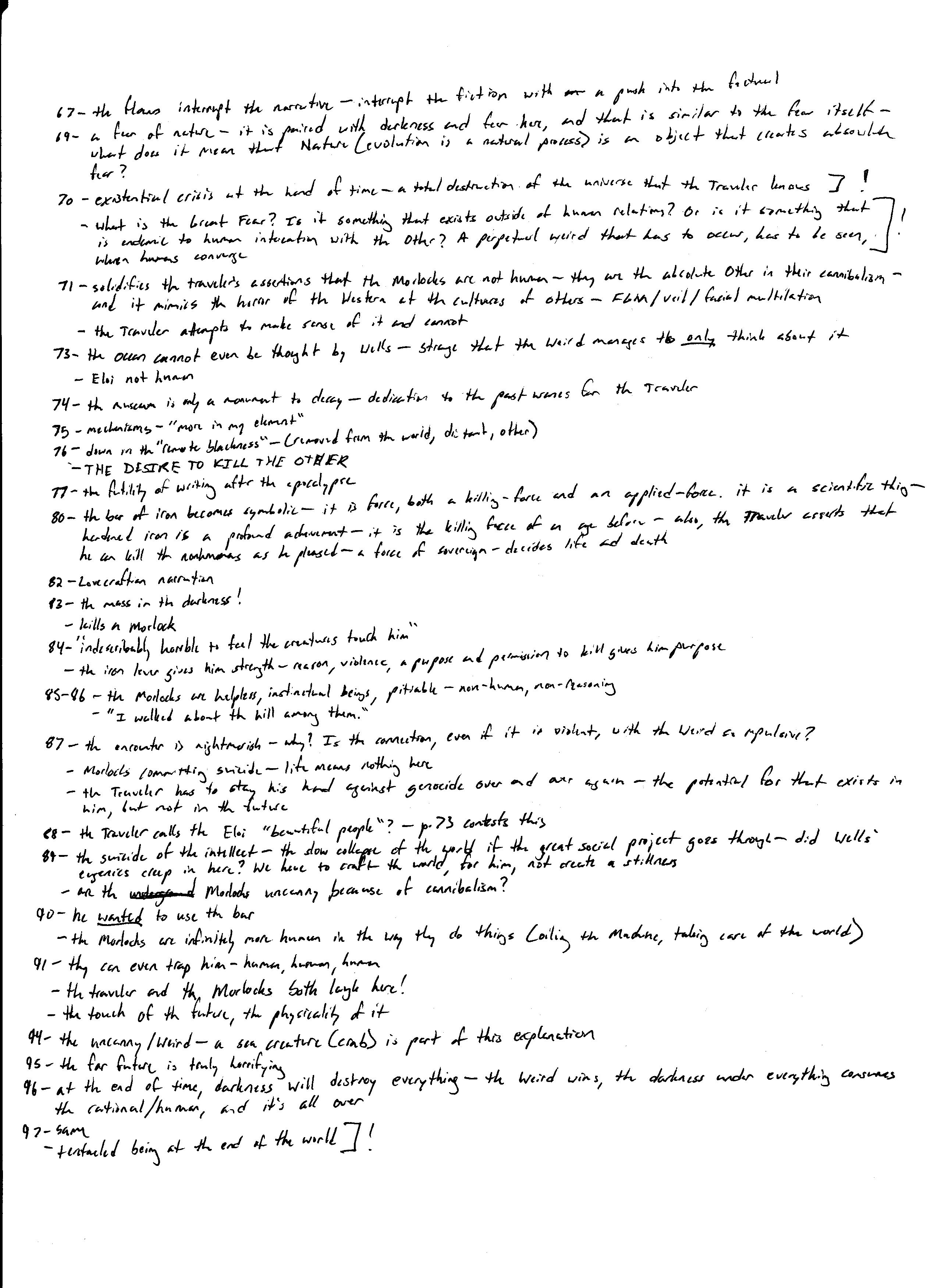
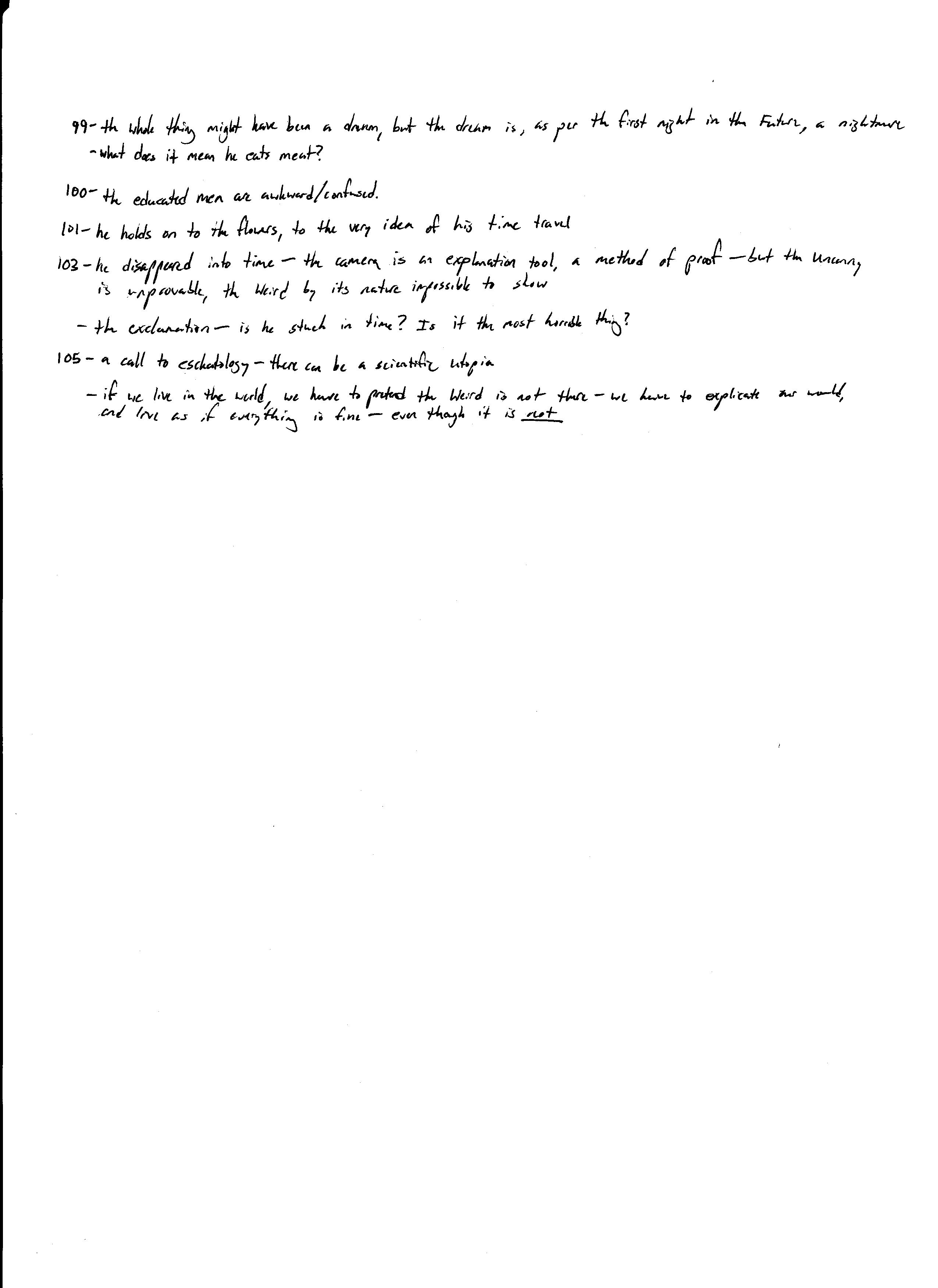
This isn’t really a post where I tell you about The Time Machine. Instead, I am going to post my note sheets. The copy of the book that I am using is this one, according to the ISBN.

So if you care about a page-by-page reading of The Time Machine and how it relates to Weird fiction and Lovecraft, then look through it. If not, I understand. I just think this could be a resource for people who might want to know about these things. Expect longer posts about these subjects in the next couple weeks; I am, after all, writing about it.

Click on them for larger.

Posted in General Features | Tagged , , , | 2 Comments