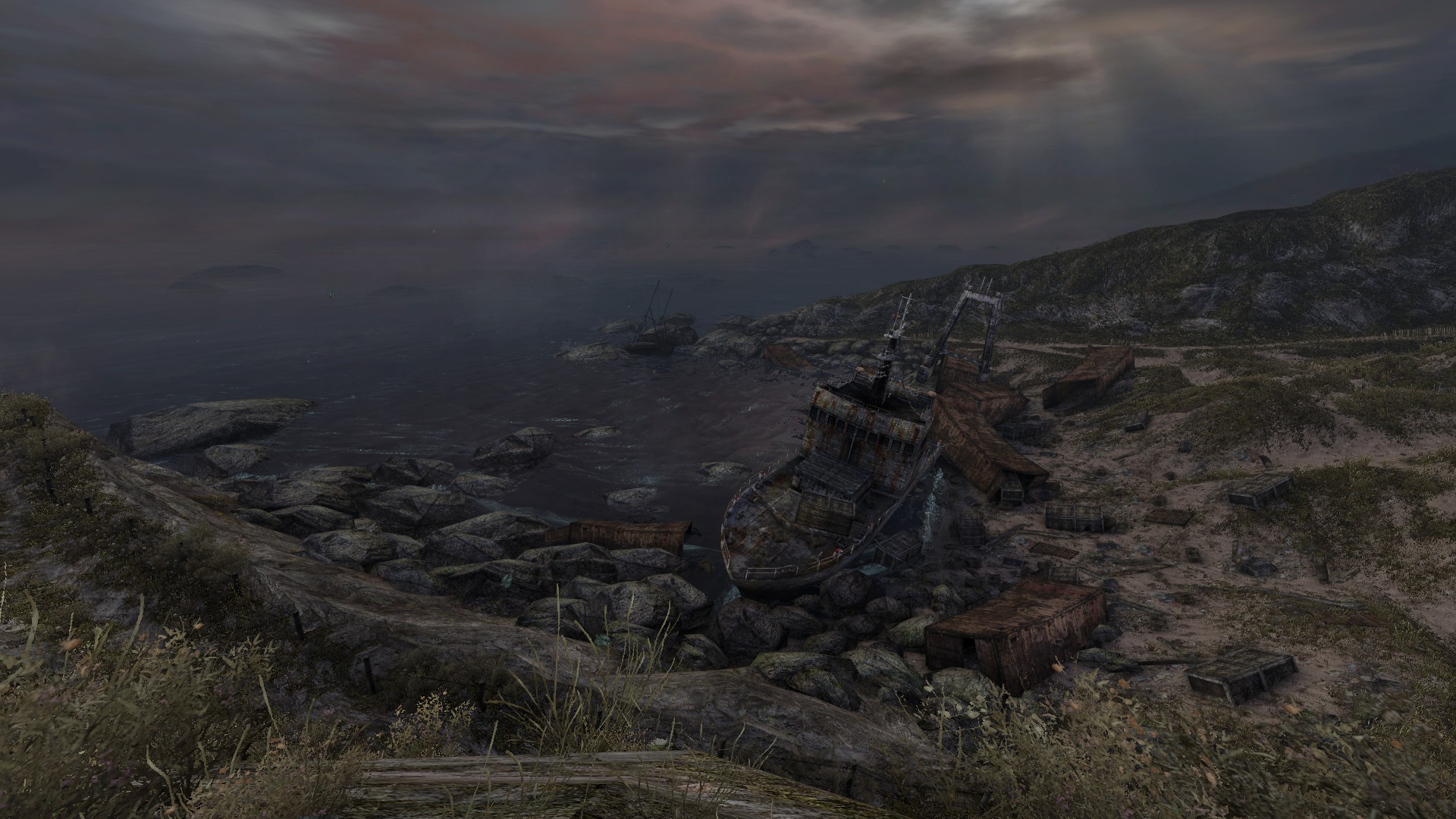
On Deus Ex: Human Revolution

WARNING: SPOILERS FOR DEUS EX: HUMAN REVOLUTION 

I am late to the party with Deus Ex: Human Revolution. If you want to read a comprehensive review of the game, I suggest this RPS article. I echo most of their sentiments about the game. You should feel safe in their arms. I would rather spend the words that I have here telling you the short of the game, and more importantly, the things that I think it does correctly. Let’s say I have three points, conveniently labeled 1-3.

#1 – DE:HR is a better science fiction story than a game

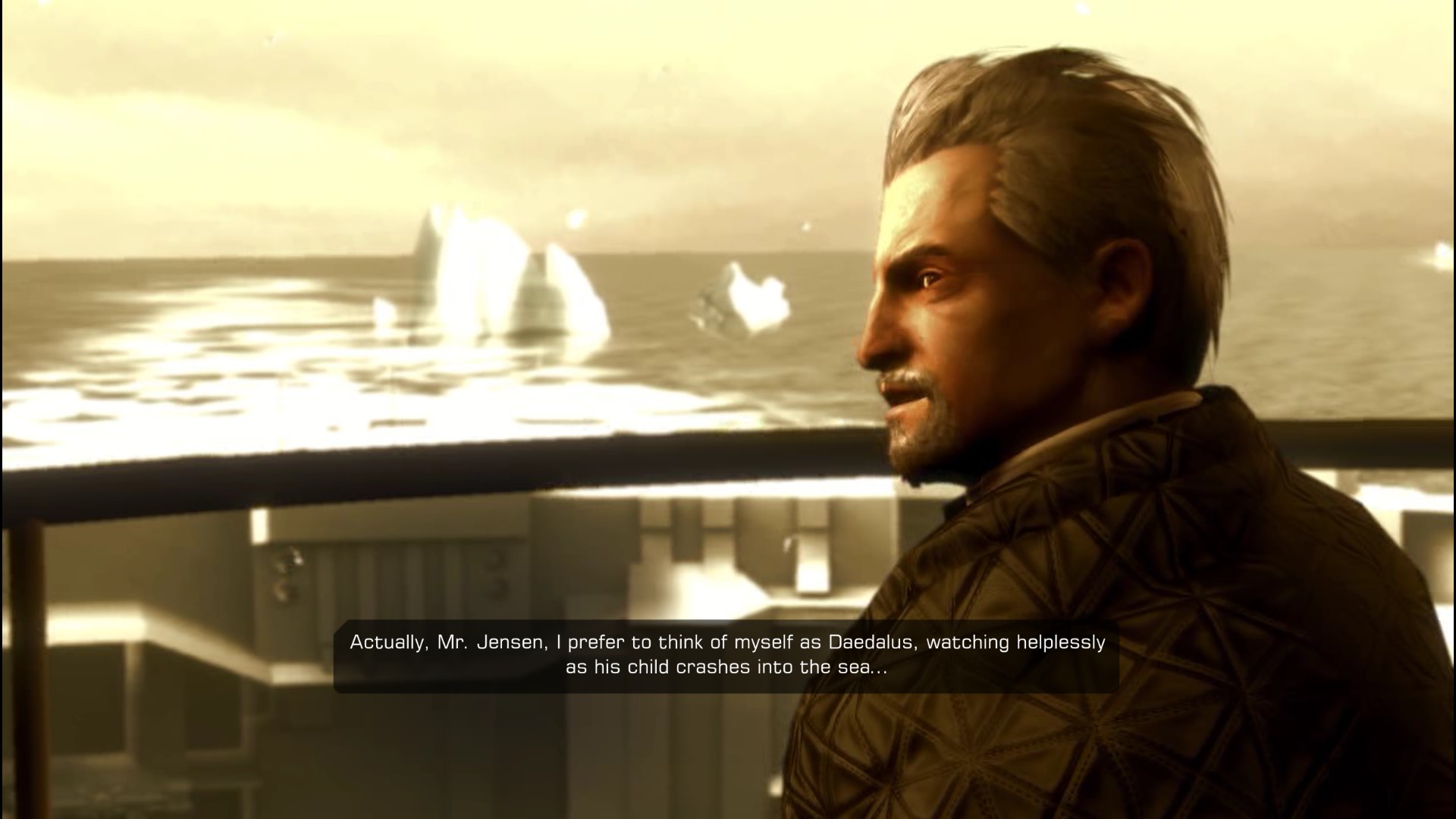
The narrative of DE:HR is brilliant, and it really forces the player to think through the question of what it means to enter into a posthuman existence. The skill progression allows the player, thorough the avatar of Adam Jensen, to really experience a realistic superhuman existence. It isn’t flying, but it is falling safely; it isn’t leaping tall buildings in a single bound, but it is leaping three meters off the ground in one hop. But at the end of the day, the game portion of DE:HR really only exists so that the player is forced to think through the implications of being superhuman, and that is a problem. For the most part, I figured out puzzles quickly, and I often felt like a rat in a maze. I finished the game in about seven hours, and it would have been much quicker if the game wasn’t so brutally unforgiving to a no-kill playthrough with no fighting stats. My point is, the ludic components really only exist to make the narrative stronger; playing the story is more effective than being told to the story, but I rarely felt rewarded in the gameplay. I would suggest that my experience with DE:HR really looked more like an ethics simulator than a traditional game, and you can take that how you will.

#2 – There is not a single positive or independent woman in the entire game

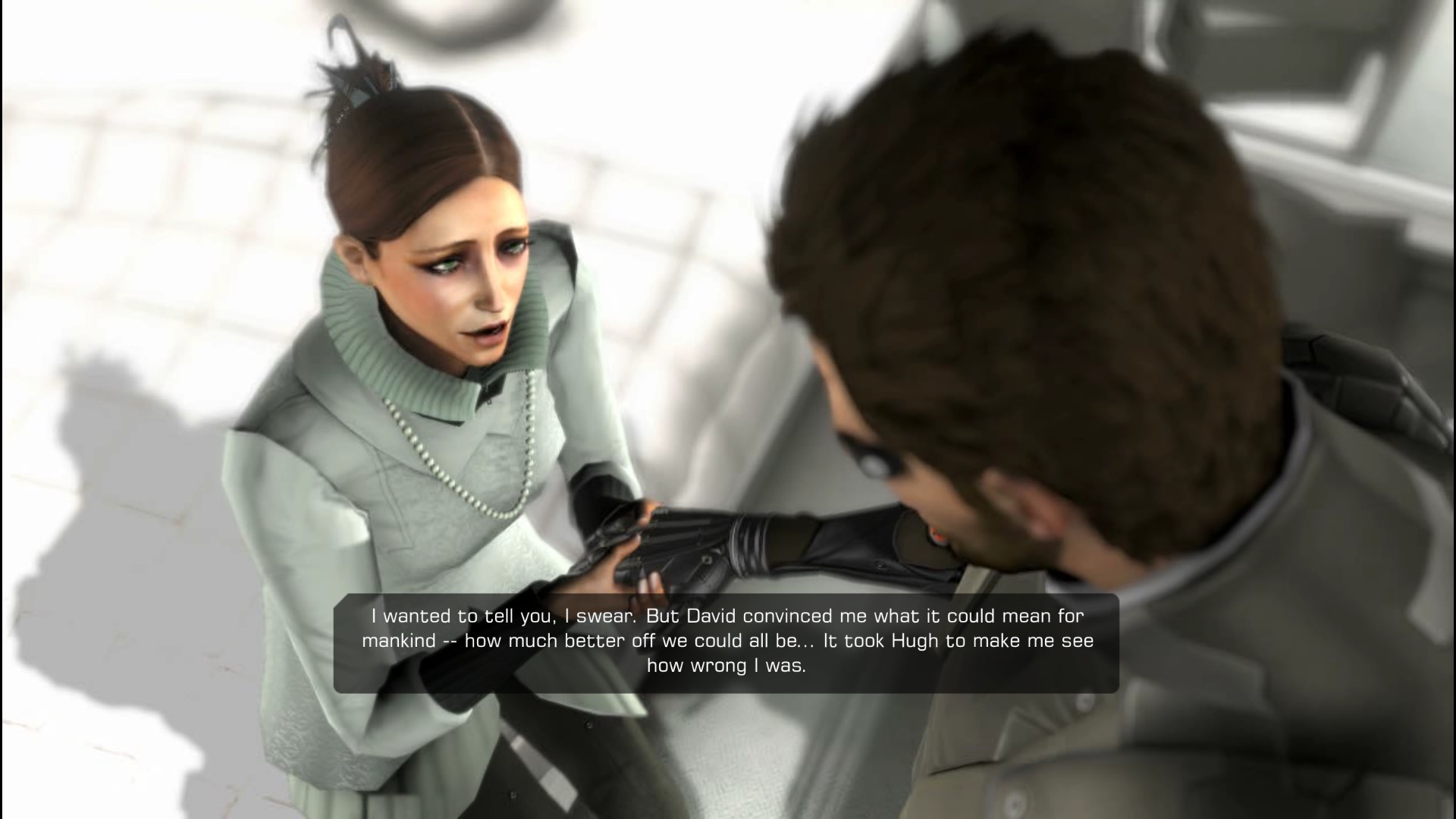
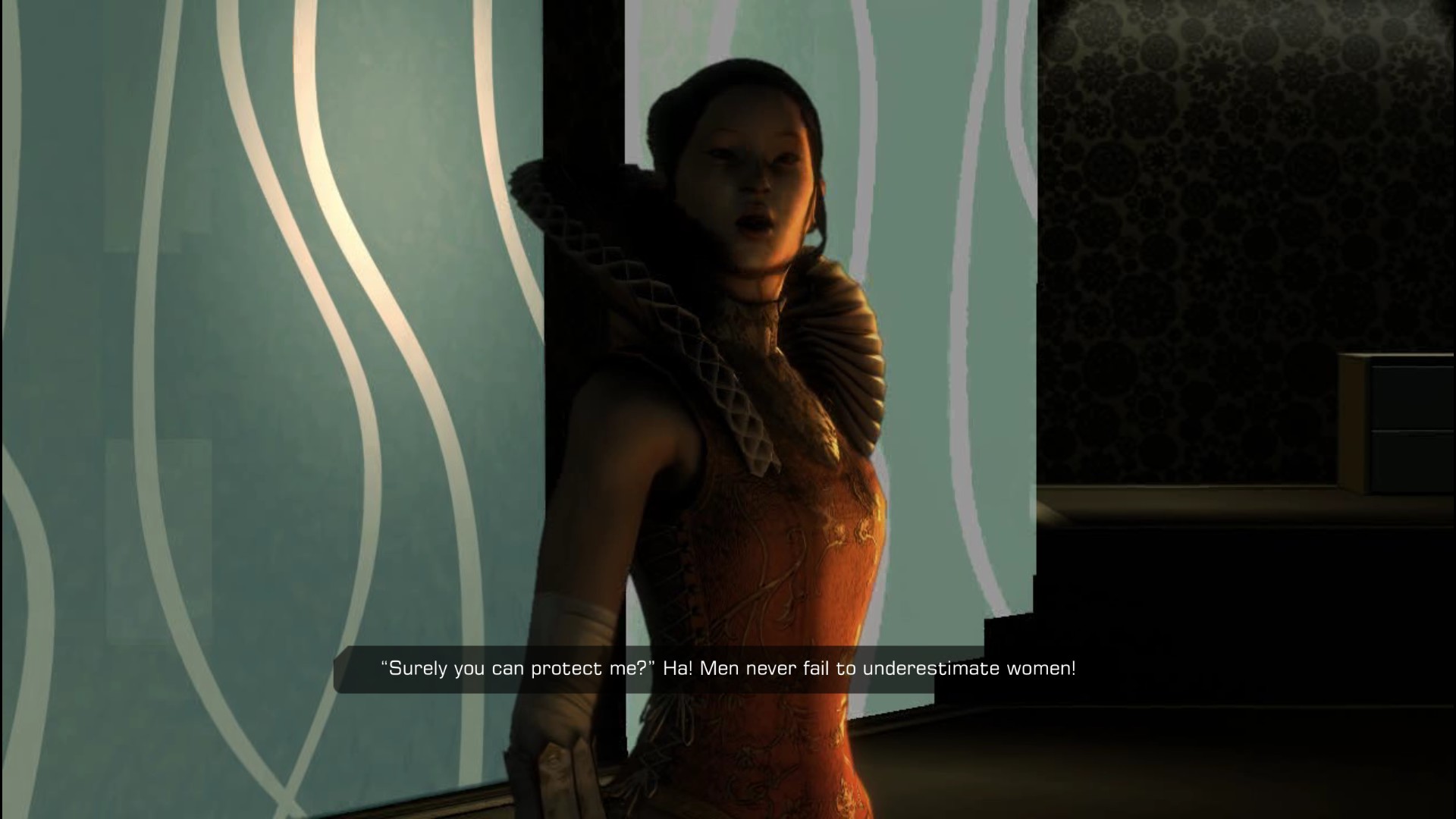
The game fails the Bechdel test, of course, but it also portrays women in a pretty horrific light. Every female character that begins as an ally becomes evil by the end of the game, the ones who were evil to begin with stay evil, and every other woman that exists needs to be helped out. In fact, there are several side quests that are solely about solving problems for women–getting rid of a pimp, spying on a suspect, and confronting a murderous boyfriend are included in this. The latter mission is particularly insulting; Malik, a character who seems to be a strong woman throughout, abandons her investigation into her best friend’s death because she is “in over her head,” a condition that is never made clear beyond its expedient use in allowing the mission to be handed over to Jensen. In all, this is just another example of casual sexism in video games, but DE:HR is a particularly egregious example.

#3 – The game invests the player in a cybernetic project

I think this might be the most interesting part of the whole thing. DE:HR is a game that has us playing a character who has undergone augmentation, meaning that he has cybernetic implants that alter his physical and mental capabilities. As the opening of the game explains, Jensen doesn’t really have a choice in the matter–augmentation is forced on him to save his life. The rest of the game is played by leveling the character and performing labor to earn money; both of these actions give the player points with which to upgrade Jensen’s augmentations. There is a second layer to this, though, which is the way the player interfaces with this. The game presents a scenario to the player in which the player has perform acts of cognitive labor in order to get points to put into an augmentation system that was foisted on the player by the design of the game. Like Jensen, the player has no choice by to put the time in and play the augmentation game. In a very real way, DE:HR becomes a simulation of what it would be like to live in an augmented society. The player makes the same choices that an augmented person would, and the open nature of the game means that variable play styles are accepted and accounted for in the level design; players are free to make the same kinds of choices they would in real life without fear of the game punishing them for acting on their “real” augmentation desires.

In all, I  liked the game, and my biggest complaint is the same one that everyone else had about the game: why are there boss battles?

Posted in Video Games | Tagged , , , , | 4 Comments

On Mass Effect 3

THIS POST CONTAINS GREAT BIG SPOILERS FOR MASS EFFECT 3. IF YOU DON’T WANT THE GAME SPOILED FOR YOU, DON’T READ THE NEXT BIT. MOVE ALONG.

So everyone in the world is angry about Mass Effect 3.

There are a number of reasons for this anger. “Gamers,” whatever they are, are an ornery bunch of miscreants, and they often want things that they can’t have. Surprisingly, one of those things is a decent ending to a 100+ hour long video game trilogy. You probably know this if you are reading this post, but let me hook you up with some knowledge in case you stumbled in here and didn’t care enough to click away when the bold print assaulted you during entry: the endings for Mass Effect 3 have been universally hated.

The problems really start when Shepard is confronted by an ancient AI that explains that the cycle of Reapers destroying advanced civilizations every 50,000 years or so is the product of an ur-conflict between organic life and synthetic life. Synthetic life will always eliminate organic life in the end, the AI explains, and so the only way to ensure the survival of organic life in perpetuity is to make sure that civilizations that are capable of creating full-fledged AI life are eliminated before they can tank the universe (basically). If you want it explained to you better, look here.

So then the AI, in the form of a little kid, points out three different doors that correspond to three different endings. The three endings (and there are really only three; an extra ten seconds here and there does not 17 endings make) are roughly based on the three possible ideologies that Shepard can prescribe to during the course of the game.

Door #1: Shepard can kill all synthetic life in the universe. This means all of the robot people that Shepard has grown to love would die immediately, but so would the Reapers, the giant robots who are dedicated to destroying all organic life in the galaxy.

Door #2: Shepard obliterates his body for the chance to control the Reapers. This means that Shepard will die as we know him, but essentially lives on as some Reaper god doing whatever the hell he wants.

Door#3: Shepard is obliterated and every being in the galaxy is altered on the level of their DNA, destroying the dividing line between synthetic and organic life and eliminating the problem of synthetic life killing off organic life.

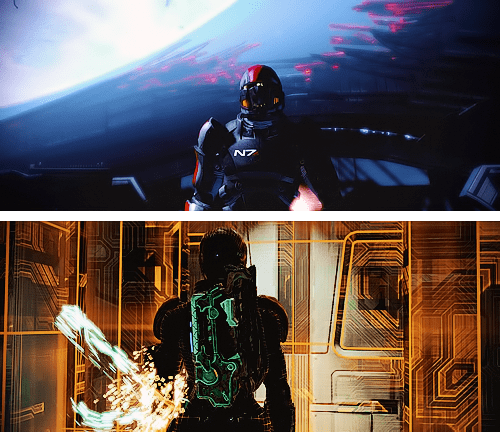
And then the game cuts out of cinematic mode and lets you made a decision. It is difficult, and I admit that I stood for more than a few minutes looking back and forth between my three options and weighing the cost-benefits. I made my choice of #2 and watched Shepard heroically hold on to some electric space conduits that promptly burned him into nonexistence. The Reapers left the galaxy. None of Shepard’s friends died. I was happy.

Then I looked  at the internet. I had been careful to avoid reviews, trailers, demos, and any promotional material for the game before I played through it completely. I made sure that I was getting an authentic experience, whatever that means, and it was only when I looked at my favorite gaming news websites that I learned just how much people hated the ending. Luke Plunkett’s article on Kotaku sums up most of the rage about the game; most of it boils down to “it didn’t end how I wanted it to.”

That is a reasonable complaint, and to be fair, I might have liked it because the game ended exactly how I wanted it to. From the very beginning of Mass Effect 3 it was apparent to me that a theme of the game was sacrifice. Difficult choices had to be made, and they had implications that stretched far beyond Shepard as a being. For example, there are two distinct instances where Shepard has to decide if he will allow a species to be eliminated simply because they exist in potential opposition to Shepard’s allies. I made the choice to cure the genophage and to save the geth. My Shepard was one who was concerned with saving lives, and he always knew that self-sacrifice was an option. He disintegrated because it was the only way he could be sure of getting rid of the Reapers.

If you notice, the above point I made was about my Shepard. This is a point that Plunkett makes clear in his post: Mass Effect is about making Shepard your own character. The endings took that away from the player. There is no easy choice. There is no way to blow up the aliens and watch Shepard live out his life on some backwater alien planet.

I thought it was brilliant. Video games are educational, even when we don’t want them to be, and the frustrations that players felt over the end of ME3 are teachable. The superheroic ending in which Shepard saves the galaxy and retires is regressive; that ending would mean that the Mass Effect series is no better than the generic fantasy and science fiction novels crapped out by nameless hacks over the past hundred years. Shepard’s death takes the game from genre fair into something truly unique and artful–it shapes Shepard’s story into something like a legend.

There is also something to be said about how Mass Effect 3 is a video game in a classic sense. Like pinball or an old arcade cabinet, you don’t really play to win. Instead, you play against the clock, knowing that you’re going to lose, that your skill won’t be enough. You know you’re going to lose all those extra lives.

Posted in Video Games | Tagged , | Comments Off on On Mass Effect 3

On Any Empire

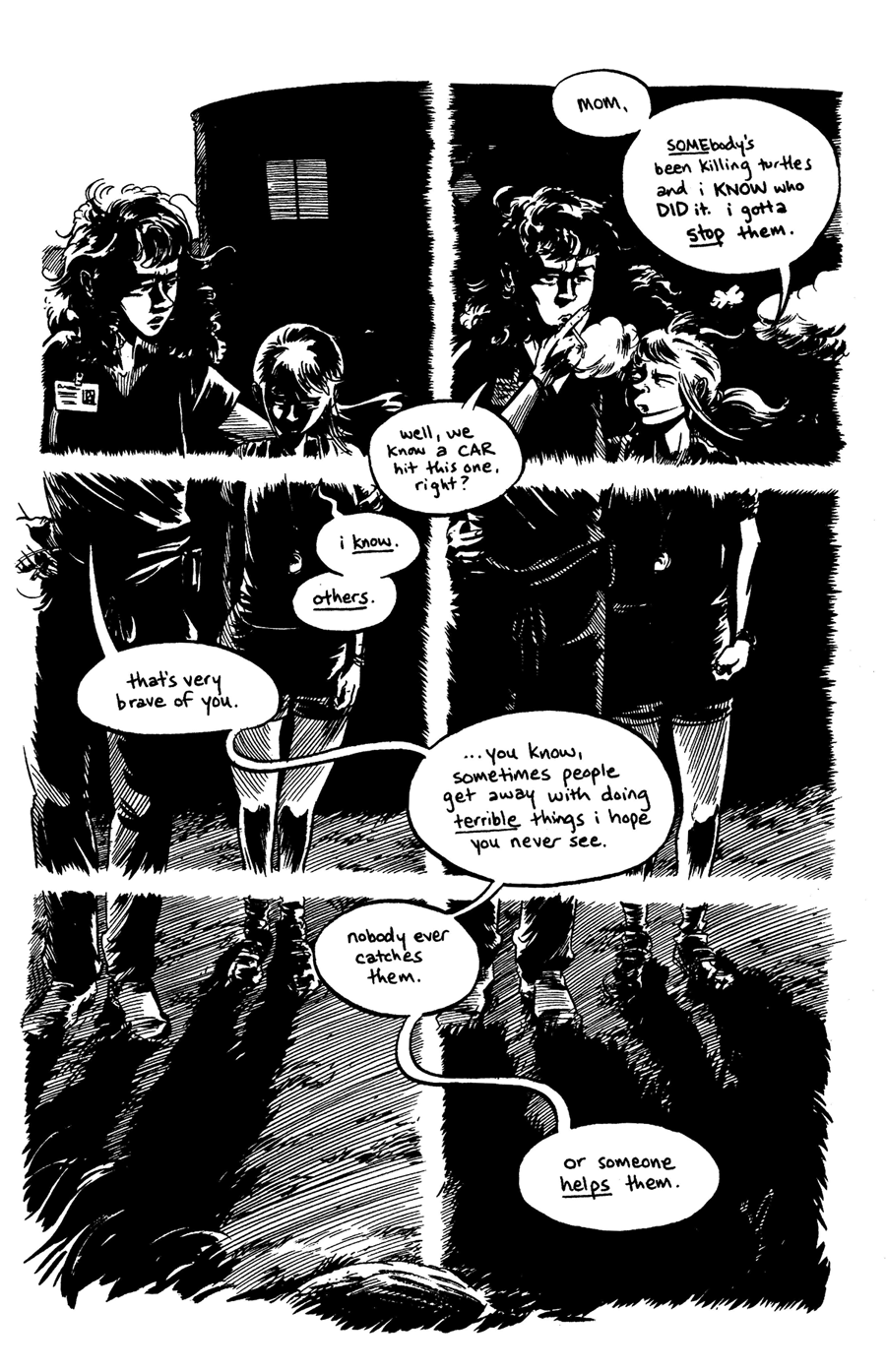
This is really just a short post to talk about how beautiful Nate Powell’s Any Empire is. I don’t want to ruin the story for you, so I won’t try to review or summarize any of the plot–it’s an affective text in that everything good I got out of it came from my emotional reactions and affinities that I have for its characters. I will say that the book eschews traditional storytelling and goes for a much more disconnected and memory-oriented, free associative way of communicating.

I guess I should post some pages to illustrate what I mean.

I think this page is brilliant by any standard. Powell takes two sequential full-length portraits of a mother and a daughter and then splits them into six. The way that we read comics (left/right/down) means that we are forced to combine all of the aspects of the two distinct times into one scene. The scene is supposed to resonate in our mind as a clean cut of a film, showing a woman comforting her daughter while smoking, and the camera pans to their feet before it cuts to a different scene (in this case, another page). The dialogue also pushes us along, taking the reader from the faciality of the page into the mixed tones of the lower panels, which also mimics the subject being discussed; violence, and shame about violence, makes us look at our feet. We should feel like children, and at that point in the narrative, I was ashamed of what I knew was going on. You’ll have to read it to see what I mean.

Another page that I thought was pure brilliance:

The dotted line panels are obviously flashbacks, and explanatory ones at that. I think there’s something more brilliant going on, though, and it is the sense of space that Powell gives us. We start with a wide establishing shot and move into a gym. We don’t stop there, however. We get a close up of on intense expression with a bruise under it, and we zoom in even more, but this time back into the past. Then we zoom out, still in the past, a transition between the present and history that was breached seamlessly, and we have a panel of the past that is bigger than anything else on the page. Within that, we have a smaller panel of a dream, a wish, a thought.

We are supposed to understand here that the event of drawing on the eye, and the thought that created that desire, is more important than the world that the kid lives in. The line between reality and fiction is pointless when desire enters the picture; desire overcodes and takes over the banal physical world, dominates it, drives it out of the space of the page.

That’s all I have. Maybe these pages will encourage you to go try out Any Empire. I think it is amazing, and his previous book, Swallow Me Whole, is my favorite comic of all time.

Posted in Comics | Tagged , , | Comments Off on On Any Empire

On The Authority

If you’re up on the Twitter wire, you might know that sometime last week, in a fit of strange nostalgia, I read Ellis/Hitch issues of The Authority. A little bit of confessional bio for a second: The Authority is the first “run” of a comic book that I ever read. Before that I had read lots and lots of single issues and had a serious Sonic the Hedgehog comic addiction for about five years. But The Authority was the first time I sat down and read an entire series (this is the Ellis/Hitch stuff) all in one whack. And I loved it, of course. So that little bit of confessional investment aside, I want to say some stuff about the issues.

I will let Anne Thalheimer at PopMatters do the work of giving you the short of the comic:

The Authority is, at its fundamental core, a treatment of the Justice League of America taken to its logical conclusion. Seven of the most powerful superhumans in the Wildstorm Universe take it upon themselves to protect Earth from all threats, internal or external. These threats are usually gargantuan in nature and the eradication of these threats equally Herculean. This is widescreen, cinema-scope super-heroic fiction at its finest. Consisting of Jenny Sparks, Swift, the Engineer, the Doctor, Jack Hawksmoor, Apollo & the Midnighter (a gay version of the World’s Finest duo i.e. Superman and Batman), The Authority was a spin-off from the late Stormwatch series, which took as its premise a UN-sanctioned super group. The creators responsible for these epic wonders were Warren Ellis (writer), Bryan Hitch and Paul Neary (artists) and together they delivered 12 pulsating issues that illuminated the jaded super-hero comic book industry.

1. What The Authority Do

In an interview about Desolation Jones, Ellis stated that

I saw no reason why the violence should be enthralling. Following the dictates of the hard-boiled detective genre Jones plays with, there had to be violence in every episode, but I didn’t want it to be without consequence, you know? So, when it happens, it’s stark and horrible, brings you right back down to earth – hopefully.“

While we get comics criticism pretty often from Ellis, getting a sense of his comic aesthetics is a little more difficult. The statement above assumes that the normative consequences for violence in comics is relatively low–which puts The Authority in a particularly interesting light. You see, The Authority is a superhero team comic. The characters go from incredibly original–Jenny Sparks, the spirit of the 20th century and Jack Hawksmoor, a god of cities–to derivative characters rendered whole-cloth from the history of superhero comics. The Authority is not some rag-tag group of individuals who have to prevent jokesters or wealthy moguls from taking over the world–they prevent catastrophe on a global scale. They prevent a moon-sized primal god from wiping out life on Earth. They prevent colonization of their reality by an alternate England ruled by alien Sicilians. They do big things, and they do them violently.

And maybe it is how The Authority do things that is interesting. A couple people have already hit on my point here, so lets just skip to the block quotes. Grant Morrison wrote in his Supergods that

“…the members of the Authority were comfortable with their powers, using them to sensible fight “bastards” and improve the lot of everyone on planet Earth. It was the utopian vision of Siegel and Shuster strained through British cynicism and delivered on the end of a spiked leather glove. It took the accusations of fascism that had haunted Superman and suggested a new kind of superfascist, one that was on our side.” (311)

Andrew Terjesen speaks to this as well in his “Why Doctor Doom is Better that The Authority,”

“… The Authority’s power makes it more likely that people would choose whatever the Authority wants for fear of getting beaten up. This might not be as big a deal if we could be sure that no one would ever use the power of the Authority to further their own agenda, but we have no guarantee that they are correct in their perceptions of what is best for us.” (89)

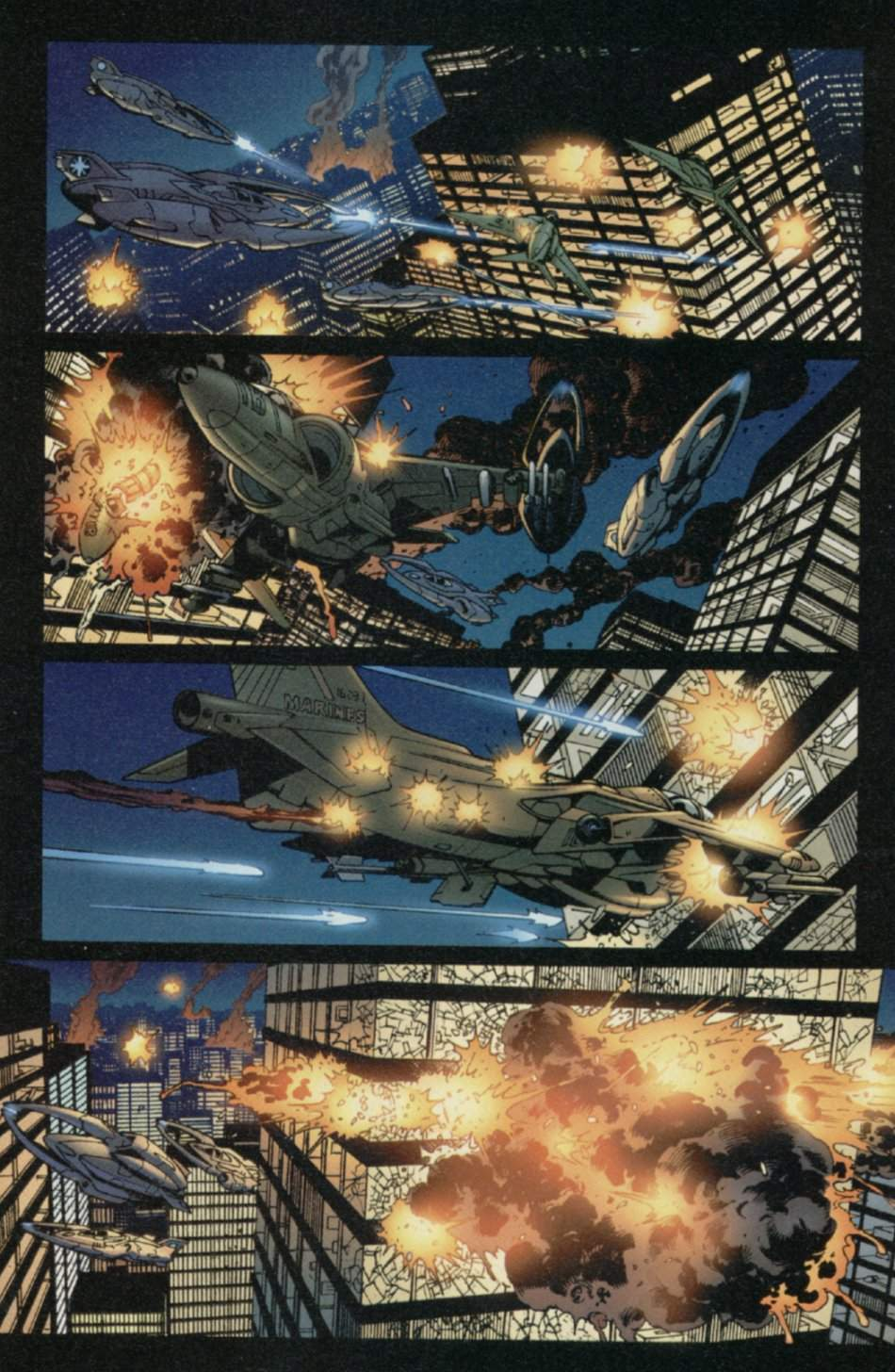
So The Authority are a team who direct the world through violence, whether we like it or not, and that violence has very few consequences. The often misquoted “great power equals great responsibility” line takes on a new form in the context of The Authority; they have the greatest power, and so they take on the greatest responsibility. This has consequences in a number of ways. For instance, read this page

The Engineer, with the help of some old-fashioned moral support, uses her “great power” and, on the next page, disintegrates the soldiers who are attacking her. She uses her power to enact a violence that is so overwhelming and total that the possibility of retaliation is literally impossible. She atomizes her enemies.

This is the entire project of The Authority: using superpowers to commit violence on the largest scale possible. “Stories on the largest scale we can imagine,” as Ellis said in the original proposal for the series. In another issue, Jenny Sparks wipes the entire continent of Italy off the map of an alternate-reality Earth. Everyone dies, of course, and she uses that as a way of explaining her powers to that world. She forces them, in her language, to “be good.” We should be horrified, of course, by all of this. Mass murder becomes a way of getting things done for the team, and Grant Morrison is right to call them fascists. Colin Smith reads it a different way, but I’m in the camp of thinking that atomic weapons are war crimes, so I’m in a different camp than Smith is anyway.

[SIDEBAR: Warren Ellis obviously has his own way of thinking, and being bored with, superheroes. They are human-figured gods, in all ways, and I don’t think it is any coincidence that all of members of The Authority are godlike in their power sets. There are no mere tricksters or dazzlers on the team–everyone has the ability to commit murder on a mass scale. There is a long history of gods doing terrible things to show their power and to make sure that humans behave, and unlike real life, there is no way to be an atheist in the world of The Authority. You have no choice but to believe. When Grant Morrison talks about comic book characters being our new gods, he should realize that they are the same as the old gods, and that The Authority are about as Old Testament as it gets.]

So that is what the team “does.” They commit acts of violence on a global scale and make sure everything is hunky dorey on the whole. Jack Hawksmoor, discussing the destruction done to a city after a huge battle, says “How many people would’ve died if we hadn’t been here? It’s not a great answer, I know; but it’s the best there is. We saved more people than we killed.” That’s the world that The Authority live in. That is what they do.

2. What The Authority Looks Like

Bryan Hitch was the artist on the first twelve issues of The Authority, and he is widely credited with creating what is now called “widescreen comics.” It is an aesthetic movement that is typified by uncompressed storytelling combined with large actions–it is a Roland Emmerich film in comics form. The fact that I can describe it this way is maybe the most telling thing about widescreen storytelling–it is based on film techniques rather than traditional comic book ways of showing and explaining characters and scenes.

In any case, Hitch invented it. In an interview, he talks about what drew him to comics, and that it was specifically Curt Swan’s Superman art, done in a “naturalistic style,” that pulled him in. One of the key things about Hitch’s art is how effortless everything looks; the superheroes look like people in their element, doing what they are good at, like sports players or Olympic swimmers. It looks authentic. In another interview, Hitch talks about the way that he and Ellis plotted out their issues of The Authority together:

“When Warren and I first came up with the idea of the Authority the three stories were worked out as just one line pitches: The Authority overthrow a tyrant armed with thousands of Supermen, The Authority repel an invasion from an alternate earth and The Authority Kill God. My input was more along the lines of asking for and describing things relating to the action, such as the dogfight over LA and having the invasion of The Carrier being on horseback. My input on Ultimates is far greater as the working relationship with Mighty Mark Millar is much closer.”

The stories that the The Authority are involved in are giant, and they require giant artistic visions. Hitch is amazing when it comes to this, and there are huge vistas destroyed in the most beautiful ways. People are trapped under piles of artfully rendered rubble. The drawn world, and the characters in it, become adapted to the kind of violence that The Authority are involved in. It makes a lot of sense that widescreen comics come out of this comic–we need huge focal lengths in order to comprehend all of the destruction.
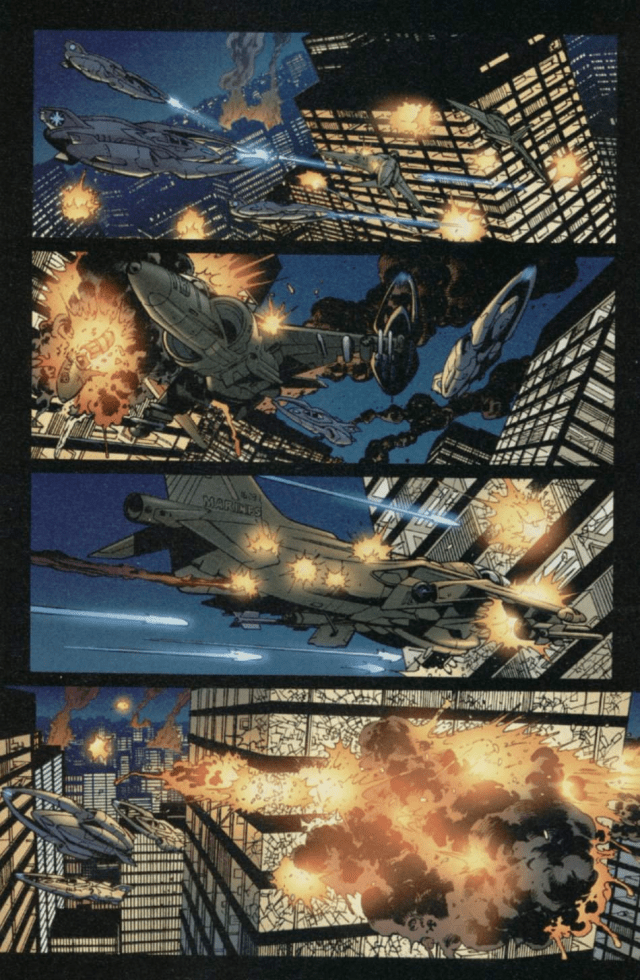
This page is particularly resonant for me, especially considering that this was in 1999. The world was really buying that we were in end of history, or at least all of the non-grim meathook parts were. The visual representations that we were experiencing in that time period were all about the destruction of our world–the sheer number of late-1990s natural apocalypse is stunning. What I mean by “natural” is that there were a lot of movies in which the apocalypse occurred at its reasons were completely opaque–a meteor comes or an alien invasion happens. There are no reasons; they simply happen.

The Authority presents the world in a similar way, but instead of a solution with quirky working-class oil people, or Jeff Goldblum, we are presented with an equally opaque response. The people on the ground, the ones dying in the hundreds of thousands, don’t understand what is happening; The Authority is hidden to them–they just feel the impact. The visual world of the comic reflects this–there are lots of panels of random violence, cinematic in the way that Transformers 2 is cinematic. Things are happening, and I can’t really make sense of them, but I get a feeling of great conflict.

Hitch comments about this in yet another interview where he suggests that the storytelling techniques he used during his JLA run were “a difficult fit.”  He claims that there was a struggle between his desire to open up the action, presumably into a cinematic mode, and writer Mark Waid’s desire to keep the stories personal to the characters, compressing the action with dialogue and emotion. This is telling about the way The Authority‘s aesthetic is revolutionary–Mark Waid is the perfect distillation of Silver Age knowledge and ethics, and if it doesn’t fit with his vision of comics, it doesn’t fit with the way that comics sees itself. Nicolas Labarre writes about the page layout of the issue above, and notes that the battle becomes too big for individual pages, and that a two page spread has to be read as a “surface” in order to make sense. Hitch is pushing the physical boundaries of comics reading here, collapsing the old and bringing in the new.

[Too Busy Thinking About Comics actually posted about the aesthetics of The Authority in the middle of my writing this, comparing it with a modern issue of Justice League, making a point about how the expansive images, particularly splash pages, create a sense of large world in which monolithic happen.]

3. What The Authority Means

The year 1999 means something. In fact, it is a critical part of the series, with Jenny Sparks being the spirit of the 20th century and all. So the 90s are rolling around in the comic–U.N. approved measures, biological weapons, a prophetic giant aircraft crashing into an equally giant tower. These are all, fundamentally, images of destruction that were replicated across media in the closing decade of the millennium. In his mournful essay “Transaesthetics,” Baudrillard wrote

“Our images are like icons: they allow us to go on believing in art while eluding the question of it existence. So perhaps we ought to treat all present-day art as a set of rituals, and for ritual use only; perhaps we ought to consider art solely from an anthropological standpoint, without reference to any aesthetic judgment whatsoever. The implication is that we have returned to the cultural stage of primitive species.” (19)

Comics are just words and pictures, as we know, and they are no more immune to this process of collapse than a photograph of your grandmother. The Authority is Baudrillard’s ritual in the most base way–it attempts to divine the reasons behind being in the world. It is part of the same process of being-opaque to the common person that I remarked on above; no one understands the machine that is existence, and so we have to create ways of understanding. The Authority are bastards, but like Morrison said, we want them to be on our side. The subtle critique of the whole thing is that there is no such thing as “our side.” The average person is just another building, another expendable object, something to be burned and trapped and vaporized. People are merely numbers. The Authority aren’t prophets on this point–Ellis merely uses them to think through the very 1990s way of risk assessment. There is nothing sacred, not even life, and if the numbers work out, sometimes a city has to be sacrificed (or an aspirin factory has to be bombed.)

So what does The Authority mean? I don’t know, I just thought that sounded like a really nice way to wrap this up instead of saying “conclusion.” The comic is a way of thinking about the world, and it is a way of thinking about how terrible everything is, and that even in the fact of galactic, mind-boggling scale problems, the actions of those in power are probably going to be the same. For Ellis and Hitch, a grand scale necessitates a utilitarian politics that I am, frankly, unhappy with. But I think the comic is beautiful because of how it breaks and reflects a world on the cusp of the 21st century. So take that how you will.

Posted in Comics | Tagged , , , , | 5 Comments

On Dear Esther (again)

I played through Dear Esther again. In my initial post, I made some assumptions and arguments about the storyline that was going on in the game. I have to tell you right now, at the top of this post, that I was wrong. In fact, I played the game again, and I came to absolutely different conclusions about the narrator and the fictional conditions that created the world that he lived in.

I started writing this post as a way of telling a new story. In fact, I just deleted 500 words of plotline. I was going to tell you about Donnelley and Jacobson and the illness they had and what that means to the narrator (who I had named N., like in a Kafka novel, to simplify my story.) But I was reading my notes from my second playthrough, and it felt disingenuous. The story feels too big, and even if I copied the words down straight from my page, it would somehow miss the point. We have a long tradition of theorists and philosophers explaining in great detail that the world is too big, that language always has an excess, that a mere fraction can be captured. And I am afraid that if I tried, even if I took tens of thousands of words and posted a screenshot of every ten seconds, that I couldn’t communicate it to you. I can’t make words that would approximate the feelings I had while playing the game, and it was only better the second time.

However, I think I can talk about instances of enjoyment. Moments where I felt some immense affective force. I don’t think I can explain them properly–so I’m just going to

1. The chief concern in the game is the death of Esther, the narrator’s wife. She died in a car accident, and a man named Paul was responsible. The narrator tells a story of meeting Paul, and claims that he was “beyond any conceivable boundary of life.” The man was consumed by guilt, and the narrator says later that he finds himself “increasingly unable to find that point where the hermit ends and Paul and I begin.” The hermit, as we are told, came to the island in a boat without a bottom and died there at an incredibly old age. He is a dead mythological figure, and the narrator thinks that he and Paul are the same.

2. This quote, presumably about Donnelley:

He left his body to the medical school and was duly opened out for a crowd of students twenty-one days after his passing. The report is included in my edition of his book. The syphilis has torn through his guts like a drunk driver, scrambling his organs like eggs on a plate. But enough definition remained for a cursory examination and, as I suspected, they found clear evidence of kidney stones. He is likely to have spent the last years of his life in considerable pain; perhaps this is the root of his laudanum habit. Although its use makes him an unreliable witness, I find myself increasingly drawn into his orbit.

3. I like the surreal, dreamlike qualities of the game. I like the idea that time collapses for the narrator and for the player. My original post made a mistake because I took the end of the game, where the narrator says “Esther Donnelley,” as a moment of revelation. I thought it “solved” the story in that it gave a name and psychosis to the player/narrator. But I know I was wrong. Everything has collapsed–history is gone because everything is happening, will happen, and has happened. The deep past is present on the island, which feels post-apocalyptic. Everything is in ruins, even though the narrator says he lives there.

In my final dream, I sat at peace with Jakobson and watched the moon over the Sandford junction, goats grazing on the hard shoulder, a world gone to weed and redemption. He showed me his fever scars, and I mine, between each shoulder the nascency of flight.

4. My second playthrough really focused on the narrator’s relationship with Paul. I feel like someone will eventually do the revealing work on the character of Paul that is laid so deep in the game–the narrator could be Paul, after all, even though it is unlikely. In any case:

There were chemical diagrams on the mug he gave me coffee in; sticky at the handle where his hands shook. . . . You could trace the connections with your finger, join the dots and whole new compounds would be summoned into activity.

This is the act of playing Dear Esther. It is flailing in the dark, connecting the dots with your mind and input organs, trying to force meaning out of it. It actively resists meaning anything at all, and there is something comforting in that. The game, by the very nature of its structure, renders itself opaque to us. The multiple narratives, driven together by random number generation, crash into our minds. It renders our interpretive mechanisms sharp yet ineffective. I have read some beautiful interpretations of the game, but they are all wrong, simply because they exist.

5.  I’m going to end with my favorite quote from the game. It doesn’t fit into this post, and maybe it’s for the best:

A sound of torn metal, teeth running over the edge of the rocks, a moon that casts a signal. As I lay pinned beside you, the ticking of the cooling engine, and the calling from a great height, all my mind as a bypass.

Posted in General Features, Video Games | Tagged , , , | 16 Comments

Station 37

This will be quick: play this game.

The game is Station 37, a game made through some kind of weekend jam thing in Canadaland. It is old-school stuff, but the design is impeccable, and it has some really cool firefighting mechanics.

I can’t tell you anything else about the game without spoiling it. The bloody thing is free, so go get it, and play it immediately. I think that the end of the game is some of the most frustrating fun that I have experienced in a game, and I have played Skate 2. So, seriously, go check it out.

Here is the really boss trailer so you know what you are in for:

Go play it!

Posted in General Features, Video Games | Tagged , , , | Comments Off on Station 37

On Dear Esther

THERE ARE SPOILERS FOR DEAR ESTHER IN THIS POST.

(This is me from the future. I have made another post about this game, and I basically changed everything I thought in point #1 below. Check it out.)

As faithful readers will know, I posted a transcript of the Dear Esther trailer and some thoughts about it a while back. I bought the game on release, and I just finished it a few minutes ago, so I thought that I would write about the game immediately.

1. Dear Esther changes on each playthrough. There are three scripts, and at each moment where the narrator speaks, the game picks from one of those scripts and delivers some text from it. That means that you get snippets from each story, and it really makes each playthrough of the game different. I have only played it through one time, though I plan on doing it more, and this is the story as I understood it.

The narrator is named Donnelly. His wife, Esther, was killed in a car accident. Donnelly, sometime after this, goes to an island that has particular meaning for him and his wife. The lines between reality and hallucination begin to blur for him–drugs could be involved. Before the game, Donnelly has done a number of strange things: burning all of his belongings, painting religious quotes and scientific diagrams all over the island, and throwing all of his letters to Esther into the ocean. Along with this, Donnelly is fixated on a man named Jacobson, a man who wrote the original history of the island. Jacobson died on the island a hundred years before, a victim to syphilis, and his infection drove him to mania. Donnelly, an infection from a broken leg spreading through his body, isolated from the rest of the world, makes his way across the island to a giant aerial tower. He reaches it, he jumps off, the game the world fades to black.

2. Dear Esther might not be a game. It uses the infrastructure and rhetorical devices of a video game to tell a crippling, affective story, but it doesn’t have any of the hallmarks of a traditional game. The player isn’t able to interact with the world through the player character, the entire story is told through disembodied narration, and there is only one goal–the end of the game. In the same way that a movie or a book plods, inch after inch, to resolution, Dear Esther has a clear end point, literally visible in the first moments of the game, and the player is taken there without deviation.

3.  Dear Esther is a game about making the player feel. That is all. There is nothing else that the game is concerned with. The symbolism is heavy handed, the writing purple at times, but the combination of those things with the stunning visuals is really just an effort to make the player understand the emotions that Donnely is feeling. The death of Esther is a blow to his very being, and it (apparently) shatters his mind. I felt deeply complicit in both the guilt that the narrator felt and also in his slow suicide–as soon as I saw the beacon, I knew what would happen. I felt it, and we started the trudge forward.

Alec at Rock, Paper, Shotgun (a favorite site of mine) writes that Dear Esther really did “work its dark, metaphysical magic” on him, and later writes

Not that it isn’t interesting, but I don’t see it as a puzzle to be pieced together. I do not believe Dear Esther is the search for an answer, or even for a meaning. I believe it is an experiment with the senses and the emotions. It is a Lonely, Guilt-Stricken Man Simulator. It is a journey through morbidly beautiful emptiness, a maudlin cocktail of sight, sound, implication and metaphor designed to conjure up a feeling of purposeful despair.

And I agree with this, for the most part. The game tries to make you understand what it is like to know that there is nothing left in the world worth caring about. I am resistant to the interpretation of the game that asserts that the whole thing is in the narrator’s mind, that the island is constructed by him, and that it is about an internal journey. I think that, in order to have real, stick-around meaning, the game world has to actually exist.

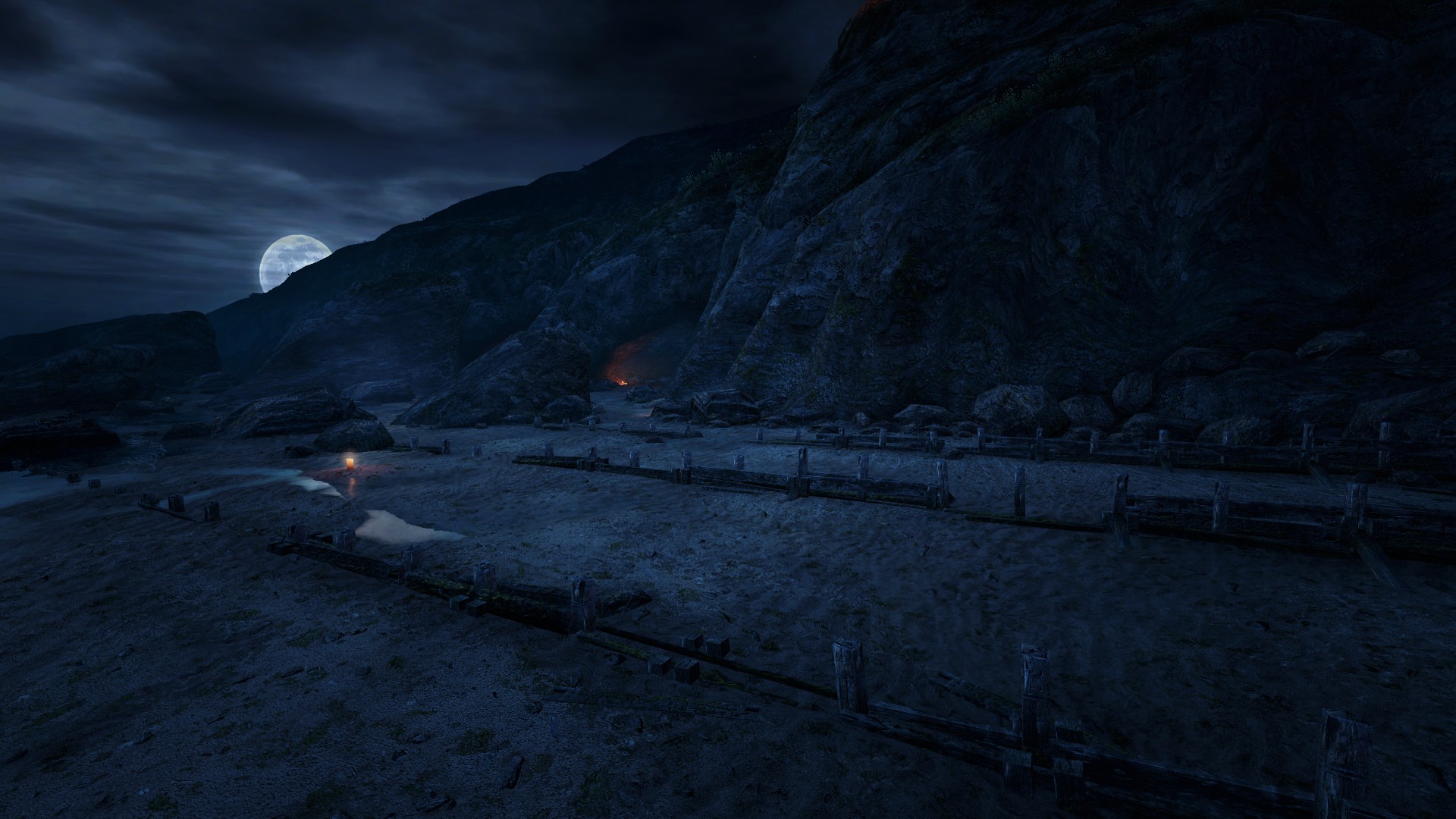
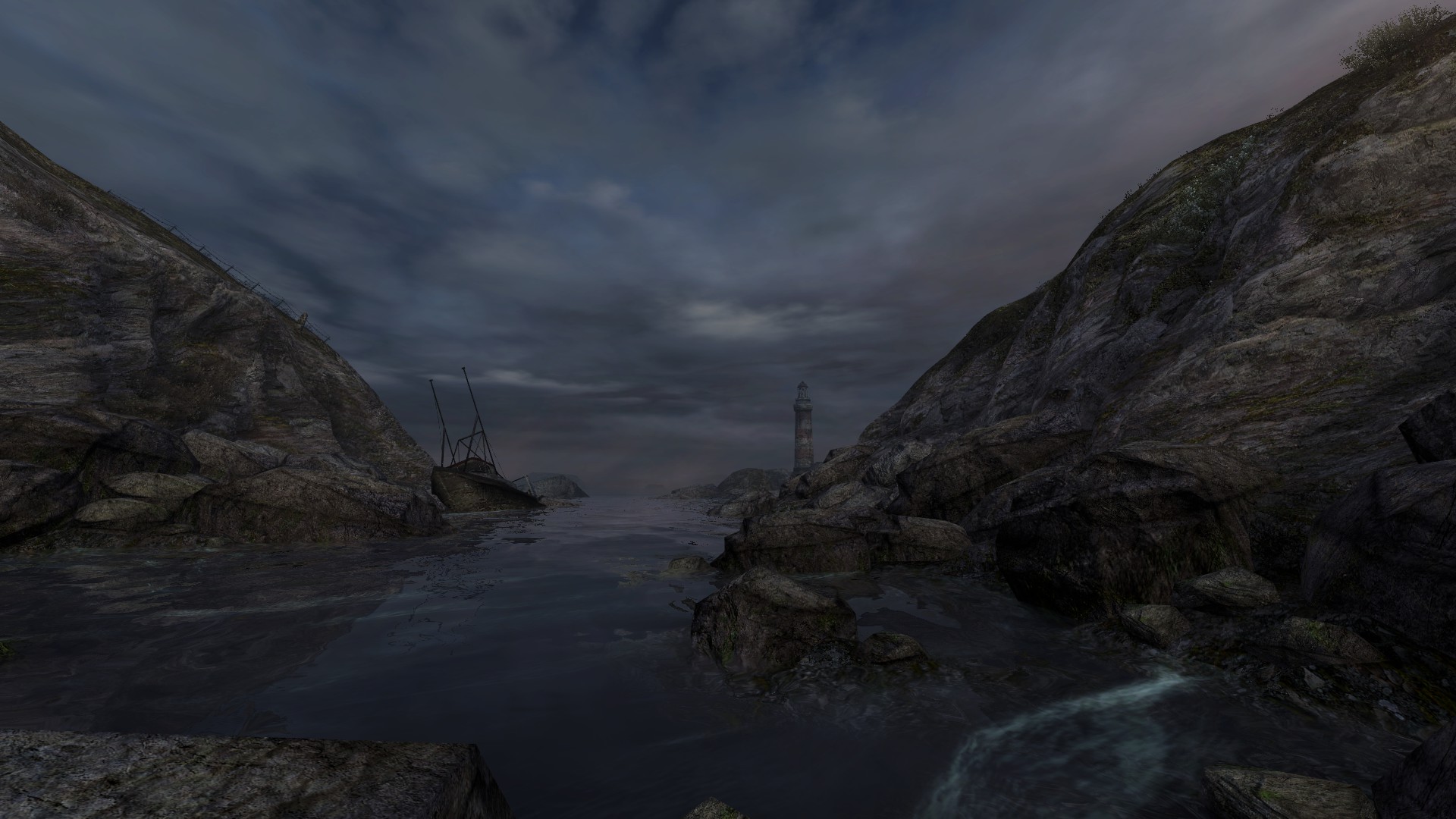
The reason is that there are two narratives going on. One is the player character, his guilt, his mourning, and his suicide. The island characterized as a space of death, of isolation, and of a slow decay, but that is only for the man-made intruders on the island. The lighthouse is ruined. The shacks are abandoned. Ships rot on shorelines.

The other narrative runs counter to that, and it is the story of the island. The island, through all of this, is blameless. Though shepherds die and ships run aground on unforgiving rocks, the island stands still as an unchanging haven. The narrator’s life is ruined because of a massive change, the interruptive terror of his wife’s death, but the island could never feel that kind of change. Its beating heart of crystal formations, unmoved for thousands of years, stands monolithic against time.

"Bent back like a nail, like a hangnail, like a drowning man clung onto the wheel, drunk and spiraled, washed onto the lost shore under a moon as fractured as a shattered wing. We cleave, we are flight and suspended, these wretched painkillers, this form inconstant. I will take flight."

4. The game presents us with a way of thinking about the separation between health and infection. The narrator, who spoke a lot about infection in my playthrough, is consumed by a psychic pathology–grief, and worse, guilt. He cannot shake it, and because of that, finds solace in a total infection of the body. His body has to match his mind. There becomes a pair bonding of the stained being, an existence that needs to replicate a stained soul with a ruined body. The result is predictably nihilistic–the only result of that is destruction, but on the way to that destruction, there is the recognition of beauty. The interior of the island can never be known without the recognition, and the movement toward, death. This is all pretty Romantic, syphilis-desiring stuff, but it really is the theoretical thrust of the game. Infection breeds death, but also a profound appreciation of the world, and a deep mourning for the loss of it, a loss that can only be truly understood on the way to death. I thought it was pretty beautiful stuff.

"I first saw him on the side of the road. I was waiting for you to be cut out of the wreckage. The car looked like it had been dropped from a great height. The guts of the engine spilled over the tarmac. Like water underground."

5. So you should buy Dear Esther. It costs less than two movie tickets, is about as long as that experience, and is infinitely better. The soundtrack is amazing, composed by Jessica Curry, and you would do well to listen to some of the free samples on her website.

6. It looks like thechineseroom, the developers of Dear Esther, have another game they plan on releasing this year. It is called Everybody’s Gone to the Rapture, and I can’t wait to buy it on day one.

7. I liked Dear Esther. I want to play more games like it. Cradle looks like it could be really, really amazing.

Posted in General Features, Video Games | Tagged , , , , | 5 Comments

Macke Interview at Figure/Ground

This is really just a quick thing, but a prof/mentor/friend of mine, Dr. Frank Macke, has been interviewed by Figure/Ground about a lot of different things. I think that the things he has to say about his formulation of communicology is really smart, and it can inform a reading of text and the body together in a really unique way. In any case, have some choice quotes:

As a Foucaultian, I find the concept of discipline to be a matter of tremendous epistemic significance.  Although it does not take nearly as much time to form as it did in previous ages, an academic discipline is a significant intellectual accomplishment.  It is, of course, contingent on other disciplines, flowing in and out of their histories and methods, and like all systems it is bound to experience entropy.  But it serves a critical function for intellectual work.  A discipline entails a set of conditions for asking questions, addressing experience, assembling data, and reading texts.  The discipline of sociology concerns the socius, the social body, as a thematic and problematic for the analysis of the comportment of groups.  The discipline of psychology concerns the psyche, the Geist (spirit) or mind, as a thematic and problematic for the analysis of meaning, intention, and individual comportment.  The discipline of communicology, as my colleagues and I have recently come to formulate and define it, concerns the communis, the relational body—the chiasm (or flesh), as Merleau-Ponty puts it. The chiasm, understood, again, as the relational-body, or the speaking-perceiving body, is not interchangeable with the socius or thepsyche.  The speaking-perceiving body is defined by its mortality—by the inarticulate vulnerability of its birth and infancy and, then, by the processes of maturity, aging, and departure.

Communicology, psychology, and sociology are, all three, quite recent developments in the history of intellectual work.  The three of them, along with the systematic study of language and representation (in the philological tradition as: semiotics, linguistics, rhetoric, and poetics) have immense potential to constitute a vital and responsive Geisteswissenschaften for the 21st Century, particularly if the North American scholars in these fields would, once and for all, let go of positivism and behaviorism.  Simply, I have no idea how one can productively generate theory and insight into matters of human experience with the same general methods used for the analysis of the natural world.

I am, as you may now, heavily invested in the question of the community and what makes up communities (and the body of the community), and now you see where that (partially) comes from. Have some more!

Inasmuch as communication theory obliges us to understand the meaning of human community and communion, it follows that we must pay attention to the manner in which human experience is constituted in relationship.  Even with incredible scientific advances, such as in vitro fertilization, or even cloning, human beings are not ultimately created in laboratories.  We are, each, carried to term in a womb.  Upon birth, even after the umbilical cord is cut, we cannot survive apart from human nurturing.  Our existence is relational.  Our experience is relational.  Our meaning is relational.  From where I sit the only way of asking the right questions about experience is by way of existential phenomenology and, after the strong influence of Richard Lanigan, semiotic phenomenology (which he has termed “communicology”). 

This remarkably close to the kind of arguments that Peter Sloterdijk makes about the fetal life and what it means to live in a world where the second self is destroyed–we have to fix it, we have to repair ourselves, we have to try to reconstitute the womb.

In any case, read the interview.

Posted in General Features | Tagged , , , | Comments Off on Macke Interview at Figure/Ground

My Niko Bellic

These are five moments that my Niko Bellic experienced in GTA IV.

1.  Niko Bellic walks out of the hospital. He touches his ribs. The giant green cross mounted on the side of the building gives everything  sick tint. Liberty City, slick with rain, radiation green. Niko touches his newly-broken, recently patched ribs. He calls Roman. No answer. He calls Playboy. No answer. He walks down the sidewalk and tries to flag a cab as it drives by. “Hey!” Niko calls, his arms in the air, his ribs aching. The cab turns on its blinker and swerves onto the sidewalk, knocking a telephone pole over in the process. The cab driver doesn’t seem to notice. Niko selects his destination.

2. Niko Bellic puts the dealer in his gun sight. He draws in breath. “Please, please don’t do this, you’re the boss man, you’re the boss,” the dealer says. This is the end of the line. A rooftop execution. Niko thinks back to the Balkans, to the Mediterranean. Niko Bellic thinks about an entire village torn in two and executed. The children had their backs to the wall. The dealer has his back to the sky. Niko Bellic draws in breath.

3. Niko Bellic takes an Irish girl out for dinner. They take a cab back to her apartment. He thinks about asking her if he can come in, but decides against it. They’re just friends. She says goodnight and walks away. Five steps from her door, she pauses, doesn’t move. Nico Bellic waits for her to turn around and invite him in. Secretly, he is happy, though it cannot be seen. She starts moving again and walks through the door. Niko Bellic throws his hands in the air. “Hey!” he yells, and a cab puts on its blinker, taking the sidewalk at speed.

4. Dwayne tells Niko Bellic that he is lonely. Niko thinks back to his own time in prison. The world has changed, Niko Bellic thinks, and a person must change with the world. Niko gets out of the cab and walks to the apartment building where Dwayne lives. He knocks on Dwayne’s door. There is no answer. Niko racks a round into the shotgun he is carrying and shoots the lock off the door.

5. Niko Bellic wakes up in his townhouse. The sun shines through his high windows as he turns off his beeping alarm. He puts on his suit and tie. His shoes do not match. His black sneakers, the first thing he bought after getting off the boat in America, have meaning for him. He gets a text message. He watches television. He goes downstairs. Outside he sees a man on a motorcycle. Niko Bellic knocks him off and takes the bike. Down the road there is a a plank sitting on the edge of industrial pipes. I wonder what will happen if I don’t hit the ramp in the right way? he thinks. He guns the engine and the violent buzz of the engine drowns out the rest of his thoughts. Niko Bellic, living the American dream, flies through the air.

Posted in General Features | Tagged , | 3 Comments

Some preliminary Dear Esther remarks

I am excited about Dear Esther coming out next month. It will be a day one purchase for me, and there aren’t a lot of games that hold that kind of weight for me.

So this is the trailer for the game. I know that probably no one actually watches the videos that I post, but really do yourself a favor and watch it:

The game is going to be profoundly sad, but I think that it will really be an amazing piece of art. I have a strong affective experience with the video, especially the voiceover; it made me weep uncontrollably for about two minutes. So there’s something there, and I have to play it.

Also, I tried to google around for a transcription of the words in the trailer, and I couldn’t find one, so here is the voiceover from the trailer for Dear Esther.

 I’ve begun my voyage in a paper boat without a bottom. I will fly to the moon in it. I’ve been folded along a crease in time, a weakness in the sheet of life. Now you’ve settled on the opposite side of the paper to me. You can see your traces in the ink that soaks through the fiber, the pulped vegetation. When we become waterlogged and the cage disintegrates, we will intermingle. When this paper airplane leaves the cliff edge and carves parallel paper trails in the dark, we will come together.

For my post about the game when it came out, look here.

Posted in General Features, Video Games | Tagged , , , | 1 Comment