Boris Groys, Ernst Jünger, Agent 47: Identity and the Hitman Franchise

I recently finished Boris Groys’ Introduction to Antiphilosophy, which I enjoyed quite a bit. It is a collection of essays that Groys wrote at various times; as he says in the introduction, they were not written to be read together, but when juxtaposed they form an interesting kind of assemblage. The heart of Groys’ work, as I have read him, centers on the archive as a way of understanding new movements and the avante garde in politics, art, and everything else. For Groys, the maintenance of a good archive is important–completion is a fundamental form of that.

This entails a praxis of rescue. A good bit of Groys’ writing is about making sure that forgotten philosophers can be seen, particularly Russian ones–there is a long period of expatriate Eastern European philosophers fleeing to Western Europe, influencing the intellectual sphere heavily, and then being promptly forgotten by history. So the process of remembering the past, and the ideas that had heavy weight there, seems to be really important for Groys.

That was a digression that I didn’t mean to make, but I wanted to make sure that the idea behind Groys’ writing was clear. In Introduction to Antiphilosophy, he performs a reading of Ernst Jünger and his theories of the total destruction of the individual in the wake of technological progression. Instead of individuals, we are left with infinitely replaceable, infinitely serial human beings–for Jünger, this was combined under the figure of the worker.

Groys writes about Jünger’s theory: “The technological and serial nature of modern experience has a certain effect on human subjectivity (which is itself a sum of those experiences): it renders the human subject exchangeable and replicable.” If the value we place in experience is not in the actual experiencing, but rather in the serial nature of those experiences, then human subjectivity becomes serial rather than unique; we become a mob defined by proclivities and monocultural desires.

For example, lets think about the Call of Duty franchise. They are all defined by their serial gameplay: the same mechanics, the same ideology, the same kinds of levels. And we want those things, as consumers; as the producer who was anonymously interviewed at Kotaku said, “ don’t spend [their] money on new IPs”. Jünger’s examples are contemporary for him–film is his technological devil, but the sentiments are the same. As a species, we like the repeatable. In civil life, this is called safety; economically, this is job security. We desire tropes in every aspect of our lives. 

For Jünger, there is an infinite seriality that comes with modern technological life, and Groys reads an additional step into that: immortality. If every worker or soldier, every cognitariat in Bifo’s words, is replaceable and absolutely nonunique, then the single is totally eroded into the multiple. Any time the multiple rears its head, the same is invoked; everything lives forever. We are already comfortable with this idea as a concept. Movie Tropes exists to fulfill this very function, to prove to us that there is nothing unique in the world, that we are serially living through experiences that come from before–everything is an evocation of the prior.

Groys writes:

To this extent, then, Jünger considers both the soldier and the worker to be immortal. In order to survive in a technological civilization the individual human being must mimic the machine–even the very war machine that destroys him. . . . The machine actually exists between life and death; although it is dead, it moves and acts as if it were alive. As a result, the machine often signifies immortality. It is highly characteristic, for example, that Andy Warhol. . . . also desired to ‘become a machine’, that he also chose the serial and the reproducible as routes to immortality. (135)

Which takes us to Agent 47.

The Hitman games are marked by a couple things: large, elaborate levels and mimicry. As Agent 47, a killer clone hitman who is “the best in the business,” the player is shown a target and given a number of mission conditions and told to go complete them in whatever way the player desires. This can be as stealthy as impersonating a waiter and delivering a bomb to a target in her dinner tray or as violent as rolling into a residential neighborhood and shotgunning through everything between player and target.

Of course, you are rewarded by the game for doing things in as stealthy a manner as possible–diegetically, Agent 47 is the best because he can mimic anyone and do anything. He is bald, of average build, and wears a nondescript suit; he is also a perfect clone, a combination of all the best genes that humanity has to offer. Aesthetically and ontologically, Agent 47 is the everyperson.[1]

My claim here is that the Hitman games are the perfect example of the way that Jünger’s thesis can play out. Each level is its own little clockwork world with its own serial repetitions. The very nature of scripting behavior as a method of game creation means that patterns emerge–this policeman always walks by that trash can where you can easily store his body. This also means that the game is repeatable; any player of Hitman knows that you have to start a level over and over again so you can test out every possible combination of events that ends with the best possible success for the mission. The game’s ability to run a program over and over again, to mimic a set of conditions serially, both allows for every player to have the same experience and for the single player to play the same conditions over and over again. The connection to Jünger is apparent–the individual experience of the game doesn’t matter so much as the reproducibility of conditions that enable gameplay to happen. Of course, there are experiences–the way I solve a level is different than the way that someone else solves it. But these experiences don’t matter because they can always be overwritten. There isn’t a possibility for beautiful mistakes or uniqueness in the game. Instead, there is overwriting of the personal in favor of the machinic.

There’s a problem with the way I’m characterizing this: isn’t this how all games work Well, yeah. That’s sort of why Jünger is so easily applied here. But there is something else that makes the Hitman games so appropriate to talk about from Jünger’s theoretical viewpoint: mimicry.

Agent 47 is successful in his missions because he can easily, and convincingly, mimic anyone. He can put on a new set of clothing, carry a weapon, and literally become another person. There is a level in Hitman: Blood Money where Agent 47 has to infiltrate a rehab clinic. A possible solution is walking in, stealing clothes from the head therapist, and walking around as him. 47 walks past a number of guards, security cameras, and orderlies who deal with the head therapist every day, but none of them ever become suspicious. None of them yell out that the therapist has a beard and 47 does not.

The central thesis of the Hitman series mimics Jünger: all humans are infinitely replaceable. Agent 47 can be any person because, to other people, aesthetically mimicing is being. On a technical level, 47 changes; he takes on properties that prevent processes of alert and violence from occurring. 47 is infinitely polyvalent. He is one state change away from any subjectivity.
And what is the cause of this thesis? What makes it rear its head in this game? Is it because a key developer thought, like Jünger, that the modern period was characterized by the elimination of the individual in favor of the matted-down Same? More than likely, no. A likely point, though I have no evidence of this, could be the way that games are forced to handle assets because of memory limitations. It is more resource efficient to display a single element and apply it to a number of different positions on the screen–having to create fewer elements is a material motivation from the roots of animation, and the application to video games makes sense. So we see the same backgrounds, the same storefronts, the same rock models.

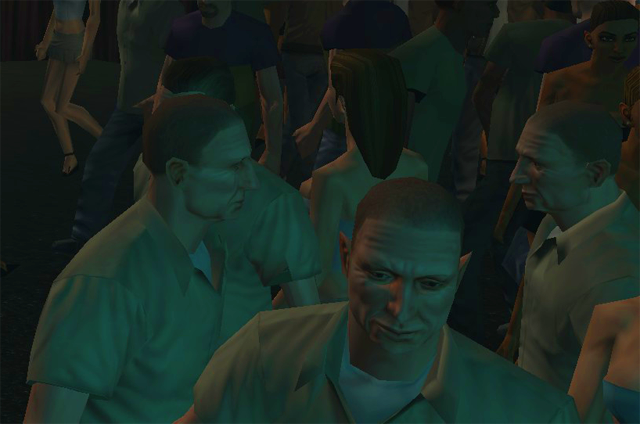
But we also see the same character models. We see the same people, repeating infinitely, filling up the screen.

A final example: a large street party in New Orleans. The streets are filled with copies, mostly only differentiated by skin color or a hat or a glowstick necklace. It saves system resources, surely, and makes technical sense. But it is more than that? Is it a meditation of replaceability, on immortality, and of the collapse of the Many-Possible into the One-That-Is?

~*~*~

1. He is also white and male, which means that the “perfect human” is really just a combination of those qualities. I recognize everything wrong with this; that discussion just doesn’t fit into the scope of this blog post.

Groys, Boris. “Ernst Jünger’s Technologies of Immortality.” Introduction to Antiphilosophy.
Posted in Video Games | Tagged , , , , , | Comments Off on Boris Groys, Ernst Jünger, Agent 47: Identity and the Hitman Franchise

Half Life 2’s Cut Content

I’ve been phoning the content in for a couple days, and I apologize for that–yesterday I was hiking and today I spent most of my time watching The Dark Knight Rises (expect opinions on this tomorrow).

Anyway, this is a short bit linking you to this excellent piece by Joe Martin over at RPS about the cut content of Half Life 2. To be honest, I have never liked the game itself–it is boring to me–but I really respect the vision and design that obviously goes into every little bit of the game. Martin’s article explores a mod of HL 2 called “Missing Information” that restores quite a bit of cut content from the game. This includes environments, guns, enemy types, and mechanics that were left out of the final game because they didn’t fit the narrative or ultimate design style of the game. At the end of the article, Martin writes:

 [Missing Information is] more like a graveyard full of ideas there’s no point pining over. All that time I spent pondering what the game might have been like has been a waste, because the value isn’t in the ideas themselves – it’s the refinement of them.

Guiltily, I thumb open my copy of Raising The Bar and take a fresh look at what lays inside. A quote from Gabe Newell’s foreword immediately pops out: “It doesn’t matter what we cut, so long as we cut it and it gives us the time to focus on other things, because any of the options will be bad unless they’re finished, and any of them will be good if they are finished.”

And this makes me think about Kristeva’s notion of abjection (also I had several long conversations yesterday about it, so that might be involved.) I’ve touched on this before, but at the root I think there is something interesting about what is included in a game and what has to be sacrificed, kept out; Kristeva writes that abjection makes life liveable, and so I imagine that abjection makes games playable. The multitude of cut content in HL2 had to be created and then eliminated from memory–as much as possible–in order for the “true” game of HL2 to exist.

I think there is something to that.

Posted in Video Games | Tagged , , , | Comments Off on Half Life 2’s Cut Content

Pat Holleman Writes on Authorial Intent

I don’t have a whole lot to write today–I had some big hang-outs with a friend that started at 9am, which hasn’t left me a whole lot of time to do internetting and the kind of hard-hitting journalism/complaining that you all know and love.

Luckily, Pat Holleman has a post over at The Game Design Forum that I can direct you to. The post is about authorial intent and what kind of role it should play in games studies. If you remember, or are in the know, Holleman is responsible for the “reverse designing” of Final Fantasy 6 and Chrono Triggerwhich means that he spent a whole of time working through those games and figuring out what makes them work on a technical and narrative level.

Side note: I think that kind of work is incredibly valuable.

In any case, Holleman’s post addresses some concerns that have recently popped up about games and authorial intent. These criticisms are the generic “BUT THE AUTHOR IS DEADDDDDD!” criticisms, which claim we should ignore the intent and history that surrounds a work and instead focus on how we interact with it. Blergh.

Anyway, Holleman writes this:

Firstly, most games don’t have an author; they have a team. That team is held together by design documents, meetings, master plans, producers, publisher demands, and many other factors. There are many industry-wide practices used to ensure that the intent of the designers is carried out everywhere in the finished product. And, of course, there is playtesting. As far as I know, no book, movie, or piece of music has ever endured the kind of scrutiny and revision that comes from hundreds of hours of metrically-driven playtesting, watched by dozens of people, analyzed by all kinds of computing and math. It’s likely, therefore, that the intent which binds a team together might tell us something meaningful and enduring about certain games.

This does not mean that authorial intent is king, and that other interpretive strategies are wrong. Rather, I think it points to a legitimate tack in the subfield of game design writing: the study of intentional design vs. emergent gameplay. If you look at the math that supports the gameplay of a title, certain intentions become very clear. For example, when we looked at the stat system of Final Fantasy 6, we saw that the way the magic power stat and the damage forumula for spells were disproportionately more powerful than anything else in the game. Magic is the only damaging ability that’s basically the same for every character. (The “Fight” command, although shared by all, is drastically different from character to character because of the weapons they equip.) It stood to reason, then, that this was an intentional way of making all the characters mostly equal, so that there were not two or three characters who were grossly more powerful than the rest. It didn’t work perfectly, but it did work adequately, and the math bears it out.

He continues from there. Holleman is doing some really interesting stuff, and it is games criticism that I think is really valuable–it is a material, literary, and theoretical analysis of game objects. More than that, Holleman isn’t locking us into a particular ideological stance on reading and the way games work.

Anyway, go read it, I am tired.

Posted in Video Games | Tagged , , , , | 1 Comment

On Goblin Camp

I. Goblin Camp

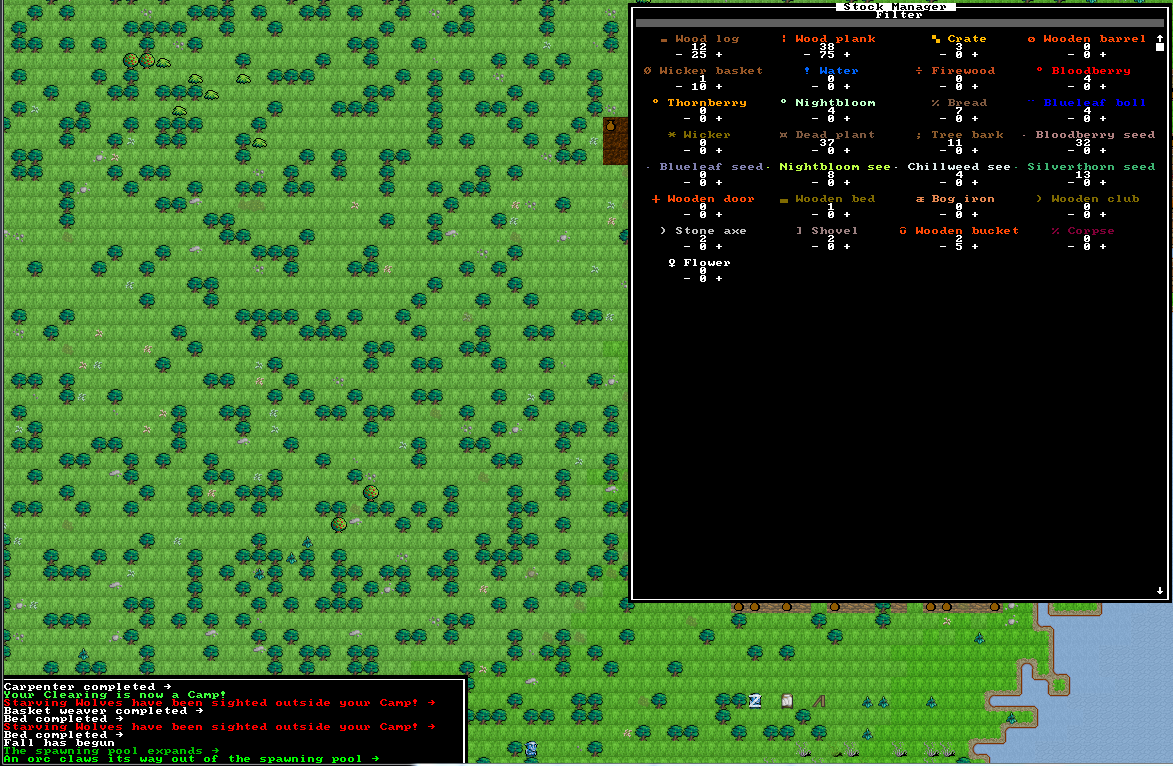
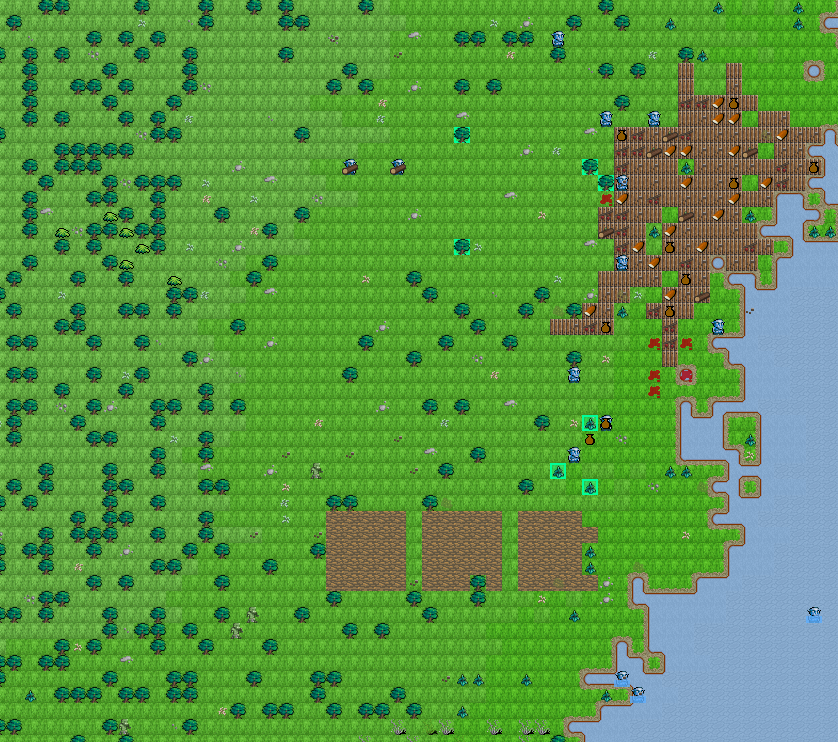
Goblins like to camp. It is in their very goblin blood–a desire to construct small buildings, plant seeds, harvest plants, weave baskets, and generally create a civilization based on raising children by putting all of the poop and corpses you can find in one place.

Or that might just be the way that Goblin Camp thinks goblins work. To be fair, it seems to be accurate. Goblin Camp is a Dwarf Fortress-like game that is built on having a usable, clear UI that allows you to manage lots and lots of small guys who do a number of menial tasks for your visual pleasure.

In the spirit of total disclosure: I have never been able to play Dwarf Fortress for more than two minutes, max. The sheer number of tasks that are possible, combined with a lack of usability, makes my mind shut down almost immediately. Goblin Camp shortcuts through all of that. It is easy to get started, and more importantly, it feels rewarding to play it. The first time that my goblins started running around and doing shit on their own I felt like a king. These tiny characters were doing what I wanted them to do. I had some control.

I crave control in games. I want to be able to tell every little creature what they are supposed to be doing at any given time. If a game is the interaction of a player with a system of rules, then I want to be the player who interacts the most and the best. Or that is what I think before I begin playing–most of the time I get overwhelmed. As much as I want to be that guy, I have never been able to pull off being a hardcore min/maxer or manager of minutiae. 

If we’re getting down to the most honest level of honesty, I am most comfortable with a Dungeon Keeper level of management. I like to tell the people I am ruling over what to do, and I like them to accomplish those tasks quickly but at their own pace. Goblin Camp fills that desire–it turns me into a kind of global suggestion wizard. I’m just some person who flies around and says “Hey, you, it might be nice if you started making better food for yourself! Also, go put your poop over there!”

II. The Spawning Pit

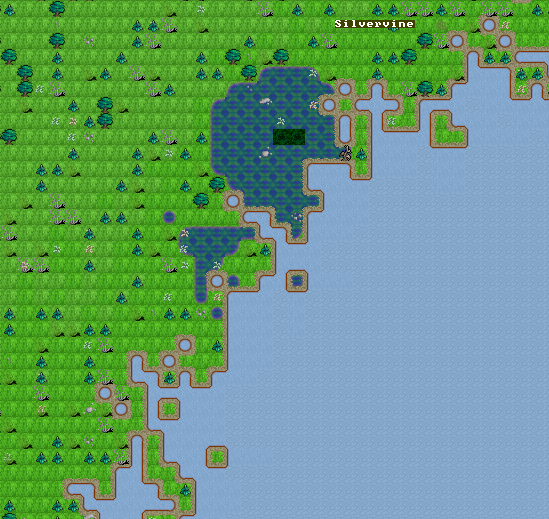
It is the poop and corpses that make Goblin Camp something more than a clone of world management games. The reason is the spawning pit. It begins as a small, one-square, green pit. As the game goes on, your denizens poop, kill, and died–the spawning pit is where all of that goes. Armed with buckets, the goblins diligently take all of the wasteful productions of their society across an expanse of land and then dump it into a green hole. 

Then goblins and orcs start coming out of it. You see, the only way to expand your goblin civilization is to dump things into the spawning pit. It is a beautiful illustration of both Kristeva’s abjection and the way that contemporary capitalism functions, particularly in the way that the spawning pit continues to grow. No matter how far away from your camp that you place it, it will eventually come to encroach on your goblins’ territory. It will take over everything, ruin buildings, make a wasteland of fertile fields. It grows and grows, but you can’t get rid of it. You need it.

You need to make the goblin camp.

Download Goblin Camp here.

Posted in Video Games | Tagged , , , , | Comments Off on On Goblin Camp

On Prometheus

So I have been puzzling over a Prometheus post for a few weeks now–in fact, I’ve been thinking about it since I made this post where I tried to answer some of the answerable questions of the film. However, what finally spurred me into articulating my actual position on the film was Ben Abraham sharing, and responding to, a post titled “Calvinball Mythology and the Void of Meaning” (he followed up on it with this post.) Both of the posts are super-smart and you should really go read them before you read this one. They both contain some really great arguments for interpreting the current fascinations of blockbuster films.

First of all, and this is just a small disagreement that doesn’t have anything to do with the rest of the post, I don’t think that there has actually been a proliferation of mythologies in the latter part of the 20th century media. We have seen certain series attempt this–it is important to note that two of McCalmont’s examples are written by the same writer–but it isn’t a broader trend. In fact, I would say that the average media experience is indifferent to mythology altogether–for every Prometheus there are hundreds of films and tv shows that are just about the banal existence of regular folks, or rom coms, or Judd Apatow comedies, or Tom Cruise vehicles. So yeah, if we cherry pick our examples, there is a mythologization that has occurred recently: Harry Potter, movies about hobbits, and games of hunger held at the cusp of dusk. But more than that, McCalmont blows any definition out of the water when he equates mythology with “narrative expansiveness.” The scenario he is describing, in which there is a unifying mystery to a long work split into volumes, is a cornerstone of fiction and the modern novel. The Sherlock Holmes series functions in this way, as well as Don Quixote, comic books, pulp novels, and even Shakespeare. What I am saying is that it isn’t so much a desire for mythology as a desire for a continuation of the things we love–it is a desire to have a comforting narrative, which isn’t the sole property of mythology. In fiction, we have characters we can invest in; I love Ripley because she is capable and independent in Alien, but I need her to succeed in Alien 3  precisely because she is Ripley.

So, Prometheus.

1. There Is Nothing For You Here

Prometheus is a film that presents a lot of questions and gives you absolutely fuck-all for answers. As McCalmont notes, Prometheus answers exactly one question: the Space Jockey from Alien is a giant white dude. It is important to note that the question being answered is not one posed in the movie you are watching–it is a question posed by a thirty year old film that is only vaguely related to the one you are watching. This is a signal, I think, to the rest of the film and the questions that it raises: there are no answers for the viewer here. Sometimes you don’t get answers for a long time. Sometimes they don’t come at all. All inquiries are deferred to a nonexistent other time; please take your coat when you leave.

McCalmont calls deferral of answering “Calvinball mythology,” citing Calvin and Hobbes‘ game where the rules are made up as you go along but everyone pretends that the game is highly structured. It is a useful analogy, but it is one that assumes that the writing of Prometheus is not purposefully structured in such a way to prefer large gaps of understanding. In a true act of laziness, I am going to let Ben Abraham do my analysis for me. McCalmont’s writes

Though ostensibly a mystery, the plot of Prometheus is really nothing more than a series of doors slammed in characters’ faces by a cruelly indifferent universe. The film begins with a group of humans voyaging to the stars in search of Big Answers to Big Questions. However, once the humans arrive at their destination, every attempt to uncover answers results either in death or the discovery of yet more questions. As death follows puzzle and puzzle follows death, a clear theme begins to emerge: The universe is utterly indifferent to humanity and has no interest at all in answering its questions. Though laughable on a dramatic level, the decision to have the alien attack the humans on sight actually makes a good deal of thematic sense: if the universe is unwilling to answer our questions, why should our gods be any different?

In response to another bit of the text, though it applies here as well, Ben Abraham writes that “obscurantism is not anti-metanarrative, in fact it’s just a reinforcement of the meta-narrative of an “indifferent” universe.” This is straight-up true, and this leaves us in a deadlock.

The McCalmont-Abraham problem puts us here: the film attempts to dispel a metanarrative of meaning. In doing so, it supplements that with a metanarrative of the void.

My reading of the film hinges less on the metaphysical, however. Instead, via Edouard Glissant’s notion of opacity, I want to view the film as a meditation on communication rather than a damning of metaphysical answers.

2. The Opacity of the Creator

Glissant deploys the concept of opacity when discussing the perceived other. He contrasts it with “transparency,” its functional opposite. When a being is opaque to me, I have no filial relation to her, I don’t see anything other than a pure difference that can’t be traversed. In contrast, transparency is the idea that I am able to “see through” the other figure, meaning that there is no perceived difference between myself and him, creating a totality of assimilation–we understand one another, we perceive no fundamental differences, and so forth.

Lorna Burns explains in her “Becoming-postcolonial, Becoming-Carribean”:

…by introducing the concept of opacity, Glissant emphasises that what is acknowledged by the perceiving self is only the opacity of the other person (the otherness of the other-person) produced in that particular instance of relation. Opacity is always only ever opaque to me, its singularity is relational. But, importantly, its singularity is also irreducible, always exceeding my attempts at understanding: ‘I thus am able to conceive of the opacity of the other for me, without reproach for my opacity for him. To feel solidarity with him or to build with him or to like what he does, it is not necessary for me to grasp him’. This term, then, fulfils the criteria of the absolute other necessary for creolization, but attributes to the other person a status beyond Relation. For to acknowledge the other as opaque is to realise the existence of an unknowable otherness without assimilating all differences. The singularity of the other, then, refers to the potential latent in the relation between self and other to produce a singular, equally opaque, and creolized reality.

This is precisely what I see at work in the relationship between the humans of Prometheus and the Engineers, and I think there is a triangle of opaque relationships between the Engineers, the humans, and David. All of them understand one another as positioned others–David is “merely” a creation, the humans are “merely” beings to be killed at a whim, and the surviving Engineer is reduced to a “mere” psychopath.

I think it is important, and ultimately brilliant, that the film dwells on this opacity instead of making everything transparent. The key moment of this is when David speaks to the Engineer and has his head promptly ripped off and used as a bludgeon. In the act of attempting to render the Engineers sensible to the audience, of giving a key that could begin to unlock their opacity and render them transparent to the audience, we are violently told no.

So it is at that moment that I think Prometheus is being smart. For me, it solidifies that there are not plot holes, but purposeful aporias. It is not a stagger in filmmaking, but a resolute statement that there are certain things that are unknowable. Unlike McCalmont, I don’t see this as shutting the door in the collective face of the viewer. Instead, it is a radical reassertion of the way that relations are between beings living and nonliving alike–you cannot know the other, and you shouldn’t attempt to reduce them.

Like Glissant, I think this is important because I think it presents us with ways of thinking about irreducible others. Scu has spoken, though not written often, about the opaqueness of animal life.

The takeaway: Prometheus, for me, becomes a thought experiment about ethical relationships and how they happen between equally opaque beings. Do the Engineers understand humans? If they do, it is probably to the same degree that the humans understand David. What does it tell us about our own relationships with other beings?


Posted in General Features | Tagged , , , , | Comments Off on On Prometheus

On Diegetic HUDs

Brendan Keogh has an interesting bit about diegetic HUDs over at Games on Net, and that got me thinking about the purpose of HUDs and the kind of presence-of-the-player that they assert in the diegetic space of the game.

As Brendan so helpfully defines for us, the diegetic HUD is

when the heads-up display (your health, ammo, and all that information) that sits there flat against the screen in most videogames is incorporated into the game’s fictional world. When done well, it draws the player deeper into the game by dismantling that conceptual wall of the interface that is always there between the player and the game’s world.

The argument that Brendan develops over the course of the article is that diegetic HUDS help to dissolve the perceptive space between the player of the game and the first-person viewpoint that the player is often inhabiting. Keogh uses Deus Ex: Human Revolution to demonstrate a number of different elements of the diegetic HUD; waypoints, health, and reactions to the world by the character are transferred to the player through a collapse of points of view. The player sees what the character sees, not merely in content, but in how that content expresses itself as usable data to Jensen, the player character.

Keogh continues:

But in a game like The Getaway on Playstation 2, [eliminating the HUD] does more harm that good. The Getaway was obsessed with realism. To a fault. Instead of a HUD, the game insisted that all information would be presented to the player in the world itself. This worked in some cases (such as the character leaning over and looking like they are in pain when they are severely hurt) but just made things confusing in others. When driving across London, instead of a radar pointing to your destination, your car’s indicators would turn on, telling you which roads to turn down. This worked horribly, and you could spend forever doing laps around an obscure lane way you were meant to turn down. In this case, the problem would’ve been solved simply by having a HUD.

I drift from Brendan here. I think that the elimination of the HUD and the useful information that it brings is actually something valuable in video games. There is a value to struggle, to constantly having to fight to achieve a goal, and I think that games are the place for that to happen (instead of some libertarian wet dream free market). The design for struggle is what made Dark Souls and Super Meat Boy so popular.

And so I wonder if the lack of a HUD might be a good thing. It creates the character as a weaker being, one with less information at its disposal than is needed to be successful. It creates an existential crisis in the player–I am no longer collapsed with the superbeing, but instead I am radically outside of them, aware of my own insignificance. In those moments, the player’s success becomes a realization that obstacles can be overcome from extreme odds, which contrasts the standard narrative of a superbeing overcoming middling-to-difficult obstacles.

The good ground is probably in the middle. The radical interruptions to the superbeing Jensen’s machinic body with EMP grenades, which Keogh points out are some of his favorite parts of the game, cut close to making the player realize that she isn’t invincible or super. But, like always, I am suspicious of always winning in games–always being better than you are. It encourages weird behavior, like communally celebrating fictional genocide.

And that is weird, right?

Posted in Video Games | Tagged , , , , | Comments Off on On Diegetic HUDs

Hypatia Symposium: Feminists Encountering Animals

As frequent readers of this blog probably know, I come out of a strong feminist background. I was incredibly lucky to work with a number of really brilliant feminist scholars when I was in undergrad, and basically anything smart about feminism or women’s studies comes from those people. Additionally, the “question of the animal” (as the academic phrasing goes) is something that I dwell on a lot. Ethical relationships between beings basically takes up 35% of all of my brain power at any given time (and has caused me to have some pretty spectacular disagreements from time to time.)

In any case, the newest issue of Hypatia is a special issue titled “Animal Others.” The entire thing is unlocked for free right now, so you should go peruse and read it before it gets put behind a paywall again. As I have mentioned before, James Stanescu has a paper in the issue titled “Species Trouble: Judith Butler, Mourning, and the Precarious Lives of Animals” which puts forth some really smart ideas about mournable life in the context of animals. Also as I have said before, Stanescu has been really important to my own development as a person who thinks about animals, and it would do you well to check his stuff out.

Alongside this current issue, editors Lori Gruen and Kari Weil have organized a symposium  around the intersections of feminism and animal studies, bringing in several feminist and animal studies scholars and asking them various questions about the combination of the two fields. As they state in their introduction to the symposium, the participants were asked these questions:

  • Is animal studies gendered, and if so, to what effect?
  • Is so-called animal “theory” at odds with affective and/or feminist political engagement? Do you see a gap between the personal and the political (or theoretical) in animal studies and, if so, how is it manifesting?
  • Have the insights of feminists/ecofeminists been overlooked/unacknowledged in animal studies, and if so, what is lost and what should be done to acknowledge and reclaim their insights?

The responses to these questions are all astounding, and each deserves a close reading (though I am definitely in disagreement with Traci Warkentin’s arguments about the possibility of ethics towards nonhuman animals being decoupled from a food politics that makes an effort not to eat animals.) Here is the link the the pdf file of the symposium for your perusal. I think everything going on there is smart and well-argued, and I especially look forward to the conversation that this issue and symposium should jumpstart in the feminist academic community.

Below I have included some quotations that demonstrate the kind of thinking going on in the symposium. Obviously, it isn’t all-inclusive, but there are lots of fantastic provocations going on that I think should be given their due. Also, I don’t necessarily think that the following quotations are “true” so much as that I believe they offer some really interesting points for conversation and interest to spring from.

When one eats a hamburger, one wills the death of the cow whose flesh made the burger possible. When an individual opts for a vegetarian burger, he or she recognizes that death is an undesirable means to the end of his or her culinary pleasure. Simply stated, the vegan refuses to perceive the cow as killable.- Stephanie Jenkins, “Returning the Ethical and Political to Animal Studies”

and

In one especially striking exchange over my use of Lyotard’s concept of the differend to discuss the animal as paradigmatic of the “victim” (the one who does not have the ability to register its injuries in the language of those in control), [Gubar] asked me point blank if I was suggesting that animals were “more” victimized than women. Instead of seeing the interlocking structures of oppression that writers like Carol Adams, Marjorie Spiegel, and others had already pointed out at that time—and the productive theoretical analogies that might proliferate—Gubar experienced my discussion of animals as a threat: a threat, I can only surmise, to the political position she felt her own work had staked out for women, for a particular set of feminist claims, and perhaps for a semi-institutionalized prerogative that was roughly correlated to the suffering or affliction of women. – Carrie Rohman ,”Disciplinary Becomings: Horizons of Knowledge in Animal Studies” 

Posted in General Features | Tagged , , , , | 1 Comment

Team Fortress 2: 100 Hours Strong

I have played Team Fortress 2 for 100 hours.

That isn’t a lot, I know. I spent 81 hours, or something close to that, in Skyrim during the first week after release. I have probably pumped a collective 500-1000 hours into the Call of Duty franchise over the past few years. I can’t begin to tell you how long I spent, at the tender age of thirteen, min-maxing characters in the various Final Fantasy games of my youth.

But 100 hours in Team Fortress 2 feels like an accomplishment for some reason. It might be the conquering that it required–I can pick up any modern console shooter and immediately do well. I’m not always have been the best player on my team in a pick-up game of Modern Warfare 3, but I was certainly never the worst, and I like to think that my play style is both smart and adaptable. What I’m saying is that I have a skill set in console shooters that makes me very comfortable when playing. It wasn’t that way when I began Team Fortress 2. It was a struggle. I died a lot. I hit hour fifty or so before I started trying to play as a Spy or as an Engineer–the difficulty spikes around those classes, and it was far from my expertise in dude shooting that Call of Duty had cultivated.

So what made that hundred hours feel like an accomplishment?

Cooperation. Playing 100 hours of Team Fortress 2 means that, in order to win, I have had to quell my urges to be a giant shithead in games. I have had to pay attention to the movements of other players. I have had to listen. I have had to speak, not to trash talk, but to suggest routes of movement and strategies of attack. The exclusively goal-based gameplay of Team Fortress 2 has made me a better participant in the world of games.

For the record, I like the game, even if I don’t like the (not very) recent addition of microtransactions to get weapons more quickly that you would through crafting.

Anyway, I salute you, Team Fortress 2. Your designers design well; your players play well. You are a good game.

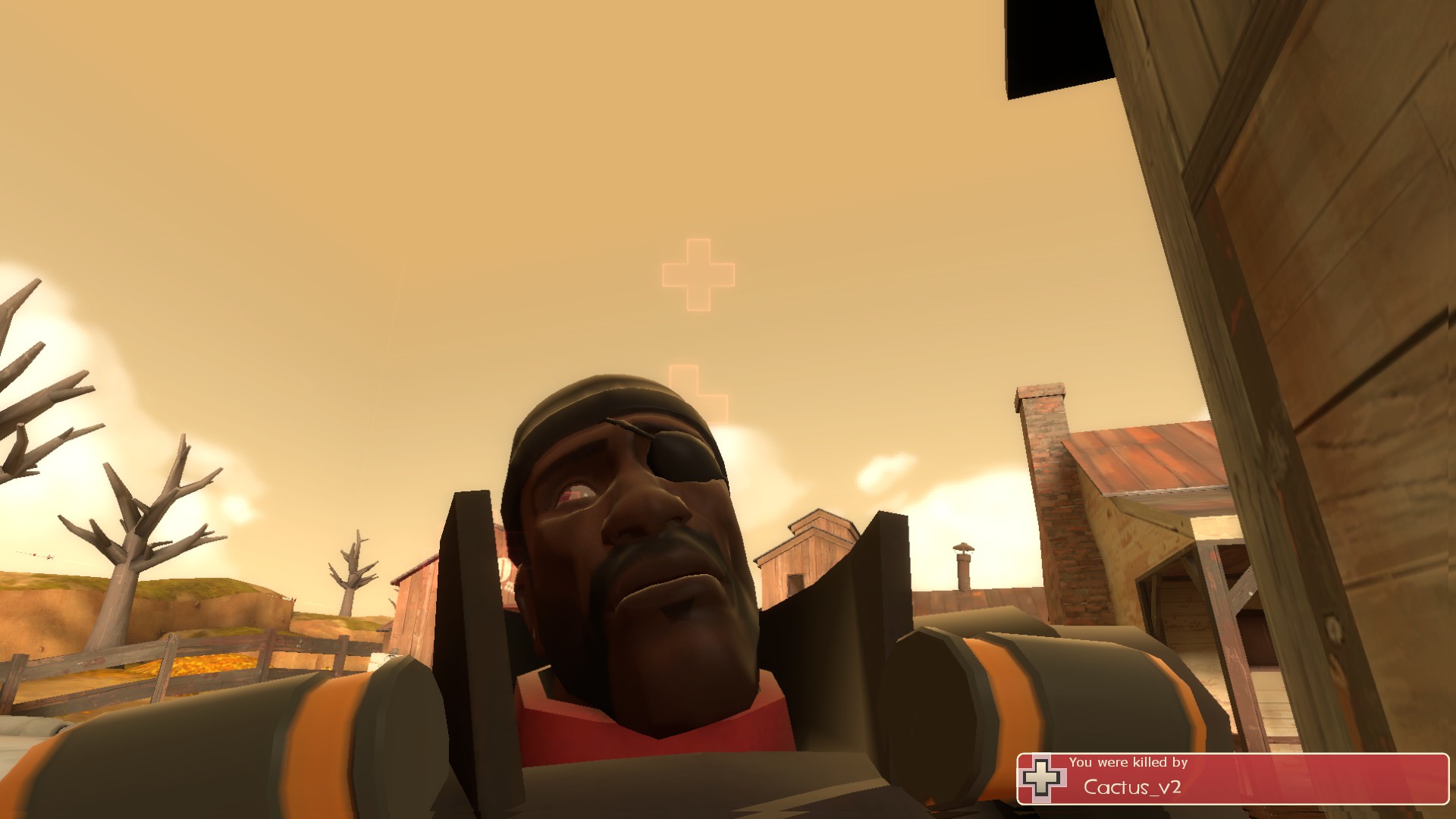
Side note: I have apparently only ever taken one screenshot in my entire 100 hours of Team Fortress 2. Here it is, in all its strange glory.

Posted in Video Games | Tagged , , | 1 Comment

On Dead Space

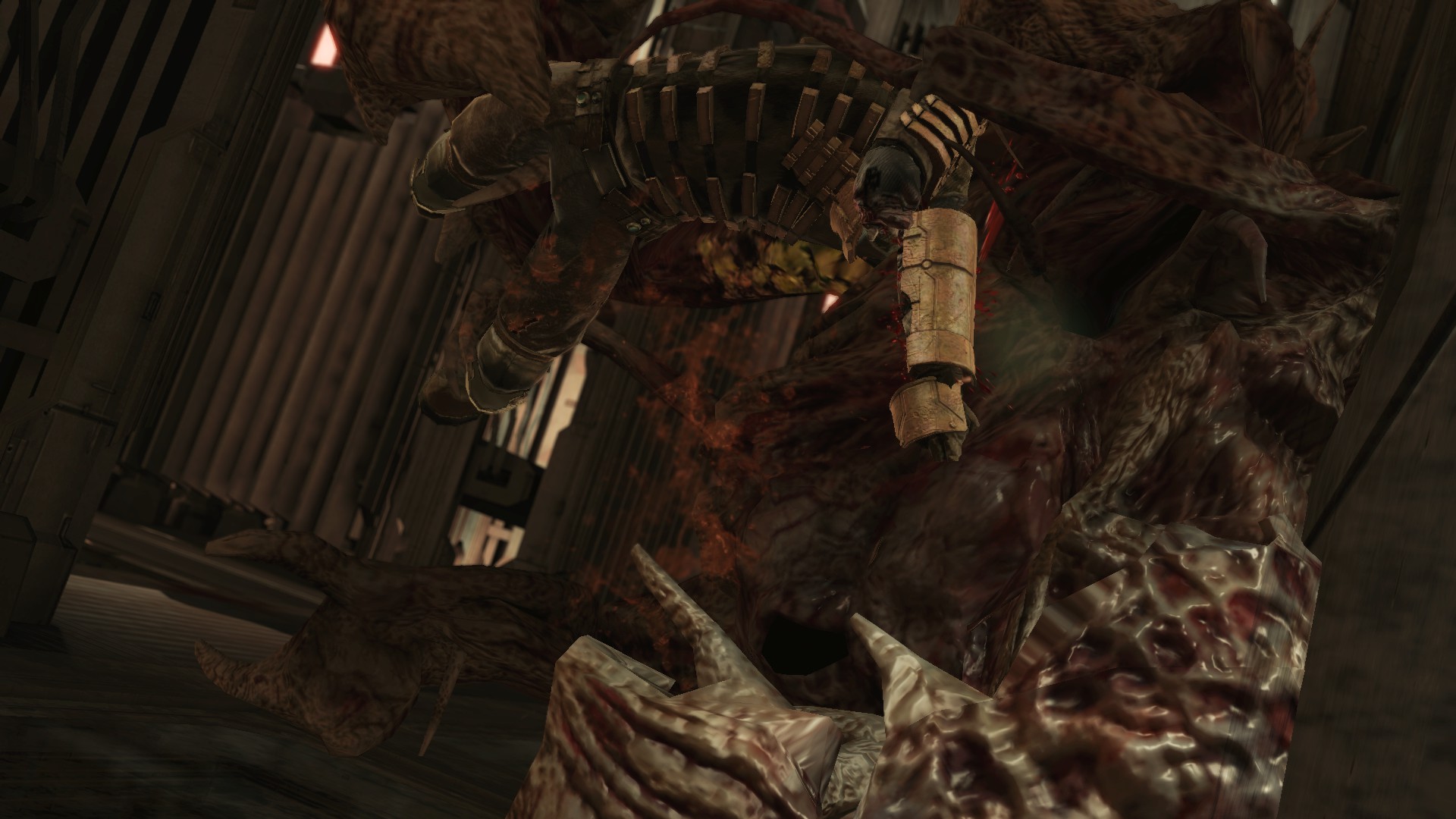
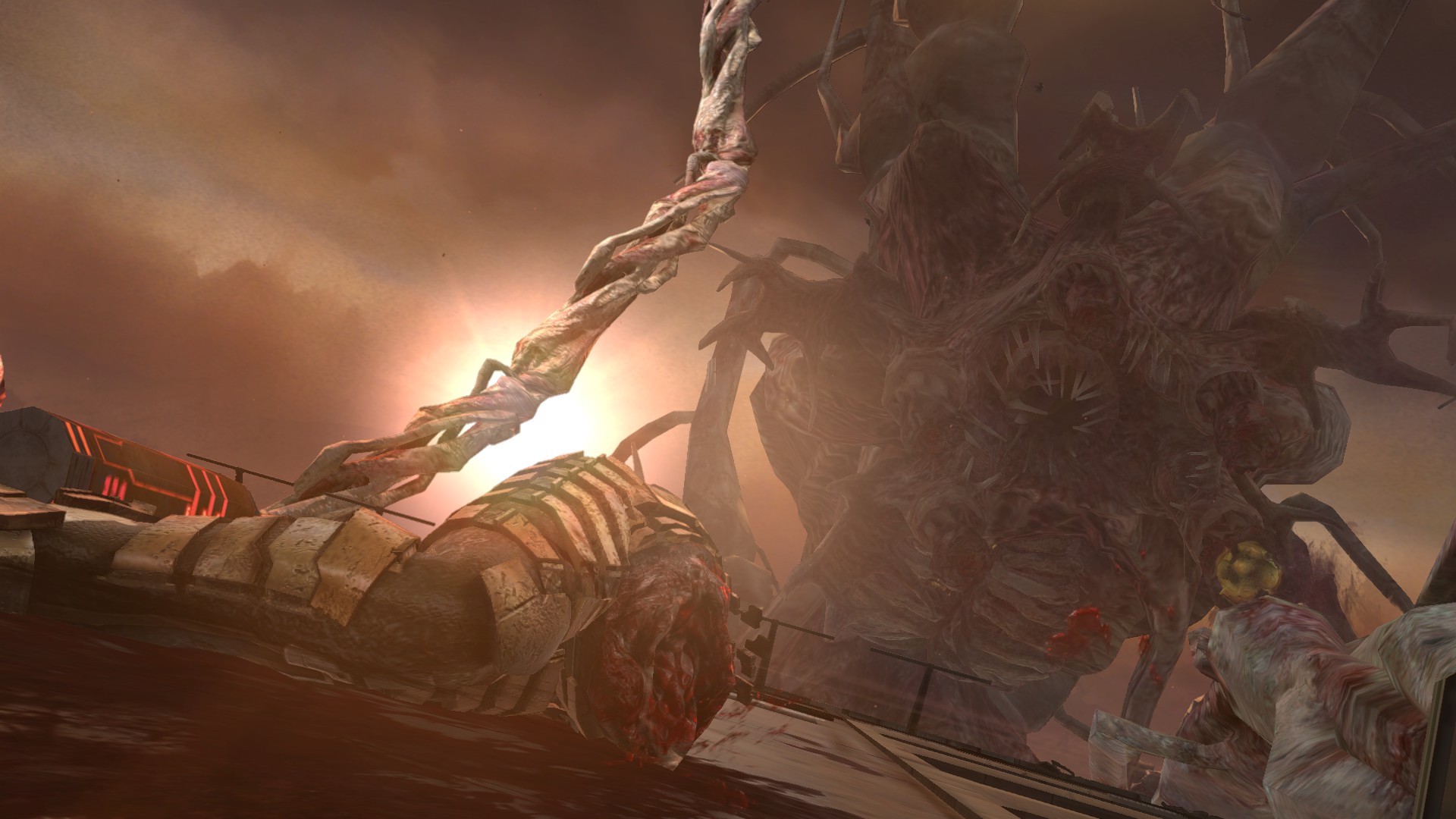
Isaac was screaming. He was screaming as his arms were ripped off. He was screaming as the spines of otherbeing went through his torso. He was screaming when he was sliced cleanly in two, his upper body falling to the ground in front of his still-attempting-to-walk-body. He was screaming when the small things burrowed into his face and neck. He was screaming when a tentacle, so long that it couldn’t be measured in the panic, grabbed around his leg and pulled him, piece by piece, into a burrow. He was screaming when he was electrocuted. He was screaming when he fell. He was screaming when a fan blade sliced through his body. He was screaming when he was crushed. He was screaming as a former friend betrayed him.

Isaac was always screaming.

Dead Space is monstrous. It isn’t easily defined; it shifts. Sometimes it is an action game, sometimes a puzzler; sometimes it shifts into an uncanny survival horror. Sometimes it isn’t even a game, but an art piece. This monstrosity, intended or not, makes it strange to play. As I remarked on twitter last week, I don’t enjoy the act of playing the game. I don’t like to do fetch quests, move big bricks, or shoot the limbs off of monsters.

My lack of enjoyment comes from the tension that informs every part of the game. The creatures in the game, seemingly existing only to kill Isaac in the worst possible ways, are quick. I move like a tank. I can never turn quickly enough or move out of the way of projectiles. As I progressed through the game, Isaac actually began to resemble a tank, covered in armor, hiding his fleshy humanity away underneath ribbing and bolts and a welders mask from hell. The tensions proliferate further: Isaac is a space engineer who can only seem to plug power sources into sockets or flip switches. He constantly performs rational quests with objective right and wrong approaches that are given to him by a delusion.

But, honestly, those tensions are gone when I think about my experience of playing the game. The otherbeing, the alien, permeating the ship; creating a new environment in which to live. The ultimate adaptable being, putting the xenomorph to shame, assimilating all matter in its path. The aesthetic of biological machinery, of production outside of a human frame, production that occurs in the absence or possibility of a human interpreter–it draws dread.

There is also Isaac’s screaming, of course. Inside his metal helmet, barbs and blades pinging off of his medieval suit, Isaac is infinitely distant from me. Inside a virtual world, one that I can only touch with sometimes-responsive controls, he is never really accessed by me. I can’t “know” Isaac. But there is another layer, beyond the screen and keyboard. The infinite gap between Isaac’s mouth and my ears. A whisper. A sadness. Sometimes it picks up wind and volume and rage, bellowing out, but it is never louder than the biological screeching of an alien maw. Isaac, as loud as he can be, is drowned out by the world.

Isaac is a silent hero even when speaking.

Posted in Video Games | Tagged , , , , | Comments Off on On Dead Space

On Doin’ The Right Thing

For a while I was going through comic shop $1 bins and buying up anything that looked weird. I don’t really know why I was doing that–it seemed like a good idea. With comics like Adventure floating around in the world, how could I not? So now I have a longbox of comics that are weird and never-read. Last week, I began going through the box and pulling out all of the things that made my head spin in fun ways.

One of the comics is What The–?! #26. I, like most comics fans, am aware of the What If? series of comics. The general gist of What If? is that comics writers take a different path from the canon of Marvel comics and then play out what would have happened–What If Spider-Man Joined the Fantastic Four? is the first issue, for instance.

What The–?! lampoons the Marvel Universe. It takes the characters and the universe and turns it into something rife for parody. It isn’t hard to do–in fact, making fun of superhero comics is probably easier than writing them. It is also a cultural document, and issue 26 really speaks to this.

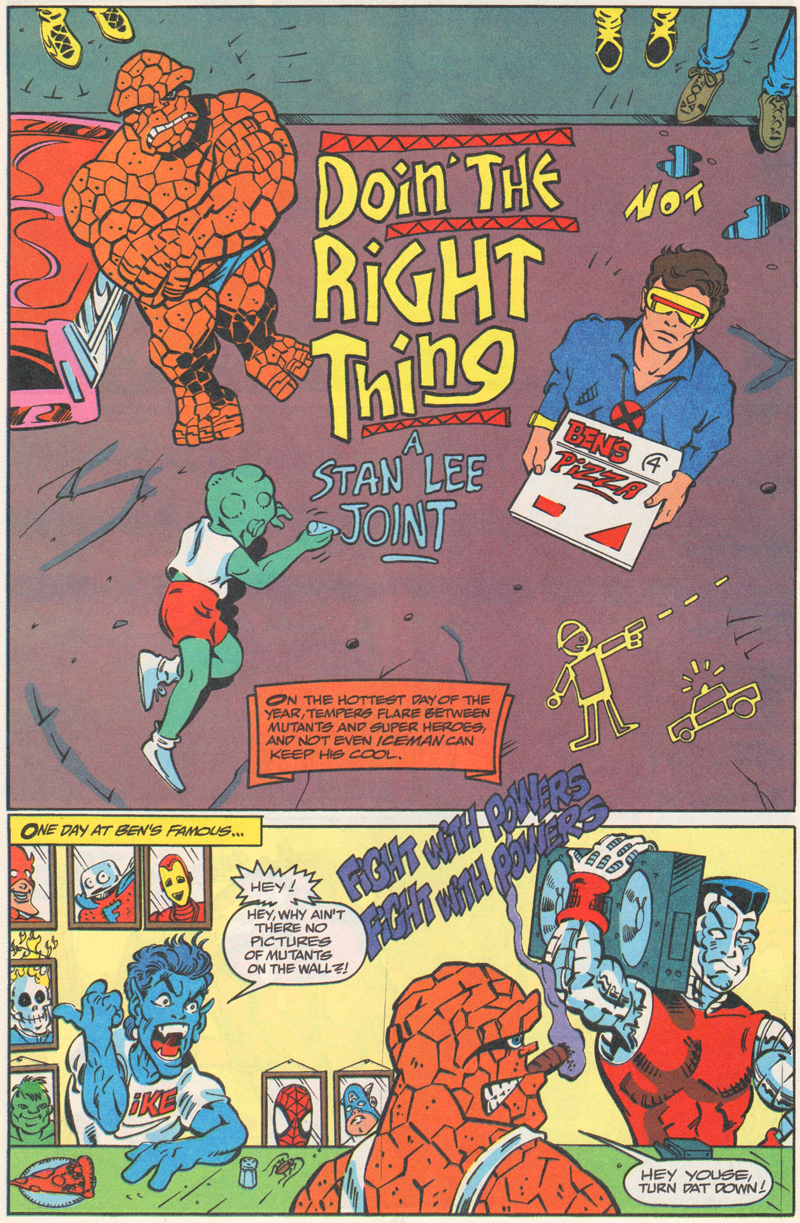
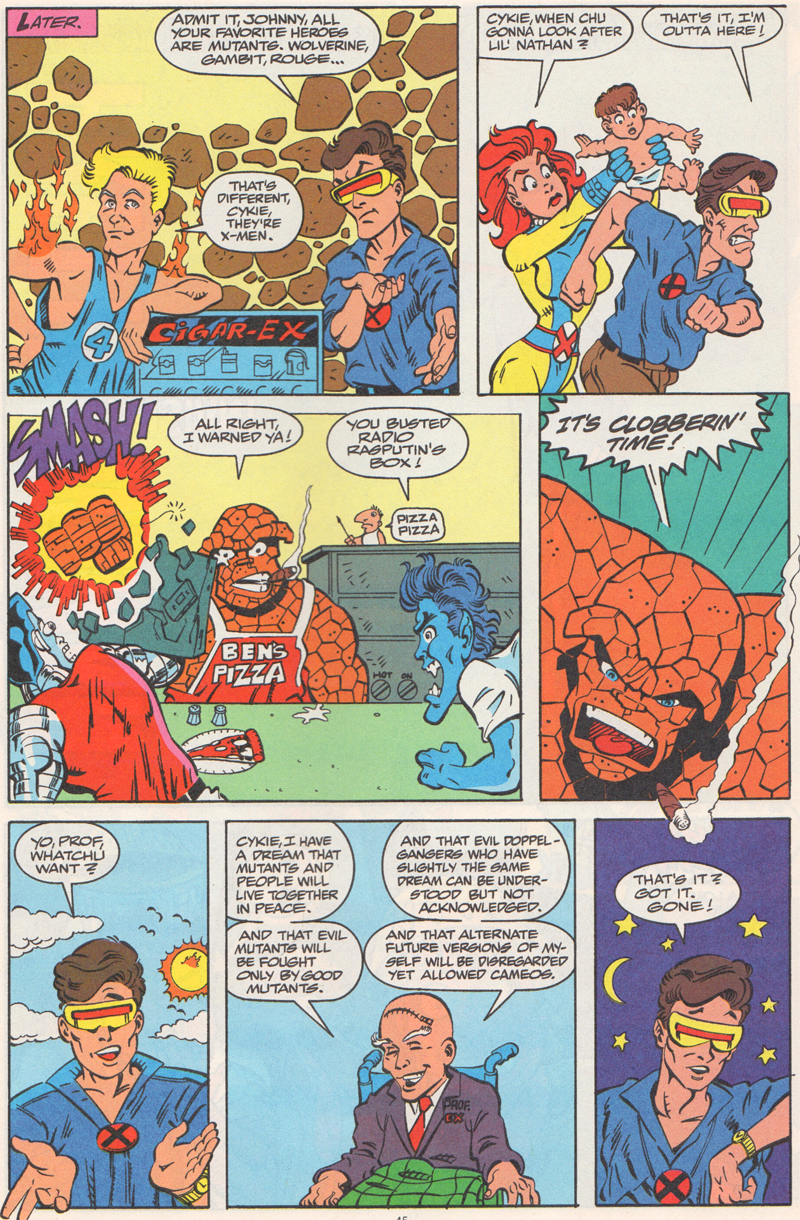
In a story called “What If the Fantastic Four Stayed in the Movie Biz?” Dan Slott and Manny Galan perform a comedic What If? scenario by imagining three movies that the Fantastic Four would have been in. The movies are all pitch-perfect: Home 4 Alone (where Galactus is in the Joe Pesci role), Pretty Invisible Woman, and Doin’ The Right Thing.

All of them are funny, but Doin’ The Right Thing is actually super smart. In the comic, The Thing takes the place of the Sal, the pizza place owner from the parodied film, Do The Right Thing. In Fantastic Four comics, The Thing often takes on the role of a minority character–he is the only “non-normal” member of the Fantastic Four and he can never “pass.” The comic pits him, inherently non-“normal” and equipped with a Jewish racial identity, against the youth culture of the comic–mutants.

In any case, it is funny, and I have included it below. Don’t tell anyone.

Posted in Comics | Tagged , , , , | Comments Off on On Doin’ The Right Thing