Dylan Trigg on Agoraphobia

Like Vincent, I too am a victim of agoraphobia. In our shared disdain for ugly architecture, vertiginous hills and strange bodily afflictions, Vincent and I are kindred spirits, separated by time but united by neurosis. As with Vincent, it has become customary for me to adhere to a series of rituals and superstitions in order get through the world. Faced with an empty lecture theatre or a sparsely populated conference hall, I will grip the contours of the room in order to get from one point to another. There, I will seek refuge in doorways or behind a column, if one is available. Fluorescent light, which Vincent may have been lucky enough to have avoided owing to its increased usage at the end of the 1920s, is my anathema. In the absence of dark glasses, it would not be unusual for me to feel as though my body were about to give way should I find myself in the midst of a brightly lit supermarket.

My episodes are endless. From the aisles of Ikea to the mountains of Montana, my psycho-geographical history is marked by phobia. Each event plots a gradual distancing from the world of unfamiliarity and a slow immersion in the supernatural. How did Vincent and I get this way, inhabiting a vampiric realm, which must seem an odd affectation to anyone who has not been touched by agoraphobia? In fact, far from a radical departure from the world of ‘normality’, agoraphobia seems to me an amplification of facets of life that are already implicit in experience more generally. One of these facets is the bodily basis of being a self.

– Dylan Trigg, “Confessions of an Agoraphobic Victim

Posted in Theory | Tagged , , | Comments Off on Dylan Trigg on Agoraphobia

Replicating Myself in Saints Row 3

2012-12-04_00005

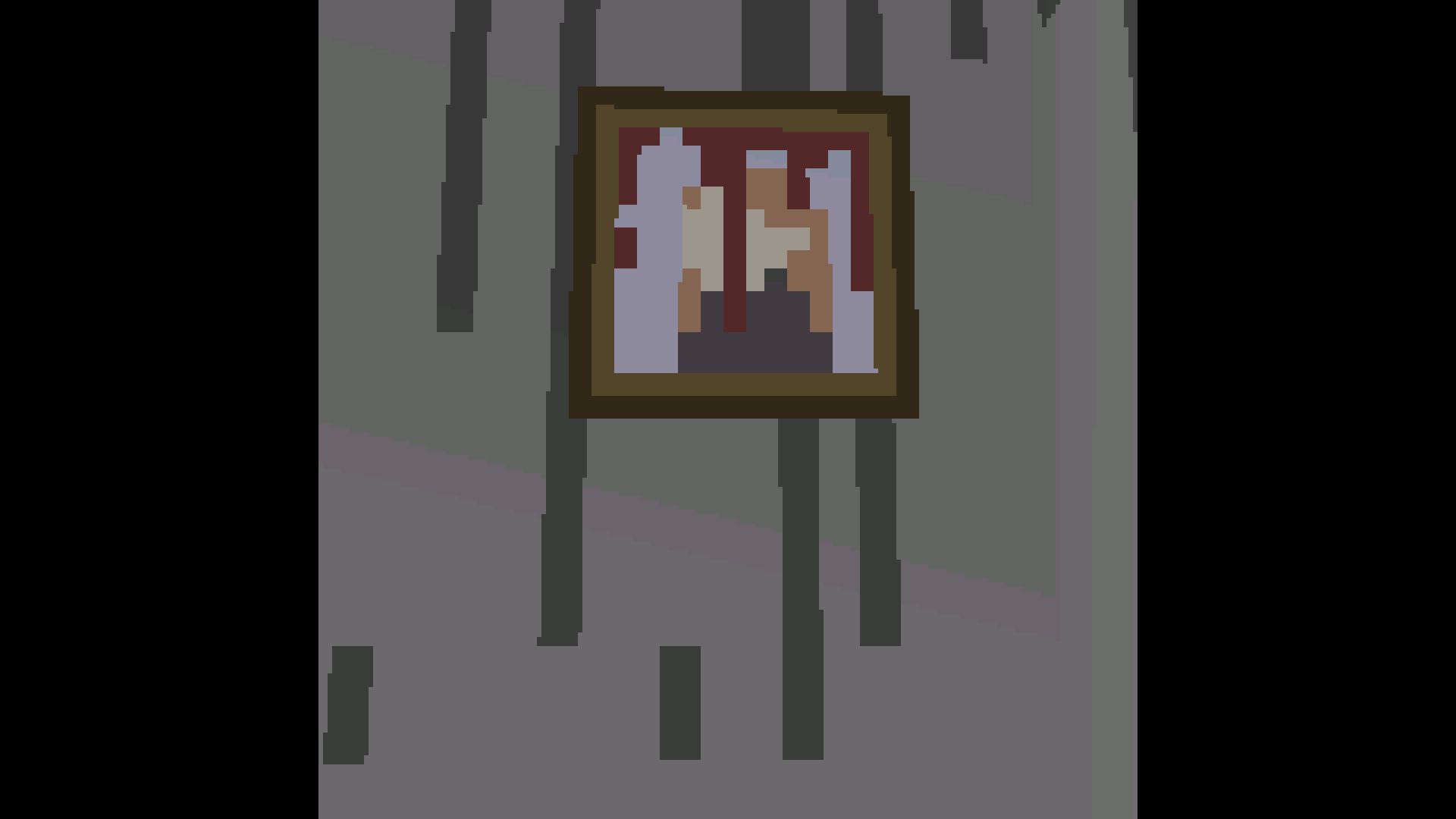
So this is my Boss in Saint’s Row 3.

I don’t have a big point to make here. I just came off of a five day writing binge, so this blog is going to suffer for a few days. Oh well.

However, I do want to say that I finished SR3 last night and it really set me to thinking. We like to talk about immersion in games, which is to say that we co-constitute ourselves and our avatars in the game at the same time. SR3 does a brilliant inversion on immersion by making it absolutely impossible. GTAIV is about a living world, and the wonderful play stories we have gotten about Nico Bellic attests to that. But SR3? I can make myself in the world, a very close copy, but I can’t recognize myself.

Saints Row 3 is a void wearing the mask of a mirror.


Posted in Video Games | Tagged , , | 1 Comment

Brendan Keogh and I in Conversation About Games Criticism

So over on Facebook, Brendan and I had a short conversation about games crit. The topic of “games in themselves” came up, which Brendan understands in this way:

 Well, I think the term “in themselves” implies an idea of looking at a game as a hermeneutically sealed-off, purified thing, completely detached from any human relationship to it (be it creator or consumer). I think that implies focusing on what shape this polygon is or how many pixels between the avatar and their goal and nothing but straight up description. I think this is entirely valid writing and super useful for those who want to understand how a game was constructed (namely, a developer readership), but I think it is less useful for an audience of players who are much more interested in understanding their reception of the game than the game as this sealed up mechanical object distinct from their engagement with it.

As we’ve spoken about before, I think being player-centric or game-centric are both lacking and I think the most important work (‘most important’ for a readership of players wanting to comprehend their reception of the game, not ‘most important’ in an ultimate sense) looks at the relationships between games and players to richly describe actual engagements and receptions. I think looking at anything ‘in itself’ potentially cuts off all the relationships with other actors/objects that make that thing itself in the first place.

So yeah. I guess when I hear “games in themselves” I think of film critics talking about nothing other than what kind of camera was used and what wattage the lightbulbs were, and I think of what Top Gear would be like if they spent entire segments talking about nothing but the motor, and not the motor in relation to the upholstery in relation to the brand in relation to a whole heap of other things that aren’t simply in ‘the game itself’.

That’s what I think of when people say games in themselves. I think of all this interesting and totally valid writing that isn’t really that useful for the readership and the goals that I am talking about.

But link me to a piece of writing you think is about games in themselves, and I will probably really like the piece and just disagree about it being about games in themselves.

To which I responded:

 Trying to be as brief as possible: games centered criticism rejects fetishizing the moment when the playing subject enters into a relationship with the game object and begins to think of the game as existing only for the subject’s pleasure. So it rides both lines: on one hand, it allows us to think through the player’s interaction with the game without romanticizing that relationship (rendering it divine); on the other hand, it does allow for an appreciation of the nonhuman, and ekphraistically impossible, elements of the game. There can be a beauty of code; the cascade of physics is, itself, a huge part of the game, and indeed probably means more for the hardware of the game than the player does.

Posted in General Features | Tagged , , | 1 Comment

Frobisher to Sixsmith

Time cannot permeate this sabbatical. We do not stay dead for long. Once my Luger lets me go, my birth, next time around, will be upon me in a heartbeat. Thirteen years from now we’ll meet again at Gresham, ten years later I’ll be back in this same room, holding this same gun, composing this same letter, my resolution as perfect as my many-headed sextet. Such elegant certainties comfort me at this quiet hour.

David Mitchell, Cloud Atlas

Posted in Quote Time | Tagged , , | Comments Off on Frobisher to Sixsmith

On Game Centered Criticism

So I woke up yesterday morning and did some work and then read Twitter. There were some tweets that Patricia Hernandez made about games and games criticism.

So I wrote some tweets and she responded to them and we had a conversation about it. Then I made a Storify out of the conversation so it wouldn’t be lost to time.

If you want to get the full content out of what is about to come spewing out of my internet mouth, you should read some things first.

1. Darius Kazemi‘s critique of Killing is Harmless and Brendan Keogh‘s response in the comments of that post.
2. This post I made a long time ago about New Games Journalism.
3. There was an article on Kotaku recently that was about how we think that games writing is broken, but it really isn’t. For some reason I can’t find the damn thing. You should read it if you find it. Oops someone found it.

I’m having you read those things because I don’t want to just repeat myself, although I will probably do that anyway.

The discussion tends to go this way:

Someone makes an argument for looking at the game object when a writer is doing games studies. It could be anyone who starts it: “Maybe we should look at the way that game structures an event” could be the innocuous phrase that starts the wheel to spinning. The response is generally similar to the one that Patricia gave in the conversation that we had: “Why do you want objectivity? Games are partially composed of players, so why can’t we talk about subjective experiences?”

There are two arguments that have to be made here, first and foremost:
1. I am not making claims that we need to be objective in games criticism.
2. There is not a zero sum game between writing about games-in-themselves and player-centric criticism.

However, I am not unsympathetic to Patricia’s arguments. After all, she writes very personal articles about the relationship that she has had throughout her life with video games–most recently, she wrote about how Fallout 2 is intimately tied with her development in relation to her family. Skimming through the comments, there is rarely any negativity, and if there is it is routinely answered by a positive comment. There is an appreciation in the current video games criticism atmosphere for experiential writing. Without replaying history, we will just say that it is because there was a shift a few years ago into New Games Journalism as a methodology.

And New Games Journalism, which describes criticism far more than it does journalism, is fundamentally about the experience that the speaking subject has while embroiled in the spoken-for object that is a video game. There is a whole cadre of current writers who are doing this brand of criticism, and they are doing it well. I want to be clear here: this is a valid method. I like reading the pieces when they come out. Experiential writing where the possibility of objectivity is thrown out the window is totally cool with me.

There isn’t a better way to say this: video games are not merely what you put into them as a player. They are not a place to purely be experienced. They are enclosed systems that (sometimes) require a player to input actions in order to operate to their full capacity. For that reason, I think that Game Centered Criticism needs to be practiced. I guess I need to explain that.

I think of Game Centered Criticism as a more full exploration of the game-player assemblage that comes out of any individual act of playing the game. It is quite popular in games criticism broadly to make the claim the we cannot escape subjective experiences, and so we should privilege those subjective experiences in our criticism. The game itself becomes an extension of the human subject in that it becomes a phenomenon emitter that transmits a signal exclusively for human use.

The critical flaw that I see here is that games come to have no meaning outside of their human partners.[1]  New Games Journalism/Criticism is based on the solidity of this distant subject/object relationship. The experiential method of games criticism holds the game object at a distance and then proceeds to fetishize the moment where the human and the digital interact with one another–in other words, the human experience of play becomes the orgasmic payoff of video games’ existence.

Game Centered Criticism, as I am trying to articulate it, is about the human being dancing with the video game (I’m cribbing a metaphor from Robin Bernstein’s “Dances With Things,” which everyone should read.) The video game is a discrete being, with qualities all of its own that are not reducible to the human being playing it. The moment when the human comes into contact with the game is a moment of dance–the human bleeds into the game through choices, controller actions, and meaning-making. But that isn’t the only thing going on–the video game contains its own meaning-making, framing, and decision making process. Only a self-centered asshole would ignore their partner in a waltz, claiming later that he was merely someone there to be manipulated and contain meaning for the “real,” active dancer. That’s how we should think about our relationship to games–as cooperative practices where relations are created between distinct, and equal, partners.

As a method, Game Centered Criticism pays close attention to ways that games operate in close conjunction with players. Instead of writing about the internal human process of playing a game like Dishonored, Game Centered Criticism takes the game as its own self-supporting entity. Dishonored‘s diegesis and mechanics do not exist wholly for the player–rather, Dunwall exists for itself, and its own history, just as much as it exists for me to “read” it or interact with it. It has a life of its own. It has a complex universe and being that rewards careful attention.

Obviously, isn’t a conservative appeal for Old Games Journalism, whatever that was. This also isn’t a denigration of New Games Journalism on the whole. More than anything, I’m just kind of tired of games only having worth because they were transformative for a human subject. We need a critical toolbox that allows us to talk about the digital and material qualities of games-in-themselves, not just as extensions of human minds into ludic spaces where we get to vacation sometimes.

Game Centered Criticism doesn’t seek to force out a particular method of doing criticism. Instead, it seeks to give us more tools, more ways of giving voice to our nonhuman counterparts that allow for video games to be so damn affecting to us.[2]

NOTES

1. There is a philosophical term for this, popularized by Quentin Meillassoux, known as “correlationism” that basically means that things in the world are trapped in a relation with the human subject as only existing for that subject (I am vastly simplifying this, read more here).

2. I couldn’t figure out a way to include this above: I think Game Centered Criticism is distinct from procedural rhetoric because of the way that it embraces a living game subject rather than a didactic machine. There’s space between Persuasive Games and Sicart’s criticism of procedural rhetoric, and I think Game Centered Criticism fits in that niche. That is a very short version of a (necessarily) very long thought.


Posted in Video Games | Tagged , , , , , | 11 Comments

Designing Horror: imscared

This post is part of the Designing Horror series.

Game: imscared by Ivan Zanotti

I’ve learned a few things about horror games while doing the Designing Horror series. I’ve learned that there are about five different tricks used to generate horror in games, particularly indie horror games. Consequently, that means that this is my last Designing Horror post for a while. I was planning on just letting it drop for a month or so in silence, but I’m coming back to make this proper post because imscared is super fucking cool.

1. How Does It Work?

imscared is a horror game where you navigate a 3D world and run away from White Face, a great big floating head ghost thing. It follows you around. It makes noise. All of this is standard horror tropeyism.

The brilliant part about imscared is that it depends on communicating to the player through text and image files that propagate in the game folder on the player’s PC. It is a game that realizes that it is a game–to rip off W.J.T. Mitchell, it is a “metagame.” It knows you are playing it; it wants to make you more scared. The use of the additional objects in the game get us to a brilliant moment–the game itself realizes the limits of the subjective horror experience and attempts to reign in the excess possible horror and weaponize it for use against the player.

2. Why Is It Horror?

It grabs onto you and it won’t let go.

3. What Did It Do To Me?

It made me write another one of these.

Read about other games in the Designing Horror series. 

Posted in Designing Horror, Video Games | Tagged , , | Comments Off on Designing Horror: imscared

On Dear Esteban

So I just finished Dear Esteban

Dear Esteban is the product of Fuck This Jam, a game jam that was dedicated to making games that the designers, well, fucking hate.

The jam page for Dear Esteban sums up the point of the game nicely:

The engrossing world of “Dear Esteban” was created for a very simple purpose. To blow an existential hole in the players perception of their own realities. We wanted present a story so enriching to the human condition, that years from the initial play through the player will look back and think: “How was I ever that naive child before Dear Esteban pulled the wool off my eyes”. We’ve created an interactive tour de force, so powerful, that society at large will have no choice but to acknowledge video games as mankind ultimate art form and the final stage before the event horizon of the human singularity.

The way to go, as the coverage shows, is to point out how Dear Esteban is poking joyful fun at Dear Esther while continuing to respect the game’s art-y nature.

However, I think Dear Esteban is a brilliant example of how Dear Esther works from a design standpoint. As you probably know, the narrative of Dear Esther is delivered in slivers and fragments–it is never the same twice, and the seemingly random splicing of three “tracks” allows for contradictory information to be communicated to the player. This necessitates a mythmaking by the player. Each player becomes her own kind of weaver, making sense of what is being told to her in bits and fragments. She fills in the gaps with her own information. In this way, the interaction of a standard game (“press E to pick up random object”) is replaced with a purely mental interaction–we’re building the game’s narrative for it.

Dear Esteban takes this design mechanic and stretches it to the very limit. It tells us about people living in bars, cats, one-star reviews, and motorcycles suspended over heads. But it gives us no way to connect those things in time and space. But, as one of the developers said, “nobody has picked up on the deep hidden connection between all the narrative in Dear Esteban. Let’s get a flame war going for what the game…really means.” Of course, that doesn’t mean there is a connection; in fact, it is probably the best assertion that there is no connection between any of the narrative elements whatsoever.

But that doesn’t keep the player from trying to connect all of these elements. By stretching the symbolic/narrative participation factor to its very limit, we are able to see how sense-making is a part of all ludic events.

Look, all I am saying is that Dear Esteban is basically the broken hammer.

Posted in Video Games | Tagged , , , , | Comments Off on On Dear Esteban

Guattari on the Post-Media Era

The emergence of these new practices of subjectivation of a post-media era will be greatly facilitated by a concerted reappropriation of communicational and information technology, assuming they increasingly allow for:

1. The formation of forms of dialogue and collective interactivity and, eventually, a reinvention of democracy.

2. By means of the miniaturization and the personalization of equipments, a resingularization of the machinic mediatized means of expression; we can presume, on this subject, that it is the connection, through networking, of banks of data which will offer us the most surprising views;

3. The multiplication to infinity of “existential operators,” permitting access to mutant creative universes.

Felix Guattari
“Postmodern Deadlock and Post-Media Transition”
Soft Subversions

Posted in Quote Time | Tagged , , , , | Comments Off on Guattari on the Post-Media Era

Thacker on Aesthetics and Biomedia

Whoa – well, if biotech is the after-party of the Enlightenment, then I’d hate to imagine what the hang-over the next morning will be…But what if biotech is not really about hyper-rationality, but really about something else – like aesthetics, for instance? I mean, yes, on a certain level biotech is very obviously the instrumentalization of life, and one can easily show this, from archaic practices of animal domestication and breeding to the most high-tech nano-sciences, what would change would simply be the episteme and its corresponding mode of valuation (thus there would be a biotech era corresponding to each stage in capitalist development – an agrarian biotech, an industrial biotech, a post-industrial or post-Fordist biotech, maybe even a post-caplitalist biotech). And today, the techophilic emphasis on the convergence between biotech and infotech, along with the globalized pharmaceutical industry’s bottom-line mentality, certainly points to this ‘after-party’ feeling. Yes, but I wonder. I think about cloned mammals (the failures as well as successes), human ears grown on the back of a mouse, lab-grown organs on specially-designed polymer scaffolds, 3-D data-viz for genomics, custom-tailored bio-pharmaceuticals, ‘genetic design’, plasmid libraries, hybridomas – it seems we haven’t really considered the aesthetics of the biotech industry. It is at once abject and sublime. So you want to see bio art?, I’ll show you bio art (and it sells, too)!

– Eugene Thacker, “An Era of Zoe and Bios: An Interview

Posted in Quote Time, Theory | Tagged , , , | 3 Comments

A Diagram of Principles

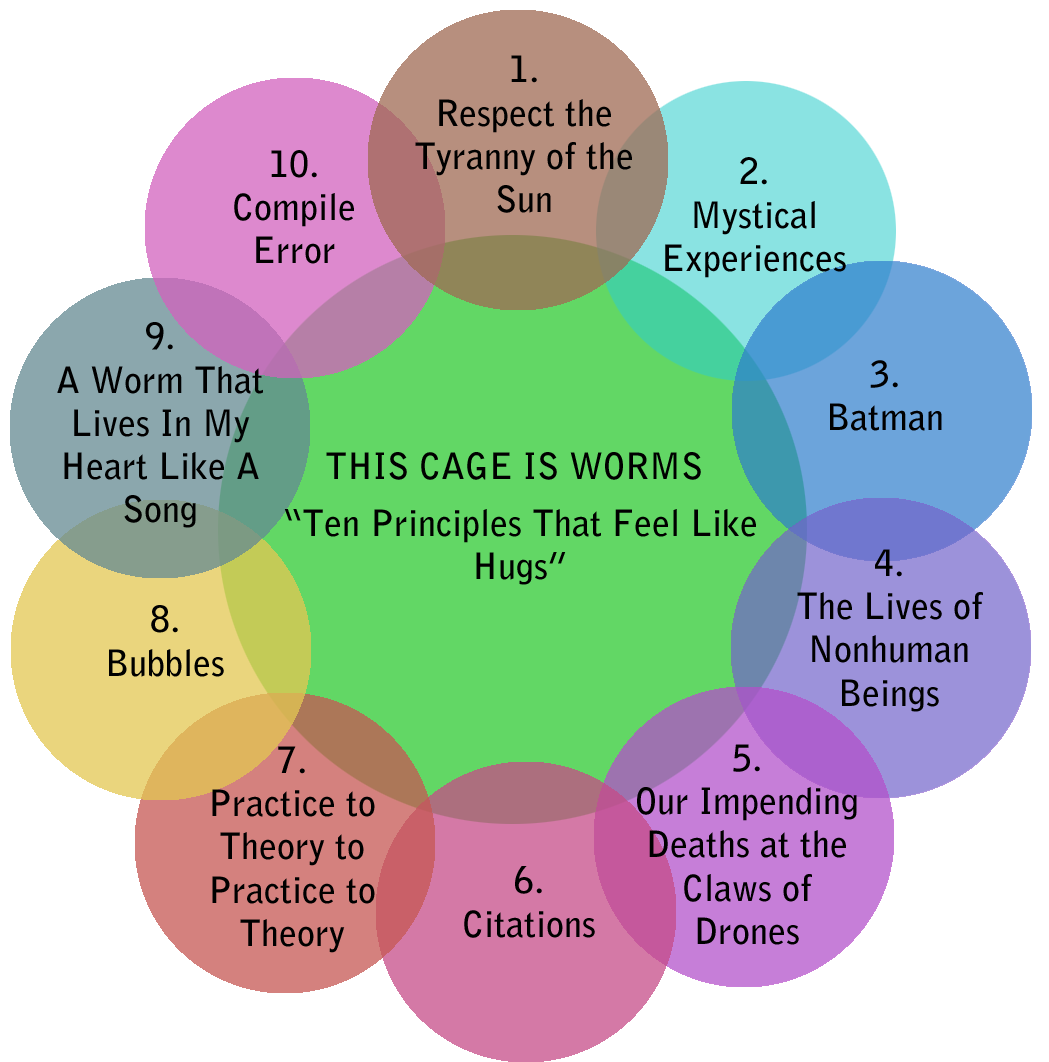
So the Institute of Critical Animal Studies released their new diagram of ten principles. I am reproducing it below.

It got me thinking. I thought a lot. I thought so much. And then I made my own.

I present to you the Ten Principles of This Cage is Worms.

Posted in General Features | Tagged , , | 3 Comments