Return To Skyrim: Dragons, Thieves, Chitin, Magic, and Ugly Hats

2013-02-06_00002 2013-02-07_00007 2013-02-08_00004 2013-02-08_00009 2013-02-08_00015 2013-02-08_00017 2013-02-09_00002 2013-02-09_00004 2013-02-09_00005 2013-02-09_00008 2013-02-09_00017 2013-02-10_00007 2013-02-10_00011

Posted in Return to Skyrim, Video Games | Tagged , , , , , | Comments Off on Return To Skyrim: Dragons, Thieves, Chitin, Magic, and Ugly Hats

On Depression Quest

Go play Depression Quest and give the devs some money while you are at it.

depressionQ

There has been a lot of debate over the what has been called the “Twine revolution” and if the games being produced in the Twine engine are games. I don’t care about that debate; I have a very laissez-faire attitude toward the concept of game–I would rather extend the concept to basically anything rather than limiting it down to some kind or core concept. I tend to buy the arguments about the large definitions of games, with Anna Anthropy’s definition of games being my prime referent and favorite: “a game is an experience created by rules.”[1]

Most of the Twine games I have played until now take the “rules” to be linearity. There is a single path taken through a text. You follow it, you move outward into descriptions, and then you play through the story. The Twine game that I made, Or, What Is It Like To Be A Thing? works in exactly this way. There is some choice, but that choice is mostly an illusion.

Twine games have been very successful is providing profoundly affective experiences within, and meditating on, those limits. Marras’ mom is home is my immediate go-to for showing how Twine can set up huge systems of choice while also making you painfully aware of the very real boundaries that exist in both the game and the world that the game is modeling, and the fact that most Twine games use the default black background really piles on this effect–I get trapped in all that blackness. A sense of melancholy runs through a huge number of Twine games that I have played, although sample bias might be an issue. [2] Todd Harper’s Building Blocks is a great example of the kind of dark, linear, emotive Twine game that I’m talking about here.

So Depression Quest.

First, I have nothing but praise for the game. It works. It is as perfect of a simulation of depression as I think we are likely to ever get. It certainly describes my own experience, and judging by the discussion on Twitter about the game, I think it covers an entire range others’ experience too.

Second, its presentation and technological achievement should have a ripple effect through the Twine world. If we’ve had a Twine revolution, this is one of the Great Works of Twine (TM). It is showing us the gamic possibilities of Twine as far as variable management and sound are concerned (from what I understand, there is some real brute forcing of the engine going to to make things as elegant as they are in the game.) However, it isn’t making Twine do anything that Twine isn’t capable of doing already–all of this has been waiting inside of Twine for a game to let it out.

That isn’t very clear; I mean that Depression Quest is very clearly an example of Zoe Quinn, Patrick Lindsey, and Isaac Schankler looking at what Twine does well and decided to do that as hard as possible.[3] There isn’t any awkward shoehorning of new techniques or mechanics from other fields in the game–it is a body made of Twine, wanting nothing else, needing nothing else.

You’ll notice that I’m avoiding the plot of Depression Quest here. This is on purpose; it isn’t that I don’t want to spoil something for you. In fact, I don’t think the word “spoil” makes any sense in relation to Depression Quest. Most of what you do in the game is purely quotidian–spoiling Depression Quest is basically like “spoiling” what you are going to do on your next shitty Wednesday night.

The truth is that I don’t want to prevent you from living it, from suffering it. I’ve thought a lot about the concept of “games that hate you.” These are games that actively drive you from them. They are games that know they are games. They are games that know they are only activated when you are touching them, controlling them, living in their systems. But nonetheless, they want to drive you out. They want to make you feel so much that you can’t help but put them down in confusion and sickness and rage and sadness. Depression Quest, much more than any other game, hits that note for me.

The short of it: Depression Quest is not only good, it is truly revolutionary. It sets standards for relationships with games. It sets standards for relationships with ourselves, with our bodies, with our minds. It shows us what we can do and what we are, like a mirror that gives you the future and the brutal present all at once.

Go play it.

——————————————————————————————-

  1. Rise of the Videogame Zinesters
  2. I think Porpentine has done some of the better work of taking Twine into pure joyous crystal paradise with Cry$tal Warrior Ke$ha and All I want is for all of my friends to become insanely powerful. Also, Merritt Kopas’ Queer Pirate Plane.
  3. Mammon Machine’s review of Bloody Princess Farmer and Bubblegum Slaughter RE: writing is super important here (I couldn’t figure out how to integrate this into my broad argument up top):

     Writing in games sucks because no matter how many writers they hire and how good they are, they still treat writing like a chore instead of letting it express some pure aesthetic joy the way the game art and music tends to, which is probably the reason why musicians and visual artists love making fan stuff out of games but writers are just embarrassed by it. Okay sure I guess IF has done that but who reads IF. More seriously, IF is narratively oriented (which is great) but I like this direction a lot better. I’m going to say it’s a bit more like poetry. Technically, not romantically.

    I’m saying that twine games are making writing function like graphics and music and that’s the way it always should have been.

Posted in Video Games | Tagged , , , , , | 1 Comment

Gamescenes Interview With Angela Washko

GameScenes: What is your relationship to World of Warcraft? What does it mean to you, as a female-player?

Angela Washko: Well I used to play pretty “hardcore” while I was in college. One of the common responses from male players to my questions about how they feel about female players is that “they just aren’t as good” or “that it’s not natural for women to be good at video games.”  Which (though I can’t back this up with scientific evidence) seems quite ridiculous to me! [WARNING: INACCESSIBLE GAMING LANGUAGE COMING UP]  When I was playing at my most competitive I was generally  #1 or #2 in DPS (damage per second) and wearing some of the best equipment you possibly could for the content available in the game at that point. But I always found that there was suspicion about my rank and participation. One of the guild leaders was very affectionate toward me, and this created some tension with other guild-mates (including my IRL boyfriend hehe)…that I might be getting preferential treatment because of this.  I felt uncomfortable that “give her a boob job!” was sometimes used as an exclamation of victory or success in a raid, never liked that for some reason my guild-mates had a fascination with talking about butt sex (butt sechs), and of course all of the discussion of getting back into the kitchen……but I never did anything about it and was too scared to say anything expressing dissent.

My art practice has developed into a feminist practice in which I use play to address power structures embedded into collective consciousness through media. I started to re-play the role-playing console games I grew up with (Final Fantasy 2-10, Chrono Trigger, Metal Gear Solid, Valkyrie Profile, Star Ocean and more) – deconstructing them for the obvious impact they had on forming my ideas about relationship roles. This is quite silly on one hand, obviously it is absurd to project yourself onto a video game character, but people do…and I did. That project is called “Heroines with Baggage.” Then I started thinking about World of Warcraft and the fact that the developers were not responsible for reinforcing negative stereotypes about women, it was the community.  Now I feel as though I have the tools (and courage) to talk about the language in a way that hopefully unearths the reasoning behind it.  Hopefully it will impact the breadth of things discussed and the way in which they are discussed on the servers I play on…this was the initial goal, but I’m not sure that I’m in it for that anymore.  It was easy early on to package this as a “feel-good” “change-the-world(of Warcraft)” project and the more I do it, the less realistic that is as a representation of what I’m doing.

Read the rest of this interview at Gamescenes.

Posted in General Features | Comments Off on Gamescenes Interview With Angela Washko

Figure/Ground Interview with Anthony Paul Smith

What effect has the information age and technology had on the university and on pedagogy?

I take a kind of Deleuzian approach to the question of technology and pedagogy. Very simply, too simply probably, one of the lessons of the metaphysics he and Guattari sketch out over their Capitalism and Schizophrenia volumes is that nothing is essentially going to be revolutionary or reactionary. I think that’s really true of information technology, where we are tempted to either celebrate as the new means of democratization or decry it as further eroding the place of the university in society. I can’t simply celebrate it, in part because my own teaching style is pretty traditional. I use a mix of lecture and discussion in-class, I organize my lecture with powerpoints only because my handwriting is so poor that I can’t effectively use the blackboard (the physical one in the classroom, not the software…). I’ve never found the use of message boards or blogs to work for my own pedagogy and I have seen an over reliance on bad internet sites for research with my current students that is really troubling, revealing a laziness when it comes to research that I don’t think was so easy to indulge before. Then of course there is the strange threat of the MOOCs that plenty of other people have talked about and know more about than I do. At the same time, I can’t decry it because I have personally benefited from the folding of time and space that these technologies allow for. I’ve done online lectures on Laruelle, met amazing people I likely would never have in the old school way of networking, benefit from the ease of access to literature the internet affords, and all that. For me it really was about class mobility. During my undergrad the internet allowed me to have a rich intellectual life even though I was also having to work 25-30 hours a week on top of full-time courses. Pedagogically I don’t see a ton of value in technology other than that folding of space, other than access, but it should be thought about very carefully alongside the aspects of the university we want to defend, keeping in mind that, like information technology, the university is itself a mix of reactionary elements and spaces of freedom.

Read the entire interview at Figure/Ground.

Posted in Quote Time, Theory | Tagged , , , , | Comments Off on Figure/Ground Interview with Anthony Paul Smith

Galloway on Images

One of the key consequences of the control society is that we have moved from a condition in which singular machines produce proliferations of images, into a condition in which multitudes of machines produce singular images. As evidence for the first half of this thesis consider the case of the cinematic or photographic camera, a singular device with the ability to output thousands and thousands of images in constant mutation.

Galloway, The Interface Effect 91

Posted in Quote Time, Theory | Tagged , , | Comments Off on Galloway on Images

Can We Kindly? by Samantha Allen

This is a guest post, which isn’t a normal thing for this blog, but I read Samantha’s piece and immediately offered to put it here. So here it is. – CK

-+-+-+-+-+-

Samantha Allen is a transgender woman, ex-Mormon and a PhD student in Women’s, Gender and Sexuality Studies at Emory University writing a dissertation on sexual fetishism. She has contributed to The Border House and is also an erstwhile singer-songwriter. You can find her on the web or on Twitter.

[Author’s Note: After I wrote this essay, I sent it to Mattie Brice and we had a long e-mail exchange about it. Mattie and I had a careful conversation about its relevance and its representation of the “Would You Kindly” / “Would You Kindly Not” back-and-forth, an exchange which Mattie has not participated in officially since the publication of her original piece. Because several differences of opinion emerged in this e-mail conversation, I should note that, while I take issue with Jonas Kyratzes’ piece in my essay, I’m not therefore claiming any position on behalf of Mattie. I hope that both Mattie and Jonas can read this piece in a spirit of generosity and open dialogue.]

Can We Kindly?

Samantha Allen

As measured in Internet time, I’m entering this conversation late enough to risk complete irrelevance. I’m told that the Twitter firestorm that followed Mattie Brice and Jonas Kyratzes‘ recent exchange has come and gone. When I asked Cameron Kunzelman to summarize that Twitter conversation for me, he replied, a little sardonically: “There was a great big fight and now everyone has forgotten about it because that is the nature of the video game community.” This essay is, in part, an appeal for a nuanced, thoughtful and sustained conversation about the role of experience and identity in games writing that can move beyond the 140-character lines we draw in the sand. If I’m entering this debate late, it’s because I’ve spent a week ruminating on it, trying to sort out my thoughts and deciding how to formulate them as diplomatically as possible.

I was, unwittingly, a part of this debate when it first erupted. When I saw a recent weekly roundup on Critical Distance, I discovered that my own essay on The Border House about my gender expression in Bioware’s role-playing games was cited as an example of precisely the sort of “games blogging through a personal lens” that had come under fire from Kyratzes and Joel Goodwin. I’ve been waiting to weigh in because I needed time to move beyond my knee-jerk response to being told, however indirectly, that my own style of games writing is a questionable one. And, to be honest, some of Kyratzes’ and Goodwin’s concerns with identity politics and confessional writing do resonate with scholarly conversations in my field of Women’s, Gender and Sexuality Studies. Another excuse for my tardiness, then, is that I needed to re-read large portions of the feminist canon.

Because I believe in the importance of making one’s standpoint explicit in any piece that touches on personal experience and privilege—and also because I don’t have a large body of games writing that precedes me—an introduction is in order. I’m Samantha and I’m a white, transgender woman in her mid-20s. I come from money but, thanks to some of the initial costs of my gender transition, my bank account balance often dips perilously close to $0 as I wait for next month’s stipend. That stipend comes from Emory University where I’m currently enrolled as a doctoral student in the Women’s, Gender and Sexuality Studies Program. The week that I read Mattie Brice and Jonas Kyratzes’ exchange, I was waist-deep in reading for my comprehensive exams and was, coincidentally, mulling over a classic feminist essay about the dubious status of “experience” as a rhetorical tool. More on that soon.

My format here is simple: I’ll assess both Brice’s and Kyratzes’ essays, outlining my points of (dis)agreement. Then, I’ll make my own simple argument about the role of experience in games writing. I invite critique, feedback and disagreement whether that happens on Twitter (@CousinDangereux) or in long-form writing.

In “Would You Kindly,” Mattie Brice draws much-needed attention to the hollowness of video games’ recent attempts to produce critical commentary on real-world and video game violence. Games like Spec Ops: The Line and Bioshock attempt to critique violence at a thematic and narrative level but, as Brice points out, these violent games are still “fun” on a mechanical level. While films can arguably mount a critique of violence through a hyper-realist portrayal of that violence, games are uniquely interactive experiences and, as such, any social commentary needs to adapt to the specific contours of the medium. When the developers of Spec Ops try to position the game as subversive commentary despite the fact that, mechanically speaking, the game plays just like any other hyper-violent video game, I can’t help but feel like they’re trying to have their cake and eat it too. This combination of serious tone with same-old mechanics allows the developers and the mainstream games press to posture as if blockbuster games are finally tackling the serious issues of our day when, in fact, they are simply re-packaging mechanically stagnant genres along with some sloppy commentary about the player’s complicity in the violence of the game.

Compare the portrayal of violence in Spec Ops, for instance, with the violence in a game like Condemned: Criminal Origins. Monolith didn’t tout Condemned as a subversive commentary on game violence but, nevertheless, I would argue that five minutes of Condemned can have a more palpable effect on the player than the entirety of Spec Ops’ campaign. Condemned casts the player as a detective in a city teeming with mysterious, violent characters who attack the player senselessly and ruthlessly. Guns are rare and so the player must use improvised environmental weaponry—a fire axe, a wooden plank, a shovel—to survive. The melee combat of the game is finely-tuned mechanically speaking, but I would hesitate to describe it as “fun.” Swinging a weapon requires a long wind-up but, when a hit connects, the visual feedback is sudden and brutal. This is a game that does not trivialize the brute force of a blunt object, whichever end of that object you find yourself on. The developers of Condemned position the player uncomfortably close to violence, then, but only by trying to make the game’s mechanics as weighty as its subject matter. I wince when I hit someone in the head in Condemned. When I get a head shot in Spec Ops, the game celebrates my achievement with slow-motion.

While I think Brice’s essay is one of the best tools we can use to point out just how trite this sub-genre of “violent games that are critiquing violent games by being violent games” is becoming, I would caution against easy generalizations and reductive divisions between the oppressed and the oppressors. Feminist theories of intersectionality were designed to attend precisely to this problem by pointing out both the many vectors along which people are oppressed (e.g. race, ethnicity, class, sex, age, ability) and that these “major systems of oppression are interlocking” (“The Combahee River Collective Statement”). There is room in intersectional analysis for both Mattie Brice (and myself for that matter) to talk about our experiences of oppression as transgender women and for Jonas Kyratzes to articulate the difficulties he faces as a Greek man.

An all-too-easy split between the white, cisgender heterosexual men and everyone else can risk obscuring other ways in which people experience violence as a result of their life circumstances. Don’t get me wrong! I’m just as sick as any feminist of the “What about the men?” complaint. And these white, cisgender heterosexual men do exist and they do, in fact, control the world’s political and economic systems. But consider that there are at least some straight, white male players of Spec Ops: The Line—by no means a majority of the player base, though—who have experienced the violence of war in Iraq or Afghanistan. Like Brice, I don’t think the violence portrayed in Spec Ops has anything to do with my experiences as a transwoman, but I do want to note that war may be a part of the real-world experiences of other gamers.

Jonas Kyratzes, on the other hand, might be surprised to learn that many feminist and queer academics have also critiqued identity politics as well as the role of the confessional and the experiential in knowledge production. In his landmark book The History of Sexuality, French philosopher Michel Foucault warns that the confessional mode produces the very identities that come to circumscribe us. Foucault counters a prevailing historical narrative in which institutions (like Catholicism) repress sexuality by arguing that, in fact, institutions produce the very concept of sexuality by asking us to endlessly confess our thoughts and behaviors (Foucault 1978). Judith Butler applies Foucault’s discomfort with identity categories to contemporary feminism, arguing that feminists should not practice their politics in the name of “women” but rather should regard identity categories as “sites of necessary trouble” (Butler 1993, 308). And feminist historian Joan Scott has argued that feminists should be more careful when wielding “experience” as it frequently functions as an ahistorical and unquestionable foundation for an argument (Scott 1990). Kyratzes is approximating Scott’s position when he observes that work based on experience is “very hard to criticize.”

Other feminist and queer scholars have, of course, talked back to Foucault, Butler and Scott, arguing that their positions threaten to de-politicize the feminist movement; I don’t have the space here to outline these debates nor to detail my own position. Given the shape of these scholarly conversations, though, I have to confess (ha!) that Kyratzes is touching on some interesting theoretical conversations that feminist and queer scholars have been having for the last twenty years. While I admire Kyratzes’ attempt at taking a nuanced position and his honesty in admitting that his feelings are “not easy to untangle,” it’s also clear that he needs to do a bit more untangling around questions of epistemological privilege.

I take issue, for example, with the way in which he sets up “intellectual relevance” as an implicit litmus test for whether or not “personal” or “emotional” elements belong in games writing proper. One of the key insights of feminist scholarship and political activism deserves repeating here: “The personal is political.” In the face of those who dismiss women’s experiences of oppression as purely personal, emotional, idiosyncratic and isolated incidents, we have to insist, as feminists, that our personal experiences do reflect the workings of broader social systems. Feminists have long advocated for forms of knowledge production that build theory from the experiences of the oppressed, rather than throwing theory down imperiously from the comfort of an armchair.

While I agree with Kyratzes, then, that there is a careful conversation to be had about the role that experience plays in games writing, the dividing “line between personal experience and logical argument” is a line that I fundamentally reject. Women’s writing and particularly feminist writing have too frequently been dismissed as “illogical” and overly “personal.” And in the long shadow of Enlightenment era philosophy, “logic” and “intellect” are terms that men in positions of power tend to wield in order to control political discourse. To be clear, I’m not accusing Kyratzes of being a flagrant oppressor. Although his title “Would You Kindly Not” feels a little policing to me, he does admit that there’s “room for all kinds of autobiographical elements in game writing.” I would kindly ask Kyratzes, though, that he be more explicit about the rubric he uses to divide the “logical” from the “personal” and that he be a little more sensitive to the ways in which that very division has been used to silence marginalized voices. In other words: How do we separate the “logical” from the “personal” and who benefits from that separation?

I’m hesitant to disclose my final position on the Brice / Kyratzes exchange because it’s almost embarrassingly simple: I support pluralism in games writing. We’re lucky to have a medium that can support pluralism. Because most games writing takes online, we have virtually limitless space for as many voices as possible. Our debates can move at a bracing, invigorating pace. The fact that this essay might seem like old news by now is evidence of that! And almost everyone can contribute to gaming conversations in comments sections or on Twitter.

Here’s some perspective: In academia, I fight for extremely limited space in academic journals. There are just a handful of Women’s Studies journals and, as such, a small number of editors control the shape of our disciplinary conversation. Our conversations progress glacially. I worked on my first scholarly publication for a year, submitting it in 2011. After an extensive revision and resubmission process in 2012, the journal accepted the article but won’t have the space to publish it until 2014. By the time it comes out, even I won’t agree with it anymore!

In contrast, think about the profusion of online spaces where we can talk about every aspect of games and gaming culture. We can talk about the technical aspects of games (like Shawn McGrath’s piece on Doom 3‘s source code) and we can also value our irreducibly personal experiences with games (as Liz Ryerson so eloquently argues).

For my part, I would like to see more games writing that tries to bridge the gap between the technical and the experiential, writing that explores the ways in which our life experiences become intertwined with the systemic, mechanical features of games themselves. Why is this my favorite direction for games writing? What makes a person unique are her life experiences. What makes games distinct from other forms of media are their interactive elements. Writing that explores the connections of concrete experiences to seemingly abstract interactive systems cannot happen anywhere else.

I’m excited to see more writing that fulfills on this promise but, in the meantime, I’m happy to keep reading both technical and autobiographical reflections on games. Can we kindly realize how lucky we are to have so much room for our strange, sprawling, messy but always exciting conversation on games?

References

Butler, Judith. 1993. “Imitation and Gender Insubordination.” In Henry Abelove,             Michèle Aina Barale and David M. Halperin, eds. The Lesbian and Gay Studies Reader, New York: Routledge, 307-320.

Foucault, Michel. 1978. The History of Sexuality, Volume I: An Introduction. New York: Random House.

Scott, Joan W. 1991. Critical Inquiry 17(4): 773-797.

Posted in Guest Post, Video Games | Tagged , , , , | 4 Comments

Slipping Moorings

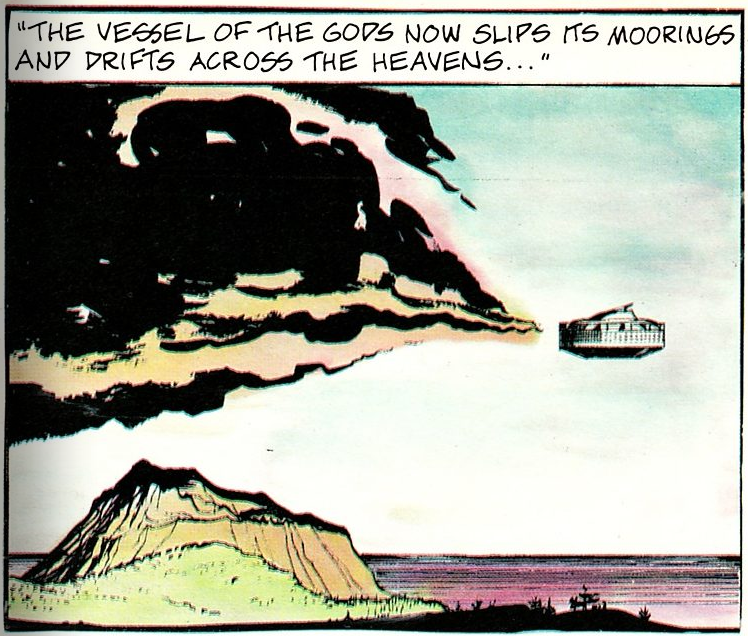
Some panel from Heavy Metal that I didn’t track very well.

gods and moorings

Posted in Heavy Metal | Tagged , | Comments Off on Slipping Moorings

Riff Raff on Interpretation

So that is an interview where Riff Raff talks about his work ethic and about how he coming up in the world of rap.

But he also talks about audience reception of his songs. I’ve transcribed Riff Raff on haters before, so here is Riff Raff on audience reception/perception and interpretation of his music:

If people don’t have a visual concept–if I don’t show them–cause p–, I hate to say it, but 90% of the world is like [confused face] you, you have, its physical, like you have to be in front of them and show them. Like if someone tell you  something, explain something, or write it like [they] be like “Oooh I don’t know, my attention span or my brain doesn’t function.”

[Singing] I done pour codeine on my white silk pants [stops]. If I say that, someone “Pssht, what the fuck’s he talking about man!” so I had to literally get codeine, spend all that money on that, and pour it on my white silk pants.

[Surprised, affected voice] “What does that mean!?”[stops]

It means that I’m pouring codeine on my–

[Surprised, affected voice] “What the fuck does that mean? I mean, so you just have that much money and time on your hands that you can make a song about pouring codeine on your white silk pants?![stops]

Yes, that’s–that’s what I mean.

[Surprised, affected voice] And you’re playing spin the bottle with two beautiful white tan bad bitches?![stops]

That’s what the video concept is about.

Riff is doing something pretty amazing here–he is obviously frustrated with overreading of his work and, at the same time, a total lack of even making an effort to “get on his level.” Which is to say that Riff Raff, in all ways, wants you to get on board with the flatness of both him and his songs–“White Silk Pants” isn’t a song about nothing but it also isn’t a song about anything more than what we are presented with.

When I wrote about Riff Raff and pure aesthetics, this is part of what I had in mind–Riff Raff himself is nothing more than a physical body with descriptors literally mapped onto him, but he also isn’t a nonexistent trash media entity. He isn’t a promo Twitter account that has never broken fifty followers, but he isn’t a media conglomerate with infinite depth paired with infinite complicity in violence.

We can’t read Riff Raff too deeply, or deeply at all, but it is also impossible to forget about him.

Posted in Critical Riff Raff Studies, Theory | Tagged , , , | 3 Comments

Heavy Metal Editor’s Note December 1978

This is the Xmas issue of HM. This is for all the people who saw one once and no one believed them. This if for all the people who have a fierce hairy animal living inside. Who believe it’ll all turn out right after something important happens, but find the questions hard to take. Who collect things. Who can never find anything where they put it down, and dream of a big lost and found somewhere.

This is for people who make up islands, planets, and houses with one of everything. Who would prefer color pictures in black and white and vice versa. Who can see river maps on printed pages. Who keep getting hints. Who can imagine giant dwarves.

This is for people who hum along in elevators. Who imagine being stranded with every busload. Who don’t step on cracks. Make up their own words. Rehearse acceptance speeches. Put things in arbitrary piles.

This issue goes with our best wishes to the people who can’t help it. Who suspect coincidences, and get the words motor and mother mixed up, who imagine everything on a different scale, vast mosquitoes and tabletop Alps.

Seasons Greetings to everyone who can’t wait and wishes nothing were ever, really, over.

Heavy Metal Editor’s Note December 1978 v.2 #08

Posted in Heavy Metal | Tagged , | 1 Comment

Nonhuman Life: Quentin Meillassoux’s After Finitude

This post is part of a series of posts that I am writing in conjunction with an independent study I am taking that is based around the concept of nonhuman life. You can read more about it here.

Up front: After Finitude is one of the more difficult books I have ever read. Despite reading Kant before and having a decent background in Descartes, Hume, and Locke, I still struggled through AF. So, with that knowledge, the next little bit is what I ended up writing in my notebook after a meeting with my adviser. Is it brilliant? No. Does it demonstrate an exhaustive understanding of Miellassoux? Not at all. But I’m trying to understand After Finitude not only on its own terms, but in relation to my broader project of working through the concept of nonhuman life and what I have been increasingly calling the vital turn.

So the following is notes, is questions, is desire for something that I haven’t quite gotten my head around yet. It isn’t definitive; it might be wrong; I might betray myself over it in the future. But here it is.

– – – – –

It isn’t about knowing. It is a respect of unknowing, of the possible infinite contingency of everything. The recognition of life outside of the human or the biological becomes a recognition of contingency, of the absolute non-specialness of the human in the world. In a universe where your atoms could implode at any moment we need the closeness of respect.

So we can have a nihilism or an ethics–we have a pretense to a closeness of the world already through the correlation–the world is deeply ingrained and indebted to us in the correlation. But that closeness is a kind of cage–the for-us of correlationism prevents a fidelity to the for-itself, and it needs to be interrupted and rethought.

So an ethics of the nonhuman precisely requires a rethinking of the correlation, of the world not being chained to humans; that ethics would require us to respect an opacity. Rethinking that relation through the concept of life could (maybe) generate an affective reaction. It is also a way of finding a middle ground between organic or faced [Levinasian] ethics and infinite obligations that are politically paralytic.

Posted in Nonhuman Life | Tagged , , , , | 2 Comments