On Bulletstorm’s Echoes

This is quick, like an echo.

Bulletstorm has a game mode in which you replay the most violent sections of the game over and over again in order to get the highest score possible in a kind of time attack challenge. The scoring system, if you’re not familiar with the game, is absolutely diegetic; special forces troops are equipped with nanomachines that monitor their activities in combat and reward the highest performing squad members. If you’re not good at fighting, you have fewer points and you can’t resupply. Without supply, you have no ammo, the world chews you up.

I go back to these scoring moments over and over again. I’ve played through them all, and when I’m bored with other games or I don’t want to do any work I load into these memories and play them out the same way over and over again.

I tell myself that it is about competition, and to be honest it isn’t that much of a lie: it is rare for me to get caught up in a competition. It has only happened with a few games, and when it gets me, it gets me hard. Geometry Wars 2 had me logging in every single day to beat the scores of everyone I knew. Team Fortress 2 and Call of Duty: Modern Warfare 2 could get me caught up in a match where I just had to win.

But the echoes get me in a different way. There’s no one to compete with–no one on my Live list even has the game. It is just me, getting stars, accruing points.

Posted in General Features | Tagged , | Comments Off on On Bulletstorm’s Echoes

Rancière on the Pure Nonsense of Life

The notes disappear in smoke, and the raised fist of the infant – a new kind of messiah different from Bartleby/Deleuze – celebrates, for all science, the hymn of life obstinately pursuing its own nonsense. Literary fiction has embraced the movement of history described by revolutionary science: the great upheaval of property; the rise of financial moguls, shopkeepers, and sons of upstart peasants; the artificial paradises of the city of trade and of pleasure, misery and revolt, rumbling in industrial infernos. But it does so only to replace the future promised by social science and collective action with the pure nonsense of life, the obstinate will that wants nothing. This is not because it enjoys contradicting the socialist science. Rather, it might unveil its flip side: the science of society, bearing a future freedom in its womb and the philosophy of the will-to-live that wants nothing were born on the same ground: the site where old hierarchies of social and narrative order break down.

–  Jacques Rancière, Aisthesis 52

Posted in Nonhuman Life, Quote Time, Theory | Tagged , , , , | Comments Off on Rancière on the Pure Nonsense of Life

On The Yahwg

Damian Sommer and Emily Carroll originally made a version of The Yahwg for the first Comics vs. Games. I don’t know what the conversation after that looked like, but I imagine it was something like “you want to make this a little more full-fledged and then release it?” Now, a long time later, we have The Yahwg.

stdrt 2013-05-25 12-26-30-63

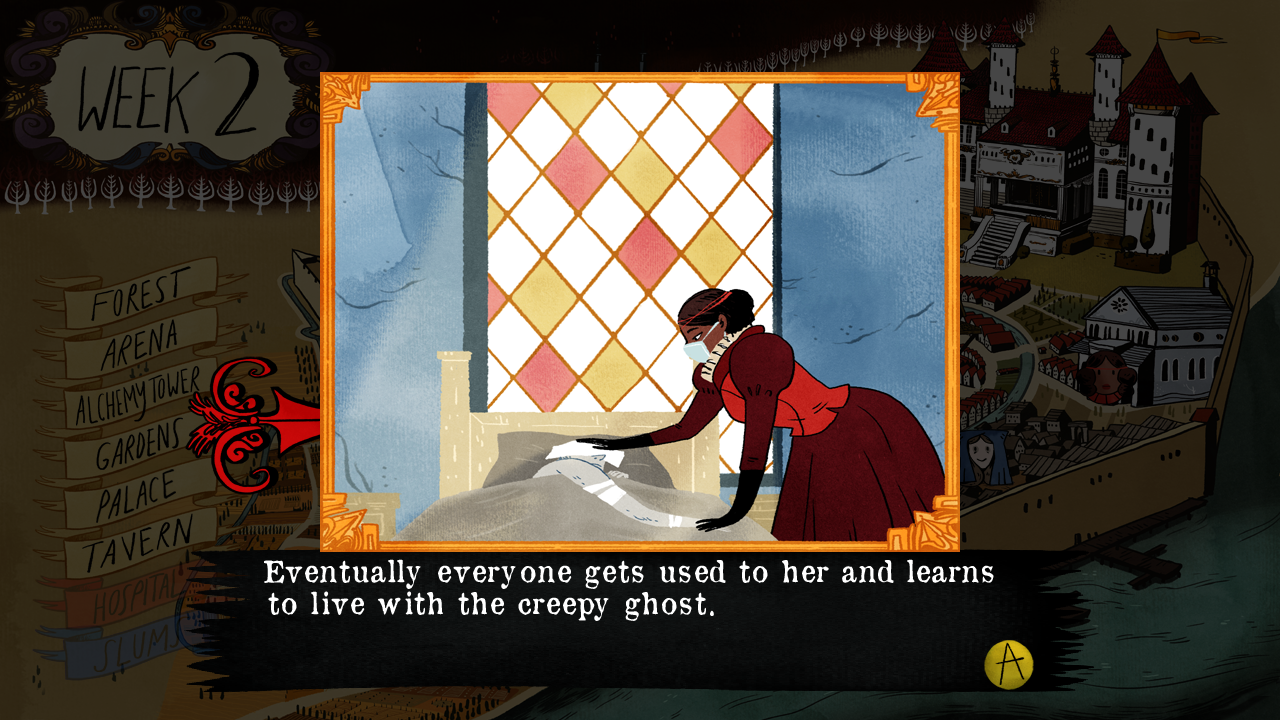
Some description: The Yahwg is a game in which a player or players control some characters who move about a town. This town will be attacked by a creature known as The Yahwg. No one in town knows this fact. Each week allows each character one action at one location in the town–you can choose to go to the forest and chop wood or go to the palace and attend a ball or a number of other things. These choices lead to events that change your stats–you get in a brawl and your physical abilities increase or you learn a little bit of magic in the alchemy lab.

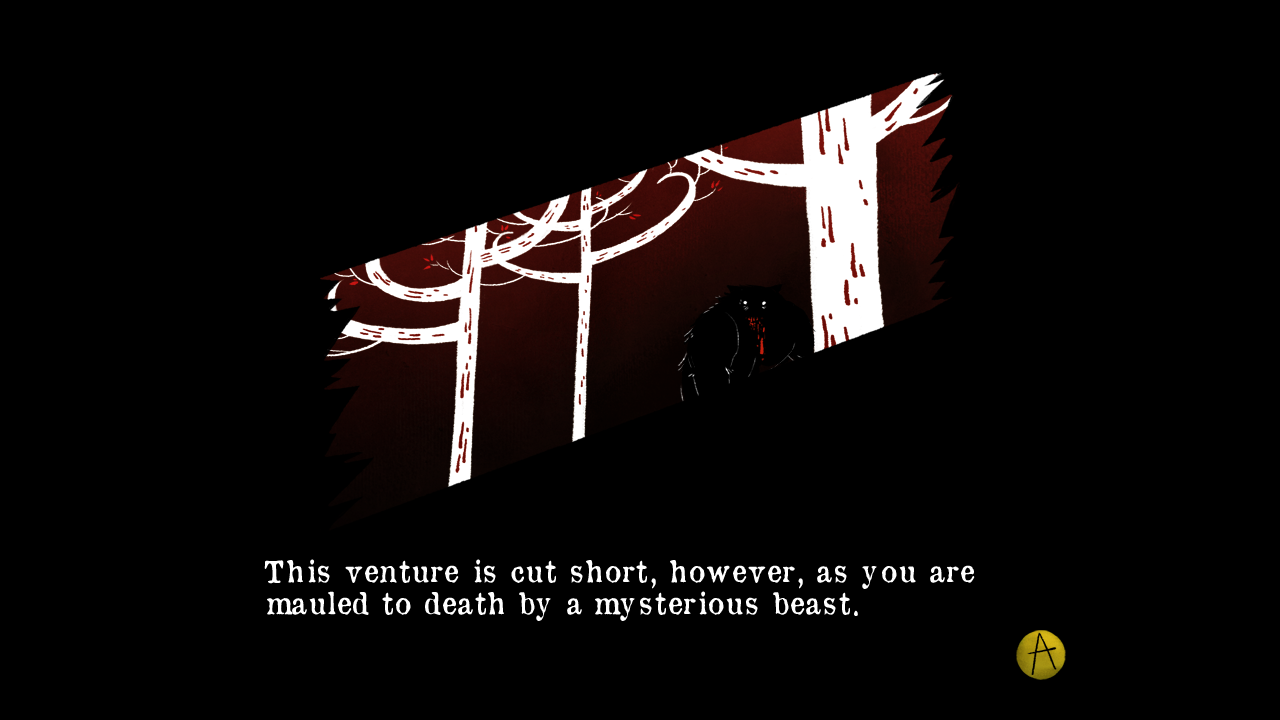
After six weeks, or six actions for each character, the Yahwg comes and destroys the town. Each character chooses the role she or he wants to play in the post-Yahwg city and the story ends. I’ve played through a few times now, and it has never ended well.

The Yahwg is a lot like another game I played recently and loved: Monster Loves You!. Both of these games are about making choices and seeing their repercussions. They’re the morality systems and dialogue trees from Bioware RPGs ripped out, retooled with some actual thought put into them, and then released as standalone games. They don’t take very long to play, and I find them more emotionally satisfying than most games.

stdrt 2013-05-25 12-30-39-38

However, The Yahwg diverges from the Monster Loves You! style of game by pulling a thematic fast one. The game purposefully pulls you into a narrative of no fewer than two characters, and in the experience of the single game, those characters are important to me. But on multiple playthroughs, it becomes apparent that it has less to do with individual characters and their experiences and more to do with a collective crisis in the face of a moment of unpredictable.

The Yahwg, like death, is always on the way, always almost here. We do what we can in the face of it, and sometimes we succeed in really fighting it with a great work of art or humanitarian work or revolutionary change, but mostly we collapse into nothing. Those around us do too. Everything ends, everything burns and crumbles in time.

The aesthetic of the game carries this emotional content into the visual realm of the game. While the writing works, and is often a mix of melancholy and humor, it is Emily Carroll’s illustration style that best mixes in the vitality of life before the coming of the Yahwg with the bleakness of knowing that it will come and tear everything in two. Her comics work, which you can read me writing about here or just look at here, has always contained this tension, and I’m really glad that we get to see her work in this format now.

stdrt 2013-05-25 12-34-46-21

What else is there to say? I liked it. It is painful, everything collapses, nothing good comes from it. It is beautiful. Loss permeates everything in the game.

You can pre-order The Yahwg for $5 which you should do. It comes out on May 30th.

stdrt 2013-05-25 12-34-33-86

Posted in Video Games | Tagged , , , | Comments Off on On The Yahwg

I Have Launched A Kickstarter for A Scary Game

You might remember that last year I created a kickstarter where I basically just asked for $200 to make whatever the hell I wanted in game form. I set a release date, made fun of Kickstarter, and went quiet for a few months. At the appropriate date, I released Funeral, a semi-success that was a lot harder for me to actually make than it would seem.

I took the money of random people and then delivered the exact nebulous product they wanted in the time frame that I promised. It is literally in the 1% of Kickstarters.

1 - pstand

So now I have a new kickstarter that I am calling Oooh way too scary game. From the page itself:

So with that in mind, the next game that I make will be a horror game that is probably not all that scary. It will be sort of side scrolly and you can’t jump and most of the time it will be about interacting with things and talking to people instead of doing anything game-y. What I am looking at is Hugo’s House of Horrors mixed with “His Face All Red” in a tortilla made out of Tom Gauld comics. Side dishes include: that scary scene where Bob crawls over the couch in Twin Peaks, Dan Clowes’ Like A Velvet Glove Cast in Iron, and some Dear Estherisms.

I want to make a funny game that has some scary parts. I want to make it available for free on the internet. I would like $125 to do that.

If you liked any of my previous games or any of the writing on this blog, think about kicking in some Canadian lunch money.

Oh also I have been making little development GIFs and posting them here.

Posted in A Game I Made, Video Games | Tagged , , , , | 4 Comments

David P. Gray Interviewed By Classicgames

Despite never having finished the game, I have this weird attraction to Hugo’s House of Horrors that I can’t really explain. Part of it probably has to do with some strange feeling of nostalgia–I had the shareware version on one of those ONE MILLION GAMES disks back in the mid to late 1990s, and the aesthetic of the whole thing has been lodged in my head for most of my life.

I’m making this post because Darius sent me an interview with the creator of the game, David P. Gray, from thirteen years ago. Here is the internet archive link. It isn’t very long, so I’m going to paste the entire thing below.

NOTE: I DID NOT CONDUCT THIS INTERVIEW. I DON’T OWN THIS INTERVIEW. I AM JUST QUOTING IT IN ITS ENTIRETY.

I think it is a really great thing that just needs to be a little more accessible than the internet archive for Hugo enthusiasts.

Thank you Kevin for doing this interview with David Gray.

——————————————————————————————-

The latest edition of Inteview with the Author is here, allowing you to pick the brain of David P. Gray, the mastermind behind the production of the series of Hugo games.

Us: How did you get started in programming and computers in general?

David P. Gray: I “fell” into scientific programming in my first job straight from school, it wasn’t my decision since I had never really programmed before but I’m very glad someone made that decision for me. I must have shown an aptitude for it. I used to secretly write games at work like Asteroids, the scientific computers were great for that. I kept getting caught, though, since colleagues used to play them and give the game away (so to speak).

Us: What other things have you made besides the Hugo series? What kinds of things are you working on now?

DPG: Before Hugo was my first shareware program “Touch Type Tutor”. At the end of writing and testing it I found I could touch type so it definitely worked 🙂 It’s in desperate need of an upgrade but it’s not as much fun as writing games so it will have to wait. After Hugo came “ProCR”, an OCR program. It didn’t work so well and sold only 92 copies. I don’t like to talk about that one… Then came Nitemare-3D which was the first 3D shooter to run native under Windows and won a Ziff Davis Best Game award in 1995. Then came Jigsaws Galore which has been hugely successful for me. It’s been twice nominated for a best game award but has so far not won.

Us: As a technical question, how did the process of porting N3D to Windows go? I know DOS has a kind of do-what-thou-wilt attitude towards hardware access whereas Windows wants everything to go through the API.

DPG: It was only possible because Microsoft had just created a driver called WinG which allowed Windows 3.1 apps to manipulate pixels in memory directly, the same way you could in DOS. Mine was the first game (as far as I know) to use it. They also created another driver, DispDIB, which allowed a special full screen mode which could take over the whole screen which I also used. Both these technologies were incorporated as standard into Windows 95 and later.

Us: How well has shareware worked out for you? Do many people register your software?

DPG: It has worked very well for me (and my family). I quit my day job back in 1991 when my sales reached twice my salary and I’ve never looked back. My wife helps a bit but our two young children that takes most of her time (and mine!).

Us: What is your favorite of the games you’ve developed?

DPG: Hugo’s House of Horrors since it was the first and got me started.

Us: What is your favorite adventure game?

DPG: From that era, probably Monkey Island.

Us: What is your favorite classic shareware game for DOS (besides yours)?

DPG: Captain Comic, by Michael Denio, since it was the first “proper” arcade game I’d seen working on an IBM PC. It inspired me to write Hugo. To be honest I don’t think it was shareware (or any-ware for that matter, being circa 1988) but it was truly astonishing at the time. I just couldn’t stop playing it until I’d finished it. I guess before that, people just assumed it couldn’t be done.

Us: How did you come up with the name “Hugo”?

DPG: I had the opening house picture done and came up with the phrase “House of Horrors” for it. So I chose “Hugo” to get the three “h’s”. I made the program hhh.exe which matched nicely with the “lll.exe” of “Leisure Suit Larry in the Land of the Lounge Lizards”, another game that inspired me.

Us: How did Hugo land a babe like Penelope?

DPG: They were high school sweethearts. After rescuing her in Hugo 1, they reversed roles with Penelope becoming a strong character in Hugo 2 and solving the whodunit. In Hugo 3 we’re back to stereotypes with Hugo once again saving Penelope.

Us: What’s the significance of 333?

DPG: The combination to the safe daubed in red on the bathroom mirror? It was originally going to be twice that number but my neighbour and friend, being religious, put her foot down and said NO WAY! So instead we used our company PO Box number, 333. This number appears several times in the first two episodes and also in the sequel, Nitemare-3D.

Us: Is there any chance of another Hugo game in the future?

DPG: I do get a lot of requests and my standard reply is that I’d love to do one but the cost of the Hollywood Studio, special effects team, famous voice-overs and cast of thousands expected by today’s market is prohibitive.

Us: One more question: Is there a strong rivalry between you and pop singer David Gray?

DPG: He he! I saw him for the first time about a month ago on TV and I can say we are totally dissimilar. According to the presenter he was last year’s “best kept secret”. Maybe if he gets mega-famous he’ll want to buy my dgray.com off me. There is also a famous snooker player in England called David Gray. I’m glad I use my middle initial…

Visit David’s site at www.dgray.com.

Posted in Video Games | Tagged , , , | Comments Off on David P. Gray Interviewed By Classicgames

Jacques Rancière on Art’s World

Art exists as a separate world since anything whatsoever can belong to it. This is precisely one of the arguments of this book. It shows how a regime of perception, sensation, and interpretation of art is constituted and transformed by welcoming images, objects and performances that seemed most opposed to the idea of fine art: vulgar figures of genre painting, the exaltation of the most prosaic activities in verse freed from meter, music-hall stunts and gags, industrial buildings and machine rhythms, smoke from trains and ships reproduced mechanically, extravagant inventories of accessories from the lives of the poor. It shows how art, far from foundering upon these intrusions of the prose of the world, ceaselessly redefined itself–exchanging, for example, the idealitites of plot, form and painting for those of movement, light and the gaze, building from its own domain by blurring the specificities that define the arts and boundaries that separate them from the prosaic world.

Jacques Rancière,  Aisthesis x

Posted in Quote Time, Theory | Tagged , , , | 1 Comment

Rancière on Life and Politics

The scientific Marxist revolution certainly wanted to put an end to the workers’ reveries, along with utopian programmes. But by opposing them to the effects of real social development, it kept subordinating the end and means of action to the movement of life, at the risk of discovering that this movement does not want anything and does not allow any strategy to lay claim to it.

Jacques Rancière, Aisthesis xvi

Posted in Quote Time, Theory | Tagged , , , , | Comments Off on Rancière on Life and Politics

On Weaponized Architecture

I’ve been anticipating Leopold Lambert‘s Weaponized Architecture since I became aware of it last fall. After wrestling with Amazon pushing my order for three months, I finally bit the proverbial book bullet and ordered it from the United Kingdom. After a short time, it was in my hands, and I took time this past weekend to sit down and read the whole thing in  a go.

The argument of the book is simple: architecture is always political. The design and construction of things in the world are such that their very existence, and the way they frame space and possibility, has measurable political effects in the world. In this way, “weaponized architecture” describes a kind of architecture that takes this seriously and lends itself to application.

Lambert spends the first third of the book outlining a general theory of the politics of architecture. The second is a reading of the colonization and subjugation of Palestine by the state of Israel through the principles outlined in the first section. The third develops an architectural weapon that could be deployed in Palestine in order to resist the urbicidal methods of erasure that have been and are used to fragment and destroy the Palestinian people and their land.

Lambert is pulling very heavily from Deleuze and Guattari’s theories–he devotes an entire chapter to the ways in which striated and smooth space get deployed in everyday architectural realities. Since the “core” of the book is a reading of architectural violence being done is Palestine, Eyal Weizman’s work on the IDF’s wall-removal attack tactics shows up several times as well. Lambert doesn’t stick to theory, however, and interviews with Brian Finocki and Raja Shehadeh bring really ground the more theoretical aspects of the the book in contemporary art, architecture, and Israeli and international law.

The third section mostly abandons theory for speculative design praxis. What does it mean to turn architecture into a weapon? Lambert designs a resistant structure–the Qasr–that could be deployed in Palestine that would fight against both traditional apartment block architecture (we are warned that these can always become prisons in the first section) and the ways in which architecture can be absolutely erased and replaced by colonial structures.

The structure is camouflaged by appearing at a distance to be Bedouin tents–nonpermanent, ephemeral. Below there is an underground structure that pulls from Deleuze and Guattari’s (and Reza Negarestani’s) notion of the hole. This hole is reinforced with shotcrete, and it is modular enough that new alcoves and tunnels can be built to support extra inhabitants. 

The beauty of the design, though, is its life cycle. It is meant to be cleared out. The expectation is that, at some point, the IDF would find out about it. It would be deemed illegal, uninhabitable even though there are inhabitants. It would be deemed cost-ineffective to destroy, so it would be cordoned off, filled with dirt, but still there. The revolutionary potential lies there. Lambert writes

The Qasr’s ruin thus remains in the landscape. Time accelerates then the process of hybridization between the building’s material and the site’s earth, dust, rocks and wild vegetation. The Qasr seems, this way, to become a product of its territory in a strange inversion of claims. Children of Salfit find in it an unexpected ideal playground, both frightening and attractive. The ruin is visible from the city and everybody know it as the building that the Israeli’s did not succeed to erase. [159]

I’m done. Go buy the book.

Posted in General Features | Tagged , , , , | 1 Comment

Released: Alpaca Run

I’ve released a new game called Alpaca Run. Go play it!

apr

A month or so ago Samantha Allen and I went to Johnson City, TN to participate in a panel on sexism and gaming. On the way home, Samantha explained a concept for a game about alpacas that would go along with a song she had written. When she was done, I was all “yeah, that could be a game.”

Then I went home and spent a few weeks working on a game.

Alpaca Run is a cross between a runner game and a music video for Samantha’s song “Transcontinental Alpaca” (which you can buy for $1 here if you want).

You do three things: you jump, you collect apples, and you listen to a song.

Inspirations for Alpaca Run include: the Soundplay series that Kill Screen sponsored, the Bit Trip Runner games, running alpacas, and the feeling of absolute joy you have when you embody a jumping alpaca.

Notably, there isn’t a fail state in Alpaca Run. I want everyone to complete it. I want everyone to have a fun journey and to get to listen to a cool song without failing over and over again.

Big up to Samantha Allen for music/vocals/concept, to Joe Culp for the beautiful background images, and to Guy Conn for sound engineering work.

GO PLAY ALPACA RUN! GO!

Posted in A Game I Made, General Features, Video Games | Tagged , , | 3 Comments

Walter Miller’s Alien Invader

It swam like an airborne jellyfish. A cluster of silver threads it seemed, tangled in a cloud of filaments–or a giant mass of dandelion fluff. It leaked out misty pseudopods, then drew them back as it pulled itself through the air. Weightless as chicken down, huge as a barn, it flew–and drifted from the direction of the sphere in a semi-circle, as if inspecting the land, at times moving against the wind.

It was coming closer to the house.

It moved with purpose, and therefore was alive. This Lucey knew. It moved with its millions of spun threads, finer than a spider’s web, the patterns as ordered as a neural array.

– Walter M. Miller, Jr., “You Triflin’ Skunk”

Posted in Quote Time | Tagged , , | Comments Off on Walter Miller’s Alien Invader