Trouble in the Neighborhood

This morning I did what I do on Mondays and walked over to a local coffee shop that is almost always filled with white men in their fifties complaining to other white men in their fifties about things that will never concern me (topics overheard today: boats, sales data).

I did what I had to do, and on my way home I could hear this really strange chirping and screaming noise. I stopped. I looked around. I saw a red tailed hawk cruising around over the parking lot that I was walking through, but I knew that squeaky chirp wasn’t the hawk.

I stood around a while. The hawk landed.

photo (1)

I watched it for a while. It seemed infinitely disinterested in the world. It looked around. I walked toward it and it stared at me for a moment. The noise kept happening.

photo (2)

Then the yelling bird appeared. It hopped around and yelled at the hawk, and the hawk proceeded to give NOT A SINGLE FUCK IN THE ENTIRE WORLD. At one point the bird was sitting less than six inches away from the hawk screaming at him and the hawk just looked at the ground.

The state of nature; the war of all against all. The small bird yells at a hawk, who presumably just wants to eat some sweet urban mice and rats without being bothered. The bird will have none of that.

If I were a political philosopher in the 18th century I would draw some life lesson from this, but I’m not, so I won’t. I just liked watching these animals have a minor disagreement.

photo (4)

Posted in General Features, Nonhuman Life | Tagged , , , | 2 Comments

Rendering the Visible II: Figure CFP

The Moving Image Studies program at Georgia State University (that’s where I am!) is putting on a conference early next year. It is named Rendering the Visible II, and it is a theoretically heavy kind of thing that is radically nondisciplinary and very accepting of nontraditional theoretical work. I’m one of the students who is working with the conference, so I would be super excited if you sent some stuff in (theoretical approaches to video games are totally welcome, by the way.)

The text of the CFP is pasted below, and the website is here.

The doctoral program in Moving Image Studies at Georgia State University welcomes paper proposals for a meta-disciplinary conference on the role of the Figure.

For contemporary theories of visuality, as they move their focus toward process and away from representation, the notion of the Figure (or “the figural”) has become increasingly important. Emerging in French philosophy in the 1960s, the figural reacts against the notion of the “figurative,” or the representational fixity of an image; the figural refers to that which induces discord within any closed system of signification, by way of forces, energies, or intensities. This idea is taken up by Deleuze as “the Figure” in his work on Francis Bacon, where the Figure is that force of deformation which pushes the image away from the cliché which continually haunts it. The Figure thus moves our attention toward gesture, rhythm, modulation, and resonance within –and at the edges of– the moving image, whether we’re talking about Eisenstein’s neuro-aesthetics or the dynamic assemblages of first-person shooter games.

This conference, thus, seeks to encourage a wide-ranging discussion of how the Figure might provide new avenues for thinking about contemporary media, as well as for reconsidering the history of the moving image in the 20th century. We invite papers that mobilize the concept of the Figure in the exploration of any visual medium. Possible areas of investigation (or experimentation) might include—but are not limited to—such issues as:

* The “aesthetic event,” and its connection to catastrophe, the accident, the mark, the spasm

* The Figure in relation to movement, animation, “non-organic Life”

* The Figure in relation to recent thinking about political affect, aesthetics, and sensoriality

* Approaches to geopolitical mapping animated by notions of contour, ground, diagram

* Connections to aesthetic theorists of modernity, such as Benjamin, Bataille, etc.

The Rendering (the) Visible conference encourages interdisciplinarity and experimentation in the study of visuality and moving image media. We are also open to projects that play at the intersection of theory and practice.

Send paper proposals (300–500 words), including 3-5 bibliographical sources and a brief biography, by 20 September 2013 to movingimagestudies[at]gmail[dot]com. Queries can be sent using the “contact us” page or directed to conference organizers Angelo Restivo, Alessandra Raengo, or Jennifer Barker (e-mail addresses available at http://communication.gsu.edu/movingimagestudies).

Keywords: film studies, television studies, game studies, new media, moving image, rendering, visible, figure, figural, aesthetics, politics, affect, political affect, body, materiality, sensation, sense, logic of sensation, non-organic life, contour, diagram, Deleuze

Posted in General Features | Tagged , , , | Comments Off on Rendering the Visible II: Figure CFP

Riff Raff Talks About His Tattoos

This interview is gold all the way through, but what is below is the first minute and a half or so of the interview.

DJ Whoo: You really have a Worldstar Hiphop, um, tattoo on your shoulder?

Riff Raff shows the tattoo.

DJW: Oh shit!

RIFF RAFF: They show me big love over there, I gotta, you know…it’s monumental.

DJW: And you got the BET joint, the BET logo too?

RIFF: BET, MTV, it’s monumental.

DJW: Riff Raff is the man, yo!

RIFF: It’s a marking in time.

DJW: At least you don’t have a butterfly like The Game, you know what I’m sayin’–

RIFF: I can’t get a butterfly ’cause I never had nothing to do with no butterfly situation so I can’t put no butterfly stamp on me ’cause that never had nothing to do with my monumental-ness.

DJW: It’s gangsta, though, I’m about to get a butterfly on my arm.

RIFF: You could get a butterfly, I mean, that could be a form of a tattoo for a transformation, like doin’ from a caterpillar–

DJW: Yeah!

RIFF: So maybe he meant that, so it’s all good.

DJW: That’s exactly what it is, you know, formin’ into something, into this nigga!


Posted in Critical Riff Raff Studies, Theory | Tagged , , , , | Comments Off on Riff Raff Talks About His Tattoos

On Rogue Legacy

241600_2013-07-07_00020

I’ve spent a little time trying to understand roguelikes–I used to think about “games that hate you” a lot, I liked Dungeons of Dredmor, and Caves of Qud is always on top of my “to play” pile even though I rarely get around to it. At the same time, I’ve never really stuck with any of the roguelikes that I’ve tried, and I have a hard time actually working through the trial and error necessary to become really good at those games. I gave Dark Souls my ten hours, understood what was going on, and decided that I would never play it again.

Rogue Legacy is a roguelike, so I saw that it was released and promptly ignored it because of the reasons above.

Then I was bored one night a week or so ago and watched a stream where Phil Kollar, Austin Walker, and Janine Hawkins played and talked over the game. It looked like a good time. It looked easy. I bought it on an impulse.

Then I spent the next week playing it during every free moment.

It has been a long time since any game has gotten its hooks into my like Rogue Legacy has. Honestly, it makes zero sense why I would want to play this game. I hate metroidvanias, I generally dislike randomly generated levels, and I’m just generally not very good at gamesRogue Legacy is twitchy and requires some skill to play well. I don’t have any of those skills innately, and I’ve never really developed them to any significant amount.

We’re an odd match, but when I got into it, I got into it. I would play character after character, but I always did it wrong. I refused to use magic most of the time when you are very plainly supposed to use magic to beef yourself up. I beat all of the bosses by brute forcing my way through with the hit point loaded Barbarian Queen instead of finessing my way through with skill. I didn’t buy equipment for a significant portion of the game, spending all of my money on skill points despite the game actively telling me over and over again that I was doing it wrong.

So why did I like it? Rogue Legacy allowed me to do these things. It allowed me to basically stumble my way through a skill-based game, where most of them would have shut me out almost immediately. Following the model of what I call “games that hate you,” most roguelikes actively make you become more skillful by R. Lee Ermeying you into a wonderful machine that swims in game mechanics, and you end up loving the game for turning you into some weird little success organism. Rogue Legacy doesn’t do that. There isn’t much of a punishment for failing–the worst thing that happens to you is that all the money that you collected during the previous life is taken away from you, forcing you to spend what you can before giving up the rest.

So that’s why Rogue Legacy is unique, I think, in its position as a very small indie pixely game roguelike action metroidvania with RPG elements (good lord). We’re finally cracking this weird retrofiction where we equate the pure mechanics of early 1990s games–platforming, limited range attacks, Metroid-y maps, super difficulty–with all the trappings that came along with them (namely opaque ass systems). Now we’re lifting, softening, and then plugging them back in. All of this isn’t very clear, and I would have a hard time “proving” any of it, but it is definitely something that I feel coming out of the nostalgia-powered indie scene.
241600_2013-07-07_00033

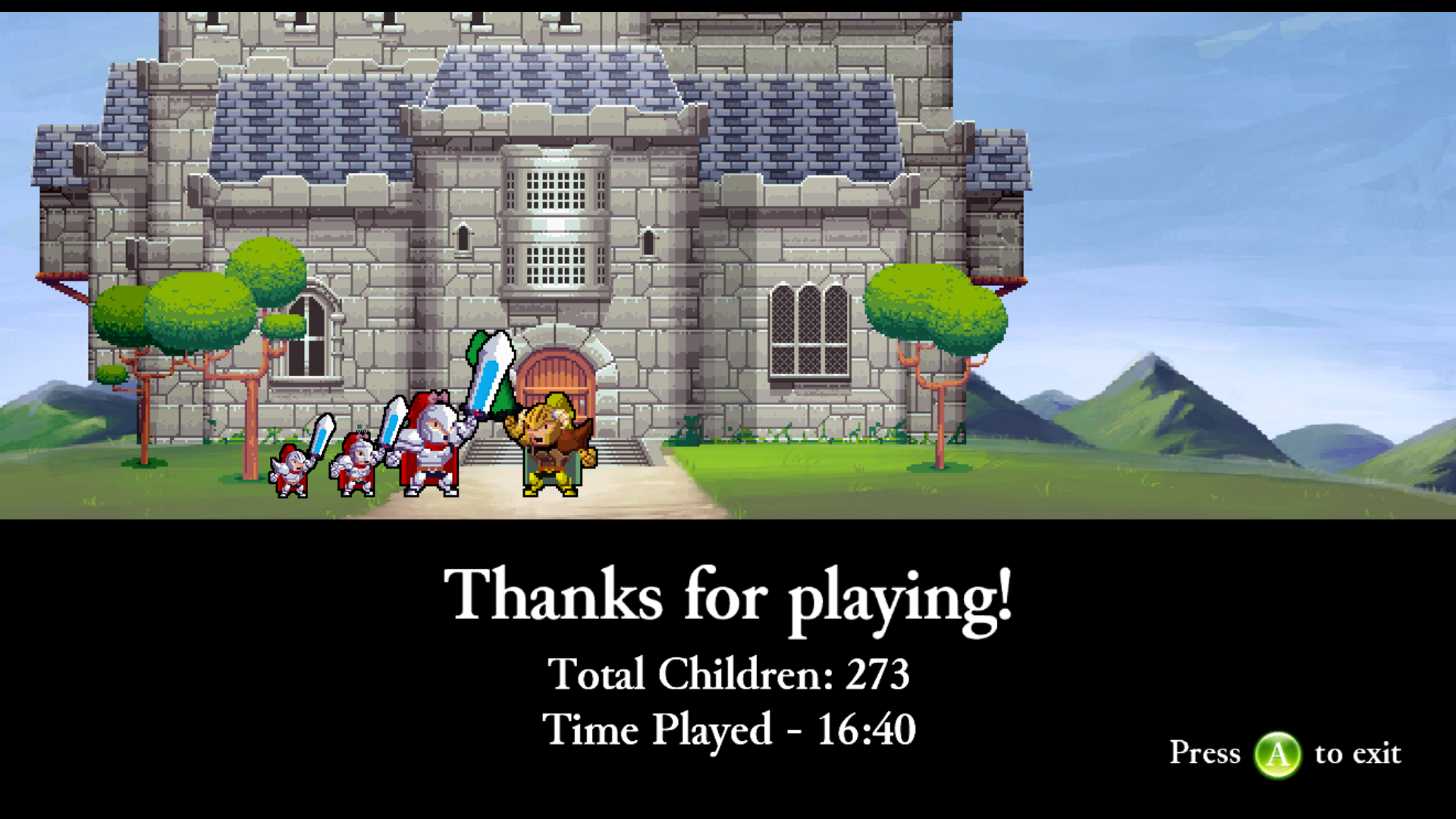
I’ll tack this on: Rogue Legacy is about generation after generation of a family who go into a castle only to be killed by the beings that live there. It is a meditation on predestination, much like every other game that feels the need to comment on why the hell a character would do these strange progressive tasks that we’re forced to do in games. I think that story is interesting, but it definitely didn’t hit me as significant or profound, and the entire narrative trope of the “final boss” left me confused as to why I was supposed to care. The game is about playing the game over and over again. I get it. So what?

ALSO: There are randomized traits that your character can have. These are things like dyslexia (all the text in the game is jumbled) or baldness (your character is bald.) One of these traits is “gay,” which has no effect on the game as far as I can tell. I’m very much uncomfortable with the addition of this trait–while 90% of the traits are genetic factors that are medicalized as disorders (dwarfism, hypergonadism), being “gay” (which is used for men and women) is both more complex than this and is definitely not a medical disorder or even a medical condition. It bothered me throughout the game, and ruins an overall great experience for what amounts to either a bad joke or an inclusive effort that reads really problematically (I can see a world in which the developers included the trait that has no effect on the game to make the point that having having non-heterosexual desire doesn’t make a person fundamentally different from heterosexuals in any way.) In any case, it gave me pause every time I saw it, and it only bothered me more as the game when on.

So those are my complex and diffracted thoughts about Rogue Legacy.

I liked the game, you can go buy it.

Posted in Video Games | Tagged , , , | Comments Off on On Rogue Legacy

Riff Raff Talks About Jodi Highroller

This is another transcription from Riff’s interview with DJ Whoo Kid, this time around the 4:00 to 4:30 mark.

NIMA YAMINI: What’s up with this character Jodi Highroller?

RIFF RAFF: It’s not a character, that’s–that’s me.

DJ WHOO KID: It’s like your alter ego? [I don’t think Riff heard him say this.]

RIFF: Okay, what’s your first and last name?

NY: Nima Yamini.

RIFF: Okay…so you’re…a…Nima?

NY: Yeah.

RIFF: And then you’re also? What’s your last name?

NY: Yamini.

RIFF: Yamini! See what I’m saying, so what’s up with this Yamini character you got? See what I’m saying?

DJW: That’s like nigga in Israel, right? Whatever. [he’s commenting on NY’s name]

RIFF: It’s another side–I think everybody–it’s just me.


Posted in Critical Riff Raff Studies | Tagged , , , , | Comments Off on Riff Raff Talks About Jodi Highroller

Riff Raff Talks About Process with Sway and Heather B

SWAY: The next song is called “Lil Mama I’m Sorry.” What’s that about Riff Raff? 

RIFF RAFF: All my songs, I just, you know what I’m saying, I’m not, I can’t classify myself as a general artist type person, I don’t want to disrespect anyone by doing that because the shit I do, I do it so fast, and I do it for fun, you know what I’m saying, so I just take my whole skills that I have back from high school and junior high be on the back of the bus freestyling and all that and I’ve just generally transferred all that shit forward, you know what I’m saying? So it’s not like I’m sitting there in the studio and like “man” I’m not that guy who stay in the studio ten hours, you know what I mean? And if I am in there for four or five hours I knock out like seven eight songs to get that shit out the way ’cause I really don’t like to be in the studio. So the songs that I knock out, I usually knock em out in like ten fifteen twenty minutes. So the answer to this song is that this is a freestyle song!

Posted in Critical Riff Raff Studies, Theory | Tagged , , , | Comments Off on Riff Raff Talks About Process with Sway and Heather B

On Living the Apocalypse in The Last of Us Multiplayer

I don’t think that I have much else to say about The Last of Us proper. People continue to play it and they keep getting pointed to my longish rambling bit about it (thanks to the people who are doing the pointing), but I don’t think I’ll follow up with anything about the plot or the game for a little while. Maybe.

I do want to say something really quick about the multiplayer for The Last of Us. Initially, I wasn’t even aware that there was a multiplayer component–it took a few days until someone clued me into it via twitter.

I can say that it works and is a clever mix of the stealth gameplay of the single player game with straight-up deathmatch multiplayer. The first couple weeks had some frustrating moments–queuing as an individual often pitted me against premade groups, which meant I and my rag-tag group got rolled pretty quickly about 50% of the time, for example. Thankfully, someone took notice of that and fixed it and now I play two or three matches a day, which is some kind of record for me because I’ve not played a console multiplayer game with that kind of frequency since the Call of Duty: Black Ops launch week.

The gameplay of TLOU is based, almost crassly, in brutality. It feels like that old Hobbesian chestnut about life being nasty, brutish, and short is being shouted in my year by a forty year old man every time I get downed by a shotgun to the face only to have an enemy stand over my prone body, flip it over, and blast my skull apart from literally inches away.

These are called ‘Special Executions,’ like they were handcrafted just for your viewing pleasure by execution artisans in a studio far away. And they were, I guess.

As you might know, I am from the American South, and I currently live there (here). The servers for The Last of Us seem to group much more tightly by region than other multiplayer console games that I’ve played. Being a console game, every teenager playing the game after 4:30pm has a microphone. I get to hear a lot of boring cursing and explicit threats of sexual violence, but I also get to hear their voices.

They have southern accents. They sound like people I grew up with. Sometimes they’re inflected upward, young, unbearably young to see the kind of violence that’s depicted in the game. Other times they laugh about the kind of killing they’re doing, this strange animal giggle while they watch their dressed-up, silly-hatted survival alter ego literally stomp the life out of another silly-hatted person.

I spent the entirety of The Last of Us listening to a southern man justify killing to himself and others. The multiplayer has me listening to southern kids gleefully murdering one another, and I have these flashes of post peak oil Atlanta, these kids wandering around in these tight-knit packs, doing the same things.

The game, once again, turns me back to Cormac McCarthy. In some interview, he talks about walking with his son and looking over and imagining fire over the hill and wondering what he would do. In the wake of the end of things, what do you do with your life? That thought ended up producing The Road, but I have a similar thought about the kids playing the last of us. These people simulating the brutality of living a life after the end of the world and taking joy in it–it makes me imagine fire over the hill.

I don’t have any conclusions. It just makes me fill strange.

Posted in Video Games | Tagged , , , , , | Comments Off on On Living the Apocalypse in The Last of Us Multiplayer

Harvest Moon: Extreme Ethical Farmer Edition Pt. 3

Do I have a chicken yet? Only watching the video will reveal the truth.

The Flower Festival happens in this video and the priest refuses to dance with me. I also talk about Marx’s analysis of the working day.

Posted in Extreme Ethical Farming, Video Games | Tagged , , , , | Comments Off on Harvest Moon: Extreme Ethical Farmer Edition Pt. 3

Trinidad James on Riff Raff

The below text is a transcription of an interview of Trinidad James by the excellent VladTV.

Interviewer: Have you ever met Riff Raff?

Trinidad James: Yeah! Riff Raff the truth.

[. . .]

TJ: Riff Raff’s been doing this way before me, so I feel like Riff Raff is just Riff Raff. He’s not the white [Trinidad James]. He has nothing…he has his own, he’s his own entity. You know, he didn’t have anything at all to do with me. He’s been doing his thing or whatever and I’m been doing me. You know I’m not “the black Riff Raff” like I’m not y’know I’m not that, I’m just doing me. […]

Interviewer: You know when someone come on with a crazy kinda style and stuff like that–

TJ: When you different, when you different…so many people don’t push the envelope so when you do you’re all envelopes together, you’re envelope family, you know what I’m saying. It’s just people talking as usual.

Interviewer: There was an interview that I don’t know if you’ve seen that the Hot 97 interview with Riff Raff?

TJ: I mean, like, you remember what you just said that whole thing about Joey? That’s Ebro’s opinion. You can’t..Riff can’t help that…I damn sure can’t help that, ain’t got nothing to do with me, you know what I’m saying? That’s how he feel. He said it, cause he said it, if we talk about it now and this is going to go online and people are gonna hear me talk about it, when Ebro said it he knew what he was saying, he’s been on cameras way before me, that’s how he felt. Can’t be mad at that if that’s how he felt. If Riff felt some type of way about it they could have fought, could have said something about it.

Interviewer: Riff was upset. Just because this was like his first Hot 97 interview…

TJ: Man, Riff a cool dude, man. He probably felt some type of way but it was what it was, you know what I’m sayin? Cause that’s just the way he felt, you can’t help how somebody feels. Shit, it ain’t really going to amount to nothing. It don’t stop Riff from flexin’ and riding around in a Porsche by the river, around Cali. It don’t do nothing. It don’t stop no money from coming in so why even follow that up for. That’s just somebody saying how they feel.

Posted in Critical Riff Raff Studies | Tagged , , , | 6 Comments

Jodi Dean Interviewed at Figure/Ground

As always, Figure/Ground has an exciting interview up, this time with Jodi Dean. My favorite part of the interview:

F/G: In 2009, Francis Fukuyama wrote a controversial article for the Washington Post entitled “What are your arguments for or against tenure track?” In it, Fukuyama argues that the tenure system has turned the academy into one of the most conservative and costly institutions in the country, making younger untenured professors fearful of taking intellectual risks and causing them to write in jargon aimed only at those in their narrow subdiscipline. In short, Fukuyama believes the freedom guaranteed by tenure is precious, but thinks it’s time to abolish this institution before it becomes too costly, both financially and intellectually. Since then, there has been a considerable amount of debate about this sensitive issue, both inside and outside the university. What do you make of Fukuyama’s assertion and, in a nutshell, what is your own position about the academic tenure system?

Dean: This is the biggest bunch of garbage I’ve ever read. I can’t believe anyone takes this seriously. Fukyama has it backwards: tenure doesn’t threaten academic freedom; it protects it. Can you imagine what a system would look like if people lived in perpetual fear of losing their jobs? How would their anxiety impact their students much less their ability to carry out research? In fact, it would look like the hideous financial sector with everyone thinking in totally self-centered ways and in the shortest possible terms. Much good academic work takes a long time –historians have to find collections in archives and then do their research; scientists have to design and carry out experiments. Scholars have to share their work with colleagues, subjecting it to critique and revising it accordingly.

The whole attack on jargon is barely masked anti-intellectualism. No one worries about the jargon of particle physics, neuroscience, or custody law. In fact, we recognize that knowledge takes multiple forms and speaks to multiple audiences. Not every audience needs to be (or wants to be) addressed the same way — and, again, it’s thinly veiled anti-intellectualism to imply that everything should be accessible to everyone. For example, I can’t read and understand a paper in theoretical physics, but I can read and follow a popular book on, say, black holes. That popular book would be worthless, however, without the real science backing it up. And, again, we shouldn’t expect that the same people who carry out the experiments, make the observations, and do the equations will necessarily be the ones to write the popular books.

You know, the real problem is this language of ‘costly’ — it points to what I already mentioned, namely, that the one percent has decided that it no longer wants to fund higher education for the majority. Why is it that tenure is costly but Lloyd Blankfein and Jamie Dimon are not? Their salaries in a single year –alone –would more than cover the salary of the entire faculty where I teach. Let’s not pretend that there is some kind of objective analysis of education going on here. It’s class war, plain and simple.

Posted in Quote Time | Tagged , , , , | Comments Off on Jodi Dean Interviewed at Figure/Ground