On Deadword

Deadword‘s homepage reads:

Launched in 1995, Word.com was one of the first-ever online magazines. In an era when the word “blog” hadn’t yet come into existence, Word captured individual voices telling honest, funny, weird, sad, and strange tales with a “realness” that, at the time, was nowhere to be found in mainstream print journalism. Stories were showcased by a colorful, weird, and eclectic digital design that won continuous clumsy negotiations with a technology in its infancy.

By the time Word was shuttered in the year 2000, it had become a repository for writing, music, visual and multimedia art from a list of luminaries too long to mention in a short introductory paragraph. Sadly, because much of Word was built with old timey web applications that no longer exist, the content here only covers the years 1995-1998. The archive from 1998-2000 is in pretty bad shape, with various broken links and missing images and sounds. Happily, we’re in the process of slowly restoring it. In the meantime, please enjoy these screenshots from the later era of Word, where semi-legendary multimedia projects like Sissyfight 2000, Fred the Webmate, Pixeltime, and USA Waste freely roamed the digital universe.

Upon being linked to this, I trawled through the different pages, doing a bit of archaeology to find the things that have been forgotten that might be interesting, or unique, or fun to read.

After spending a few days pinging around the site, I’ve realized that reading Deadword is deeply horrifying to me, and not just in the sense that it is scary, but that it is paralytic. Before Word.com was dead, it was alive, and not just alive, but thriving. I’ve read several articles that have shocked me in how brilliant they are, how fresh they feel, how much they still matter to me, a general reader, more than a decade on.

Then those articles fell away and were archived and hidden and became part of the mass of broken links and wordage barfed out in the proto- then proper- then post- blogosphere. All the things that we think are so properly important to our community, those evergreen articles of philosophy or games criticism or comics tumblrdom, they’re disappearing and getting owned by new companies and slowly, surely, things decay. Medium fails and we lose words, importance, weight that mattered at some time to some people who can’t ever return to or get returns from something they needed and wanted at one time.

In the case of Word, someone raised it from the dead. What about everything else?

#futurearchaeology
Posted in General Features | Tagged , , | Comments Off on On Deadword

The Indiecade Judges’ Comments on Alpaca Run

So the Indiecade comments came back. We had submitted Alpaca Run as a musical game full of joy and fun and whatnot. We didn’t get in, but we did get some comments back. Here they are in full–I believe there are three sets of comments separated by dashes. It would have been wonderful to get more than a couple sentences back, but I feel like this is the kind of interesting/helpful posting of comments that people are interested in. Transparency is a cool thing sometimes!

You can play Alpaca Run here.

Here are the comments:

—–
As advertised, this was a game.

I think this game is exactly what you wanted it to be – a short experience that makes the player smile for a bit. The sort of thing I’d like to see linked from a gaming blog for a quick afternoon distraction.

I’d be very surprised if you’re looking for much in the way of serious criticism or feedback given the tone of the game and submission (that isn’t a bad thing), but a way to share my score would’ve been cool. 😛
—–
Loved the video!
—–
The song is very cute, and the idea of a transcontinental alpaca having adventures is one that appeals to me. This game could have used some additional thinking to vary up the gameplay, and the graphics seemed temp at best, sadly (definitely check the tiling on those backgrounds!)

Posted in Video Games | Tagged , | Comments Off on The Indiecade Judges’ Comments on Alpaca Run

Dreamcast Worlds is Out!

picture001


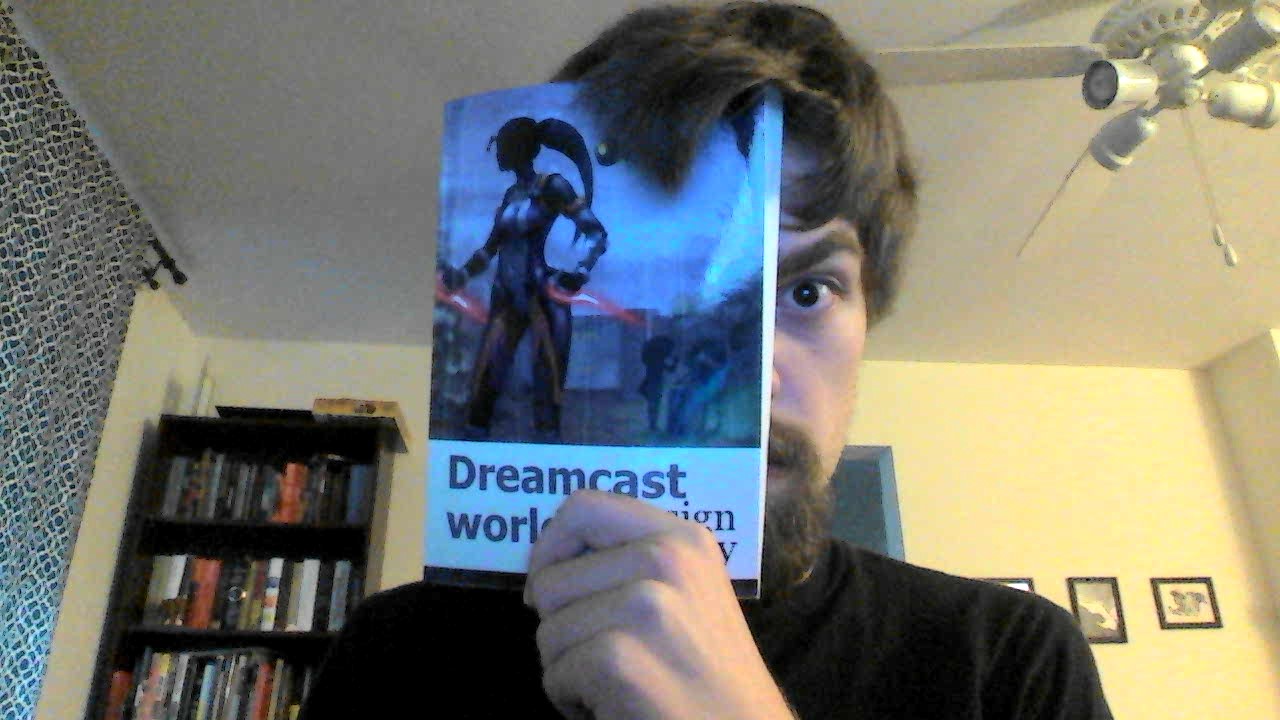
I’m a huge champion of material/symbolic/ historical studies of games, and Zoya Street has just released a book that hits all of those notes for me. Dreamcast Worlds is a close study of the Dreamcast, its games, and the world that allowed for those things to happen. As you can see, I got my physical copy in the mail today–I read the introduction of the digital copy a few months back and decided to wait out for a material object before digging in deeper.

You can buy a PDF or a softcover or a hardcover here!

Posted in Theory | Tagged , , , | Comments Off on Dreamcast Worlds is Out!

Sara Wookey on Why She Refused To Be A Part of Marina Abramovic’s MOCA Performance

I am writing to address three main points: One, to add my voice to the discourse around this event as an artist who was critical of the experience and decided to walk away, a voice which I feel has been absent thus far in the LA Times and New York Times coverage; two, to clarify my identity as the informant about the conditions being asked of artists and make clear why I chose, up till now, to be anonymous in regards to my email to Yvonne Rainer; and three, to prompt a shift of thinking of cultural workers to consider, when either accepting or rejecting work of any kind, the short- and long-term impact of our personal choices on the entire field. Each point is to support my overriding interest in organizing and forming a union that secures labor standards and fair wages for fine and performing artists in Los Angeles and beyond.

I refused to participate as a performer because what I anticipated would be a few hours of creative labor, a meal, and the chance to network with like-minded colleagues turned out to be an unfairly remunerated job. I was expected to lie naked and speechless on a slowly rotating table, starting from before guests arrived and lasting until after they left (a total of nearly four hours). I was expected to ignore (by staying in what Abramovic refers to as “performance mode”) any potential physical or verbal harassment while performing. I was expected to commit to fifteen hours of rehearsal time, and sign a Non-Disclosure Agreement stating that if I spoke to anyone about what happened in the audition I was liable for being sued by Bounce Events, Marketing, Inc., the event’s producer, for a sum of $1 million dollars plus attorney fees.

Sara Wookey, “AN OPEN LETTER FROM A DANCER WHO REFUSED TO PARTICIPATE IN MARINA ABRAMOVIC’S MOCA PERFORMANCE

Posted in General Features | Tagged , , , | Comments Off on Sara Wookey on Why She Refused To Be A Part of Marina Abramovic’s MOCA Performance

Michel Foucault On Video Games–I Mean Neo-Liberalism

I think that the uncoupling of of the market economy and laissez-faire policies was achieved, or was defined, at any rate, its principle was laid down, when the neo-liberals put forward a theory of pure competition in which competition was not presented as in any way a primitive and natural given, the very source and foundation of society that only had to be allowed to rise to the surface and be discovered as it were. Far from it being this, competition was a structure with formal properties, [and] it was these formal properties of the competitive structure that assured, and could assure, economic regulation through the price mechanism. Consequently, if competition really was this formal structure, both rigorous in its internal structure but fragile in its real, historical existence, then the problem of liberal policy was precisely to develop in fact the concrete and real space in which the formal structure of competition could function. So, it is a matter of a market economy without laissez-faire, that is to say, an active policy without state control. Neo-liberalism should not therefore be identified with laissez-faire, but rather with permanent vigilance, activity, and intervention.

Michel Foucalt, The Birth of Biopolitics pp.131-132

Oh look at that, neoliberalism functions in the exact same way as a game. Funny how that works.

Posted in Theory, Video Games | Tagged , , , | 1 Comment

Released: Catachresis: A Way Too Scary Game

IT IS HERE

header

You can play Catachresis here.

I don’t have a lot to say about the game currently. I’m very proud of it, and if it doesn’t break in the middle (save often, be gentle!), then you should also like it.

LAUNCH TRAILER (THANK YOU SO MUCH EVERYONE!)

For specific info please check out the press kit.

You can purchase the OST here.

You can download desktop versions of the game that (should) work here.

Posted in A Game I Made, Video Games | Tagged , , | 8 Comments

Derrida Accidentally Wrote About The Power of the Selfie in 1981

Time: the metonymy of the instantaneous, the possibility of the narrative magnetized by its own limit. The instantaneous in photography, the snapshot, would itself be but the most striking metonymy within the modern technological age of an older instantaneity. Older, even though it is never foreign to the possibility of techne in general. Remaining as attentive as possible to all the differences, one must be able to speak of a punctum of all signs (and all repetition or iterability already structures it), in any discourse, whether literary or not. As long as we do not hold to some naive and “realist” referentialism, it is the relation to some unique and irreplaceable referent that interests us and animates our most sound and studied readings: what took place only once, while dividing itself already, in the sights or in front of the lens of the Phaedo or Finnegan’s Wake, the Discourse on Method or Hegel’s Logic, John’s Apocalypse or Mallarme’s Coup de des. The photographic apparatus reminds us of this irreducible referential by means of a very powerful telescoping.

Jacques Derrida, “The Deaths of Roland Barthes” in The Work of Mourning, p.61

This is a quick explanation, but I like this paragraph a lot, and in true Derridean fashion it only makes sense if someone takes the time to explain it–so here we go.

Derrida is working through Roland Barthes’ concepts of the studium and the punctum. The former is what you see when you look at a photograph, sort of laundry list of objects and their history that you could account for it you were to make a kind of explanatory table of everything in a photo. The latter, the punctum, is Barthes’ work for something in a photograph that grabs hold of the viewer and refuses to let go, a kind of bear trap of affect that both draws attention and drains the viewer of her or his ability to do anything but focus on the single thing. It is a powerful, overriding force, and it is different for every single viewer.

What Derrida is arguing here is that the punctum is not unique to the photograph–the fixating function is inherent to any sign delivery system. The need to fixate and be drawn into something is something inherent in the transfer of meaning (Boris Groys’ theory of suspicion comes to mind here).

Arguments about medium specificity aren’t unique, but what’s special about this passage in the argument that Derrida is making about the particular affordance of photography that allows for a kind of highlight of the punctum: “The photographic apparatus reminds us of this irreducible referential by means of a very powerful telescoping.” By “telescoping,” Derrida doesn’t mean mere zooming. Instead, we have to think about what a photograph actually is–a moment and an incredibly small fraction of space trapped in stasis for eternity.

I bring this whole thing up in relation to the selfie because I think that selfie culture (whatever that might be) has come to the same conclusions about the punctum as Derrida did. It isn’t merely about framing or capturing the perfect picture–we’ve moved beyond the MySpace angle and the bathroom mirror. The selfie is not just about the creation of the self, of picking angles, of making my face look less dysmorphic and strange. Instead it is about attempting to craft a particular kind of punctum, a focal point, a haunting/lingering that stays with the viewer long after she or he has forgotten the studium of the photograph (clothes, facial hair, sand, umbrellas, the hotel balcony).

Or not, whatever.

Posted in Theory | Tagged , , , , | Comments Off on Derrida Accidentally Wrote About The Power of the Selfie in 1981

Frantz Fanon on Ontology

As long as the black man remains in his home territory, except for petty internal quarrels, he will not have to experience his being for others. There is in fact a “being for other,” as described by Hegel, but any ontology is made impossible in a colonized and acculturated society. Apparently, those who have written on the subject have not taken this sufficiently into consideration. In the weltanschauung of a colonized people, there is an impurity or a flaw that prohibits any ontological explanation. Perhaps it could be argued that this is true for any individual, but such an argument would be concealing the basic problem. Ontology does not allow us to understand the being of the black man, since it ignores the lived experience. For not only must the black man be black; he must be black in relation to the white man. Some people will argue that the situation has a double meaning. Not at all. The black man has no ontological resistance in the eyes of the white man. From one day to the next, the Blacks have had to deal with two systems of reference. Their metaphysics, or less pretentiously their customs and the agencies to which they refer, were abolished because they were in contradiction with a new civilization that imposed its own.

Frantz Fanon, “The Lived Experience of the Black Man” in Black Skin, White Masks

Posted in Quote Time, Theory | Tagged , , , , | Comments Off on Frantz Fanon on Ontology

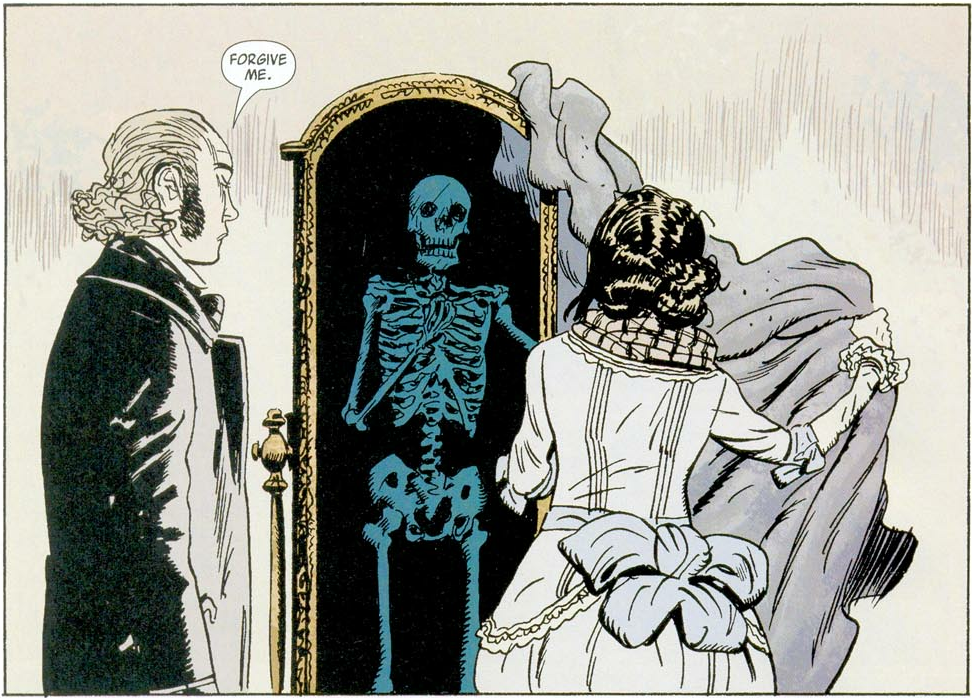
death

2 - thedead4 - 2

From BPRD : The Dead issue 4

Posted in Comics | Tagged , | 1 Comment

Maureen Ryan on the Writing of Breaking Bad

This week is DiGRA so I’m blog-light, but I’m still reading things. So there is this great piece.

“Breaking Bad” is an undoubtedly a great show, but, as is the case with too many television dramas, for while there it didn’t really know what to do with its female characters. The AMC drama clearly struggled to make Skyler and Marie Shrader (wife of DEA agent Hank Schrader) anything but subsidiary figures who rarely moved into — or deserved — the spotlight. Their behaviors and reactions were easy to predict, and if the writers didn’t show consistent interest in their emotional lives and the women’s inner depths, why would viewers care about them, let alone have positive responses to them?

I’ve been saying this for more than a year now, and I am super glad that someone has written this article and explained this in a much more cogent way than I ever could.

Posted in General Features | Tagged , , | Comments Off on Maureen Ryan on the Writing of Breaking Bad