Scu on being “that person”

Every feminist, every anti-racist, every queer theorist, every animal scholar, every person who has ever seriously engaged with the vicissitudes of identity and justice are all sick and tired of being that woman. Trust me, I know I am sick of being that guy. The one at the seminar or conference, after an anthropocentric and unsupportable point is made (we are humans because we play, or write sonnets, or whatever the idiocy is), and I sigh and raise my hand and they don’t want me to be that guy, but trust me, I don’t want to be that guy even more. It gets so bad that other people make me into that guy even when I am not being. I was at a recent conference, and I was asking a question not at all about animals or anthropocentrism, and the speaker decided my question was setting her up about animals and started answering a question totally different than the one I asked. Of course, is that persistence, that constantly being that person even though no one, especially you, wants to be that person that makes you willful.

– James Stanescu, “Vegan Feminist Killjoys (another willful subject)

Posted in Quote Time, Theory | Tagged , , , , | Comments Off on Scu on being “that person”

Twenty Years of Myst

My own birth is close enough to the birth of Myst that we’re basically siblings. I’m the older sibling that played with the younger; Myst is like the second child conceived for the added value of entertaining the already-existing child. So we grew up together, me a little bit ahead, looking back, able to see Myst change through my ever-shifting lens of nerd, heroin-chic, genderbending, trenchcoating, earth tones nihilist, big beard short hair (that’s a chronology if there’s ever been one.)

But I’ve always cared about Myst. In the late 1990s, I played it with my mother. Sometimes she would stay up all night playing and then back up a save the next day to show me how she solved a puzzle. She saved and scraped and cashed out a southern factory job “retirement” fund to buy a computer that would run Riven. And we played it together.

So congratulations Myst. You’re still lodged in the public memory. People feel the need to contextualize and memorialize you. Gamelife could be worse.

Posted in General Features | Tagged , | 1 Comment

The Nintendo Long Count Calendar

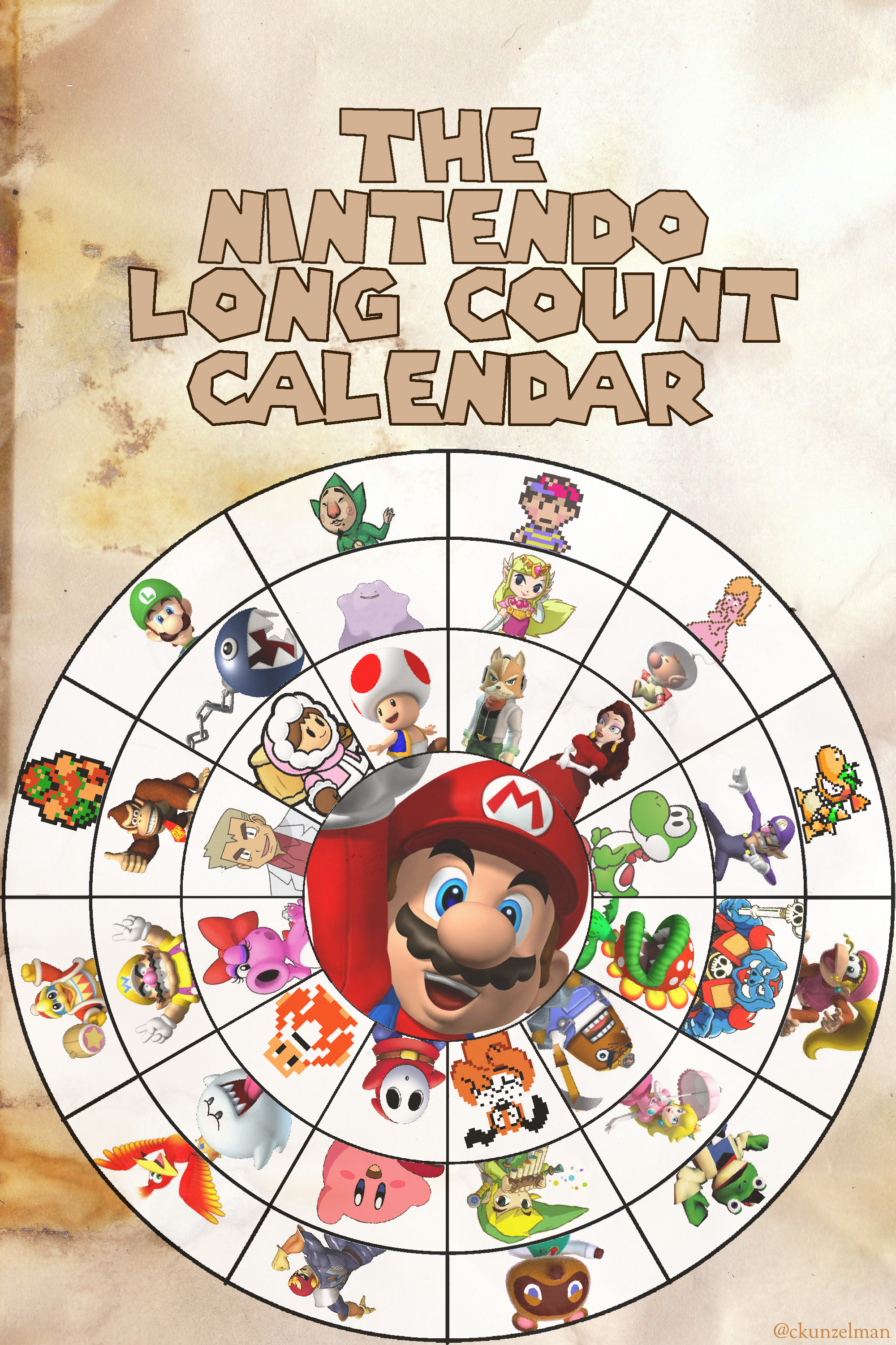
I made the Nintendo Long Count Calendar and Patricia has been kind enough to post it over at Kotaku.

Here it is, in all of its glory. It took me something like five or six hours to do it all–lots of choices, lots of photoshopping that I am not quite capable of.

Click on the picture for the truesize GIANT version that is high enough quality so that it would print out to the fairly decent sized poster.

nintendo long count calendar  - final


There’s a few ways to read it that “make sense” but my “official” way is below:

long count gudie

Posted in Video Games | Tagged , , | 2 Comments

Buy “It’s Just a Game”

So Elizabeth Simins has curated and released a zine called It’s Just a Game featuring some of the best games critics, writers, makers and whatnot out there. She’s just released a PDF of the thing, so there’s no reason not to pick it up and digitally cherish it for all time.

HERE IT IS PURCHASE IT

Posted in Video Games | Tagged , , | Comments Off on Buy “It’s Just a Game”

Why is Grand Theft Auto V So Conservative?

This post doesn’t have any spoilers that I am aware of.

v_jimmy_1024x768

I.

I’ve played something like ten hours of Grand Theft Auto V and while I don’t feel like I have a good read on the structure of the game, where it is going, etc., I do have another feel: boredom. I have mostly been bored.

There have been some great moments–switching between characters on a mission, the heists, riding an ATV, playing tennis. Mostly, though, it has been a great morass of driving around and doing very predictable, dare I say GTA-style, missions. Most have lacked excitement. “Go here,” the game says, “and kill this guy.” Or even worse: “Go here and do a fine-grained and intensive yet utterly unexciting task like towing or dockworking.” This isn’t how I want to be spending my stimulation simulation time.

II.

This past summer I played some Grand Theft Auto III. It holds up as well as you would expect. The control scheme, like most of the control schemes from the early PS2 era, is fumbling at best, and I’m honestly surprised that I was able to beat that game as many times as I did when I was a #teen. And I did beat that game, over and over again, playing through every mission and collecting every secret package and tracking down every weird internet rumor that I could about the game. If you can fly the Dodo all the way to the first island, or you can purposefully glitch into Blue Hell, then anything could be possible.

“Anything could be possible” is probably the best summation of my memories of GTAIII. I didn’t understand how games were designed and built then, being a #teen, and so I had a wild-eyed acceptance of everything I was experiencing. I also thought it was amazing for all the things you could do, including running down pedestrians, murdering rival gangs, and doing sick jumps. While today that game feels painfully limited (you can’t even swim!), at the time it was amazing, and I have fond memories of the experience.

When I fell in love with the idea that “anything is possible,” I also became deeply attached to the object that gave me that “anything”. I didn’t want to give up the world, the possibilities. More importantly, I didn’t want to give up the chance that we could get more but better in the future (which Vice City eventually did give us). These feelings on my part were partially politically oriented. To my young mind, it seemed like what I enjoyed doing with my free time was under attack–Jack Thompson and the various legislators who had, and have, made it their pet project to “protect” children from “excessive” media were spinning up on the topic of video games (yet again) just as I was really settling into “my” world [Jacked is a good book on this. I had my problems with it, but the sections on Thompson are great.]

So I went to ground. I doubled down, as young men do, on rhetoric about free speech and censorship and media effects. I learned about the history of the arguments around the topic. I read up on polemics written during the birth of the novel, film, radio, and television. I became a small-scale “expert” on the topic so when teachers would try to pin me down on questions about violent representation I would be able to speak up.

At the same time, I spent every weekend with friends where we talked about how cool the characters of Grand Theft Auto III were. We fake-planned drug deals, talked about freedom, talked about how to get rid of bodies. These are all things that teen boys talk about, I think–we would have had these odd fantasies of fictional power whether we had video games or young men’s novels or just some sticks in the woods–but GTA gave us a particular frame to discuss it. The game was, after all, modeled on the real world. Then some of us went on to try for that absolute freedom, the dealer’s life, excessive violence in the face of our social situations and I really do wonder about pattern recognition.

III.

I told that long story to give a sense of my investment in GTAIII back in the PS2 era. As I said before, I recently returned to the game.

It isn’t funny. It isn’t engaging. It is boring and a chore to play. More importantly, it always was.

The Grand Theft Auto series is only successful because of investment. It is the old Thomas Hobbes trick–you give someone an entire world and it is up to that person to make something of it. In the case of GTAV, the world that is given to the player is (intended to be) the largest possible world. Not only is this apparent in the physical location, as shown very clearly in the map size fetish around the game, but also ideologically. The game very clearly intends to allow as many people as possible to be part of the experience, and nothing gets at this better than the “humor” of the game; it is designed to be above all politics, the kind of “we make fun of everyone” that gives even the most virulent racist or sexist a way of escaping criticism. The radio is full of jokes–about conservatives admitting to being assholes during their campaign commercials, about liberals who claim that having a tv show makes you a liberal, about consumerism and Weasel News and everything in between. The sundry cast of characters the player meets in the game works similarly: the paparazzo who has to get the scoop and casts his blatant awfulness in the language of a public good, the FBI agent who demands a torture for the sake of torture rather than to get information, the yogi who preaches selflessness and concentration while demanding that a customer push her butt into his crotch. By making fun of “everything,” GTAV is trying to convince us that it is above any real commitment to an ideology.

I said a few words ago that the game “very clearly intends to allow as many people as possible to be part of the experience,” and I want to follow it up with “the game clearly fails at doing so.” The very attempt to speak from the position of the God’s eye view, somewhere away from ideology, is a guarantee that you are enmired in it. The game is so deep in casual and explicit sexism and racism that it can’t see it, let alone be critical or above it; oppressive politics is the air that Grand Theft Auto V breathes.

v_frisk_me_1024x768

IV.

So why is Grand Theft Auto V so conservative? I don’t mean that in the sense of the political party, although they’ve taken that moniker on for a reason, but rather why is its politics so regressive, racist, and sexist? Why has “doggy style” sex been a visual joke twice in ten hours? Why are two of the primary narratives “black man trying to struggle out of the hood” and “white successful criminal,” both of which have been rehearsed over and over again in media?

I think part of it is a time issue. The political moves of Grand Theft Auto V make a lot of sense in the context of the ever-more-sanitized late 1990s. In a decade where the body, the fetish, and violence were increasingly seen as the only aesthetic ways from breaking out of the “end of history,” Grand Theft Auto makes a lot of sense. Lampooning Democrats and Republicans on in-game radio hit so hard in 2001, but in a world where pundits and politicians are already sounding like parodies of themselves, these jokes don’t really land. When the world you’re creating as a parody is hardly distinguishable from the real world, the parody might as well not exist.

Another part, related to time, is that that core tenets of GTAV are no different than those of GTAIII: making a point by shocking people. When GTAIII came out, there was still power in that–MTV, independent cinema, and Marilyn Manson had all demonstrated that purposefully alienating parents was a powerful way to draw an audience. It worked–for many people I knew, GTAIII was just as exciting for its function as a “fuck you dad” as it was as a game. But in retrospect, the “shocks” of GTAIII weren’t shocking at all. They were the dominant culture repackaged in ethnic stereotypes, in homophobic jokes, and in misogynistic writing.

The Grand Theft Auto series has always been about selling our own shitty culture back to us and then explaining that we’re transgressive because we buy it.

What’s shocking after reality tv? What’s shocking after sex tape culture? What’s shocking when grisly and graphic murder is some of the most popular entertainment? This isn’t an appeal to something far away, to a long lost past, but a real question: what is Grand Theft Auto even doing anymore? To make its regressive politics seem progressive it has to project us into a past, or worse, create a strange fake version of the world where being a generally crap human being is seen as heroic. When we’re playing GTAV, we’re not experiencing a fiction of the present; we’re playing historical fiction, ideological fiction, where terrible and boring people can be thought of as progressive and interesting.

 

Posted in Video Games | Tagged , , , | 12 Comments

Foucault on the Biopolitics of Socialism

One thing at least is certain: Socialism has made no critique of the theme of biopower, which developed at the end of the eighteenth century, and throughout the nineteenth; it has in fact taken it up, developed, reimplanted, and modified it in certain respects, but it has certainly not reexamined its basis or its modes of working. Ultimately, the idea that the essential function of the State, or whatever it is that must replace the State, is to take control of life, to manage it, to compensate for its aleatory nature, to explore and reduce biological accidents and possibilities…it seems to me that socialism takes this over wholesale.

Michel Foucault, “Society Must Be Defended” p.261

Foucault is being pretty down on socialism, but there’s a way in which Marx pre-answers this critique of socialism (and implicitly communism) in Capital with a massive “no shit.” The entire point of a communist or socialist revolution is to wait until capitalism has created its own gravediggers by creating industrial machines and then training the populations of workers to use those machines. Marx’s ideas need a system of population management already instated so that communism can effectively manage that population. So not only does socialism not “critique” the mechanisms of biopower, it actively desires and needs those mechanisms in order to come into being.

Posted in Quote Time, Theory | Tagged , , , , | 1 Comment

Two Scenes From a Grand Theft Auto 5 Playthrough

It was midnight.

Franklin walked through the Vinewood Hills. He hid and then wandered around gated estates, hopping easily over walls and fences. Houses were large blocks with textures that displayed, clipped, did not look quite right, and behind those wrapped cubes there are families, cars, lights and lives. He did more. He did less. The sun came up and the day decayed and Franklin did more of the same.

Michael jumped through a door and ragdolled and hurt himself and didn’t comment, didn’t say anything. He hit the ground and he stood up and he did something, he never fell down, it never happened. He ran and jumped into a waist-level rail, flipped over it, fell three stories.


Posted in Video Games | Tagged , | Comments Off on Two Scenes From a Grand Theft Auto 5 Playthrough

Bifo on the 1980s

At the threshold of the 1980s, punk had proclaimed the abolition of the future.

Humanity no longer had any reason for remaining together. This was the feeling, the premonition. Nevertheless, the politicians, journalists, intellectuals of the time all hastened to declare that, with the workers’ political strength finally eliminated, with utopia finally stamped out, an era of unlimited enrichment could begin.

Officially the 1980s were the years of development and freedom.

It matters little that competition was exalted as the noblest feeling, and so violence of one against all others was thereby sanctified; it matters little that profit became the ruling point in culture and in communication. So, the arrogance of the ignorant became widespread and promoted as a way of life and of achieving success. This decade was an age of capitalist insurrection, and thus it officially became the age of civilization, freedom and progress.

Franco “Bifo” Berardi, Felix Guattari: Thought, Friendship, and Visionary Cartography pp. 24-25

Posted in Quote Time, Theory | Tagged , , , , | Comments Off on Bifo on the 1980s

Mark Gonzales on Not Speaking

MG: I like it and I hate it. I don’t really like the marketing or the business of skateboarding…the sport by itself, I just like skateboarding, it’s fun, it’s a fun thing to do.

You don’t like photosessions either?

MG: No. I mean, it was difficult for me to do this here with you, I didn’t want to. I was going to tell another kid to come with you guys, you know, I told you on the phone. So…

Why?

MG: It takes away what’s special about it, when you, when you video or when you…you know, when you explain something, you, you know people either beli–listen to what you say and they understand or they don’t understand, and I would rather not give them the opportunity to understand or not understand. It is better to not say nothing than to say something.

– Mark Gonzales, here

Posted in Quote Time, Theory | Tagged , , , , | Comments Off on Mark Gonzales on Not Speaking

Thinking About Trolls with Foucault

I was reading through Foucault’s Madness and Civilization this morning when I ran into this passage from the second-to-last section, “The Birth of the Asylum”:

Madness is childhood. Everything at the Retreat [a specific asylum Foucault is analyzing] is organized so that the insane are transformed into minors. They are regarded “as children who have an overabundance of strength and make dangerous use of it. They must be given immediate punishment and rewards; whatever is remote has no effect on them. A new system of education must be applied, a new direction given to their ideas; they must first be subjugated, then encouraged, then applied to work, and this work made agreeable by attractive means.” [Foucault is citing De La Rive here] [p. 252]

Foucault is clearly outlining a process that European and American systems of domination move along very comfortably–outline a population, assert that it isn’t fit to govern itself, insert governance, domination, and violence to both erase and make that population hypervisible. Infantalization is one of the most efficient methods of achieving this. Children have to learn how to become adults; culture has to happen to them so that they can make their way into the labyrinth that is existence. By positioning any minority population as literally minor gives the dominant modes of thought all of the justification that they need to politically and culturally re-educate, absorb, and cordone that minority.

I made a lateral connection while I was reading, however, to the ways that internet cultures often position the troll. While these processes are clearly unrelated, the rhetoric is eerily similar. Your bog-standard internet troll is stereotyped as a fedora-wearing, acne-covered, obese, basement dwelling manchild. Much of the arguments around trolls and their behavior comes from this arguably charitable position, and I say “charitable” here because the key assumption in a number of arguments about trolls is that they could somehow come around if only we put in the time and effort to pull them around to our side. The well-loved (I know I love it) “But I’m a Nice Guy” video makes this connection very clear–trolling has nothing to do with being a bad person, but fear. The argument that springs from this is that if we could fix that fear (through positive socialization, through more exposure of women on the internet, through better comment moderation), we would be making leaps and strides toward less awful trolls on the internet.

At the same time, I have my own fear that this can’t possibly be true. The various stereotypes I mentioned above have little correlation to the mass number of trolls and straight-up harassers on the internet. There is no way to identify the troll in the world; the stereotypes exist to give us the fiction that there is a visible population who have somehow gone “wrong” (there’s nothing wrong with being any of the things I mentioned, after all), and if we educate them, if we take their seemingly infinite ability to spit bile (an “overabundance of strength” if I’ve ever seen it), then we can channel it into a life that isn’t about making fake Twitter accounts and threatening people.

My fear is that that fiction actually carries meaning. My fear is that the stereotypes have gained such purchase that it is difficult for us to culturally think about the fact that the worst trolls in the world can be someone you know quite well who doesn’t possess a single marker of the troll stereotype.

I recognize that I’m lining up a progressive movement in the present with an incredibly oppressive and violent system of the past, but that’s sort of Foucault’s point–these asylums were developed under the auspices of a public good, something that would allow the community to “fix” its problem population by educating that population about the proper rules of conduct for the social.

Maybe trolls aren’t “broken” and maybe they aren’t merely “products of the culture.” Maybe they’re not outliers. Every time an awful moment of harassment happens, I count the seconds before the defense equivalent to they know not what they do to pop up to absolve someone. Maybe trolls who spend their day harassing other people are just shitty, awful people, and maybe we should spend more time making people safe and less time trying to “fix” and defend assholes.

Posted in General Features | Tagged , , | Comments Off on Thinking About Trolls with Foucault