On Truth: Red, White & Black

I don’t know how to start this.

Truth: Red, White & Black is about superheroes.

That isn’t right.

Truth: Red, White & Black is about comic books.

Ugh.

1. Superheroes

Truth: Red, White & Black is the story of the first Captain America. You all know about Cap, even if you don’t know anything other than his recent film and The Avengers. Captain America is a super soldier, given powers not through crazy genetics or aliens or magic, but through good old fashioned World War 2 science.

I have always thought there was something strange about this idea. A German scientist, defecting to America during the second World War, uses his designs and thoughts about human biology to craft a blonde-haired, blue-eyed superman who goes off to punch Nazis. There’s always been a hint of eugenics, of human experimentation, and of science-for-its-own-sake that made me uncomfortable.

Truth renders this discomfort palpable. Robert Morales and Kyle Baker make the history of Captain America’s super soldier serum explicit: it came out of experimentation on African Americans.
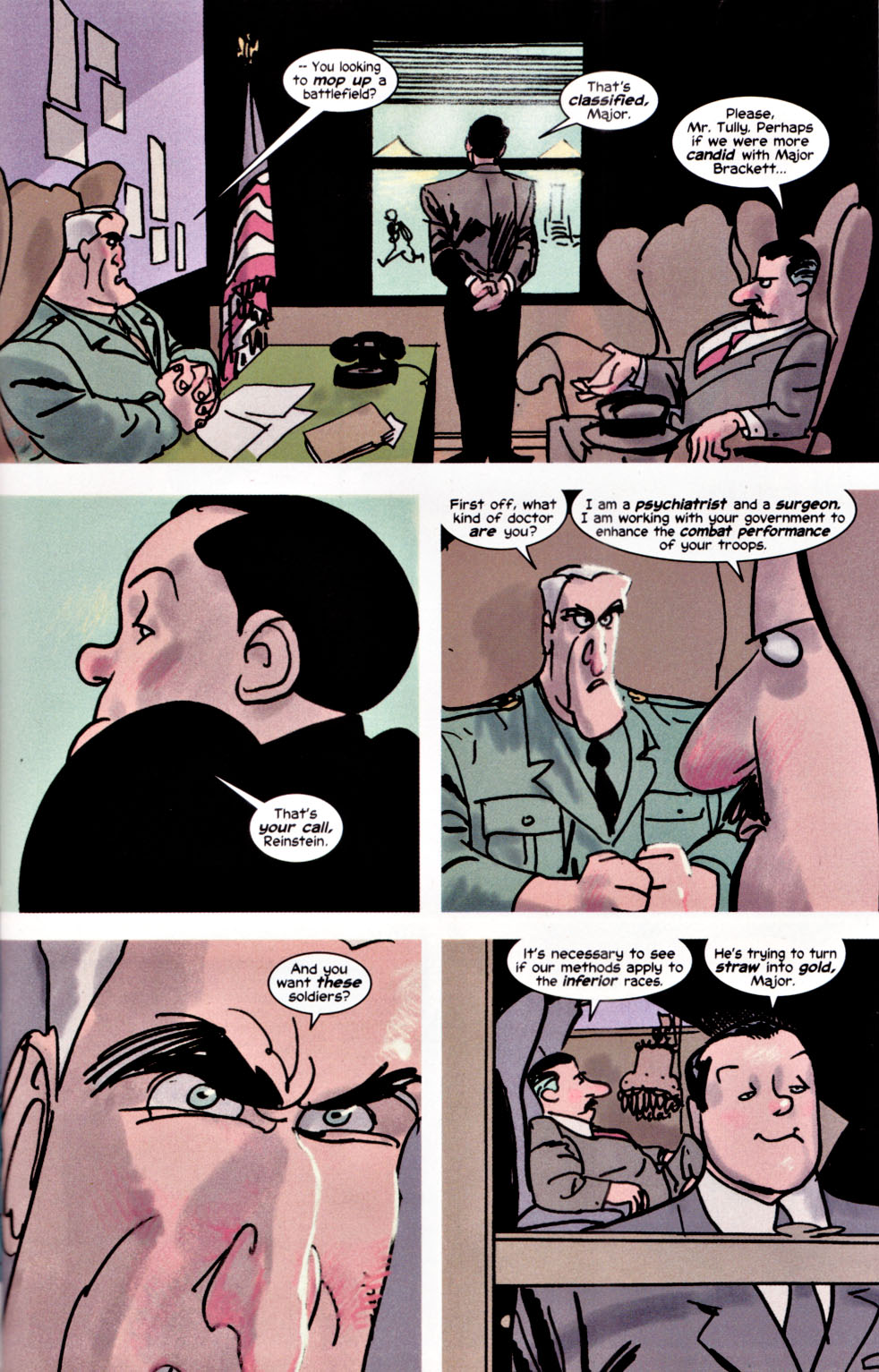
I have two simultaneous reactions to this. The first is horror, of course. The use of African Americans as test subjects for terrible things has a long history, and the kind of systemic racism that allowed for it fills me with sadness. There is no way of apologizing for it–there should be eternal shame about it. The second reaction is jaded, but it was “of course.” The history of technological development is one of destruction and genocide. The amount of suffering that goes into the construction of every iPod is unimaginable–why would the super soldier serum be any less?

There are many things that the reader is shown in Truth. We are explicitly made aware that the soldiers who were not admitted to the super soldier program were summarily executed. We are shown a man who explodes, his body literally pressed to physical limits by the muscle-growing serum. We are also shown the cold calculation behind that murder–now the scientists know how much serum is too much.

I could continue to tell you about the pain and suffering that is shown in the book. I could describe, in detail, the double violence of black men being reduced to mere weapons and then robbed of their lives. But that shouldn’t be the focus when I talk about Truth. The focus should be on the fact that these racist, fucked up behaviors are real. They have historical presence.

And they also show us that everyone needs to be aware of these things. White privilege still exists today, just as much as heterosexual, male, and a myriad of other subject position privileges that determine political existence in the world. Identity violences didn’t somehow disappear–they are still here, working their pain. I think it is something to be aware of, and there needs to be a realization on a personal level of the same kind that Captain America has. He realizes that his very act of existing in the world is a way of covering up and implicitly accepting an ordering of the world that eliminates and obfuscates minority positions. The grand signifier that is Captain America can only exist on the backs of crushed black bodies.

It throws the world in perspective.
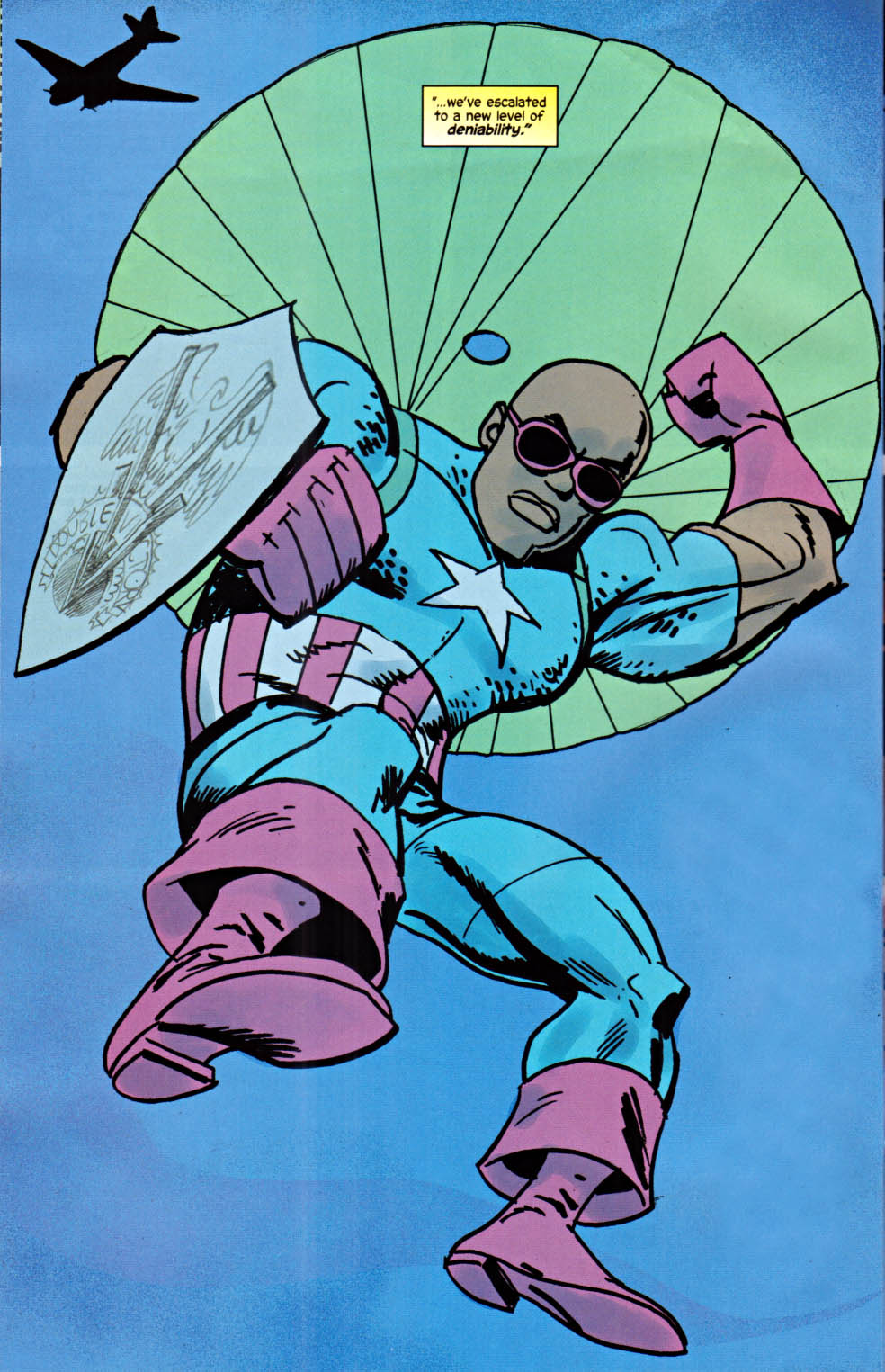
So I think Truth does good things. It is a song that has to be sung.

2. Comics

This is a secondary bit to the stuff above, but just as important: I think Truth has something to say about labor and who is supposed to get access to the the products of other peoples’ labor. Obviously these things are not equivalent, but there are parallels in the logic of the racist science machine and the Big Two comics companies. I don’t think there is a coincidence that the bodies of the African American test subjects are drawn in a very Kirby-esque way. It is a visual shorthand to make us think about the history of comics production, just like the comic itself forces us to think through the American history of race. Comics were made by people who had no choice–they signed by contracts because they wanted to make comics and that was all they were good at. Kirby was a person who wanted to make the things in his life come to life on a page, just like the men in the comic simply want to serve their country.

Both Kirby and the soldiers were abused for merely existing in the world and attempting to live life how they wanted.

For a better reading of Truth that is probably closer to what I should have written, check here.

Buy Truth if you want to. The name is changed for the paperback/HC.

Posted in Comics | Tagged , , | Comments Off on On Truth: Red, White & Black

On Cow Boy

Cow Boy is an odd thing.

There is a seriousness in it that can’t be forgotten–a boy is rounding up his entire outlaw family and turning them in. He is a bounty hunter, and whether that job description came as a result of wanting to find his family again or not is something that is left unanswered in the comic.

There is also comedy. It is, after all, a ten-year-old boy hunting around the Old West. He is as much a being of the plains and hardtack, saddles and novelty steel worn on hips too round and weird to be real.

His name is Boyd, and as you will see, that isn’t his horse.

But beyond this weird, spatial talk that I’m throwing around up top, there is something amazing about Cow Boy. It manages to ride the line between seriousness, sadness, and pure comedy in a way that is rare in the comic book form. Comics have a problem when it comes to comedy–it requires timing, and in a 2D world where chronology is absent, it really does require a deft hand to make jokes work. Cosby and Eliopoulos, the writer and artist respectively, have a tight storytelling that genuinely made me laugh out loud and feel a quaint, small sadness at the same time. The comic is a gem in an internet world of shit comics produced for the web. They deserve to be celebrated.

Taking it one step beyond this sort-of review, Boyd is a fascinating character. Sometimes we are shown what he is thinking, but mostly only in moments where it drives the story or the comedic action of plot. There are several moments where Boyd sits on his horse, riding, and we are merely seeing the world as it is. We are presented with the image of Boyd, not the character or thoughts of him, and thus his most private moments are rendered absolutely opaque to us. The following page, my favorite in the comic so far, really shows this:

I know that any half-smart writing about the Western United States automatically draws comparisons to Cormac McCarthy, but come one, this is classic McCarthy stuff. There is a “simple aggression” in Boyd, but it isn’t something that we see in the comic. Instead, we see a calculating boy who constantly overwhelms the expectations of those around him, defeating small-town sheriffs and hooligans alike. The simple aggression is hidden from us, part of the opacity that surrounds Boyd. That final panel, where Boyd looks both sad and thoughtful, is one of the few moments where we see him as an actual child. A kid and a horse, laying down for the night, ready to do it all again tomorrow.

Boyd has a long life ahead of him.

Read the comic. Talk about the comic. Make people read it. It really is amazing, and we need more stuff like this.

Posted in Comics | Tagged , , , | Comments Off on On Cow Boy

Cabinet Interview with Sianne Ngai

This isn’t something substantive, but rather it is a moment where I tell you video game and comic book people that you have to read this interview that Sianne Ngai did with Cabinet last year. Ngai writes on aesthetics in a really cool way, focusing on the marginal, non-extreme affects and emotions that are generated from aesthetic experiences. Here are some pull quotes that will force you to read the piece:

On video games and zaniness:

The dynamics of this aesthetic of incessant doing are thus perhaps best studied in the arts of live and recorded performance—dance, happenings, walkabouts, reenactments, game shows, video games. Yet zaniness is by no means exclusive to the performing arts. So much of “serious” postwar American literature is zany, for instance, that one reviewer’s description of Donald Barthelme’s Snow White—“a staccato burst of verbal star shells, pinwheel phrases, [and] cherry bombs of … puns and wordplays”—seems applicable to the bulk of the post-1945 canon, from Ashbery to Flarf; Ishmael Reed to Shelley Jackson.

I’ve got a more specific reading of post-Fordist or contemporary zaniness, which is that it is an aesthetic explicitly about the politically ambiguous convergence of cultural and occupational performance, or playing and laboring, under what Luc Boltanski and Eve Chiapello call the new “connexionist” spirit of capitalism. As perhaps exemplified best by the maniacal frivolity of the characters played by Ball in I Love Lucy, Richard Pryor in The Toy, and Jim Carrey in The Cable Guy, the zany more specifically evokes the performance of affective labor—the production of affects and relationships—as it comes to increasingly trouble the very distinction between work and play. This explains why this ludic aesthetic has a noticeably unfun or stressed-out layer to it. Contemporary zaniness is not just an aesthetic about play but about work, and also about precarity, which is why the threat of injury is always hovering about it.

Value judgment and aesthetics (this has particular weight to the “video games: smart?” debates that have been going on):

The act of professing aesthetic pleasure or displeasure, in and of itself, is not interesting to me. What is interesting is the complexity of the ways in which people then defend these judgments (which they feel just as strongly compelled to do). As Simon Frith aptly puts it, “Value judgments only make sense as part of an argument and arguments are always social events.” So in my comment above, I just was thinking in a general way about what John Guillory calls the “constitutive role of conflict for any discourse of value.” That said, the argument of my second book is that the commodity aesthetic of the cute, the performance-oriented aesthetic of the zany, and the informational and discursive aesthetic of the interesting have a unique and even indexical relation to the ways in which the subjects of late capitalism consume, labor, and exchange. Insofar as these socially binding processes are also, inevitably, sites and stakes of social struggle, the aesthetic categories featured in the book reflect these struggles, albeit in a highly indirect and mediated fashion.

Read the bloody thing right now. It is good for you.

Posted in General Features | Tagged , , , , | Comments Off on Cabinet Interview with Sianne Ngai

On Zero-Player Games

Jesper Juul has posted a fascinating article titled “Zero Player Games: Or What We Talk About When We Talk About Players” over at his blogzone. It is a cowritten piece between Juul and Staffan Björk, and I found it interesting for a few reasons that I’m going to outline below. I suggest you go read it–there is some good stuff there, though it does get pretty theoretical at times (the words “mathematics” and “proofs” were used a couple times, and my brain just shut down because I have the thinking capacity of a tiny child).

Some points:

1. To lay it out there, because I always feel like I have to, the article assumes that cognitive players who are not machines or algorithms must be humans. It isn’t true, lots of animals play games. The essay is anthropocentric, but certainly is more open to nonhuman players because it works through intentionality–anything can have the appearance of intentionality. Next point.

2. The idea that players exist as a specter to games is brilliant. The player is always there, even when the player is specifically excluded from the design of the game. For instance, Progress Quest is designed around the intention of a player to see skills increase, to have adventures, etc., even though the player never does those things. The ghost of the player is still designed around, it is the focal point of the entire experience. If I were feeling smarter (and if all of my books weren’t packed up and a hundred miles away), I would give you the appropriate quote from Derrida to back up this ghost talk (also, “Structure, Sign, and Play”).

3. The last bit of the essay takes a little turn. We are provided with this list of traits that are applied to the entity “player”:

By removing players, we could, perhaps paradoxically, show what was removed. Players turn out have a number of separable traits each highlighted by a specific type of zero-player game.

  • Players having continued agency: Setup-only games remove players’ interaction with the game state for (perhaps) the majority of the time that the game plays.
  • Players as humans: AI players negate the need for players to be human.
  • Players as temporal beings: When a game is solved, or when a game is purely hypothetical, it does not require actual players (human or not) to play it. The player effective becomes an atemporal idea.
  • Players as having intentionality: In most cases, and even in the case of AI players, we easily identify a player as an entity with an intention to perform well in a game. That intention does not need to be rooted in a psychological fact, but can simply be the exhibit of a preference for success over failure. The corollary to this is existence of spoilsports; entities that are supposed to be players but who exhibit no intention of wanting to perform as well as possible in a game.
  • Player as having aesthetic preferences: We have several times alluded to the fact that players tend to exhibit preferences for different games. Actual, human, players prefer certain game experiences to other experiences, and will compare games, and categorize games into genres. The initially quoted player-centric conceptions of games are thus revealed to be a specific type of zero-player game, that do not reflect the behavior of real players, only a type of hypothetical player devoid of aesthetic preferences.

I disagree with the second trait for obvious reasons. The fourth is weird because it assumes that players always want to win a game. I think that we can probably make assumptions that players have intentionality in that they intend to play the game–they want to navigate the world-space and ludic ecology of the game. Not everyone wants to win. Sometimes you want to be killed. I had a Day Z experience like that today–I wandered around until someone killed me, and I did it on purpose. In any case, that list is unsettling to me for reasons that I can’t put into words right now.

In any case, go read the article. You will be better for having done so, whether you agree or not (I don’t know where I stand right now.)

Posted in Video Games | Tagged , , , | Comments Off on On Zero-Player Games

A Brilliant Bit By Erin Manning

I am writing a conference paper and crunch time is upon us. I don’t have a lot of time for blog posts, but I think you will want to read this bit by Erin Manning from her book The Politics of Touch.

The movement invoked by a reaching-toward must always be uncertain: when I reach toward you, I do not know what I will touch–I do not know yet how your touch will return to me. I know only that I am willing to take the risk inherent in the movement of reaching-toward. This uncertainty is predicated on the double-take of touch. If I pretend to know the outcome of my reaching-toward, I am not really reaching-toward. In other words, when space is preconstructed (when the space between is overdetermined by my certainty about you and your simple location in the world), there is no space to cross, there is no chronotope to create, and ultimately, there is no potential for touch as a reaching toward. (122)

I am particularly concerned with this passage in relation to animals in factory farms and laboratories. I’ll let you do the interpretive work.

Posted in General Features | Tagged , , , | 3 Comments

“Creators are more important than fictional characters and corporations.”

Today was going to be my review of Kotsko’s Why We Love Sociopaths but I got busy writing something for Nightmare Mode and running errands, so that has to wait at least one more day.

Instead, you get this gem that Jamaal Thomas wrote over at Funnybook Babylon.

For the most part, the post is just a condemnation of DC Comics’ treatment of Alan Moore and the general massive fuckery that has gone on in that camp over the past couple years. It then spreads into a larger discussion about creators rights and our ethical responsibilities as consumers of comic books. Thomas writes:

Are we members of a thriving community dedicated to a unique art form? Or are we simply consumers of entertainment products featuring our favorite characters? There’s something very freeing about being a consumer. You can limit your engagement with the industry to buying comics at your local store, from Amazon or on Comixology. You can care about creator’s rights to the extent that they are protected by criminal and civil law. Your purchasing decisions can be purely defined by the quality/entertainment value of the work. If you’re a customer, it’s all about choice. In contrast, if we self-identify as members of a community, we feel an obligation to assume an expanded sense of responsibility to our own, even if they signed a bad contract.

I’d prefer to be a member of a community. There’s nothing dishonorable about limiting one’s engagement with industry to consuming the product, even though I would hope that readers who make this choice try to be ethical consumers by paying some attention to the conditions under which the books they enjoy are created.

Creators are more important than fictional characters and corporations. They are more important than the fifteen minutes of entertainment that I get from reading a good Marvel/DC superhero comic, or the two hours plus of ‘entertainment’ from a superhero action movie. I don’t know if that means I should stop reading comics published by Marvel or DC yet. I want to continue buying books written and drawn by some of my favorite creators, many of whom don’t publish work independently or for other publishers. I don’t really want to boycott either publisher (though I understand why some do). I like contributing to not-for-profits or other funds that support creators in need of help, but that just doesn’t feel sufficient.

I’m not quite ready to quit, but Moore’s words keep echoing in my mind.

This is basically my exact feelings on the subject. I’m not ready to make the David Brothers leap just yet, but I am incredibly close, and it isn’t like I buy enough Big Two for it to matter much in my life anyway. The only cape comics that I really read with any regularity are whenever The Punisher kicks up into high gear, which is pretty rare. Other than that it is Animal Man when he is being written well, fun one-shots, and miniseries. I’m pretty certain that no one at the Big Two makes comics for me anyway, so it isn’t a hug loss.

Anyway, I just really wanted you to read that bit I quoted and to check out Thomas’ article. It is good stuff.

Posted in Comics | Tagged , , , | Comments Off on “Creators are more important than fictional characters and corporations.”

On Plink

Go play Plink. Do it right now.

I don’t have a lot of things to say about the game. It is poetry in motion, and when you are playing with a few other people, you can really feel it click. My virtual musical self often gets into grooves with other people. We chase one another. A resonant beat follows our friendship. She disappears; I am left alone, a friend with the newcomer.

Maybe I do have something to say about it: it is anonymous affective love. There is something special happening when you create a double helix around the play of another person.

Posted in Video Games | Tagged , , , | Comments Off on On Plink

On The Last Broadcast

I watched The Last Broadcast recently. I really liked the film (though I thought the end was a cheesy cop out), and if you’ve seen The Blair Witch Project, there are some really interesting shared aspects between the two films. The Last Broadcast came out the year before, and you can read about the “controversy” between the two films in an interview with the creators of the film here.

I would normally review the film, talk about the way it constructs a space of experience, etc., but I really think the film does all of that for you. It deconstructs itself in the end, which makes it less interesting to talk about. My post a long time ago about Blair Witch probably covers everything that I would say about The Last Broadcast.

So in lieu of doing real analysis, I am going to give you an image breakdown of the whole film. These are screenshots that make up, for me, what it means to watch The Last Broadcast. So here are thirty something screenshots, taken chronologically, that sum up the act of watching The Last Broadcast. There are spoilers, so there is a cut after the first couple.

Continue reading

Posted in General Features | Tagged , , | Comments Off on On The Last Broadcast

Video Games and Tony Barlow’s Sharp Teeth

I just finished reading Tony Barlow’s Sharp Teeth. It is a brilliant novel about werewolves in L.A. written in verse. I realize that nothing about that previous sentence sounds even remotely interesting, but trust me.

Anyway, about halfway through the novel I can upon this little segment:

“Ever heard of Pong , Jason?”

The theory is simple.
Every boy, every man, is really
a bit of a golden retriever
or a big chocolate lab.
Watch any man’s eyes
at the bounce of a ball.
His head tilts slightly sideways, just a hair,
as a primitive focus
comes to life.

Follow the ball.

The basketball, the tennis ball, the baseball,
the golf ball, the lacrosse ball, or in this case
the mere symbol of a ball, a plain white dot,
floating across a dull, black screen.
And just like that, the pupils sharpen their gaze.
The game begins.

Stay with the ball, follow the ball.

The mind opens there, a psychological soft spot,
where reason’s stubborn persistence fades
and some underbelly is exposed.

Just follow the ball, stay with the ball. (158)

I don’t have any grand statements to make about that selection, but I do think that it captures the act of play almost perfectly. Obviously, I believe that the divide between the human and the animal is a thin, fictional boundary, and the animal desire to play and game is the same as the human one. I am in the middle of getting some work together to write about human/nonhuman animal cooperative gameplay, and this really resonates with me.

To ruin Li Po, we sit together, the animal and I, until only the animals remain.

Posted in Video Games | Tagged , , , , | Comments Off on Video Games and Tony Barlow’s Sharp Teeth

Abjection and the Video Game

Over at RPS, Jim Rossignol has a great article up about the way that bodily functions are represented and accounted for in video games.

Rossignol highlights two reasons that biological functions like eating, urinating, etc. are included in games:

1. They are funny.
2.  They “create game systems that are immediately comprehensible.” By this, he means that we can immediately identify with the desire to fulfill the drive to eat and the drive to urinate.

Toward the end of the article, Rossignol says this:

Indeed, why should I feel a glimmer of satisfaction at being well stocked with cooked food as my Minecraft character waddles off into his cubic wilderness? Because the alternative – starving to death in a cave – is so bleak, and so threatening. It’s a shortcut into real experiences. Games in which we must take precautions against even these most basic of needs are games which challenge us to pay attention, to plan, and to reap the rewards of our preparation and our caution, when we are caught in a difficult spot. They are also games that speak directly to us as normal human beings.

“Normal human beings” language aside, this is a great point. I want to think in reverse of this article, though. What does it means that the majority of games actually eliminate those functions? I think of Skyrim, for example. It is a game that is all about taking on the subjectivity of the character you are playing. You shout, you cast fireball, you shoot a bow. But you never poop.

Kristeva’s concept of abjection, that which we must ignore and cast out to live, seems to be important here. “To each ego its object, to each superego its abject,” she writes in Powers of Horror. So, at one time, the abject of the video game might have been mere nonexistence; it could have been the blank screen, the death of the game, or even the kill screen. Maybe it was leftover data, the strange mix of things that exist and yet cannot be represented or shown without throwing the entire assemblage that is a game into disarray.

The project of abjection is to hide things that interrupt our social and personal lives so that we can live them in peace–we hide or destroy corpses because they both physically and mentally attempt to destroy us. They make us aware of death, of the rotting self, and of disease. We don’t like that, and to maintain peace, we eliminate those things. But we also hide them–burying a body isn’t actually getting rid of it, but rather hiding six feet down, preventing us from seeing it, and eventually it biologically morphs into nonexistence.

So, on face, it looks like adding these things into the game provides a more “real” experience for the player. Urinating and eating food become things that you have to do; starving to death in a cave, the ultimate abject that rests in the back of the mind, is simulated in the game world. The game becomes a more full experience, more like real life.

But that is just another kind of mask; adding a poop function to Skyrim is just burying the body. The abjection of the game is separate from that of embodied human experience. Assuming that digital objects (and worlds) are superegos (they probably are), we have to assume that they have an abject. “On the edge of non-existence and hallucination, of a reality that, if i acknowledge it, annihilates me,” is the Kristevan way to put it.

And maybe this is right. The abject of the game object/world is the programming, the code, that hides all of the junk data and complex rigging that produces the world. The only way to see the hidden corpse, the maggots, the vomit of the video game is through looking at code or breaking the game. Clipping through walls or getting to blue hell.


Posted in Video Games | Tagged , , | 1 Comment