On Cart Life

Cart Life broke me in less than half an hour.

cartlife_002_20122012_150251

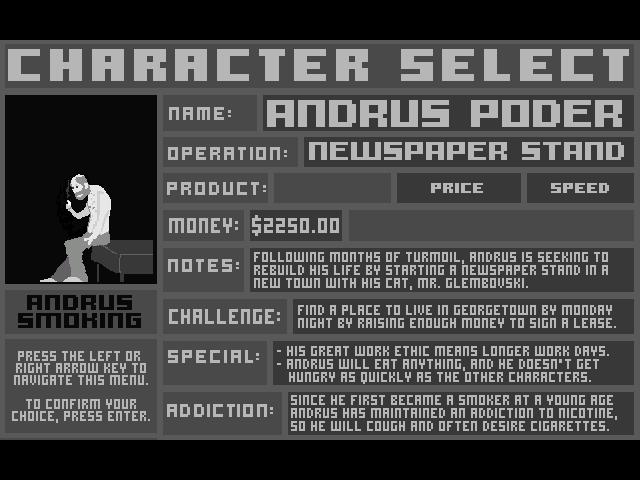
I started the game as Andrus Poder. Andrus Poder is from Ukraine. He works on his English by translating Ukrainian poetry while on the train to his new life. He has a cat, Mr. Glembovski, who he cares for deeply.

Andrus purchased a newspaper stand for $2,000. He rented a room where Mr. Glembovski wasn’t allowed for something like $125 a week.

Andrus tried to walk to a mega mart for a litter box and some food. It was closed. Andrus went home, showered, and brushed his teeth. He woke up hungry. He took the bus to the mega mart again, purchased some peanut butter and jelly, and went to work. Andrus was too hungry to open his own shop.

I fumbled. I couldn’t figure out how to eat. Andrus was hungry. I couldn’t figure out how to eat. Andrus was hungry. I tried to go into a bar and buy food. The bar wasn’t open. Andrus was hungry.

I closed the game application.

cartlife_008_20122012_151656

I knew that Cart Life would be a sad thing. I knew that something bad would happen. It is definitely part of my personal information politics that I am constantly waist-deep in stories and narratives of economic failure and systemic disenfranchisement and abjection by systems (the State, capitalism, etc.) These issues are important to me, so I stay educated on the specifics of things.

But there is something especially heart destroying about having to watch as an intelligent person and his companion animal are reduced to nothing.

Cart Life, in the twenty minutes or so that I played it, communicated to me so well that I was doomed to fail that I ejected myself from the experience to save myself the sadness. I don’t think that has ever happened to me before. The game, with its aesthetic and mechanics, was able to inform me so quickly that it would be emotionally effecting that I was able to make a gut check decision about it.

I’m writing a lot of words about this, but honestly, I’m just shocked. I’m shocked that it did this to me. I’m shocked that I wasn’t prepared for it, and I’m shocked that there is something so immediate about the effect. 

Posted in Video Games | Tagged , , , | 1 Comment

David Lulka on the lawn

The condition of the lawn in winter presents a more difficult set of issues. The immanence of grass presents no ethical challenge when lawns remain stagnant in the late summer heat. During winter and spring, however, immanence rears its head more vociferously. The grass, new and green, prospers, growing to the ankle and then above to an inexact height. More prominently, I have had weeds that are taller than me. For my part I would just as soon let the grass grow and do what it will. And, to the extent I am able, that is what I do, because the gardening activity I despise the most is mowing the lawn. I despise it because I know there are things in there, many things, which have found, for the moment, a bounty that is good. Certainly, that bounty even feeds upon itself. But that is none of my doing. And so I prefer to wait, holding off the point in time when I come along and reconstitute its form and make it a proper lawn. I wait and I wait and I wait, as I know that when I am mowing the lawn, when I am enacting an aesthetics, I am killing many things.
 

David Lulka, “The Lawn; or On Becoming a Killer

Posted in Quote Time, Theory | Tagged , , , , | Comments Off on David Lulka on the lawn

In Case You Missed It

So go look at In Case You Missed It before you read this post.

If you’re reading this, chances are good that you have seen the phrase “in case you missed it” over and over again on Twitter and Facebook.

The phrase only makes sense in the fast moving world of contemporary social media. If you post a link to something at noon, by five o’clock, unless it has been retweeted or shared throughout the day, it has faded into the mists of social media time. “In case you missed it” is a way of fighting the information tides–it allows you post repost that link hours later in order to drive traffic to it.

For example, I will post a link to this article somewhere around noon today. At about 7pm, I will repost it, saying something to the effect of “In case you missed it, I wrote about In Case You Missed It.”

The impetus to write “in case you missed it” makes sense. With so much writing going on, and the access times of many people varying widely, especially when global readers are taken into account, it does seem like a courtesy to say “hey, in case you missed it, here is my thing.”

But there is also a second face to “in case you missed it.” This face is false-apologetic. It is a face that suggests that we’re always extending a courtesy, that we’re just posting the article in case you missed it, like it somehow slipped through the view of the random twitter reader.

This is interpersonal spam with an apologetic face.

I’ve been actively poking fun at people who say “in case you missed it” on Twitter for the past few weeks, mostly with the intent to highlight how often we use the phrase in order to linkspam people who follow us. On one level, it is a social courtesy phrase that suggests we’re apologetic about having to do the linkspam. On another level, it is a phrase that serves to hide the actual intent–“hey, look at this.”

Nothing shows this more clearly than the number of actual spam posts that use the phrase “in case you missed it.” Twitter ads for toys, corporations, nonprofits, and nearly every other advertising space litter their tweets with “in case you missed it.” With it, they are doing the same masking that I do when I give the pretense of courtesy to my linkspam tweets–they want to wear a different kind of face.

The mask, in the case of spambots, is the mask of humanity. A common courtesy extended by a nonhuman is equal to a common courtesy extended by a human–we’re all apologetic, we all just want to help one another out with the spread of information that might be useful or helpful. For the bot, spreading these sweet deals on Legos is necessary for its continued existence. After all, it exists only to do that. How different is that from the human, though?   Does the gift of linkspam for the human twitter user imbue a meaning to the life of that giver? There is something to say about the lure of metrics and people viewing and engaging your work–it can become a driving force behind internet writing.

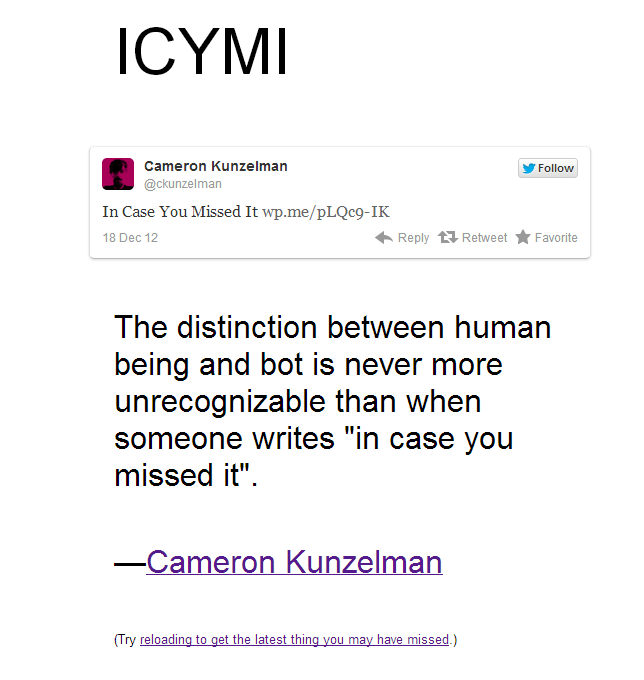
All of these thoughts led me to say to Darius Kazemi that

The distinction between human being and bot is never more unrecognizable than when someone writes “in case you missed it”.

He, because he is an amazing person, immediately took it upon himself to create In Case You Missed It. It, as I understand, searches twitter for the most recent usage of the phrase “in case you missed it” and displays that tweet. It updates in real time, and refreshing the page gives you the most recent result.

The line between human and bot collapses–without the context of the full twitter feed, it is often impossible to tell which tweets are by complete spam bots and which are about self-promoting (or friend-promoting) human twitter users. It is pretty amazing.

I also want to note another tool that does a similar thing–Joel McCoy‘s Twitgnostic. It is an extension for Chrome that strips all of the information that Twitter would normally give you. It turns each user into mere words and language, rather than a specific being with a specific goal in their communication. It is brilliant.

I have been told that Twitgnostic makes me indistinguishable from horse_ebooks sometimes.

also:

incase

Posted in Theory | Tagged , , , | 5 Comments

On Killing is Harmless

2012-10-07_00096

I recently had the concept of “sandwich criticism” explained to me. It goes something like this: you open a critique of a paper, or anything really, with a positive note. That’s the bottom slice of bread. They to proceed to make the biggest shit sandwich in the world, piled high with negative remarks, verbiage, and open hatred. Then you close by saying “this was a great contribution, good work, yes!” That’s the top slice of bread. I give this weird explanation because I want you to understand that I’m not doing sandwich criticism of Brendan Keogh’s Killing Is Harmless.

That said, I am going to heap praise where praise is due: Killing is Harmless is all of the right moves. The book itself, as an object, is a great idea. I fully support the project of working through a difficult text in public and drawing readers into that experience with you–that’s what this blog is, after all. I also think that the games criticism community needs to be exposed to more long-form criticism. At this point, you have to either hope for a long-running series or read academic books in order to get substantial, and systemic, criticism of a game.

Beyond that, I think that the general comments that I have about Killing Is Harmless are well-covered by Darius Kazemi’s review. I share the same problems that Darius does–Brendan buys into the narrative so much that he can’t pull away, and at the end, I think he’s reading himself more than anything else. This is fine; I understand that, and it is sometimes valuable when done correctly (I also believe the Keogh is doing it correctly). Brendan manages to ride a very fine line between my own game centered criticism and his deeply personal subjective experience.

What I’m doing here is not reviewing Killing Is Harmless. I am deploying a critique of it, just as I would any other book that I read and thought critically about. The following is the result of reading Killing is Harmless in two sittings and then promptly losing all of my notes for the latter half of the book. It is also the product of a lot of thinking–I read it a few days ago, and since then I have mostly been mulling what I want to say over in my head. A book of this weight deserves a fair chance and not an immediate, gut-check criticism. I gave it some time, and here we go.
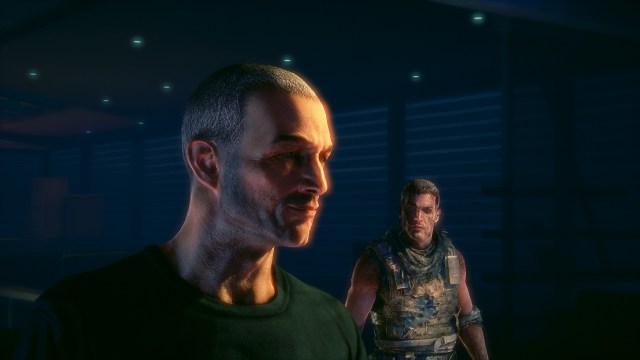
2012-10-07_00097

1. Mental Illness and Choice

Keogh opens Killing is Harmless with a Foreward that develops a theoretical framework for the book. In essence, he is setting up the stakes of his argument–he contextualizes the game is a particular time and culture, particularly through his use of the term post-Bioshock.[1] From that, he develops a core question of current “manshooter” games–why are we doing this? Keogh sees Spec Ops: The Line as a game that explicitly addresses this question and ultimately succeeds in at least partially answering it–we do it because we justify it to ourselves constantly. We make the slaughter of human-shaped polygons acceptable behavior, and this is mostly communicated to us by the blase attitudes that the characters of the games have toward those deaths. “Good guys” like Nathan Drake kill thousands of people over the course of a single playthrough of a game, but the effects of those deaths are never felt–they’re never taken seriously.

Spec Ops does take it seriously, however. It puts the violence, and the responsibility for that violence, squarely on the shoulders of the focal character of the game, Walker. Keogh writes that as

Walker is forced to commit increasingly terrible acts, who he is changes. What he looks like changes. What he sounds like changes. Perhaps what is most disturbing about Walker is that the more damaged he becomes, the more like a normal playable character he appears.  If Walker goes insane over the course of The Line, Nathan Drake and the many other playable character that came before must have been insane long before we joined with them. [2]

He follows a few sentences later:

The Line suggests that our characters are sociopaths because of what they do in their games, and then it draws attention to just who it is that is making these sociopaths do these things that they do: the player. Suddenly joking about sociopathic characters isn’t so funny when we are indicted along with them.[3]

It is this discussion of nonnormative mental states that I want to tease out. The argument that Brendan is making goes like this: “a person forced to do the things that we do in contemporary shooting games would develop a mental illness of some kind.” He also wants to shift the focus a little–instead of thinking these are always-already “ill” characters, we should understand that we, as players, are the ones in control. If Walker “loses his mind,” we are ultimately the responsible party.

I think there is a critique to be made here about the nature of contemporary warfare. The hierarchical structure of the modern military, particularly the United States’ armed forces, has had a very hard time adapting to postmodern warfare. The development of the language of the “enemy combatant” signals a shift in legal and designation thinking; we cannot clearly identify enemies so much as bodies with unknowable motivations. The military is deployed, told to do XYZ objectives, and then are let loose. Friends and enemies meld into one another; a parked truck is a bomb; a human being is a target and a terrorist and a shop owner; the contemporary period has highlighted the polyvalence everything, but the military structure hasn’t adapted well. In that sense, Walker and his two subordinates are a living testament to the inability of the human to adapt to the conditions that the American military creates. How do you navigate a space where objectives are crystal clear but your obstacles are not?

I understand why conditions like post-traumatic stress happen to a significant number of soldiers. Thrust into a bad situation and trained to do the unthinkable, they perform as they are told to. And that doesn’t come for free.

Keogh is never able to address this issue, however, because he is mostly focused on Walker’s mental state and how it interfaces with “choice.” There are several moments in the game where material “reality” does not match up with the subjective experience that Walker (and the player) perceives. The finale of the game reveals it in a series of quick cuts to these scenes–the radio that Walker used to speak to Konrad, the “villain” of the game, was broken the entire time; Konrad’s forcing Walker to distribute capital punishment was totally imagined by Walker. There are several of these events. Keogh, in characterizing these events, lenses them through “choice.” He writes that

The Line says something about how we define choices. Each time Walker insists that he ‘has had no choice’ he is in fact refusing to acknowledge the choices he has already made. He chooses willful ignorance simply because it is easier–as we all do regularly.[4]

A few sentences later he writes that

His blatant denial of the situation, the way that he makes things worse by refusing to open his eyes, is not a unique character trait.[5]

Keogh’s goal here, I believe, is to further solidify an argument that he makes throughout the book: players always have a choice. There is no such thing as being “railroaded” or forced into bad choices in a game because we have the ultimate power: we can stop playing the game. For Brendan, Walker’s biggest failure is the fact that he says that he has no choice when he really does (he could leave Dubai); this is also our great sin as players.

But I find this discussion of choice as applied to Walker as a character to be misplaced. The opening of the book, after all, is focused on how we, as players, generate characters with mental illnesses. Keogh’s assertions over and over again that Walker should just have chosen, that he should just have opened his eyes, is ignoring his own point that Walker is mentally ill. At best, he has severe trauma from seeing hundreds of human beings murdered; at worst, he has deep-seated mental illness that has gone unchecked for years. Asserting that he has a choice implies that he should somehow just “get over it,” that Walker, if he would just pull his head out of his ass, could see the world for how it really is and get out of Dubai.

In the chapter “The Gate,” which deals with the infamous killing of civilians through a player-controller white phosphorous attack, Keogh writes

Of course the real choice Walker has is to turn around and leave Dubai, and the real choice the player has it to not play a military shooter that asks you to drop white phosphorous on people. . . . Walker is choosing to be in a situation where he has no choice, and so am I. The Line doesn’t really want players to stop playing at this point. It simply wants us to accept responsibility for the situations we allow ourselves to be in.[6]

A few pages before this, Keogh addresses his own “sanity/insanity” dichotomy as it pertains to the characters, which I think is important to put out before I address the above quotation.

Watching and playing their adventure, it is hard by the end of the game not to think of the members of Delta as having always been insane. But what moments like this outburst show is that they are, in fact, among the most sane videogame characters of all time. The insane ones are those that don’t react to what the player forces them to do.[7]

What I understand this second quotation to be saying is that the characters, as they exist in relation to me, are “sane” because they react “realistically” toward the violence that they commit and witness. The “insane” characters (do I need to expressly say how uncomfortable I am with this language?) are the ones who do things that they players tell them to; they quip when headshotting nameless enemies from two hundred yards. The “sane” person has a choice, has the ability to walk away, and because Walker is “insane” he cannot see that he should give up his missions.

If we accept that Walker has a mental illness, and I do (whether it is pre-existing the narrative of the game or developed over the course of it,) I can’t say that he had any choice at all. A depressed person doesn’t have a choice to be depressed. A schizophrenic doesn’t have a choice on what she or he perceives in the world. And, therefore, if we follow the Walker/player analogy that Keogh sets up, then the player didn’t have any choice either. Let’s be honest here–with our interesting critical interjections aside, the player doesn’t have any options when it comes to deployment of white phosphorous or violence against digital humans in Spec Ops. We can always turn off the game, but, frankly, I think that is a cop out. We are never forced to interact with media. There is a choice to begin playing, or to begin watching, but after that we enter into a kind of contractual relationship with the work–the game has an expectation of me. It expects me to give it attention and to play it on its own terms, with the promise of a “full” experience. The Line doesn’t want me to stop playing after I kill civilians; it wants me to witness.

Do I really accept responsibility? And does it want me to? If the intent of the game, whether that be its own or that of its designers, is to force me to accept responsibility for forced actions, then there is an unsettling message being sent to those who live with mental illness. This thing that you have no control over with? Take responsibility for yourself. And what about deployed servicepeople? Are they supposed to take responsibility for actions that they are ordered to do. After all, they also, structurally, have no choice.

Brendan chooses to find a strength there. The game, by forcing the player to do something terrible and then own up to it, is a maturation of the genre. I can’t see that, though. I can’t see that as anything other than a massive failure on the part of the game. I don’t see a beauty in the assertion of personal responsibility in the face of massive and brutal structural issues; the game makes the player do one of the most evil things possible in modern war and then smugly asks “well, did you learn the right lesson from that? Choice was impossible all along!”

Fuck that.
2012-10-06_00008

2. Dark Hearts

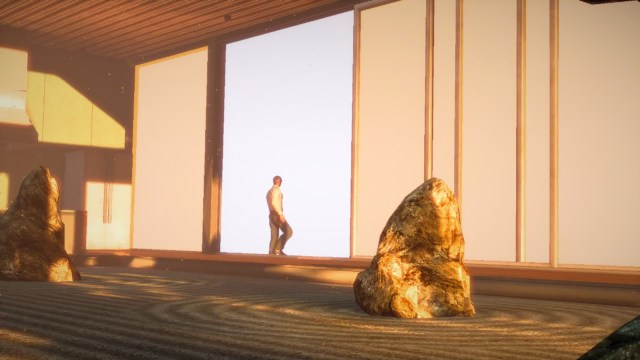
In preparing to write this critique, I went back and reread the final section of Heart of Darkness. How could I not? Spec Ops: The Line hangs from the story’s skeleton. The story of one person becoming more and more like the other, oddly, provides a template for Killing is Harmless. As Darius Kazemi wrote in his review, Brendan played The Line and was “lost in the sand of virtual Dubai.” He went in. He came out changed. I want to balance the following criticisms with my admission that the process of being fundamentally altered by a piece of media is a good thing. I’m glad that Brendan had the experience he had while in relation with Spec Ops.

The criticism that I am about to block out in short, staccato rhythm will follow this vague pattern: the process of reading and playing Spec Ops pulled Brendan in so fully that he couldn’t help but see every single moment of the game as significant. This abundance symbolic material meant that every moment of gameplay generated an excess of material to interpret. This, ultimately, caused an overreading of the game that generated a fictional equivalent; the game that Brendan played isn’t a game that exists.

The strange thing is that, on face, I think he should have every right to do that. God knows that I’ve done that my fair share, and most people who interact with and write about games regularly do it too. After all, Brendan is very clear in the Foreward of the text that he is merely attempting to get at what The Line did for him:

So what follows is not a defense of The Line nor is it a praise of The Line. It is simply a reading. It is an attempt to pick apart this game from start to end to try to understand just how I was so powerfully affected by it.[8]

This caveat, however, gets thrown out the minute that he begins making statements about what things means. There is very little prefacing of “I took this to mean” or “for me.” The word “meant,” as an appeal to the designer-gods of the experience of the game, is used fairly often. A song is “meant to make us feel uneasy about our actions.”[9] The “not to Abu Ghraib is meant as a kind of balancing.”[10] This is a lot of implicit understanding intent for a book that claims not to “know, objectively, exactly what The Line is ‘about.'”[11]

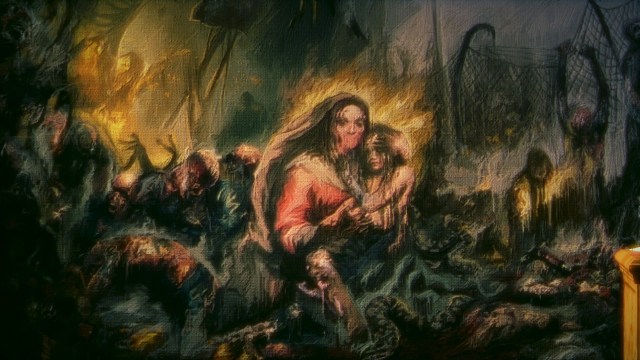
The abundance of significance the Brendan finds in the game–in his detailed analysis of the music, the set pieces, and the characters–was mostly lost on me during my playthrough. I went through the game. I caught brilliant glimpses, but it was mostly dreck. Brendan actually gets close to my understanding of the game as a whole during the chapter on “The Pit”:

Overall, I’m still at a loss of the meaning of the mass grave at this particular point in the game. Is it foreboding? Is it to show just how hard life is in post-storm Dubai? Are all these bodies executed people? Is this the “LIAR’S LAIR” the graffiti alluded to? Or is this a simple grave? I still don’t really know, and I struggle to contextualize it in the broader game. Maybe it is truly nothing more than something dumped there for shock value. Well, it worked.[12]

I, too, am at a loss of the meaning for that part of the game, like most of the game. Where Brendan and I diverge is that he must contextualize it in the larger system of meaning that Spec Ops represents. You can see it in the paragraph–he tries to make it work, it doesn’t, he runs through possibilities, and then he asserts that it has meaning even in its total failure to actually express coherent meaning.

Killing Is Harmless tells Spec Ops: The Line “you will have meaning whether you like it or not.”

There is a bitter irony to the fact that this narrative is based on Heart of Darkness. The novel is about Marlowe going into the deepest part of the Belgian Congo following a Mr. Kurtz, an ivory trader hired by The Company to extract resources from the heart of Africa. Kurtz is chosen by The Company because of his particular skillset–it is efficient at turning the natural, living world into various material goods. In other words, Kurtz is a master of interpretation–he can see the world for what it “really” is; a forest is so many hectares of logs; an elephant is x amount of weight in ivory.

Kurtz’s story ends in his own death. His methods of interpretation turn back on him; he becomes so embroiled in the world that he came to pick apart that he can’t manage to understand himself anymore. He dies emotionally torn in two–the intended and his queen resonate through the ending of the novella.

The parallel to criticism is apparent to me. There is a violence in saying “this object means these things,” and that violence is especially pronounced when an object isn’t able to stay silent. Spec Ops rarely gets to speak for itself in Killing Is Harmless. At best, it is a nature that Keogh imprints with his own experiences and desires, including one point where Driver: San Francisco invades the body of Spec Ops in order to generate meaning from crows on a wire.

Is there a moment when we should allow a game to be silent? I don’t have an answer, though I have a suspicion that perhaps we should. I am open to the possibility of the unspeakable in a video game, by which I mean that the game itself can purposefully be resisting the ekphrastic desires of its human interlocutors. I’m reminded of the often-quoted section from the end of Heart of Darkness here:

This is the reason why I affirm that Kurtz was a remarkable man. He had something to say. He said it. Since I had peeped over the edge myself, I understand better the meaning of his stare that could not see the flame of the candle but was wide enough to embrace the whole universe, piercing enough to penetrate all the hearts in the darkness. He had summed up–he had judged. ‘The horror!’ He was a remarkable man. After all, this was the expression of some sort of belief; it had candor  it had conviction, it had a vibrating note of revolt in its whisper, it had the appalling face of a glimpsed truth–the strange commingling of desire and hate.[13]

Spec Ops: The Line was our Congo, Brendan and I. I’m the Marlowe to his Kurtz. He went in, figured it out, and lost himself there. He can’t come back–Spec Ops: The Line is now infinitely connected to him. He is on the Wikipedia page, after all. The critic who was the champion of a game, turning it from something forgotten into a viable critical darling dripping with meaning.

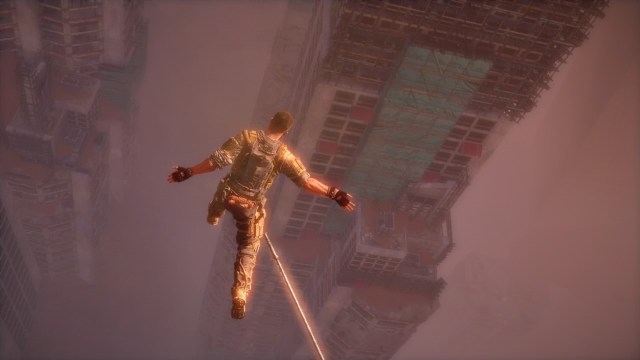
And I, like Marlowe, looked down into the precipice and walked away.
2012-10-07_00003

NOTES

1. Keogh – 7
2. Keogh – 6
3. Keogh – 6-7
4. Keogh – 91
5. Keogh – 91
6. Keogh – 79
7. Keogh – 74
8. Keogh – 10
9. Keogh – 26
10. Keogh – 58
11. Keogh – 9
12. Keogh – 58
13. Conrad, Heart of Darkness 69

Posted in Video Games | Tagged , , , , | 5 Comments

Lived Nonhuman Ethics

My core concern, both academically and also personally, is working through the question of what it means to be ethical to nonhumans. Most often that takes the form of the human ethical relationship to animals.

That said, my ethical concerns definitely extend further than animals. What does it mean to be ethical toward a computer program? A plant? A piece of metal? My interest in speculative realism, and object oriented ontology, has largely been because of these ethical interests–decentering the human being (in Meillassoux’s words, rejecting correlationism) is, for me, critical to getting to a real nonhuman ethics. Once we realize that the world does not exist merely for humans, that we will end, then we can really get down to the business of understanding the human impact on ecological systems, animal lives, and nonhuman assemblages and actors.

This post isn’t a list of things to do in order to be more ethical toward nonhumans–I’m very much in the James Stanescu camp that we are in such an ethical position that our ethics should be about minimizing violence, not pretending that we are cleaning our hands of the whole thing. In other words: we’re already damned; now what do we do?

I recently stumbled upon an example that I think might be a way of thinking through obligations toward nonhumans. There is a small thing right outside my door. I don’t know what it is called. It holds small, free newspapers that get updated twice a month or something. I really don’t understand it.

Historically, and by “historically” I mean “the entire time I have lived here,” the thing has served several purposes. Sometimes there is trash on top of it–used coffee cups, empty plastic bottles, or just stuff that might be toilet paper or rags or whatever. Someone wrapped up in the thing‘s life, its caretaker, its lover, comes every now and again. The lover dutifully cleans the thing. The caretaker fills it up with new papers. The next day it is covered in trash again.

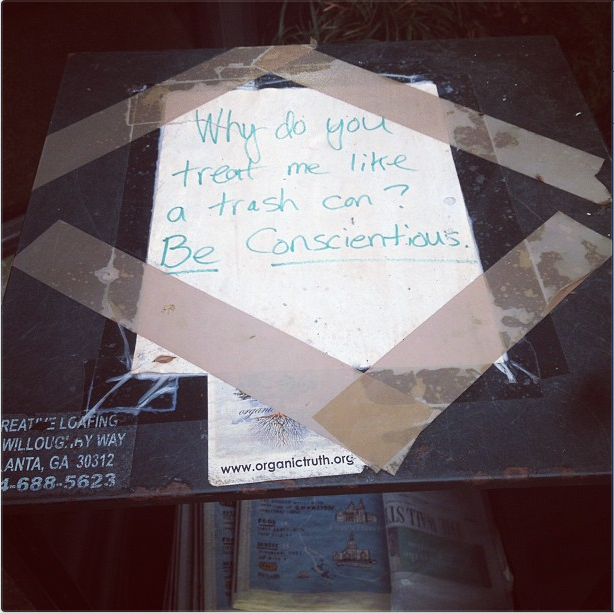
Last week, someone did this:

magazine thing


You can probably guess what happened. The trash is gone. No one has filled the thing up or stacked trash on top of it. When the thing began to speak, or when someone helped it speak, or when someone spoke for it because it could not, the state of things changed. In Rancierian terms, the distribution of the sensible was radically altered; that which was background became a speaking subject.

Theoretically, I think this is fascinating. The sign itself generated, on some level, a flat ontology. The trash makers now have to look at the thing as something that can be offended, that has a speaking voice; more importantly, the thing is now a being with a recognizable body that can be hurt. It is a nonhuman body, and when trash is stuffed into it, it is understood to be violated and wounded; the viewer, when seeing the hurting thing, is shamed.

The common response to what I have just written will probably go something like this: “the sign is written by a human, it shows that a human has vested interest in the thing, and so people don’t want to hurt/offend/piss off that human.” That, I am sure, has a lot to do with it–but we already knew that a human had a vested interest in it. There’s a sticker and a phone number. And I think, based on past “this thing is now a trashcan even though it is not supposed to be” experiences, that if someone had put a sign on the thing that said “STOP PUTTING TRASH ON THIS” that it would have been ripped off, crumpled up, and become-trash.

A speaking thing. An implicit recognition of flat ontology. We are aware of it, therefore we can change our behavior.

I read Peter Sloterdijk’s Spheres 1: Bubbles earlier this year, and he briefly discusses animals and (I think) Levinasian ethics. Short summary: Levinas says that beings with a face call to each other with infinite obligations that can never be fulfilled. Therefore, we have to do all that we can for those beings. The problem with that is the notion of the face–what is it, what has one, and so on. Levinas was never really clear on that, and kind of flipped back and forth, especially on the animal question.

Generally, the response to this is to throw it out. Phenomenological ethics, which is what Levinas is “doing,” aren’t really a good way to plot out ethical stances. It is hard to combat the existence of factory farms in that framework; in fact, impersonal and systematic forms of exploitation and violence become difficult to combat, period. Sloterdijk’s response to this way of thinking is his spherical system; his practical response to Levinas, however, is to proliferate faces. Instead of attempting to find them, we should recognize that the face is placed by the human–there is an implicit choice in the act of recognition. Make a face, change the makeup of the sensible; make a face, practice an ethics.

The sign is a face. It is a makeshift mask that works. It is a way of generating a lived, practical ethics of the nonhuman. Does it shatter the world or correlationism or solve global warming? No. But it does, maybe, show a way out.


Posted in Theory | Tagged , , , , | 3 Comments

Released: Funeral

Title

You can click the image to skip all this reading and just go play Funeral.

A few months ago I ran a Kickstarter to fund myself. Or, well, it was to fund a “game” that I had been trying to work out in my head. It would be a top down RPG-looking thing, but without combat. It would rely on my own childhood memories of Dragon Warrior. It would also be about a funeral.

I’m not very clever. The game is finished. It is called Funeral.

I’m not one for artist statements or explanations.

The dialogue is slightly randomized per NPC, so you could play it a couple times to get a more “full” feel of the game. I was trying to figure out what a Dear Esther mixing of narratives would mean in a JRPG-style context. I implemented it. It works in the sense that it is there.

I don’t have much more to say about it, so now go play Funeral

You can also download the OST for the game here (I don’t know why you would want to, but it might be fun.)

You can check out all of the games that that I have made here.


Posted in A Game I Made | Tagged , , | Comments Off on Released: Funeral

Final Fantasy IX: Destruction

This essay is part of my Final Fantasy IX series of articles.PSOGL2_948PSOGL2_951

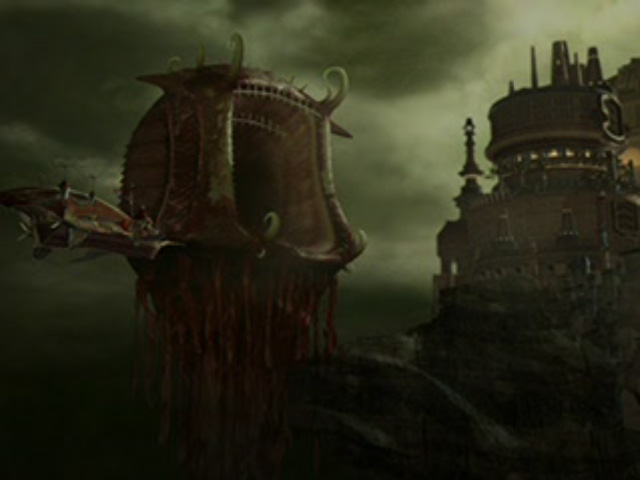
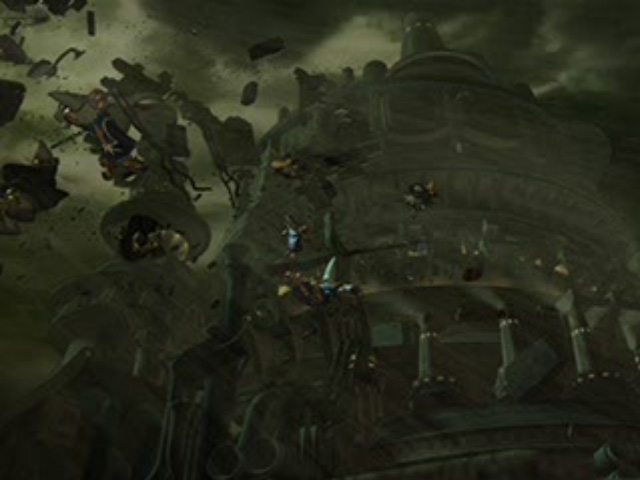
This is the first scene of mass destruction we are presented with in Final Fantasy IX. It is the eidolon Atomos being summoned to destroy the citystate of Lindblum.

You can watch the two minute video here.

A visual analysis of the scene gives you something like this: there is a giant creature sucking everything into itself. It contains a black hole, a great void, that can never be filled–and yet, here it is, drawing things into itself to fill it up. Atomos has an appetite for everything, for existence itself. The material interacts with Atomos is radically altered, not just in composition, but in relation to itself. The images are muddy, and part of that is the low-fi nature of a game made in 2000, but it isn’t just that. Lindblum soldiers, glass, airships, furniture, bricks, and construct soldiers are all absorbed into Atomos.

Atomos is an event that establishes a relation to itself, regardless of previous qualities or ontologies. It must be reckoned with.

A political analysis of this point in the narrative might be helpful. There are two nations, Alexandria and Lindblum. Alexandria is ruled by Queen Brahne who has decided to make a bid for world domination with the help of Kuja, the prime antagonist of the game. Kuja, acting as a weapons dealer, convinces the queen to manufacture automaton soldiers and seek out eidolons to accomplish her goal. The scene depicted above is the final product of those plans.

Gates are blown open. Black mages storm the interior of the city. Lindblum soldiers fight them. Atomos is summoned. Heterogeneous becomes homogeneous.

This moment of attack is important because it sets a strain of thinking about destruction that echoes through the rest of the game: destruction is an event that radically rearticulates relationships between entities.

There is no way for me to read the numerous events of mass destruction in Final Fantasy IX without appealing to the deployment of nuclear weapons against civilian targets by the United States in Japan toward the close of World War II. The acquisition of eidolons by Brahne mirrors the political aims of the United States–having weapons of mass destruction means that you can prevent the opposition from having their own weapons of mass destruction. It is the ultimate political play (literally, as in it is the final one possible).

The history of the world of Final Fantasy IX, Gaia, is presented to the player piecemeal. We are shown statues and titles of books (this will get its own post.) What we are painfully aware of is the fractured nature of the past world. Only in recent years have kingdoms settled into stable territories and states–the creation of technologies of travel and stable trade have generated an “end of history” for Gaia.

However, the Gaian end of history mirrors the 1990s “end of history” in Western liberal democracies. Proclamations of stability ignore the xenophobia that stability rests upon. Cleyra, a country of anthropomorphic rats, is often referred to as a nation of vermin by the the more humanesque denizens. The Alexandria war mongering draws out regional hatred for Alexandrians in Lindblum. These countries, with long histories of fighting, are split along territorial and ideological grounds. They are disparate.

But the summoning of Atomos unites them. The bourgeois knight, the princess, the agrarian girl, the monster, the construct, the rat, the manufactured other, and the hitman all unite together to dismantle the hyperviolence of state-sanctioned weapons of mass destruction. The event streamlines difference–it provides a rallying banner that the characters, and nations, of the game can assimilate beneath.

The nuclear bomb reduced living beings to dust. It ignored class, race, species, ownership, debt, love, lust, and hatred. It eradicated difference.

So the narrative of Final Fantasy IX provides an alternate history. It presents us with a world where action after the nuclear option is actually possible. It is a hope that there is a narrative outside of that political problem, something significant, that adds meaning to absolute destruction and the rendering of being into ash.

Posted in Final Fantasy, Video Games | Tagged , , , | Comments Off on Final Fantasy IX: Destruction

Interview with Theron Jacobs

I conducted this email with Theron Jacobs over email. You can find him on twitter @TPHD

Cameron: signal–noise–signal

Theron: PERSONALLY, I IDENTIFY WITH NOISE

C: So Theron, you’re a poet. There is a camp of video game studies that makes a claim for the autopoetic nature of gameplay–that is, they argue that radically new experiences come from the game-player assemblage. Can you explain this phenomenon?

T: CERTAINLY NOT.

AS A POET, MY JOB IS TO AVOID THE IMPULSE TO EXPLAIN.

(IS AUTOPOETIC DIFFERENT FROM AUTOPOIESIS? IM NOT FAMILIAR WITH THE TERM)

C: Nah, just the adjective form of autopoietic that I misspelled.

Are you a comics person? I heard you had some comic book projects in the works. Can you talk a little about comics and, if you do, why you like them?

T: I GREW UP READING CONAN AND 80’S X-MEN AND LIKE THAT. THEY WERE COOL, BUT I BECAME INCREASINGLY LESS INTERESTED IN THEM AS I ENTERED MY TEENS. MY RELATIONSHIP WITH COMICS COOLED UNTIL THE MID 90’S WHEN I SIMULTANEOUSLY DISCOVERED THINGS LIKE CHARLES BURNS’ “BLACK HOLE” AND MINICOMICS LIKE “MONSTER” FROM BRIAN RALPH.

BOTH WERE EXCITING, BUT MINICOMICS MORE SO.

THE IDEA THAT WITH AN EXTREMELY LIMITED BUDGET AND NO TOOLS SAVE PAPER AND PENCIL, I COULD PRODUCE SOMETHING EXCITING, NEW AND COMPLETE, IN A FORM SHAREABLE WITH OTHERS IS INSPIRING.

THE LOW BARRIER OF ENTRY IS DEFINITELY ONE OF THE REASONS THE MEDIUM IS SO ATTRACTIVE TO ME.

I LIKE THAT I CAN START AND FINISH SOMETHING IN A SINGLE BURST.

IT’S DIFFICULT TO SUSTAIN MY ATTENTION PAST A SINGLE BURST, SO THIS IS CONVENIENT.

IT’S ALSO WHY I LIKE TWITTER SO MUCH.

C: It is interesting that you mention Black Hole–I recently read it a couple times and wrote about it on my blog. There’s a strange relationship between the content of that comic and the communal property of twitter–Black Hole is, at the bottom, about kids with diseases creating their own flawed communities. Twitter is sort of the same thing.

What do you think?

T: I CAN SEE THAT PARITY.

I JUST LOOKED UP THE WORD PARITY. I KNOW WHAT IT MEANS AND I WAS PRETTY SURE I WAS USING IT CORRECTLY, BUT I SOMETIMES LIKE TO VISIT THE DEFINITIONS OF WORDS. IT’S NICE TO SAY HELLO.

THE FIRST DEFINITION IS: THE STATE OR CONDITION OF BEING EQUAL, ESP REGARDING STATUS OR PAY

THE SECOND: THE FACT OR CONDITION OF HAVING BORNE CHILDREN

PICTURE ME PREGNANT AND SQUATTING OVER A SWAMP–THE SWAMP IS HUNGRY AND WANTS TO EAT MY CHILDREN BUT I AM FURIOUS AND CLENCHING. I AM CLENCHING AS HARD AS I CAN.

I DIDN’T COME TO TWITTER FOR THE PEOPLE, BUT IT WOULD BE DISINGENUOUS TO PRETEND I AM NOT PART OF SOME KIND OF COMMUNITY. I WAS ON TWITTER FOR A LONG TIME BEFORE I DISCOVERED OTHER PEOPLE BEING CREATIVE AND INTERESTING. AT FIRST, IT WAS ALL TECH PEOPLE, JOURNALISTS AND ENTREPRENEURS. I FOUND THEM FASCINATING FOR A WHILE. NOW THERE ARE LOTS OF INTERESTING FOLK.

I THINK THERE ARE A LOT OF UNHAPPY OR UNHEALTHY PEOPLE ON TWITTER AND THAT SOME OF THEM CONNECT ON THAT POINT, IF THAT’S THE ANALOGY YOU’RE MAKING.

I TOTALLY HAVE AN AGENDA ON TWITTER, BUT IT’S NOT COMMISERATION.

C: Oh that is interesting–what is your agenda? Give me THERON’S TWITTER MANIFESTO

T: IT’S A SECRET. FOLLOW ME ON TWITTER DOT COM FOR IMPORTANT CLUES.

C: I already follow you on twitter.

Change of topic: tell me about music.

T: HOLD UP, IM GOING TO ANSWER YOUR QUESTION LOL

I’VE ALWAYS HAD THIS IDEA THAT THE REALLY IMPORTANT THINGS I WANT TO COMMUNICATE TO OTHERS CANNOT BE CONTAINED IN WORDS.

I WANT TO CONVINCE PEOPLE TO PLAY MORE. TO LOVE THEMSELVES MORE. TO ACCEPT THEMSELVES.

I SPENT A LOT OF TIME IN MY YOUTH BEING PARALYZED BY ANXIETY AND NOW THAT I AM NOT, HELPING OTHERS TO ADJUST THEMSELVES FEELS IMPORTANT.

BUT I DON’T THINK IT HELPS TO EXPLAIN OR PROVIDE REASONS; I THINK ONLY DEMONSTRATION IS PERSUASIVE.

SO MY TWITTER AGENDA IS TO BE A PLAYFUL, RELAXED, ACCEPTING PRESENCE.

THAT’S MY MAIN AGENDA. MY SUB AGENDA IS “HORSE”

C: Lets play a Choose Your Own Adventure game

You wake up in a dark passageway. Wind whistles above your heard. Far ahead of you there is a pin prick of light. Behind you there is a growling.

What do you do?

T: >BEGIN GROWLING BACK

(I RAN THIS TXT ADVENTURE TWITTER ACCOUNT, BEFORE I GOT DISTRACTED BTW: https://twitter.com/TEXT_ADVENTURE)

C: Your stomach begins to growl with ferocity. The growling behind you gets closer. You still haven’t turned around. The pin point of light in front of you disappears when you blink.

T: >I CLOSE MY EYES AND RECITE THE LITANY AS I HAVE BEEN TRAINED TO DO (TPHD VS THE BENE GESSSERIT http://tphd.tumblr.com/post/8402458242/i-will-face-my-fears-i-will-permit-them-to-pass)

C: You feel a warm hand on your back. All sound ends. A hymn wells in your throat. Your eyes open. There is no darkness. Light emanates from each object; every atom, a sun.

You look behind you. Standing before you is a very old woman. I am your final mother, she says without moving her lips. Existence grows faint.

Do you reject the music of the spheres?

T: NAW, IM READY

C: A comical buzzer sounds. Red curtains fall from the ceiling. A man with a too-tight smile hands you a check.

END

Alright, one last question: what are your plans for the near future? Things in print? Zines?

T: COOL. NICE. FEELS LIKE I WON, EVEN THOUGH I GOT STUCK WITH THE BILL.

IM WORKING ON A LOT OF STUFF! COLLABORATIONS WITH @aRealLiveGhost AND @ACTUALPERSON084, KIDS BOOKS ABOUT THE APOCALYPSE, ANOTHER BOOK ABOUT BLACK MAGIC. ALL KINDS OF THINGS.

PROBABLY THE FIRST TO BE REALIZED IN THE REAL WORLD OF PHYSICAL THINGS WILL BE POSTERS, THOUGH. I KNOW PEOPLE WANT TO PAY ME MONEY FOR POSTERS AND THAT SEEMS LIKE A NICE THING.

EVENTUALLY, IM GONNA PRINT SOME POEMS INTO A BOOK.

MAYBE PEOPLE WANT TO GIVE ME MONEY FOR A BOOK OF POEMS AND THAT, TOO, SEEMS VERY NICE.

C: I probably want to give you money for a book of poems.

THE END

Posted in General Features | Tagged , , , , | Comments Off on Interview with Theron Jacobs

Final Fantasy IX: Collecting

This is the inaugural post in a short series that I am going to be doing about Final Fantasy IX. As you may know, I have been playing the PSX-era Final Fantasy games in order to give them a fresh look. From nostalgia-wrapped Final Fantasy VII to divisive Final Fantasy IX, I have played well over 100 hours of low-rez JRPGs.

I was never able to complete my “master post” about Final Fantasy VII because I couldn’t get a hook on the game. Ultimately, I didn’t feel strongly about it, and the blandness (that’s right) of the game left me wanting. After that, I did manage to play through Final Fantasy VIII and write a significant amount about it; I might return to it one day. However, just like Final Fantasy VII, VIII has a way of sucking a will out of me. A weakness in plot and character, in system and design, keeps me from interacting with it fully. To be succinct: both of those games are not very rewarding to analysis.

I knew that returning to Final Fantasy IX would be, well, fun. I remembered that it punted the angsty high schooler mentality to the curb and drastically withdrew from futuristic or cyberpunk-inspired imagery. Final Fantasy IX is all about a return to fantasy, and to my surprise, comedy. I also found it remarkably rewarding, much more than the two previous games, while also sharing similar themes.

So, my point: I think Final Fantasy IX is the culmination of Final Fantasy games on the PSX. This, of course, is literal–it is the last game in the series to appear on that console. But I also mean that the game itself is a culmination of design lessons learned and themes as they are developed. 

So I have things to say. That said, I also want to engage with that has been said previously about Final Fantasy IX. Below is what I have found so far about the game through some googling. If you know of anything else, feel free to comment or tweet at me with citations. I want to, you know, do a good job.

Roundtable Interview with several creators
Interview with Sakaguchi
Interview with Hiroyuki Ito
Why FF9 Was The End of A Great Series
Interview with Sakaguchi and Hashimoto
Interview with Toriyama
Sakaguchi’s memos about FFIX
A GameFAQ of references
Final Fantasy IX’S mechanics of identity
The Dream Traveler FFIX review – this is a multipart video analyis
Final Fantasy IX review at That Guy With The Glasses 
Review by Erin Bell at GameCritics
Why Final Fantasy IX should be Square-Enix’s Blueprint”
Revising the Classics – Final Fantasy IX
Finite Fantasy: The Problem with JRPGs

Posted in Final Fantasy | Tagged , , , , | 2 Comments

On Bifo’s The Uprising: On Poetry and Finance

IF YOU ARE COMING HERE FROM FACEBOOK, CAN YOU PLEASE COMMENT AND TELL ME WHY THERE IS SO MUCH TRAFFIC COMING FROM THERE TO THIS POST?

I have also written about Bifo’s The Soul At Work and Ironic Ethics.

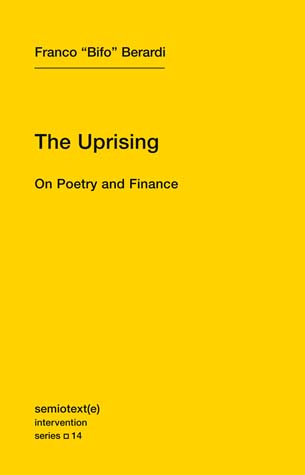
I finished the last hundred pages of Franco “Bifo” Berardi’s The Uprising: On Poetry and Finance last night. This post isn’t going to be a comprehensive review of the book–its manifesto tone and direct call for application resists summary. It is already concise, meant to be read out loud and in public; the stark yellow of the cover means that it wants to be seen. It is a book with a radical life that doesn’t pander.

9781584351122

Bifo is a wonderful developer of concepts. Previously, in After the Future, he explained that we are living in a post-future period; we live in a world where the promise of the future has been shattered. It no longer exists, and we have to formulate new political identities to deal with this reality.

As I read Bifo, the rest of his schema come out of that problem: how do we become politically effective when the very condition of the world exists to depress us and rob us of political effectivity?

Like I said, this isn’t a comprehensive review; there are just some things from the book that I want to write about, or cite, or bring to broader attention. I’ll just do that.

1. Semio-inflation

William Burroughs said that inflation is essentially when you need more money to buy less things. I say that semio-inflation is when you need more signs, words, and information to buy less meaning. It is a problem of acceleration. It is a kind of hyperfuturism when the old accelerative conception of the future is the crucial tool for the capitalist goat. [96]

Semio-inflation, as a concept, gets at the excess of the contemporary period. I don’t mean conspicuous consumption. I mean the constant assailing of the subject with information and the cognitive adaptation that we undergo in order to live with that violence. The sheer plurality of meaning attached to every object, what we’ve lazily been calling postmodernism for the past thirty years, causes a chilling effect on political action. The swarm of signs and possible interpretations that surround objects mean that those objects are eternally receding from a direct politics–we can’t get a proper handle on things, can’t parametricize, because of semio-inflation.

One way of short circuiting semio-inflation would be to assert material and vital qualities of beings. Taking into account concrete assemblages, and how they produce signs and semiotic systems, allows us to “deflate” and, while not getting toward Truth (because who cares), but at least getting toward an effective praxis.

2. Sensibility

Sensibility is the ability to understand what cannot be verbalized, and it has been a victim of the precarization and fractalization of time. In order to reactivate sensibility, art and therapy and political action have to all be gathered. [143]

Sensibility is a pretty wonderful concept. As I understand it, it is somewhere above affect but yet still possesses a subaltern status inside of the subject. Bifo clarifies more:

By sensibility, I mean the faculty that enables human beings to interpret signs that are not verbal nor can be made so, the ability to understand what cannot be expressed in forms that have a finite syntax. [144]

Sensibility is a psychic mode of absorption and interpretation that acts as a kind of damper toward affective and semiotic violence as it is directed at the subject; “sensing” is a way of bottlenecking, of closing the self in relation to the world. This is another way of getting at, and appealing to, a certain kind of materiality–it is a way of solving through semio-inflation.

These are some concepts that I thought were rad.

Posted in Theory | Tagged , , , , | 4 Comments