On Tegan and Sara’s “Heartthrob”

Tegan and Sara have a new album out, their first since sometimes’ Sainthood. It is an album, so there is a single. For the rest of what I am going to write, I need you to listen to the single and watch the video.

The single has been out for a few months, and I’ve hit it a few times–I would listen to it over and over again and then let it drop out. A few days later I would repeat the process. “Closer” wants me to come back to it. It needs you, but it doesn’t want me all the time. It isn’t an Owl City track or something from the new Taylor Swift. “Closer” doesn’t burn its way into my mind, exhausting me, forcing me to hum couplets in the shower. It just wants me to come back every now again. It wants fidelity and commitment, but it doesn’t want to overstay its welcome.

In essence, “Closer” embodies a tension; it both wants you and wants to forget you.

Heartthrobs, as a unity, is much the same. The throwback, 1980s aesthetic of the video for “Closer” envelops the entire album. Synths and pleas for love bring recall early Madonna–these are descriptions of worlds, of being in the world, but not the world that we all live in. Tegan and Sara draw us between the then and the now, the past and the present.

Thematically, the album is brilliantly coherent. Almost every song presents us with a moment of mourning–the loss of the erotic, or the loss of another, or the loss of a sense of self. When paired with the throwback aesthetic, the sense of mourning is doubled. We can’t go back in time. But we can remember, we can always remember how things were, and that’s where the pain comes from.

The past can well up in a synthetic drum and make us feel the lack in everything.

An example: “How Come You Don’t Want Me

How come you don’t want me now?
Why don’t you want to wait this out?
How come you always lead me on
Never take my call, hear me out?
Why don’t you want to win me now?

I don’t mean to paint the album in this sort of melancholic, black light (although there’s nothing wrong with it, and if that is all Heartthrob managed to do, it would still be a masterpiece.) The strength of the album is in its pure joy. It isn’t just mining the music of the 1980s to discover and miss teenage romances. Instead, it is recalling of those events to get at a pure joy. As I told a friend after a commute where I listened to the whole album: “This is an album of gay party anthems.”

That was the best way of expressing what I thought about the album at the time, and I’m not sure that I can come up with a better summary. Even the slow songs, the sad ones like “Love They Say” or “I Was A Fool” are begging to be club remixed. They want you to jump up and down while they play in the background.

These are songs to make out to. Heartthrobs isn’t an album for headphones; it is an album for beds and backseats and hands all over bodies. It is a soundtrack for something missing replaced by something there–it is a call for joy, for finding love in the moment, for singing and staying all night.

The beauty of the album doesn’t only rest in this thematic work. Sainthood marked the first album where the sisters did not split the work of songwriting. This is to say that pre-Sainthood there were “Tegan songs” and there were “Sara songs” and never the twain would meet. Heartthrobs has cemented their co-writing abilities; where Sainthood felt wildly uneven sometimes, Heartthrobs feels like the coherent work of one mind; it is a miraculous machine of intersubjective creation between all of the parties involved.

Heartthrobs is much the same as the best songs on the album. It has a high layer, a beautiful aesthetic, that touches me. It vibrates. It hums. But the underlayer, the feeling, the excess of the song itself–that drives the whole affair. It is a voice that extends beyond itself–the undercurrent of the album flows outside of its own bound in the same way that the why and try of “How Come You Don’t Want” me exceeds language.

Heartthrobs is a joyous, plaintive cry.

Posted in General Features | Tagged , , | Comments Off on On Tegan and Sara’s “Heartthrob”

Figure/Ground Interview with Gary Genosko

As you see, I’m bad at giving advice. I can barely recommend readings. Books are toolboxes. They help to solve problems, answer questions, ask the right questions. They can be read in any way you can invent. They can be emptied out and reorganized. Lately I’ve been dreaming about books that are not ebooks but consist of chapters available for download on an ibooks site. But not just chapters of books (not as preludes or samples to wholes); maybe just choice passages. Maybe even footnotes. Or lines. Or a few concepts, rich turns of phrase. I would mash-up a book consisting of a deliriously edited smattering of Bifo, Tiziana Terranova, and Maurizio Lazzarato.

I would download sound files of the entire published works of Birmingham school cultural studies read by unlikely celebrities. I challenge my earphone wearing audio book listening students to put the texts to music, to play them, to jam with them. Once in Helsinki at the Baltic Theatre festival I saw a book of mine on Guattari used as a prop on stage in a performance. I was thrilled. I recently saw a book of mine on sale online by a US reseller for 5,000 dollars – only an idiot would pay that much! But what a glorious idiot!

Gary Genosko at Figure/Ground

Posted in Quote Time, Theory | Tagged , , , , | Comments Off on Figure/Ground Interview with Gary Genosko

Video Game Critics: Check Out Some History

As some of you may know, I am technically in a film studies program even though I don’t do film work whatsoever. One of the required courses for my degree is an Advanced Film Theory course. In essence, the class is a primer in the disciplinary theories of film studies from the past 130 years or so.

I’ve been remarking on twitter over the past few weeks that games studies, particularly the critical internet writing community at large, could learn a lot from early film studies. The reason is pretty simple: the critical issues that face games were also faced, almost exactly, by film studies.

The strange thing is how similar the questions are. There were debates over the basic art nature of film–can something that is capturing the real, merely indexing, is there room for art there? Or the question of fidelity to the medium–film studies had violent debates on whether film should merely show the world or if it should embrace fiction, or subjective experiences, or total avant gardeism.

What do we have now? We have a totally plural space where personal films, big-budget films, documentaries, and every other imaginable form of film is represented. There are issues of access and marketing, of course, but the violence of capitalism assures us that there is no “level playing field” of art.

So maybe, just maybe, we can stop having silly spats on Twitter about the nature of games and what games are “proper” games. Because, end of the day, we’re going to end up with a plurality. All games are legitimate games. We should stop pretending that our personal proclivities are somehow universalizable or correct. We should also stop pretending that there is a zero-sum game involved with games and the writing that accompanies games. Do I prefer game centered criticism? Yes. Do I think that it might be the best way to properly think the game as a living cooperative being? Absolutely. But I’m not so ridiculous as to say that wholly personal writing should be eliminated or removed from the discourse around games.

You’ll notice that I’ve conflated two things–the writing around games and the games themselves. Something that I have also noticed while reading the film theorists is that these things are totally inseparable. Tastemakers actually do make tastes, whether we  acknowledge it or not. Theorists and critics influence game development; they also make games that alter game space. Anna Anthropy is essentially a contemporary Sergei Eisenstein, both writing on the art form and actively showing us its contours.

I’ll close with a bit from Siegfried Kracauer on “the issue of art” from Theory of Film.

If a film is an art at all, it certainly should not be confused with the established arts. There may be some justification in loosely applying this fragile concept to such films as Nanook, or Paisan, or Potemkin which are deeply steeped in camera life. But in defining them as art, it must always be kept in mind that even the most creative film maker is much less independent of nature in the raw than the painter or poet; that his creativity manifests itself in letting nature in and penetrating it.

Note: that quotation is super masculinist and the penetration metaphor is strange, but the parallel between “games are close to art BUT NOT REALLY” arguments that I read is too close to ignore.

Posted in Video Games | Tagged , , , | 2 Comments

A Moment of Pause in Just Cause 2

2013-01-26_00001

This isn’t something long or thought out–it is just a feeling that I got. Part of this has to do with the draft of an article that Samatha Allen wrote in response to/spurred by/alongside a presentation that I gave at a conference this past weekend.

Just Cause 2 is a game about absolute freedom. Diegetically, the protagonist is a black ops agent inserted into a banana republic to find someone; there are no connections to the locals, no responsibilities, and he works toward his goal constantly. Lateral movement is literally the point of the story.

From a gameplay perspective, the game “works” because the player is constantly doing whatever the fuck she wants to. You see that tower in the distance? Hijack a helicopter, fly to the top of it, jump out the heli, parachute onto the tower. Base jump off the top, parachute at the last moment, and blow up a small town’s water supply. Chaos reigns, literally, because Chaos is a kind of performance currency that the game uses to lock moments away from the player. Can’t progress? Go blow shit up.

But then there are these people. They are locals being detained at a security checkpoint; there are checkpoints on the road leaving most towns. They don’t have any movement ability. They can’t buy or sell goods without being harassed by their own government. And here we see governmental oppression being simulated in front of us.

Most of the time I don’t notice it. Standing on the hood of a car shooting motorcyclists with a shotgun doesn’t give me a lot of time to reflect on my environment.

This time I did.

Posted in Video Games | Tagged , , , | 1 Comment

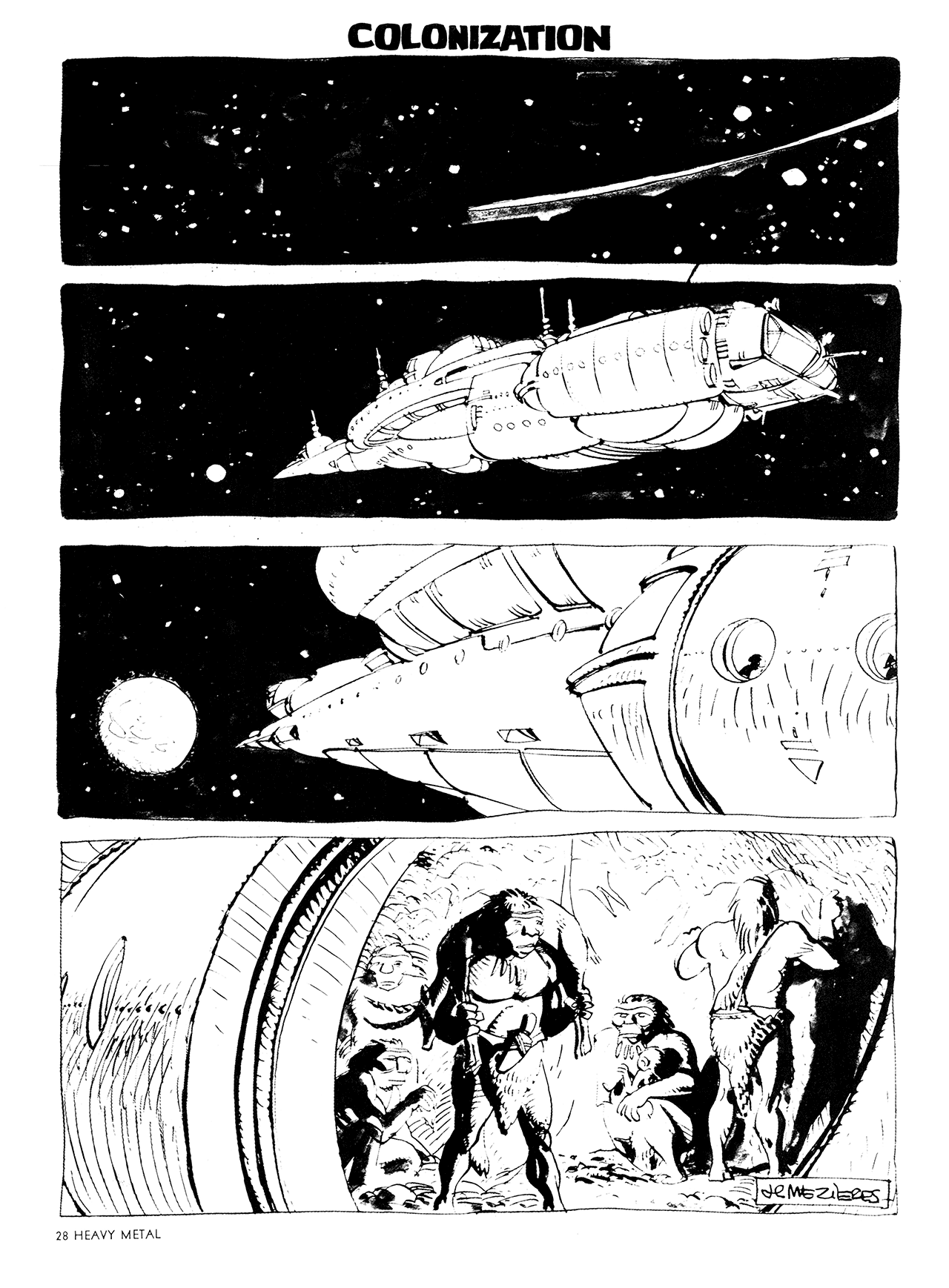
Colonization by Mezieres

I am super busy getting ready for a conference so I don’t have time for proper bloggings.

Here is a one-page comic called “Colonization” by Jean-Claude Mezieres.

I think it is pretty cool.

Heavy Metal V2 #2 - Page 27


From Heavy Metal vol.2 #1

Posted in Heavy Metal | Tagged , , , | Comments Off on Colonization by Mezieres

Supplement to my Queer Games Talk At Strange Relations

So this is the supplement to my talk “Machines and Connective Tissue: The Queer Renaissance in Video Games.”

Articles/Blog Posts/Words

I think it is profoundly important to avoid speaking for, especially when the queer games community is a very prolific community when it comes to thinking about their own work. What follows is a short list of blog posts, talks, etc. that have been written by queer games developers and critics. (Note: if anyone has anything to add, feel free to tweet me or comment and I will add things.) Also, this isn’t meant to be a “best of.” It is things that I read while preparing my talk that I thought were particularly insightful.

Games

So here is a list of queer games that I think are particularly great. It is a mix of both Twine, which I mentioned in my talk, and other things. Obviously, this isn’t exhaustive, but I think it is a good primer as far as the plurality of queer games and what they do. What can a body do/what can a queer game do and all of that.

Posted in General Features, Theory, Video Games | Tagged , , | Comments Off on Supplement to my Queer Games Talk At Strange Relations

The Robo-proletariat

In a continuing cycle where Ben Abraham writes something, Daniel Joseph responds, and I comment on what they both wrote, here I am doing it again.

Ben wrote a post titled “The End-Game of Labour Automation Meets Social Media” in which he analyzes the work of bots in creating social relations on social media websites. He writes:

Let’s look at an example: the ‘About Birds‘ Facebook page has 9-likes. One of them is me. Who else has liked this clearly spammerific etsy-esque store attempting valiantly to sell bird-decorated products? Actually ‘About Birds’ is just one of a suite of similar pages – About Monkeys, About Dolphins, etc – and some of the people who interact with these pages are clearly, well, bots or at best sock-puppets, and they appear to constitute the majority of the ‘likes’ on the page.

So the “work” of social media as it is framed by Facebook, which is liking, sharing, and generally hawking on a page, is being performed by, at best, a being that is untouched by a human for 75% of its “working day.” On the other end, it could just be a bot that hangs out, creates social relationships, and likes pages.

Daniel responds and adds to Ben’s post. The main takeaway from Daniel’s post is this:

The marketers know there are bots out there messing up the accuracy of the data, but this only matters if capitalists see the bots as fundamentally altering the value of the data. If the capitalists do, either facebook will need to invest heavily in anti-bot programs, or have their business, and its value extracting ability, melt away. What we see here is the ongoing struggle between workers (us) and capital – between the real people labouring to produce value and the vampires. When capital does hit this limit, because of spammers or activists like Darius (random bots 4 lyfe) [f]or Ben it will constitute a moment of decomposition.

We live currently in a field of production that is shot through with the nonhuman. Of course, human lives are constantly intimate with the nonhuman, but this if different; there is a world where bots, and their connective/informative capacities, are actually doing labor. They are connecting. They are making things work together. They are generating information.

I take a different turn than Daniel does above. I don’t think that we will hit a limit, a moment where advertisers will say “damn it, we have to get away from these bots!” The bots, as I see it, are crucial to keeping the entire myth of capitalist production, of the virtual of capitalism as Bifo would have it, operating. The bots function as immaterial, perfect laborers–they “like” and link, connecting to one another, and more importantly, to humans.

They make themselves, like Latour’s ARAMIS, more real with each human who accepts a blind friend request. Photos lifted from imgur become a personal history. And so, like many of us, the bot labors not in a specific way. They labor through pure connection, and I’m wary of reducing this to the interruption of data value–instead, these bots become a kind of gold standard for value. It isn’t about eliminating the bots from the system, but eliminating the ahistorical, the properly “nonliving” bots, from your data set. In this way, the more “living” of the bots, those sharing pictures and liking pages and having a thousand participating twentysomething friends that maybe knew them in high school, those will be included.

Because they’re producing, they’re alive. And because they’re alive, they count.

“like”-ing as living


Posted in General Features, Theory | Tagged , , , , | 3 Comments

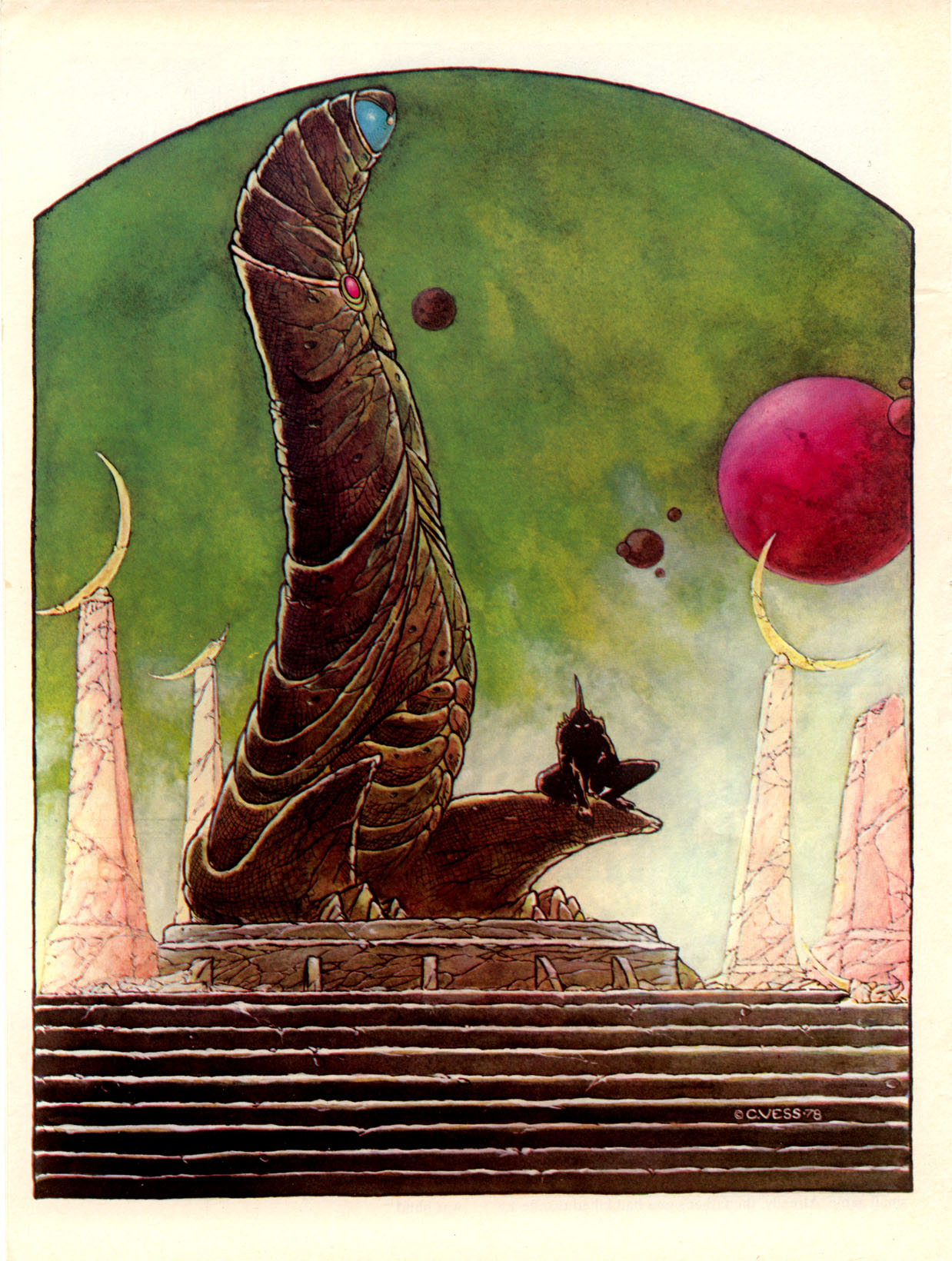
A Charles Vess Art

Heavy Metal V1 #12 - Page 19

An untitled Charles Vess drawing/painting/art from Heavy Metal #12

Posted in Comics, Heavy Metal | Tagged , , , | Comments Off on A Charles Vess Art

Nonhuman Life: Announcement and Book List

This semester I will be taking an independent study on the concept of “nonhuman life.” As a part of that, I have decided to make my weekly notes, small essays, or whatever from the class available publicly–thus, for the next fifteen weeks or so, there will be a thing once a week called “Nonhuman Life” here on the blog. Each week will cover a different book and I will say some things about the book.

That is all unnecessarily formal.

Here is the (tentative) list of books that I will be writing about. Some might get added or dropped, of course. They are organized by “cluster”–I am trying to focus on both the speculative turn/postKantianism and how that interfaces with how we think through the notion of “life” in the current field of philosophy or whatever. I am also including links below in case you, for some reason, want to run off to Amazon immediately and buy any of these books.

Additionally, the posts that I will be making over the course of the class will be open for comment, and I encourage anyone who wants to read along and have a conversation to do so.

Cluster 1: Kant

Cluster 2: Relations

Cluster 3: Life

Posted in Nonhuman Life | Tagged , , | Comments Off on Nonhuman Life: Announcement and Book List

Mattie, Maddy, and Me

There are two essays that you need to read before reading what I am about to write:

Mattie Brice – “Would You Kindly
Maddy Myers – “Why Do I Like Violent Video Games So Much

These essays share a topic–violence and video games–and they each take the topic in a separate direction.

For Mattie, it is the development environment around the contemporary AAA video game that is at fault when it comes to violence. What has traditionally been about (mostly) Great White Men doing Great Things has shifted slightly, taking the form of Great White Men being put into not-so-great situations and then attempting to mourn those situations; this, at the core, is Spec Ops: The Line after all–“a man forced to do these things will suffer.” Mattie pairs this analysis with a political call, although she doesn’t frame it in those terms–instead of games that focus on the political crisis of whiteness and masculinity while metaphorically throwing their hands up in defeat, maybe we could make games where there a ways of being, and healthy being, outside of the dominant ideologies and identity politics.

For Maddy, the contemporary set of narratives about violence in the video game industry have value. These narratives are linkages to very specific kinds of power fantasies that are tied to her own embodiment–she writes: “I think the only reason why I ended up being a feminist is because I’m inside this body, and I know how powerless I feel.” Video game violence is a conduit for feelings of powerless in life, and she is aware of it–she is judging herself for finding value in this violence as much as any reader could judge her. In essence, she agrees that video game violence is problematic, but there isn’t any solvency in creating new kinds of games that operate around her body–she wants to escape that body, if only for a play session.

Can we create power fantasies without creating power imbalances? The process of systemic violence against other people that is constantly enforced by media is, at the heart, the very concept of “culture.” It is a way of asserting that certain kinds of violence are both justified and necessary in order for the world to operate “correctly.”

I, like Maddy, don’t have any answers. I only have questions that will, in all likelihood, never be solved. These issues, sadly, have always existed in media and they’ve never been solved out. The most popular novels in the United States trade on racism, political stereotypes, and misogyny so often that it has become both simultaneously ignored and accepted by basically anyone–I don’t see outrage on Twitter whenever a Tom Clancy or Clancy knockoff is published.

I, like Mattie, want to see things change. I want to see new bodies and new subjectivities presented to us to be, become, and befriend in video games. I want a political program that embraces a plurality of existence beyond a grizzled white dude shooting various other people, and I don’t want the “turn” to be HE HAD TO DO IT, DON’T YOU SEE?! or HE WAS CRAAAAAZY! because both are fucked up, and more importantly, they reinforce a well-loved, conservative narrative of “things are this way so deal with it.”

Posted in General Features, Video Games | Tagged , , , , | 1 Comment