Preliminary Thoughts on The Knife of Dunwall

205100_2013-04-17_00011

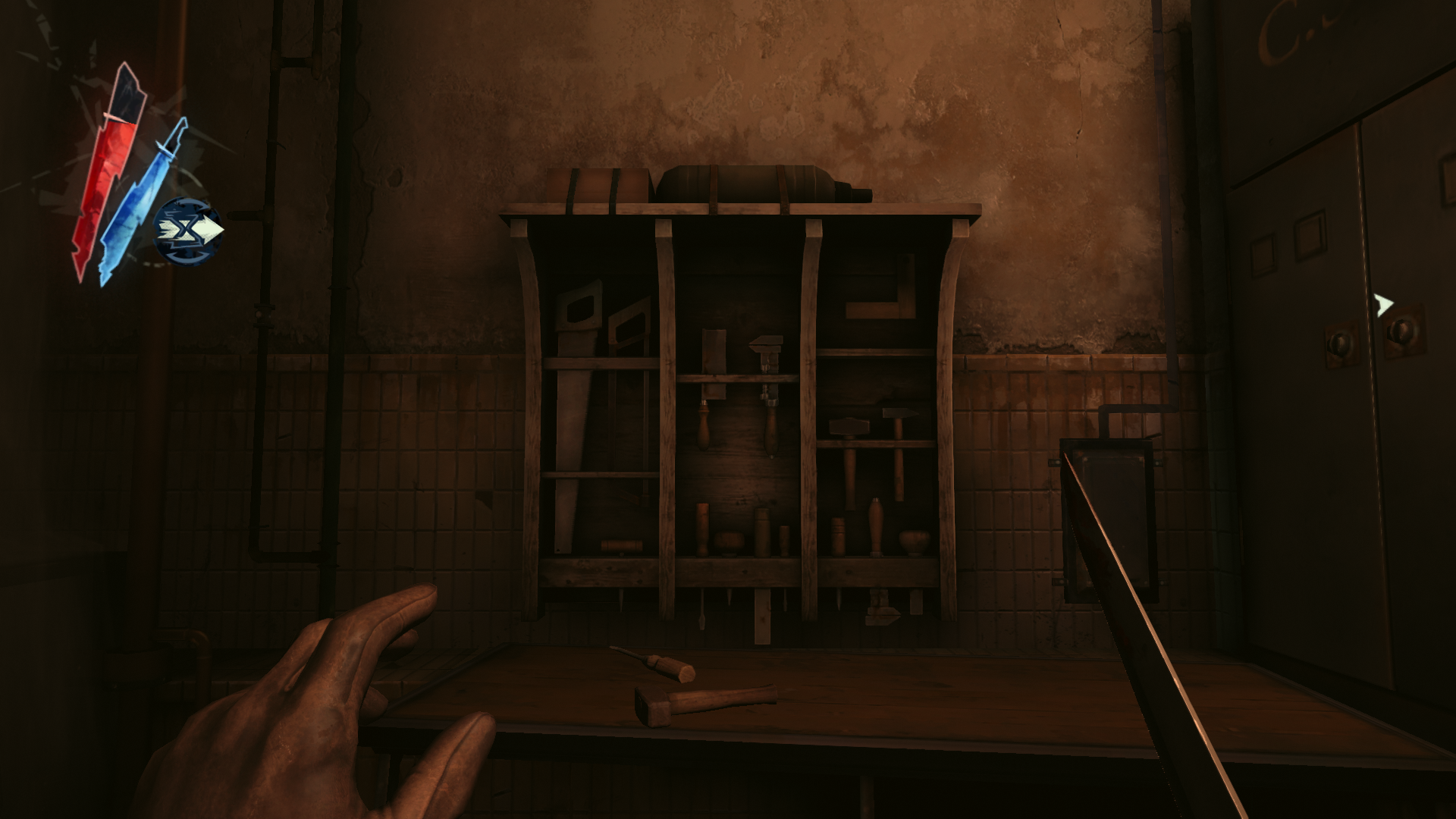
I’ve played through roughly half of the first “stage” or “chapter” or “section” or whatever the hell it is called in the new DLC for Dishonored called “The Knife of Dunwall“.

My main interest in this DLC stems from the fact that it is centered around Daud and his Whalers, a group of assassin’s that we saw for a small amount of time in the game proper of Dishonored. A little more importantly (for me): the locations and the content is supposed to focus on the whale slaughter that supports the city/world of Dunwall.

I started the game tonight thinking I could play through it in a few hours, but I probably only made 30 minutes of progress. So, preliminary thoughts that will probably change before I finish it.

1. The design seems confused. I think that the level design of the main game is good in that it provides the player with several pathways to get to an objective, and two or three of those pathways are always apparent. For example, if you have to get through an energy gate, there is always a way to climb over it and a way to disable it within visual range of the gate; if you can see it, you can see a path to “solving” it.

In the first two areas of “Knife,” I don’t see that happening. The opening of the stage has a fairly unclear way of moving forward, and I never felt like I had good sightlines on enemies, their paths, and the designed paths that would allow me to get around those enemies as long as I play well.

My method of solving the first area ended up being “well shit I will just run” and then running through the entire map.

2. The second stage of the first level introduces a new enemy to the game. He is a butcher of whales, a big beefy bald man who carries around a huge, person-sized saw. The “power butcher” has qualities of other enemies that we’ve already seen in the game–he’s beefy and hard to kill, but he has a power cell on his back much like the strider enemies in the main game. That’s supposed to be the trade-off; he’s hard to fight head-on, but if you get the drop on him, he’s easy to kill in one shot.

It also has other, strange, nonsensical qualities. I found myself trapped against a wall or an object several times, unable to move, while this power butcher just stood against me in a very “early FPS game melee enemy” kind of way and made my health drain. Additionally, if he sees you from a fair distance away, his move is not to find cover nor is it to attempt to close the distance. Instead, he leans back, heaves his saw, and FIRES BULLETS OUT OF IT LIKE A MACHINE GUN. I don’t understand it at all, but it did cause me to be killed several times, and it was profoundly annoying.

3. The game didn’t allow me to do what I wanted.

I understand that is the King Complaint in games: I wanted to do X but game only allows for YZ things, so boo.

This isn’t that complaint. I wanted to kill everyone in sight, but I found it difficult to do so. So difficult, in fact, that after thirty minutes of trying to kill +/- ten enemies on normal mode, I essentially rage quit the game. I want to stress that I’m a fairly calm game player, and I can literally count on my fingers the number of times that I have been angry enough to stop playing a game (three of those times are Devil May Cry related).

So why did I want to kill all of these fictional, overpowered slaughterhouse workers? Because we were in a slaughterhouse. More importantly, the machinations of the slaughterhouse were shown to me, explicitly, in grotesque detail. And in that moment, I wanted to punish the fictional people that worked in this fictional mass murder simulation.

That’s a little weird, and I recognize it, but affect doesn’t work on levels of reality and fiction. The injustice that I perceive and the rage that I feel at video game animal mass murder is just as real for me, affectively and emotionally, as seeing footage from inside chicken houses, or reading factory farm workers narratives, or reading press releases from flesh-selling companies.

The design of the enemies, and the number of power butchers, meant that I couldn’t kill them. To kill them all, I would have had to stay silent and deadly. In this power fantasy, and Dishonored is unabashedly power fantasy, I couldn’t react with justified rage and power. Instead, I have to sit by quietly, acting only when the level design and the enemy AI provided gaps for me to strike.

In other words, the stage itself is structured in such a way as to be saying “hey, this is terrible, but you should be able to be calm and cool headed about it.”

And maybe all of this is just because I am bad at the game. Maybe tomorrow I will turn it on again and play through it quickly and this will all have been a bad episode. That doesn’t matter so much, though; this is how I came to it, this is how the system worked on me today, and I’m going to carry it with me throughout the rest of the experience.
Posted in Video Games | Tagged , , , , , | Comments Off on Preliminary Thoughts on The Knife of Dunwall

Thacker on Life

This third kind of life, the”nameless thing” so often described by Lovecraft, is a paradigm for the concept of life today. The concept of life encompasses so much, from the most reductive biological viewpoint to the most open-ended ethical or existential viewpoint. When definitions or criteria for life are given, even these are subject to modification and revision. There is a sense in which the major problem concerning life has to do not with its definition, and whether such a definition is possible, but with the very plasticity of life, a shape-shifting quality exhibited in all the different ways in which we use the concept to correlate to the different phenomena that are deemed to be living–the plasticity of all the different ways in which life is thought and shaped, all the myriad ways in which life reflects upon itself and shapes itself, all the forms of existence, resistance, and insistence that life it.

Eugene Thacker, After Life p.4

Posted in Nonhuman Life, Theory | Tagged , , , | Comments Off on Thacker on Life

A Video Game Playing Itself

So Tom 7 did some stuff and created, essentially, a control algorithm that allows a game to play itself.

FYI at the end of the day this is a research blog so mostly this is for personal archiving.

Posted in Theory | Tagged , , , , | Comments Off on A Video Game Playing Itself

Supplement to #RespectCon13 Talk

Today I am speaking at RespectCon about sexual violence in video games. This post is a collection of links that I talked about, and through, in the talk.

1. Jason Schreier “You’ll ‘Want to Protect’ the New, Less Curvy Lara Croft

2. Andrew Goldfarb – “Bioshock Infinite Cosplayer Becomes Official Face of Elizabeth

3. Anna Moleva as Elizabeth

4. Bioshock Infinite “hands around the throat” scene–I began the clip at 10:32

5. Ken Levine talking about how they made Elizabeth “real”

Posted in Theory | Tagged , , | Comments Off on Supplement to #RespectCon13 Talk

On Monster Loves You!

226740_2013-04-06_00001

My taste in games has altered over the past few months. I am less and less willing to put thirty hours, much less forty, sixty, or eighty, into a game. Although I spent last year playing some long games (most notably Final Fantasy[ies] 7,8,9), I’m increasingly done with it.

At the same time, my desire for shorter games has meant that I want to actually enjoy the time that I’m putting into the things. Long games depend on the balance between boring segments and exciting pieces to bend heavily into the latter category; if I sink 40 hours into a JRPG, I’m directed (through design, through narrative) to remember the best parts.

That doesn’t work for a game that lasts for two hours. I want to be entertained, to be drawn in, for the entire time that I’m playing. The time constraint is a good one, and shorter games like Dear EstherKentucky Route Zero, and Tomb Raider have captured my imagination significantly more than Skyrim, which I have put 124 hours into compared to the 20 or so hours (combined) that I have in the games I listed.

226740_2013-04-06_00009

226740_2013-04-06_00010

Monster Loves You! is a short game (also a game with a terrible title.) I have played through the game a single time, and it took all of 37 minutes. At $10, that’s a pretty steep time-to-money ratio, but let me assure you: the game is worth it.

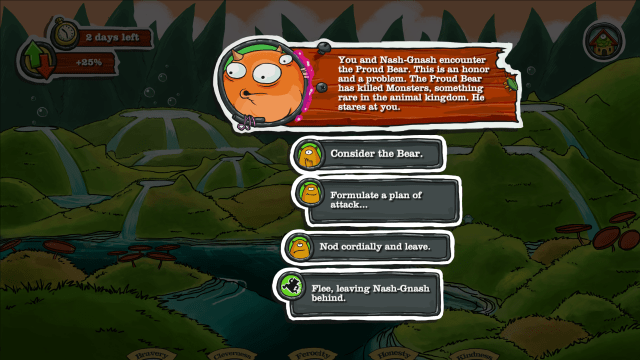
The game is, at the bottom, a choose your own adventure game with a little more complexity. The game begins when you, a monster, are born at the bottom of the communal spawning pool. This moment of birth is combined with a moment of developing agency, and from that point onward the game is driven by decisions that the player makes.

Early on, these decisions are both personally formative and social. For example, the player will be presented with a prompt like “you and another monster were wrestling and broken an expensive vase. You were caught. What do you do?” (the writing is much better in the game proper, I promise.) Your decision, chosen from three or four options, gives you points in one of several categories. These categories are varied–kindness, ferocity, and bravery are among the possible personality traits that the playermonster can develop in the early game.

What makes Monster Loves You! interesting is how the player is corralled into decisions. During the early parts of monster life, these different qualities of character can be raised and lowered fairly easily through interactions with other monsters, social problems, and wandering around in the forest. At the halfway point of the game, however, the focus changes–as an adult monster, your responsibilities change to be focused on human/monster relations. At this point, most of your personality traits are “locked in,” and the game becomes a process of navigating politics through your crystallized monster being.

Monster Loves You! is somewhere between a dating sim, the moral choices of a Mass Effect game, and a text adventure game. The choices that one makes, and the opportunities that one has, change every game. No monster grows up the same. Not every moment and problem is solvable by the monster the player has at hand, and there were times in the game where I wished that I had been more brave as a child, or been more ferocious, so that I would have more tools with which to make monsters less afraid of humans.

226740_2013-04-06_00011

In a world of heartless AAA titles and narrative grand standing, Monster Loves You! is a breath of fresh air, and I wish I could play more games like it.

Posted in Video Games | Tagged , , , , | Comments Off on On Monster Loves You!

Philip K. Dick’s Coffee Robot

“One postcred please,” the speaker said. It began to tick ominously. “Or in ten seconds I will notify the police.”

He passed the postcred over. The ticking stopped.

“We can do this without your kind,” the speaker said.

“One of these days,” Joe said wrathfully, “people like me will rise up and overthrow you, and the end of tyranny by the homeostatic machine will have arrived. The day of human values and compassion and simple warmth will return, and when that happens someone like myself who has gone through an ordeal and who genuinely needs hot coffee to pick him up and keep him functioning when he has to function will get the hot coffee whether he happens to have a postcred available or not.” He lifted the miniature pitcher of cream, then set it down. “And furthermore, your cream or milk or whatever it is, is sour.”

Philip K. Dick, Ubik pps.81-82

Posted in Quote Time | Tagged , , , | Comments Off on Philip K. Dick’s Coffee Robot

A Quick Note About Criticism and Bioshock Infinite

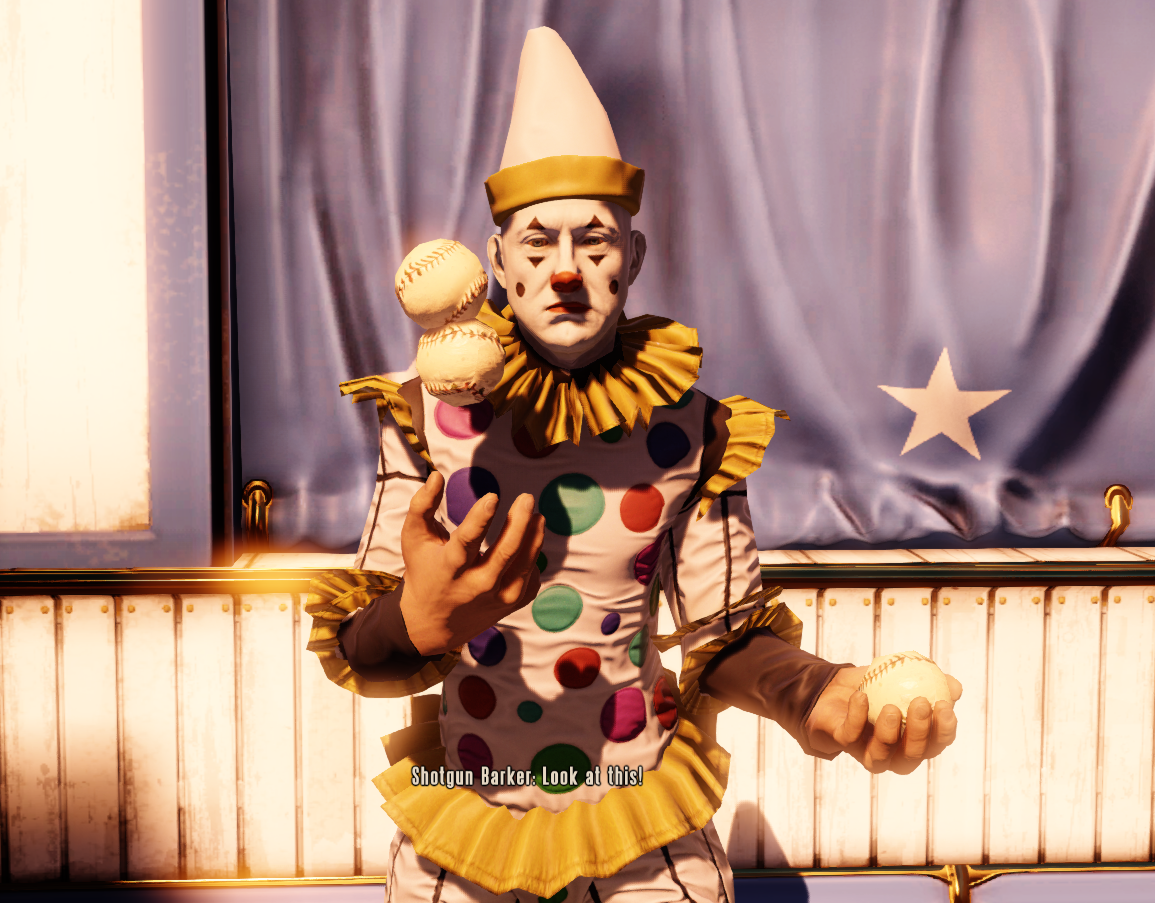
SPOILERZ FOR BIOSHOCK INFINITY AND BEYOND: THE RECKONINGjugglerThere is some video game adage that I have heard a few times that goes something like this: a video game gets more testing in the first week of release than it does through the entire development process. Call of Duty sells millions of copies in a couple weeks, and if everyone plays a level for an hour, that’s a million hours of testing (which sort of blows my mind.) There’s no way that a QA team could catch every single bug or slight error–the sheer volume of testing that is going on in the hands of consumers eclipses the efforts of an entire trained team.

[A note: I want to take a moment here to say that the QA team is amazing. The quality of my experience with Infinite is shocking compared to other AAA releases.]

I bring up the testing because there’s also another “stress test” that goes on immediately after release: thoughts about the plot. Sparky Clarkson’s recent post picking through the end of Infinite in detail had me thinking about this: Ken Levine and his writing team must have a clear vision of what the multiverse of Bioshock Infinite looks like. There has to be a map internally at Irrational. At the same time, how the “branching” system of constants, variables, and tears work is explained in such a piss poor manner that a huge amount of discussion of the game is just about working out this system of worlds.

Infinite is very clearly playing the same game that Inception did, which is to say that it is the appearance of complexity where there is none. Inception wowed audiences with its narrative complexity, but standing back from the film, it is profoundly linear and easy to work through. It has the trappings of difficulty, it tells you that it is difficult, and it doesn’t give you a clear answer in the end. In our contemporary media environment, that is mindblowing. [Note: it is eerie to look at the Infinite tag on tumblr and see the exact same claims being made about that game as Inception when it was released e.g. “it is the smartest game ever made”]

Back to the testing: in the hours after release, the plot of Bioshock Infinite was also thought about more than it ever had been in-house at Irrational.

This is always happening, of course. When a game is released to critical ire or love, what “works” outside of the development environment is immediately picked up on (and the opposite happens, too.) The case of Infinite is especially interesting, because it isn’t a moment of the general public saying “no, X does not work.” Instead, it is a moment of a collective mind coming together to think through a (maybe purposefully) complicated narrative.

Ending: I am very interested by a game that presents itself as brilliant and immediately falls apart in the face of any real scrutiny of its plot. Is this a product of AAA design and development? Is it possible to write large-scale complex narratives across and through designers, writers, artists, and team leads? Or is it always necessarily fractured because of the scale of the assemblage, of the economics, of the problems?

I feel like this is a very Daniel Joseph post.

Posted in Video Games | Tagged , , , , | 2 Comments

Richard Cobbett on Bioshock 2

The list goes on, but its most important element is that where BioShock was ultimately the story of a city, BioShock 2 is the story of its people – and in particular, a father and daughter relationship. On the surface – or to be more exact, several fathoms under it – that might sound very familiar. Like so much of BioShock 2 though, the style makes it different.

Under Ken Levine, both original BioShock and BioShock Infinite offer effective emotional moments. They’re a colder flavour of emotion though – Nolanesque, if you will – coming more from the head than the heart. Even ignoring the fancy speeches that inevitably accompany them, their reason is always to illustrate authorial points. That doesn’t make them bad – many of them are very effective indeed – but even a hammer with big sad eyes painted on its handle will always unmistakably be a tool.

Richard Cobbett – “Bioshock 2 Retrospective

I think Bioshock 2 remains my favorite game in the franchise, and I think Cobbett is exactly right in his evaluation of how Levine made his arguments in the first and third games in the series.

Posted in Quote Time, Video Games | Tagged , , , | Comments Off on Richard Cobbett on Bioshock 2

Rhizome Profiles Alex Myers

So Alex Myers has a lot of radditude and you can look at his blog and his twitter for constant updates on his life.

I constantly want to write at length about Alex, but I’ve yet to spend the time to look through all of his work and find the throughline, the connection, or whatever. That will probably come over the summer.

In any case, Daniel Rourke profiled Alex over at Rhizome.

A taste:

In terms of the Player-God, I think yes, I’m always trying to kill it. But at the same time, I’m trying to kill the Maker-God. There is no one place or source for a work. There’s no Truth. I reject the Platonic Ideal. Both maker and player are complicit in the act of the experience. Without either, the other wouldn’t exist.

Posted in Theory | Tagged , , , , | Comments Off on Rhizome Profiles Alex Myers

Interesting Bioshock Infinite Posts, Podcasts, and General Things

So this is going to be the place where I collect posts about Bioshock Infinite that I find interesting and worth keeping up with for FUTURE THINGZ I WRITE. I’m a big fan of making these personal data collections public, so here’s the page. Bookmark it (no one uses those anymore, do they?) or whatever.

8870_2013-03-26_00027

I am so serious that all of these pieces are great and you should read them all in full. If you have any suggestions, feel free to tweet them at me or put them in the comments so I can add them to the list.

I also want to be clear that I don’t agree with all of these, and there are some that I absolutely think are wrong, but I think getting an basic archive of the critical conversation is A GOOD THING TO DO that shouldn’t be tied to my own proclivities as A THINKIN’ DUDE THINKIN’ ABOUT VIDEO GAMEZ.

Here is a thread on NeoGaf (I know, I’m sorry) that neatly lays out the plot of Bioshock Infinite. If you need Bioshock Infinite explained, that is a good place to go.

You should assume that there are SPOILERS in all of these (even though it isn’t true.)

0000000000000000000000000000000000000000000000000000000000000000

1. Courtney Stanton – “Booker Dewitt and the Case of the Young White Lady Feels: a Bioshock Infinite review

2. Oh No Video Games – “Spoilercast: Bioshock Infinite” (audio)

3. Kirk Hamilton – “The Problem with Bioshock Infinite’s Combat” (feat. Jon “UR GAME SUX” Blow)

4. Darius Kazemi – “Bioshock Infinite and Against the Day – bifurcated transdimensional twins?

5. Daniel Joseph
– “Bioshock Infinite & The End of History
– “On Universals, Formalism & the Critical Reception of Bioshock Infinite

6. Austin Walker –
– “On and Off the Rails: The Problem of Player Agency in Post-Bioshock Games
– “I Can See My House From Here: Bioshock Infinite, Nostalgia, and The Uncanny
– “This Is Not An Agent: Bioshock Infinite’s Elizabeth Problem

7. Tom Bramwell – “The Hall of Heroes: Bioshock Infinite’s Fort Frolic

8. Chris Kohler – “Letters from Columbia: Breaking Down Bioshock Infinite

9. Cameron Kunzelman (self promotion station) – “On Bioshock Infinite

10. Rab Florence – “On Bioshock Infinite

11. starburp (I’ll put a nonhandle if someone gives me one) – “untitled” [on race representation in BI}

12. flutibear – “to the anon who asked about Bioshock Infinite” [on the gendered nihilism of BI]

13. Devin Faraci and the Profoundly Boring Gimmick – “Hulk vs Devin vs Bioshock Infinite” [the second section by Faraci is the most significant to me]

14. Kirk Hamilton (sorry for the ableism) – “Bioshock Infinite Is Insanely, Ridiculously Violent. It’s a Real Shame” — Daniel Joseph responds with “Is Bioshock Too Violent?

15. Reid McCarter – “Booker DeWitt and the Guilt of a Nation

16. Adam Sessler with Jeff Gerstmann and Kevin VanOrd – “Bioshock Infinite SPOILED GAMES!” [a thirty minute talk on the game interspersed with video]

17. Anjin Ahnut – “Infinite Privilege

18. Alex R. – “God Only Knows

19. Cyril Kowalski – “Modern shooters and the atrophy of fun

20. Gary Alexander – “Columbia: Problematic Racism Theme Park

21. Kieron Gillen – “About A Girl: Assorted Thoughts on Bioshock Infinite

22. Brian Taylor – “Gamer’s Advisory: Bioshock Infinite

23. Daniel Golding – “Bioshock Infinite: an intelligent, violent videogame?

24. Michael Abbott – “Shooter apotheosis

25. Iris Ophelia – “The Devil’s In the Details: Bioshock Infinite Companion Elizabeth isBuilt to Breathe Life into the Most Mundane Moments

26. Low Score Podcast – (the last hour) “Put A Songbird on It

27. Claire Hosking – “Birds” [analysis of Elizabeth, the game’s internal relations, and a partial response to Courtney Stanton’s post at the top of this page]

28. Leigh Alexander – “Bioshock Infinite: Now Is The Best Time

29. Todd Harper – “Infinite Regress

30. Brett Douville – “Bioshock: Infinite

Posted in Video Games | Tagged , , , , , | 8 Comments