On the Death of Stuart Hall

Stuart Hall is gone.

There isn’t much for me to say. It is hard to speak of an absence felt so clearly that it becomes present — Stuart Hall’s death is less the loss of a person and more the solidification of a legacy being written in the firmament that is the study of people and their culture. It has always been rare to be remembered as greater than you were, but what else can we do in the case of Hall? He took abstracted capital-T Theory, reduced it, clarified it, and made it both accessible and absolutely necessary for innumerable fields. Who has had a further reaching effect across space, in material and minds, throughout their life? He did what every single critical academic dreams of doing — he made his ideas appear so correct and irresistible that they changed the space of what could be thought, to what end, and for whom. He gave every one of us tools for reading and writing that could be turned around and used as weapons, a great revolt of the masses that assaulted High Modernism with cereal boxes, television, and portable CD players as no-longer-bad objects.

If this doesn’t cohere, it is precisely because I cannot cohere in the face of knowing that things are different now, that there’s been a tear in the fabric of the world as I know it, that things will be ragged and strange for a while.

To take from Malick — “let me feel the lack.”

Posted in Theory | Tagged , , | Comments Off on On the Death of Stuart Hall

Released: On August 11, A Ship Sailed Into Port

If you’re supporting my Patreon, you received access to this game yesterday.

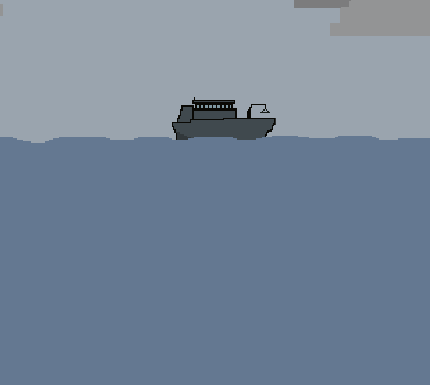
On August 11, A Ship Sailed Into Port is a simulation of what it is like to run an online magazine, or at least what I think that process must be like. I suggest that you play it with headphones, open it in its own window, and play it in a single sitting. It takes less than five minute to play.

ship

You can play the game here.

The wonderful soundtrack was made by Jack De Quidt.

I would love to hear any feeback on the game either here in the comments, via email, or through twitter.

Posted in A Game I Made, Video Games | Tagged , , , , , | Comments Off on Released: On August 11, A Ship Sailed Into Port

Flushed is Out!

Flushed: A Toilet-gaming Ezine is out! I haven’t had a chance to check it out yet, but there are so many amazing people involved that it literally cannot be anything but great. It is a statistical improbability!

Go grab it for $1 (OR MORE GIVE MORE).

Posted in Video Games | Comments Off on Flushed is Out!

Nick Mamatas on Harlan Ellison

Nick Mamatas wrote an interesting short retrospective on Harlan Ellison’s work and recent output.

There’s a strange pain to being a Harlan Ellison fan. On one hand, he’s undoubtedly one of the most courageous writers to come out of the American scene in the 20th century, and his voice is a rare one. On the other, the role of Harlan Ellison is a persona to be played by the man, over and over again, and with horrifying results. The same perpetual adolescent “fuck you,” punkish libertarian attitude that demands that we pay the god damn writer also produces a man who will grope a woman, apologize, and then waffle on the apology when it isn’t immediately accepted.[1]

My Harlan Ellison is in 1974, the Harlan Ellison coming out of Civil Rights activism, the Harlan Ellison who wrote in bookstore windows as a dual combination of ruthless self-promotion and a desire for people to see that writing is work. I want the man who impressed such a deep nihilism on me that I’ve never quite been able to recover from it. Speculative realism and vaguely associated branches of thinking have a fascination with H.P. Lovecraft and Thomas Ligotti, both horror writers who craft stories in which the human comes into contact with reality and either comes away irreparable scarred, or better for them, dead.

Why not Harlan Ellison? The introduction to Approaching Oblivion ends with this:

Had I done this book in 1970, as I had originally planned, you’d find in this space a clarion call for revolution, a resounding challenge to the future. But it’s four years later, Nixon time, and I’ve seen you sitting on your asses mumbling about impeachment. I’ve gone through ten years waiting for you to recognize how evil the war in Nam was. I’ve watched you loaf and lumber through college and business and middle-class complacency, pursuing the twin goals of “happiness” and “security.”

What fools you are. Happy, secure corpses you’ll be.

You’re approaching oblivion, and you know it, and you won’t do a thing to save yourselves.

As for me and you in this literary liason, well, I’ve paid my dues. Now I’m going to merely sit here on the side and laugh my ass off at how you sink into the quagmire like the triceratops. I’m going to laugh and jeer and wiggle my ears at your death throes. And how will I do that? By writing my stories. That’s how I get my fix. You can OD on religion or dope or war or toadburgers, for all I care. I’m over here, watching you, and giggling, and saying, “This is what tomorrow looks like, dummy.”

And if you hear me sobbing once and awhile, it’s only because you’ve killed me too, you fuckers.

I’m stuck on this spinning place with you, and I don’t want to go, and you’ve killed me, and I resent it, and the best I can do is tell my little tomorrow stories and keep laughing as the whirlwind whips the dirt in the playground at Lathrop grade school into the ominous dust-devil. [Approaching Oblivion pp.16-17]

When I read this, Harlan Ellison politicized me. This selection from the introduction of the book is peak nihilism couched in smugness, but he does such a careful job to move the mask ever so slightly to the side — beneath the superiority, there’s an immense amount of sadness that we didn’t do better, that as a species, we’ve never been able to deliver on what we’re most certainly capable of. Ellison says it isn’t a call for revolution, but if it isn’t, I’m not sure what is.

One day, probably soon, I will wake up and learn that Harlan Ellison is gone, and there will be a gap.


1. I cannot express how much I think this is just awful shit. What an asshole.

If you enjoyed this post please consider supporting this blog.


Posted in Theory | Tagged , | Comments Off on Nick Mamatas on Harlan Ellison

Game Criticism Time Machine: Corvus Elrod on Moblins

Game Criticism Time Machine is a series of posts on this blog about, or linking to, videogame criticism pieces from more than a year ago. 

Everything about the Moblin’s movement also speaks to their abilities… or rather, their lack thereof. When you first encounter them patrolling the corridors of the Forsaken Fortress, they lead with their noses, sniffing the air, peering closely at the dark corners of their patrol. Their top heavy bodies swing massively as they walk, speaking of their power and lack of control. Their lower lips droop and bounce as they move, giving them a slack-jawed-yokel feel and giving them an unrefined and unintelligent apperence. Should they sense/hear the movement of a barrel (which Link is hiding under), they react with a large squeal and peer anxiously around, looking for the source of the disturbance. If you remain still, they quickly lose interest and go about their way. Later, when you find yourself in combat with them, they wind up for their powerful blows, there are no sudden and unexpected strikes, only well projected sweeps of their spears.

– Corvus Elrod, “Character Profile: Moblins

I love analysis pieces that take the visual rhetoric of a character’s design and attempt to match it up with how that character operates in a game world. This is a short but really great example of that kind of work.

Posted in Game Criticism Time Machine | Tagged , , , , | Comments Off on Game Criticism Time Machine: Corvus Elrod on Moblins

On Assassin’s Creed Part 1: The Fiction

Everything in Assassin’s Creed begins with the assassin’s creed: “nothing is true, everything is permitted.”

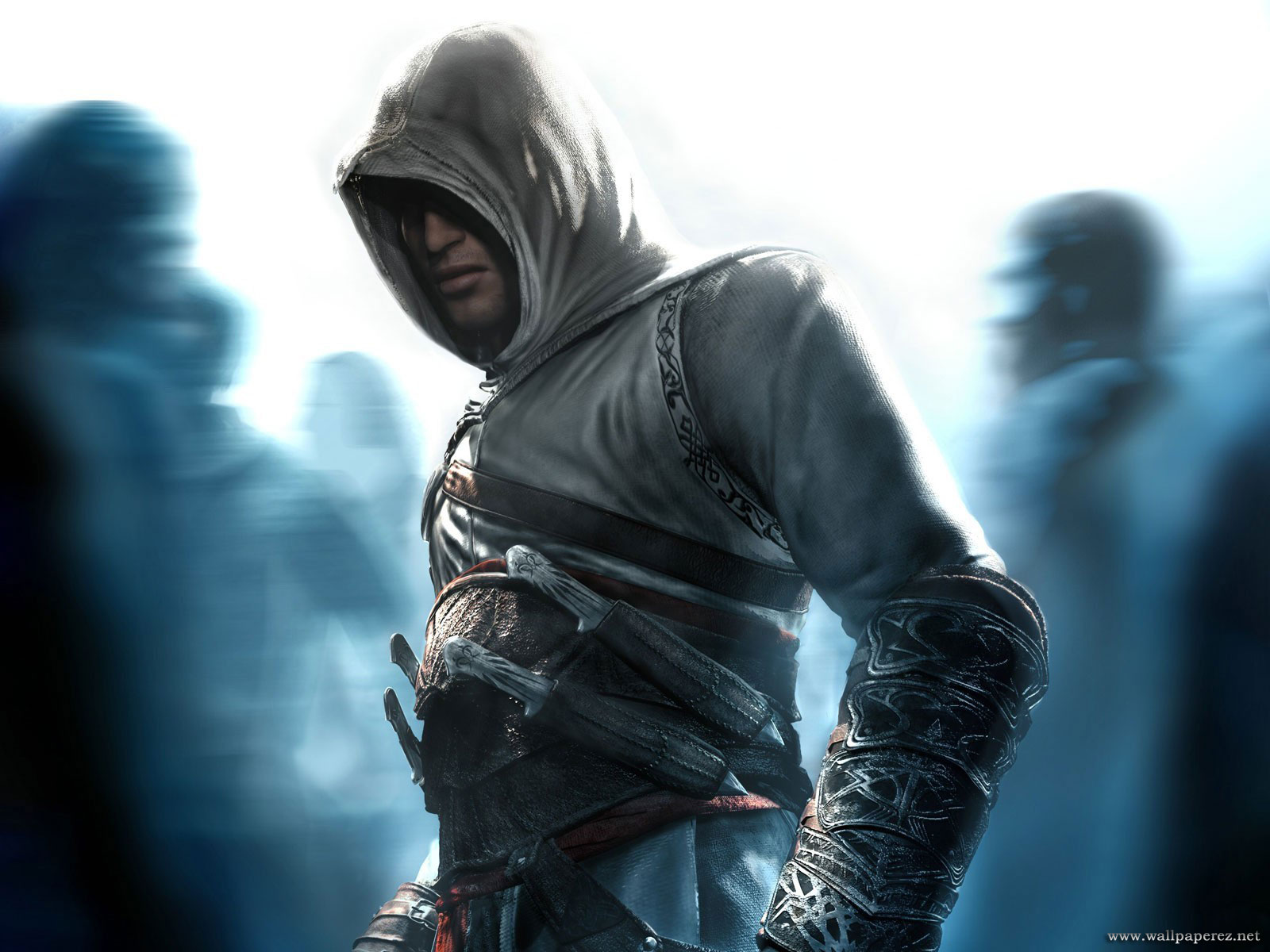
Not literally. We’re introduced to the world of Assassin’s Creed through an overheating and glitched-out Animus, a machine used to isolate and experience genetic memories. We play the tutorial, learning how to jump around on buildings and move through the world of the game, all surrounded by faceless, fawning semihumans. Things get stranger; we wake up.

We no longer control our unnamed hooded figure. We’re Desmond Miles, mild-mannered bartender, sitting up on the Animus machine listening to a monomaniacal doctor and his technician explain things to us. Maybe now, and if not now then certainly later, you pick up that their names are Warren Vidic and Lucy Stillman. The first is a Templar who needs Desmond to experience the life of his ancestor, Altair, in order to reveal the location of a device that can be used to control the world; the second is an Assassin sleeper agent who is doing everything in her power to stop the Templars.

The meat of the game isn’t here, though, at this top level that is constantly more complicated the more games that are added to the series. It is instead one level deeper, in the Animus, in the past.

altair2

As I said at the beginning, Assassin’s Creed‘s focal point is around the creed itself: “nothing is true, everything is permitted.” We’re introduced to Altair through his inability to understand this phrase — on a mission to protect an artifact, he shows that he does not understand, putting himself and his brotherhood in danger. How someone who lacks the most basic understanding of the central tenets of an organization is able to not only rise but become a minor master in that organization is left unanswered, but because of this initial folly, Altair is demoted down to the lowest level of assassin by his commander, Al Mualim. In order to be forgiven by his order, Altair must assassinate nine targets throughout the Holy Land during the Crusades, restoring a semblance of peace during the brutal Crusades.

We’re moving through this very intricate set of details from the beginning of the game because they function in much the same way as a prophecy would in a traditional role playing game. It contextualizes the events that are about to occur, but it also assures us that the compartmentalized events we’re about to experience for the next fifteen hours are all in service to a single, golden plot thread. Much of the rest of the game is split into chunks of memories that work in scenario format: Altair goes to a city, does some recon work, and gets the go-ahead to assassinate one of the nine targets. After jumping through some hoops, we do the job, and Altair receives a small piece of a very grand puzzle in the form of a long monologue from his target. We travel back to the Assassins’ fortress, Al Mualim contextualizes what just occurred, and Altair proves that he has grasped another part of the Creed more explicitly.

That is the ebb and flow of the game’s narrative, with each wave being the targeted assassinations themselves. The real struggle of the game is presented here — with each assassination, Altair learns more of the order that exists in opposition to his own, the Templars. From the outset, the Templar targets you assassinate call into question how their deaths could be considered just: “Why me, when so many others do the same?” asks the first, and there is no answer. The lesson that is drilled into our heads over and over again throughout the game, almost to the point of ridiculousness, is that the Templars and the Assassins are much the same, with the only difference being the methodology that each groups deploys.

Late in the game, it is revealed to us through several different encounters that this difference in methodology can be easily summed up as “Assassins want freedom, Templars want slavery.” Both claim that their plans will lead to the eternal peace that humans deserve, and both assume a genocidal stance toward the beliefs of the other. We are told by parties from both camps that “it only takes one” to continue the ideology of the Assassins or the Templars (a fact that is taken to its extreme with the development of the Animus technology which “reads” genetic memory). While the paths of Templars and Assassins are given to us as equal in a number of ways, including an equivalence in the kinds of violence that both have to commit in order to facilitate their plans, there is still a clear line drawn for us near the completion of the game.

The final mission of the game reveals that Altair’s master, Al Mualim, actually believes that the Templar tactics of total domination are better in the long run for humanity that the Assassin’s freedom-centered beliefs. He possesses a Piece of Eden, an artifact that can project grand illusions, and has used it to mentally dominate all of the other assassins and townsfolk nearby. He has, as he claims, found “proof” that nothing is true and everything is permitted. Later, after Altair has defeated a stage of the boss battle, he clarifies his position, stating that “as long as men may take free will, there may be no peace.”

The debate back and forth continues predictably. I want to make it clear that I think the narrative of Assassin’s Creed has done a lot of rhetorical work to point out the moral gray area that the debates between the Templars and the Assassins are happening in; the arguments being made by the slain Templars don’t seem to be treated as jokes, and I believe that there’s a sincere effort on the part of the writing and development team to put a lot of doubt in the mind of the player about who is actually right in the final calculus. However, Al Mualim’s conversion into an Emperor Palpatine-style master manipulator/supervillain forces rhetorical point of the end of the game into a certain direction. Instead of summarizing, let me give you the last substantial bit of conversation between Altair and his master:

Al Mualim: Who you are and what you do are twined too tight together.To rob you of one would have deprived me of the other. And those Templars had to die. [sighs] But the truth, is I did try, in my study, when I showed you the treasure. But you are not like the others. You saw through the illusion.

Altair: Illusion?

Al Mualim: That’s all it’s ever done, this Templar treasure, this Piece of Eden, this word of God. Do you understand now? The Red Sea was never parted, water never turned to wine. It was not the machinations of Ares that spawned the Trojan War, but this! Illusions! All of them!

Altair: What you plan is no less an illusion–to force men to follow you against their will!

Al Mualim: Is it any less real than the phantoms the Saracens and Crusaders follow now? Those… craven gods who retreat from this world that men might slaughter one another in their names? They live amongst an illusion already. I’m simply giving them another, one that demands less blood. Altair: At least they choose these phantoms.

Al Mualim: Oh do they? Aside from the occasional convert or heretic?

Altair: It isn’t right.

Al Mualim: Ahh. And now logic has left you. In its place you embrace emotion. I am disappointed.

Altair: What’s to be done then?

Al Mualim: You will not follow me, and I cannot compel you. Altair: And you refuse to give up this evil scheme!

Al Mualim: Seems then that we are at an impasse.

Altair: No! We are at an end! [source]

There are two things that are happening here. The first is that Altair, and therefore the order of Assassins that follows him through history (and the next games), is the embodiment of a pure classical liberal worldview. Choice and free will are the most important values possible, and even if those values are put in the charge of something that betrays them — Al Mualim’s “phantoms” — what matters is not that they were compelled but that they had an option to be compelled. The Assassins are therefore the culmination of the core values of the Western canon of philosophy and political theory, which I need to point out is a canon that has been thoroughly critiqued for its focus on and valorization of increasingly atomized agents who are praised for being unique and singular but only taken seriously when they are in a mass.

The second, maybe more important, argument of the fiction of Assassin’s Creed is that the only way for this impasse between two worldviews to be crossed is through violence. This solution, which ends the game, is a moment where we have to scratch our heads. How is it that a game with a fairly sophisticated sense of a morally grey political ecology falls prey to what it essentially a “clash of civilizations”-style argument for the incommensurability of two different worldviews when they come to different conclusions about the same set of facts?

It is an open question. There’s no solution to it, partially because Assassin’s Creed purposefully leaves us with no ground at the end of the game. It ends abruptly, with the Templars of the contemporary era using the information from Desmond’s memories to find the Pieces of Eden in the present day. The game ends with symbols in blood on the walls, an open wound with no resolution, waiting for a sequel.

Tensions between worldviews and narrative structures are eased, solved, and complicated further by additional games in the series (which I will hopefully get to soon). But there’s an alternative history, one where this game flopped and the franchise never became a franchise. What does it leave us with? A fictional world internally debating with itself for fourteen hours, the fifteenth existing only as a quick and convenient blade for asserting a tired political lesson that became tired a century ago? Something more? Something less?

Posted in Assassin's Creed, Video Games | Tagged , , | 1 Comment

On 100% Complete

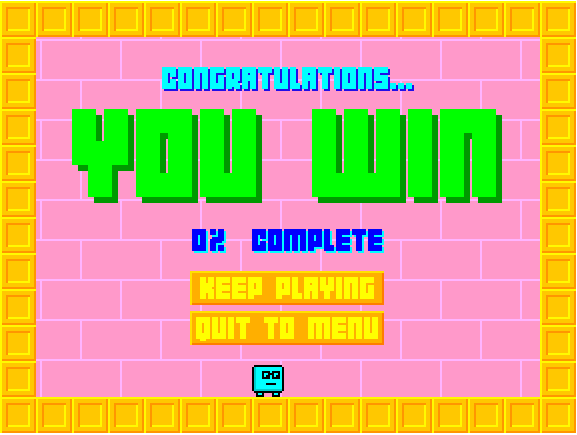
I stumbled on this neat little game called 100% Complete today. The basic gist is that you’re a little cube thing who has to reach a door to complete the game. It is very easy to reach the door — when you start, it is right there.

When you go through the door you see this:

100 complete2


There’s a great gap between what the game presents as complete and what complete really is. In reality, you have done all you need to finish the game — you have, in the language of the game, beaten it. But you haven’t exhausted it (in a Deleuzian register). You have not taken a full account of the potential of what this videogame body can do and then performed all of those actions. In 100% Complete, the things you can do are hidden behind walls, in chambers behind pushblocks, or at the bottom of pits. They take the form of collectible pizzas or bouncing basketballs. They are at the same time totally irrelevant and absolutely essential to any feeling of pleasure that could come out of the game.

I’m a big fan of these games that lay contemporary gaming practices bare. How different is 100% Complete from a Tomb Raider or an Assassin’s Creed in any way other than scope and scale? How much of those games are about going through the motions of plot completion — forward momentum — in order to get to a moment of a pure collectathon sublime? And is the desire to get to a [feel-good state of game, a post-flow, a dull hum of breadcrumbed grins] the core of what he are offered now?

The busywork of games in the ludic millennium.  

Posted in Video Games | Tagged , , , , | 3 Comments

New Review in ImageText

A little more than a year ago I did a review of Bart Beaty’s Comics Vs Art for ImageText, and after a little waiting, it is out! I’m really happy with the review, especially because I did it so long ago and it is definitely from a period where I was doing a different kind of work than I am now. The more things change the more they stay the same, amirite?

You can read the review here.


Posted in Comics, Theory | Tagged , , , , | Comments Off on New Review in ImageText

A Week in the Life of a Guard on a Rooftop in Assassin’s Creed

250px-AC1_Saracen_Archer

Day One

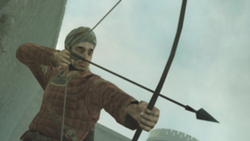
What a great job! I moved here from my home village three days ago, and all it took was bumping into one of the hundreds of guards roaming around the city in order to realize that there’s a strong demand for people who are willing to stand around on a rooftop all day. I stood in fields yelling at birds for years…for free! They even gave me a nifty bow and taught me how to sort of nock an arrow. They asked if I knew how to yell, and I told them about the birds and the field, so of course I rocketed right to the top of the list for rooftop duty. I don’t really know what happened to the last person with this job, but they do have me standing in a really big and gross stain most of the day.

Day Two

The city is so beautiful! There are so many people here! They crowd the streets, especially the markets, carrying their baskets or pots full of goods back and forth. I bumped one of the pot carriers on the elbow the other day and she dropped her pot into someone else, which cascaded through the crowd and destroyed ten or fifteen pots worth of goods. No one was happy, but no one said anything. Guards are loved throughout the city! What a great place!

Day Three

I was standing on my rooftop today, and I saw some guy in all white with several swords strapped to him running really fast on the roof across the street. I looked at him for a little while, and I thought about giving him a heads up that there is bird poop and stains and just general detritus all over these roofs, but he was gone so quickly. This city is so vibrant!

Day Four

Saw the running guy again. It is so boring up here! Sometimes when I’m walking from corner to corner on my roof I see another guard really far away. I tried to wave this morning, but he wasn’t facing toward me. I thought to try again the next time I saw him, but he was facing away again. I didn’t bother a third time. Also, I’m wondering where all the goods in the market come from. I see people walking around with stuff, and I see people leaving the city, but I never see wagons coming in.

Day Five

That guy in white keeps running by. Today he ran across my roof, hopped across the street, and then just stoop there. It made me so angry! I nocked an arrow and yelled at him to get down off the roof, and he didn’t, so I yelled really loud and some other guards chased him. They climbed up on the roof and he killed them one by one. Then he walked fifteen feet and jumped off the roof into a pile of hay.

Day Six

I hate that running guy. I hate this job. I want to go back to the field. That other guard still won’t even look in my direction.

Day Seven

[Guard 221 was found dead with a stab wound through his kidney. We found him in the exact same place we have found the previous two hundred and twenty guards.]

Shoutout to Samantha Allen’s “Diary of a Western Videogame Protagonist

If you enjoyed this post please consider supporting this blog.

Posted in General Features | Tagged , , , | 1 Comment

Vicesimus Knox Did An Objective Book Review in 1786

I’m taking a class in Romantic concepts of technology this semester, and I read little thing by Vicesimus Knox about libraries and books and having a grand old time reading. Near the end of the piece he writes:

I confess I had been much more conversant in a college library than in a circulating one, and could not therefore but be astonished at the number of volumes which the students would devour. The Helluo Librorum, or Glutton of Books, was a character well known at the university, and mentioned by the ancients; but I believe that their idea of him is far exceeded by many a fair subscriber at the circulating library. I have known a lady read twenty volumes in a week during two or three months successively. To be sure they were not bulky tomes, such as those of which it was predicated that a great book was a great evil. The print in the pages of most of them, to speak in the mechanical style of mensuration, were three inches by one and a half., and the blank paper exceeded the printed in quantity by at least half on a moderate computation. [“Of Reading Novels and Trifling Books Without Discrimination”]

What I find wonderful here is that the “objective” ending of the paragraph, in which Knox gives the measurements of the books the woman read, is really about the affective capabilities of the book. Because of its objective status in the world as an object of x any y dimensions, it immediately has a different symbolic weight.

Objective Game Reviews needs to take on this model. Don’t just describe the object; assert that it is either good or bad because of the size, shape, and amount of time you’re intended to spend with it.

Posted in Theory, Video Games | Tagged , , , , | 1 Comment