Kilmercast Episode 3 and a New Website!

topgun18

First thing is that Kilmercast has a new home on its own website!

Second this is that we have a new episode on the Val Kilmer cornerstone film Top Gun. This is our best episode yet, and I think we’ve really started to hit our stride. Laurel has a new microphone and we’ve added some different segments to the show.

Third is that you can now subscribe to the show on iTunes! Please subscribe to it and rate it so that we can become Very Famous[TM]

Posted in General Features | Tagged , , | Comments Off on Kilmercast Episode 3 and a New Website!

Game Criticism Time Machine: Andrew S on Videogame Demos

In the anticipation of a game that is sometimes years away, arguments will erupt about its quality, often hinging on such damning empirical evidence like screenshots and whether they were faked or not. Massive armies of the overstimulated who have nothing better to do will swarm websites like Gamestop and NeoGAF and Amazon leaving comments about a game that they haven’t played, and likely isn’t even finished yet. Meanwhile, our favorite video game news outlets will be given their monthly ration of screenshots to post, and the whole process begins again. This is how the machine works. And video game culture at large not only accepts it, they love it.

Back in the early days of PC Gaming, demos were essential for getting the word out about a game. This is how the Shareware scene started. Publishers would release the first mission or chapter of a game for free, and you would have to pay to play the rest of it. These chapters were often made up of sub-missions, and provided enough content to be classified as a game in itself. For a while, this was enough to support a fledgling game development community and allowed it to compete with the big studios and their boxed games available on store shelves.

– Andrew S., “The Video Game Demo

Posted in Game Criticism Time Machine | Tagged , , , | Comments Off on Game Criticism Time Machine: Andrew S on Videogame Demos

Interview with One More Turn

A few weeks ago I did an interview with Kevin King of One More Turn about my games. He asked really great questions, and it prodded some answers out of me.

I’m generally not a person to write artists statements or arguments about my games. Most of the time I want the things I make to stand for themselves, and if they can’t manage to do so, then I didn’t do a good enough job to begin with. In some ways, I think that’s weird in the contemporary indie dev scene — there are entire websites that exist only to allow developers to speak about their intentions with design — but I’m straddling a line between art and commercial development that I really haven’t parsed very well yet.

All of that said, I say more in this interview about my design process and what I am thinking about when I make games than I ever have before, and if you’re interested in that, it is worth listening to.

Posted in Video Games | Tagged , , , | Comments Off on Interview with One More Turn

Another Ad For A Game Design School

The first ad for a game design school that appeared as a sponsored ad in my Facebook feed intimated that game design was really just about totally radical controller skins. In this one, game design is mostly about making a woman in a low-cut shirt smile. “Do you even game?” it asks me.

game design school 2

Do I even game?

Posted in Video Games | Tagged , | 2 Comments

Trying to Read Again: New Copies of Deleuze and Guattari

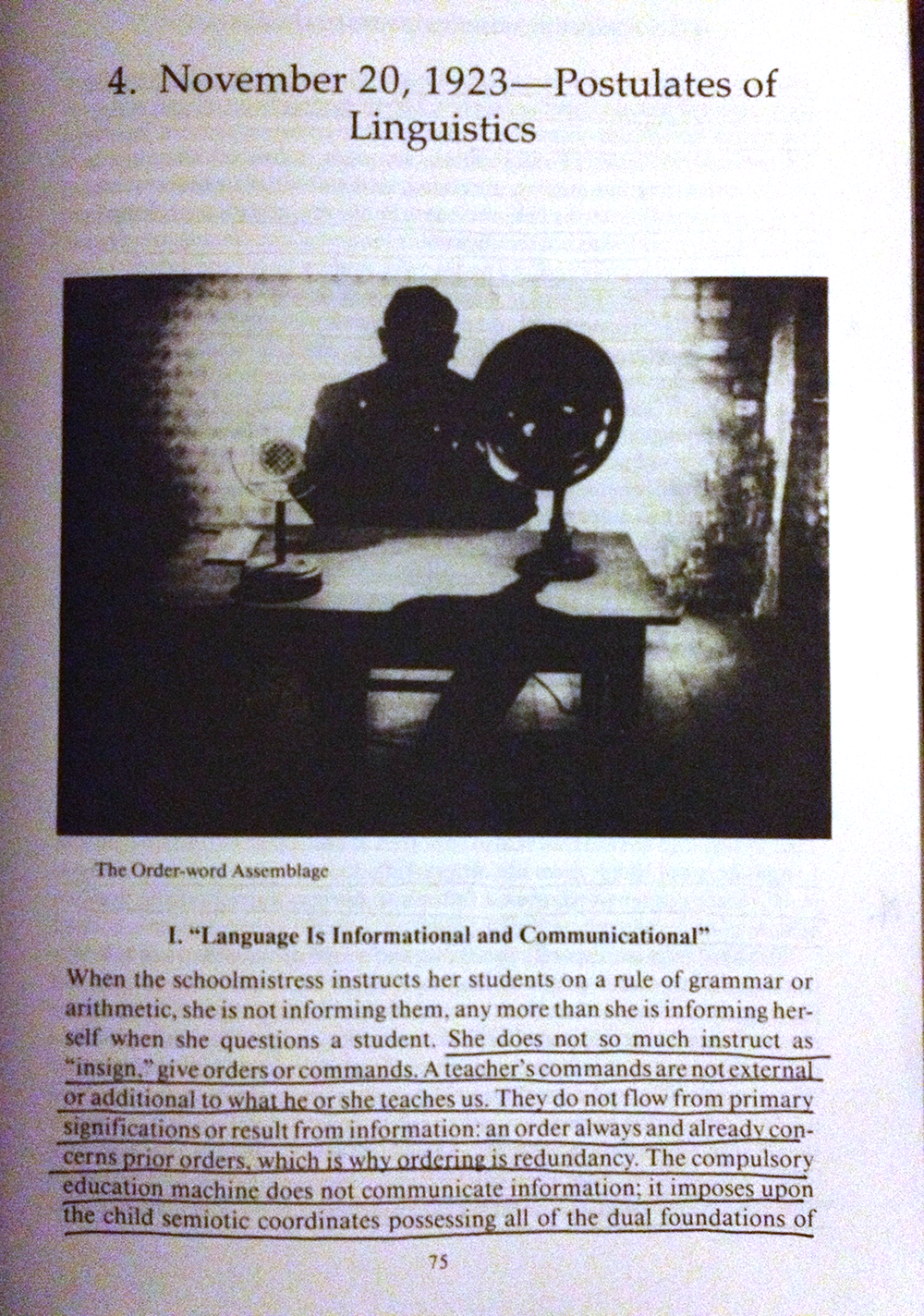
I’ve had my copies of Anti-Oedipus and A Thousand Plateaus for a long time. They’ve been paged through over and over again. I’ve read through them in high school (understanding nothing), college (understanding a little), and graduate school (understanding a little more). They’re still books, but now they’re archives of me.

It is weird to see what has changed. High school me read with a heavy-flowing, wide-tipped pen and underlined every political passage in Anti-Oedipus with wild abandon. I remember making the lowest possible score without failing in a math class my final semester in high school because I was working through A Thousand Plateaus. I have no idea what I got out of it other than a 90% underlined “Micropolitics and Segmentarity.” In any case, as Deleuze and Guattari write in “Rhizome,” the books caught me up in themselves. They crept through me and changed how I thought. When I was sixteen, I was reading them not as philosophy, but as wildly evocative fiction, nonfiction, as an announcement of totally weird shit involving history and Nietzsche and apparatuses. I was enthralled with a story about philosophy bound up in a lecture by Professor Challenger, who slowly explained big and strange concepts to me while slowly becoming a monster. It was exciting and new and encouraged me, via philosophy and critical theory, to be where I am today.

They have a material history. I was able to purchase Anti-Oedipus because I scraped together cash over a very long time. Then my friend drove me thirty minutes away to the nearest bookstore, where I spent something like $30 on it. For some reason, he had water in the backseat floorboard of his car, and on the way home he stopped at a stop sign, causing the book to dunk right in it. It made me feel awful — the expenditure of $30 at that time might have been $100 — and the first few pages of the book are still discolored today.

The corners are all flipping up from being turned so often. They’re creased and folded from being put in bags, getting caught on fabric. They’re water damaged from coffee, water bottles, being stuck in backpacks when I’m walking in the rain. The edges are just grimy from being touched over and over and over again.

So I am retiring these copies.

olddgbooks

and I bought these copies

newdgbooks

One reason that I’m doing this is that I feel like I’m at the point where I need to come at these texts fresh. My original copies are so underlined and annotated that I have problems seeing the text as text and not as a set of prearranged arguments that I’ve outlined for myself.

Another reason is that I think these new copies, published by Bloomsbury, are just betterA Thousand Plateaus is a difficult book, and the cramped text of the Minnesota didn’t do anything to help with that. The Bloomsbury books are laid out in a new way, with a well-spaced font that gives you space to, you know, think about what is actually on the pages.

Comparisons really quickly:

atp1

atp3 atp2

I apologize for the awful pictures, but the first image is from the Minnesota edition of A Thousand Plateaus. The second two are from the Bloomsbury edition. The opening picture is on a separate page, the text isn’t as cramped, and there’s some neat layout stuff going on (and the number for the subheading is removed).

In any case, I’m excited to read these books again in these editions.

Posted in Theory | Tagged , , , | 1 Comment

Game Criticism Time Machine: Lyndon Warren on his Digital Dark Age

Game Criticism Time Machine is a weekly series where I find game criticism from more than a year ago, post an excerpt, and encourage you to read the piece.

That is the box which contains all of my earliest childhood gaming memories. See I have always lived with a computer. The same year I was born (1985) my father bought a brand new IBM compatible personal computer. No joke I learnt my ABCs from this thing because I had a game for that.  It wasn’t a 486, a 386 or even a 286, it was an IMB XT, the XT presumably stands for extreme.  It had two floppy 5 1/4 inch drives but no hard disk, so to get anything to work you needed to insert the DOS boot disk to load up the operating system and in the other drive insert the disk for the program you actually wanted to run. I can’t remember a time when I didn’t know what an operating system was. These things have become coded into my soul.

Lyndon Warren, “My Own Personal Dark Age

I love first person accounts of media archaeology and obsolescence.

Posted in Game Criticism Time Machine, Video Games | Tagged , , , | Comments Off on Game Criticism Time Machine: Lyndon Warren on his Digital Dark Age

On Assassin’s Creed Part 2: The Game

In the previous piece that I posted about Assassin’s Creed, I wrote about the narrative of the game and how it holds up the rational, liberal subject as the most important kind of subject that can be produced by a system of governance. In this short essay, I’m going to continue this analysis of the game, but in the register of its mechanics and how they are presented to the player.

Assassin’s Creed as a franchise is concerned with actions of zooming in and zooming out. The frame for the games is this concept written as largely as possible — we are players playing a game where a character is playing a memory of someone doing very difficult and intensely-focused actions. This zooming in and out between macro- and microscales is given to us not only through the narrative frame, however, but also in gameplay itself.

The mission structure of Assassin’s Creed mirrors this larger pattern — there are “memory blocks” with discrete sets of collectibles, missions, and assassinations. In the course of playing through the narrative of the game, you progress through them linearly, “fast forwarding” through “non-critical” memories in order to get to the parts that matter the most for evil corporation Abstergo. But there is always the option to perform a “zoom out,” taking the memory blocks not as finite structures, but as part of the memory stream that you can dip back into whenever you want. Memory is a river that you can step into twice, three times, as many as you need to collect the things you need to get to 100% completion. This flexibility of the game’s systems, which always allow us to perform the act of zooming out and then zooming in to access any part of the game at any time, resonates again in the open world structure of the game.

assassinscreed

Like other open worlds, from Grand Theft Auto V to Infamous, the maps of Assassin’s Creed are node-based. We can wander around doing whatever we want for as long as we want, and when we want to “move forward” in time, we can access the next node on the giant map that progresses the plot.

This ebb and flow of node selection is a process of zooming in and out on events that occur in the game. I feel very comfortable saying that there is a “standard scale,” a zoomed-out quality to most of the actions that players perform in Assassin’s Creed: you run around the map, you climb up towers, you collect flags, you ride horses. Each of the various cities contextualize these actions, tailoring them to their particular opulent or ruined architectures, but in the end, the running, the climbing, and the annoying of guards is fundamentally unchanged from location to location.

I describe these actions as “zoomed out” because our relationship to them is like looking at the ground from a plane; there are movements, differentiating features in the broad strokes of things, but minutiae is mostly lost. You hold down the free running button to get from point to point and that’s your relationship to most of the actions you take during these open world segments. You’re taking what Nietzsche might have called the God’s eye view; today we call it “playing the minimap.”

What establishes a mechanical rhythm in Assassin’s Creed is the zoom in, the focal moment, which is unique in that each action taken effects the entire scene. The structure of most of the missions that are accessed in the open world nodes work this way — you are given a target, you focus on that target and her or his movements, and then you perform a timed action on him or her. You follow a merchant, stand still as he looks around, creep closer as his back is turned, move closer, hit the pickpocket button. An assassination mission works the same — you find the target, trace his movements while carefully controlling your own, and intervene for a single surgical moment before dashing away across rooftops.

Mechanically, this is merely giving us what can only be called “assassin feel.” These very specific and targeted movements force the player into feeling like a scalpel, a single-use object that is very efficient at that single use.

Point and counterpoint, however, and so these very specific moments only have the qualitative feel that they do because they are not the targetless, running-around times. These moments of feeling highly effective with a strong purpose in life are contrasted against directionless running and climbing. Being zoomed in only has meaning because it does not afford us the access and choice of options that being zoomed out does.

On one hand, this is incredibly effective as a mechanical system for delivering a particular experience to a player. The designers and developers of Assassin’s Creed set up a very specific possibility space for Altair, and that space is explored efficiently and to a greatly “immersive” end in the sense that you really do experience the day-to-day of an assassin in this world. The systematic rocking back and forth between zoom levels becomes a rhythm of life.

On the other hand, it becomes very boring. Rhythm in music, or even film, works because it sets up a specific plan that is predictable, but the real payoff is when that rhythm is broken. This could happen on purpose — a reverse shot where there shouldn’t be one, for example — or merely through the media object ending, a natural interruption of the rhythm. What makes purposeful ebb and flow work as a useful tool is knowing that it eventually wears itself out — being mechanical, artificial, it needs maintenance in order to continue on in the world.

I think this might be the root of many of the criticisms I have seen so often about Assassin’s Creed. Before this most recent playthrough, I was warned about the missteps that the game made: it is too long, it is a big empty world, it is boring. And all of those are true, to a point, but I feel like they are all byproducts of the zoom in/zoom out rhythm. Once you perform or experience the structure for longer than a couple hours, it ceases to be vibrant and interesting; it becomes a chore, a heartbeat that requires effort.

Rhythm is a wonderfully efficient mode of generating investment in a media object, but the duration of that rhythm has to be reigned in and controlled, made finite. The predictability of it is an machine for creating player investment, but the moment that I wake up to that reality, I push myself from the experience. The moment I’m not longer humming along is the moment I realize I don’t want to hum any longer.

If you enjoyed this post please consider supporting this blog.

Posted in Assassin's Creed, Video Games | Tagged , , , | Comments Off on On Assassin’s Creed Part 2: The Game

Kilmercast Episode 2 Released

As you may know, my friend Laurel and I have created a podcast called Kilmercast where we are watching the films of Val Kilmer and talking about them in podcast form. For the first episode we watched geek classic Real Genius, and for this second episode we talked about the somehow-geekier Willow.

willow9

You can listen to the episode here.

You can check out the tumblr page for the podcast here.

Also, I want to say that I make lots of GIFs and screencaps per film, which I then put on the tumblr page, so if you want lots of Val Kilmer in your feed everyday make sure that you follow the Kilmercast page.

willow9


Posted in Film | Tagged , , , | Comments Off on Kilmercast Episode 2 Released

On the Incredulity of Call of Duty

Quickly:

Currently I’m working on my thesis and I’m stuck at home variously because of inclement weather and so I’ve been putting quite a few hours into Call of Duty Ghosts in order to both clear my head and avoid work.

I don’t play with a microphone, but I do love listening to other people play. The kinds of conversations you get are wide and varied. Sometimes you get to hear fifteen minutes of one side of a phone call. Sometimes it is trash talk. Other times it is the low, dull hum of the newest Eminem album being idly sung to by a teenager.

There’s one throughline that runs through all of these varied kinds of communication, though, and that’s the “WHAT?!”

If you’ve played any of these games, you know it well. Someone who is mic’d but isn’t talking is killed in the game, or misses a shot, or falls out a window, or spawns in a bad place, and he (and it is always a he) screams out “what?!” It is the ultimate question, one which there is no answer to. Here in the game, a minigame of the universal game, the pure contingency of relations is rendered questionable. We can’t answer this angry youth. We can’t offer him solace — “play better” is the communal offering.

So it is perfect, or beautiful, in a way. This purely existential question — “why are things the way they are?” — screamed over and over again over a network attached to one of the most popular games of all time. Not the hum of Eminem, but a chant, repeated over and over like a prayer.

Posted in Video Games | Tagged , , | Comments Off on On the Incredulity of Call of Duty

Game Criticism Time Machine: Duncan Fyfe on Jade Empire’s Outtakes

I’m quoting a long chunk of this post from 2007 by Duncan Fyfe, but I had totally forgotten about this part of Jade Empire.

I don’t know what game ever got this right: the “funny outtakes”. It’s hard to get right, of course, because it’s an awful idea. Over Jade Empire’s ending credits, the characters Dawn Star (voiced by Kim Mai Guest) and Sky (voiced by Cam Clarke) talk about their “experiences” making the game Jade Empire. So you have the fictional character Dawn Star blathering on about working with “the writers” at the real-life company BioWare. Now, it’s not that I can only read this game strictly literally. I don’t understand, however, what comedic potential is being realised by “Dawn Star” acting like she’s on a real-world press junket. Reminds me of those interviews with fictional characters — who on earth is interested in these things?

Nor do I understand why BioWare is so eager to violate the verisimilitude of their story. Thank you, I guess, for not doing it in the game proper, but when you don’t commit to your somber mythology, guess what, neither do I. You don’t even have the decency to make it an easter egg, unless you were thinking players might not sit through your nine minute (!) credit sequence.

And I don’t understand why BioWare suddenly decided to cut loose at the very end of their dour, meaningless epic, and where, after Knights of the Old Republic, their sense of humour went. Jade Empire’s outtakes follow a certain comedic style in which you emulate a form (in this case, press interviews and promotion) but forget to say anything funny, so that’s just the joke, that it’s a secret thing you found and it’s kind of like they’re on Entertainment Tonight. Yeah, there’s a couple of jokes in there, but it’s like open-mic night and BioWare’s the last one to excitedly jump on stage and launch into their horrific comedy bit and then completely die. It’s embarrassing.

Posted in Video Games | Tagged , , , , | 1 Comment