On Kill Screen #3: The Intimacy Issue

I like Kill Screen. It is a magazine that pushes all my buttons in a lot of different ways. On face, it’s a small-sized print magazine about video games. But it’s so much more than that, at least for me. It’s like reading a really great twitter feed, or hitting on a blog that just keeps giving. Reading Kill Screen is like talking to someone you’ve known your whole life–every issue is like catching up, learning more about what they have been doing since you saw them last. It really is a profoundly affective experience, and more than that, it feels intimate.

The new issue is, of course, about intimacy. And that is strangely appropriate for this magazine, since it really tries to get under your skin. There are interviews and articles, semi-fictions that feel like Blanchot in the digital era, and simple statements, artistic moments labeled with “Pause” that make you do just that.

But this is a review, not a love-statement, and I have to talk about the articles. With every issue there are things that I like and there are things that I don’t; welcome to existence. I often have a strong reaction to what I like and what I don’t, however, and this issue is like that. For instance, I poured over “Save Aeris,” an article about the community desire to resurrect Aeris in Final Fantasy 7. On the other hand, I couldn’t bring myself to finish the tell-all “Suicidal Tendencies,” which examines the game Love Plus+ in all of its strange intricacies paired with the author’s depression.

What is important about Kill Screen, I think, is that it provides a space for smart ideas about video games. At weird as it sounds, there isn’t much of that in the internet world. Things like Gearfuse often fill that hole for me, but they seem to be switching content over to a less theoretical model. Black Clock also works for that, sometimes.

But anyway, I just want to build off some of the ideas in this issue. I am taking a long time to get to any real content, so let me just start with this quote by Katherine Ibister:

“We had this exhibition called ‘Be a Red-winged Blackbird. I didn’t really like birds very much, but there I played this simple computer game, with pretty crappy graphics actually.” In the game, players took the role of the bird, making choices about how to build a nest, who to mate with, and where to find food. When Ibister was done playing, she found that she could relate to an animal that she hadn’t been fond of. “It was just putting myself in the position of making decisions, and having to connect myself with that bird, that made me empathize in a really different way.”

There’s something great happening there, but also a danger. In the video game industry, especially when affect is spoken about, there is a huge push to say that video games breach the way that we socialize. In the end of the interview that I quote about, Ibister says that video games could be used to curb violence in situations of bullying. There is a lot of talk about the way that video games interact with certain kinds of autism. What all these studies suggest is that there is something in the becoming-virtual of video games that allow for them to be spaces where human beings can reconstitute portions of themselves–most importantly for these scholars, I think, is the fact that beings become divested of the body in these spaces, therefore creating a space where the mind operates by itself. I can see education being easier to take in that space; learning becomes an activity that doesn’t require a physical presence. It becomes an act of the mind, and only of the mind, in that kind of Cartesian way that gets some people excited.

But it doesn’t do a lot for me. I can only see that there could be a kind of tragedy in that situation. Sure, Ibister came to empathize with the bird more, but did she know the bird? I don’t want to get into questions of authenticity, but did understanding the day-to-day of that bird do anything to her life? I would be interested in knowing if she became more aware of the things that she can do to improve that bird’s life: does she recycle? Is she a vegetarian? Did that moment of understanding the bird translate into something that is active?

This has been floating around in my mind since my University had The Poverty Simulation come to campus. Lots of students that I know went to it, and they, as the tagline of the website suggests, “live[d] a month in poverty…in a few hours!” I can’t express how insulting I find this, but the effects are interesting. Lots of students spoke to how it challenged the way that they think about poverty. Some got the slightest inkling of the precarity that a great many families experience every day, every week, every month.

But for every one of those students there were ten who thought it was a fun game. They laughed, they thought that it was stupid that they had to go, and they dismissed it. Sometimes I think about how unlikely that is, but then I think of an anecdote my partner told me once: in a class she was in, they read a book, and in that book there were various stories about people who live in poverty. Some of the stories were about near-poverty line families, and some were about abjected, hyperprecarious families. In the latter cases, some students in the class refused to believe that those people exist.

And that is what I think about when I hear about these moments of empathy that happen through video games. We, as a culture, understand that there is a significant distance between games, especially video games, and “reality.” That’s the argument that the industry itself always makes when it defends the violence, sexism, and gore of games: “Kids can tell the difference, and if they can’t, an adult should make that clear to them.” We know when something is fake and when it isn’t. I’m just not sure that empathy can be genuine when it is mediated by a medium that we stress, socially, to be absolutely fake.

But that is a long quibble with a short interview, and I actually think that Ibister’s theories about “moving positively” and then “feeling positive” are probably true.

The other articles that I think are interesting in the issue:

  • “Save Aeris” by Brian Taylor — This might actually be the article I have the most to say about, but it’s largely just about the specifics about the scenario, and I think that Taylor does it better than I ever could. Smart journalism that does some great headwork while giving you a genius history of the past. I really, really applaud this article.
  • “Character Building” by Brendan Keogh — A brutal look at how Keogh’s eating disorder was mirrored in his Grand Theft Auto habit. Genius writing.
  • “A Creation Myth” by Jason Schreier — MUDs are and always have been a weird phenomenon to me, but Schreier does a great job of breaking down the desire to create a MUD in a way that I can understand. Really worth a look.

I just want to stress that this has been the slightest of reviews. This magazine is amazing, and it has only gotten better every issue. I think you should subscribe to it, or at least buy an issue to support it. This is a world where there is not a lot to save, but this is worth saving.

Posted in General Features, Video Games | Tagged , , | 1 Comment

On King, More, and Factory Farms

I just finished Stephen King’s Full Dark, No Stars. It was alright, not the best thing ever, but the first novella, “1922,” is damn near perfect. It hits all the high notes while avoiding most of the low ones.

The interesting thing about it, though, is how it interfaces with factory farming. King is a very liberal writer, and I don’t think it’s surprising to find this kind of opinion in this book. Spoilers about the novella are about to follow, so you should be aware of that.

“1922” follows a farmer named Wilfred Leland James. Through emotional manipulation, he enlists the help of his teenage son in order to kill his wife, Arlette. After that, they stash her in the bottom of a dry well and pretend that she “run off” to be away from the rural farm. The motivation for this crime is that she comes into possession of 100 acres of land that the Farrington Company wants to own. The intersection with factory farming comes from this connection–the Farrington Company is a pig farming and slaughtering corporation, and the land itself is close to highway, railroad, and water, which makes it prime land for the needs of the company. The murder of Arlette, par for a King novel, is brutal. It’s bloody, and I’ll spare you the language, but it is similar to a pig’s slaughter. A cut throat, thrashing around, gurgling and squealing.

So this murder, this slaughter of a human animal, is used to avoid the reality of the hog farm, to avoid “watching pig-guts float down [his] previously clear stream.” King does this work for me–this quote comes from an internal monologue where Wil thinks about the 100 acres becoming his after his wife is declared legally dead.

I can wait. Seven years without smelling pigshit when the wind’s out of the west? Seven years without hearing the screams of dying hogs (so much like the screams of a dying woman) or seeing their intestines float down a creek that’s red with blood? That sounds like an excellent seven years to me. (37)

The image of the dirtied creek is repeated several times, and it makes sense; the industrial world, and its violence, is intruding on the idyllic rural space. There is a reflection of modernity, then, and of its mechanisms, something that John Gray remarks upon: “some of the most successful experiments of modernisation have been in countries that have grafted new technology onto their indigenous cultures.” While Gray is talking about contemporary emulation of Europe, it applies just as easily to Wil James–he “grafts” the methods of slaughter into himself in order to distance himself from modernity’s apparatus, even if Wil James does not see it that way.

This is floating around in my head because I just finished Utopia in a class that I’m taking, and methods of slaughter are at the heart of a section of communal eating.

From thence the beasts be brought in, killed, and clean washed by the hands of their bondsmen, for they permit not their free citizens to accustom themselves to the killing of beasts, through the use wherof they think clemency, the gentlest affection of our nature, by little and little to decay and perish. (78-9)

For More, the slaughter of animals has to be deferred to slaves, so as to preserve the humanity of the free citizen. It’s complex, but the heart of the idea is effectively the same as King’s: slaughter and killing beget slaughter and killing. Beyond that, maybe the root of violence exists in the first instances of violence against animals. More discusses the hunt at length, and his analysis could just as easily be about war–he likens strategy and intellect as necessary for both.

In any case, for King, even the perception of slaughter can create a fear that degrades, but the seed itself has to be planted. In More’s case, violence in society is avoided when slaughter of animals is avoided. For King, animal slaughter is an infection that creates fear. That fear is justification for nearly anything.

That’s all I have to say about it.

Posted in General Features | Tagged , , , , , | Comments Off on On King, More, and Factory Farms

On Awkwardness

I finished Adam Kotsko’s Awkwardness yesterday.

I think that it was good, if slim, and the content works for what Kotsko is doing–laying out the nature of awkwardness, how we experience it, and ways to combat (or rather, embrace) it. I read this review of the book over at The New Inquiry a mere moment ago, and I think that it hits on some important issues, which I am going to ignore here.

I want to talk about Kotsko’s notion of radical awkwardness. I think that it’s a brilliant thing, and something that needs to be interrogated. Ultimately, Kotsko sees radical awkwardness as something that can draw connections, bring beings together, and foster some kind of balance between the critically awkward and the normative. Active rejection of the normative allows for the individual to break the very idea of the normative down, and I can get behind that; if radical awkwardness is a response to “a lack of any norm at all,” to embrace rawkwardness (a term I just coined) means to eschew the social order. And this is good, probably, especially in the light of breaking down barriers between different races, classes, what have you–radical awkwardness allows for Larry David to associate and have a complex friendship with a black couple, arguably something that he wouldn’t be doing if he weren’t radically awkward.

The worry I have is that radical awkwardness doesn’t transcend the gender and sex gaps. In fact, women are mostly silent in Awkwardness, since the characters that are analyzed most closely are, with the exception of Lindsay Weir from Freaks and Geeks, males. I’m not calling Kotsko out, however, because I get it–men are fully at the center of discourses of awkwardness and narratives inside that discourse. It isn’t his fault that the wealth of entertainment in the field of view concerning awkwardness is almost solely centered around men.

In any case, I’m not sure that rawkwardness makes softer barriers between men and women in Kotsko’s view, and rightly so; he pulls enough strong examples from Apatow’s movies to confidently say that, in Apatow’s universe, “women represent the social ordering that is going to deprive men of their awkward adolescent bonds.” This is really the state of popular film right now: the male as the fun child, the female as the strict regiment that binds. It doesn’t end in comedy, though, where this breaking and re-establishment of the social order is a keystone of the genre. Inception operates on the same fundamental idea; women will drag you down from your fantasy.

It’s hard for me to believe that rawkwardness can ever break this down, even if it breaks down the social order. If awkwardness is caused by a lack of communication, and rawkwardness allows for better communication, is it really awkward anymore? What can we say about abnormal when the normative is swept away?

I’m left thinking of awkward women. I’m thinking of Florence from Greenberg. I’m thinking about Charlotte in Lost in Translation. I’m not sure that radical awkwardness could even reestablish some sense of fullness in either of those characters, and I’m left wondering if there is simply an access to awkwardness that women are fundamentally ill equipped for. Would rawkwardness cut through the complex social relations that they have with the world in order to make them feel like they’re part of their community? I don’t know.

It could be an inherent problem with how women are written in contemporary media. With only one way out, and that resolution always coming in the form of plot, women are often absent from multiple readings. It’s a sad thing, but it’s true right now; it’s hard to think of an awkward way out of a problem when the problem was constructed with a single, plot-oriented solution.

In any case, I’m rambling and asking questions. You should read Awkwardness. It gives something wonderful, and takes nothing from you, and it should be lauded for that. Also, it has a bright orange color, which makes people ask you about it, in which case you awkwardly explain that it’s a theoretical justification/explanation for awkwardness.

Posted in General Features | Tagged , , | 2 Comments

A Short Review of “The King of Limbs”

I’ve been listening to Radiohead’s new album on repeat the past couple days. I think that it’s beautiful, and probably the first album of theirs that I have really enjoyed since Amnesiac. There’s a beautiful mix of both “technical”-feeling songs and slow, heartfelt, Thom Yorke-y tracks. I keep using these fluid terms because Radiohead requires them; I don’t want to fit them into a paradigm that they obviously resent. This is simply new music from a band that sometimes releases new music. The emotive capacity that the music carries, which is really how I evaluate music these days, is superb.

I’ve been avoiding reading reviews of the album. I’ve purposefully cut myself off from most, if not all, of the internet’s review websites. Sometimes that puts me way, way off the grain (I liked Nicki Minaj’s album, and apparently no one else did), but I think that I have some greater appreciation for the music now that it’s not being mediated for me. No more star numerics narrating music to me.

In any case, if you want to hit the highlights of The King of Limbs, listen to “Codex” and “Morning Mr. Magpie.” Both tracks are simply amazing. The former is Yorke at his best emotional crooning; the latter is all the good of Radiohead’s experimental and pop sensibilities put together. They both seem to be pretty political as well; one is about suicide, the other, thieves. I’ll let you figure out which is which.

So listen to it. Be mediated by me.


Posted in General Features | Tagged , | Comments Off on A Short Review of “The King of Limbs”

The Power of Comics

I don’t read many monthly comics (I don’t have the cash), but this panel from this week’s issue of Amazing Spider-Man might force me to go out and buy one. I think this is the power of comics: the ability to show a moment in its totality, nothing moving, nothing spoken. J. Jonah “BRING ME PICTURES OF SPIDER-MAN!” Jameson’s wife is dead.

This is what we’re given:

Posted in Comics, General Features | Tagged , | Comments Off on The Power of Comics

On Little Big Planet 2

There are not very many things that get me on this blog anymore, but Little Big Planet 2 has set off some kind of crazy thoughtengine in my brain, and I can’t stop thinking about it. I am about to unleash a critical mass of comments, and they are critical, but I want to stress that I enjoyed this game more than any other game in the past couple years. It is clever, the design is great, and the emotions that I got from playing the game were warm and fuzzy and everything good–and maybe that’s a problem.

You see, you play Sack Thing, a little person who is unsexed and genderless–you can actually dress it however you want–and the game starts by showing you how to do some very basic things with your little Sack Thing. You learn to jump, grab, grapple, hop, shoot…you do everything that a Sack Thing could possibly do. Throughout the game, you are given new items to dress and customize your Sack Thing with. You make it yours, and in part, you make it you.

Now, there are two parts to LBP2. There is the main storyline, which I’ll talk about in a moment, and there is the game-outside-the-game–the custom levels. The metanarrative of the game is that your Sack Thing lives in a world of pure creation. It is Craftworld, and everything in it is to be used to create things with. Stickers make the world prettier. Objects can be used and appropriated for higher purposes (for instance, in several levels you pilot animals that have animal-specific “superpowers”). Everything is used to build toward something that is wholly you and yet owned by everyone–a community level.

Does this sound familiar to anyone? It sounds like neoliberalism to me. There’s a beauty of value that can be shared by everyone in the very ethic of how LBP2 looks at the world. It is not a world-that-exists, but rather a world-that-can-be-crafted. When I say everyone here, I mean everyone. The LBP franchise loves to point out the multiethnic component of the crafted world and the crafters of the worlds themselves. The opening videos to both the original game and the sequel make sure to show every ethnicity, race, nationality, and class enjoying the fun of creating something (read: enjoying participating in the market.) The first game pandered to this even more, making sure that each level was reflective of a different area of the world (though it still ended up feeling a little racist; India is all bellydancers and fireeaters, Asia is ninjas and kami, Africa is lions, etc.)

The Story mode of the game leads even further inward. The story begins by showing a great big monster, the Negativitron, destroying parts of Craftworld. You, Sack Thing, meet a man named Larry DaVinci who is part of an organization called The Alliance. The Alliance has come together to destroy the Negativitron, and you have to go through each level, collecting new members and trying to outpace the destruction that the Negativitron creates with your own creativity.

Come on now. Alliance? Team members who are: inventors, benevolent factory owners, benevolent asylum owners, benevolent weapons development scientists, and a little Sack Thing that has no voice, but smiles and dances anytime that another character speaks to it.

It’s a neoliberal wet dream. All of the productive forces in the universe working together to save the world in its current form. This is “capitalism with a face” better than it’s even been done before; it’s capitalism with your face, one you customized, and it’s capitalism that we all own together.

To sum this up, I think we need to take some of the Negativitron’s final words to heart. Speaking to all the characters, it says:

You can never truly defeat me. I am in all of you…I am all of you. (. . .) You created me. If you destroy me, you destroy yourselves. (o)

It is correct. The only way to stop the Negativitron would be to stop creating things; the only way to stop decay and violence and destruction is to stop the expansion of the market. And we can’t have that.

So I jumped on its head repeatedly until it died.

I just worry about how we intake video game information, and while I used to think that scholarship about games was stupid, I’m not so sure anymore. Just like the idea of closure in comic books, I think we need to be aware of what we are complicit with when it comes to media. Film shows you things; comic books make you fill in the gaps. Video games fill in the gaps with real visual data that you direct in a specific way, and more than that, the spaces where you have control and where you don’t are blurred–is a quicktime event controlled? What about cinematics?

I worry all the time about everything.

Posted in General Features, Video Games | Tagged | 3 Comments

On Minecraft

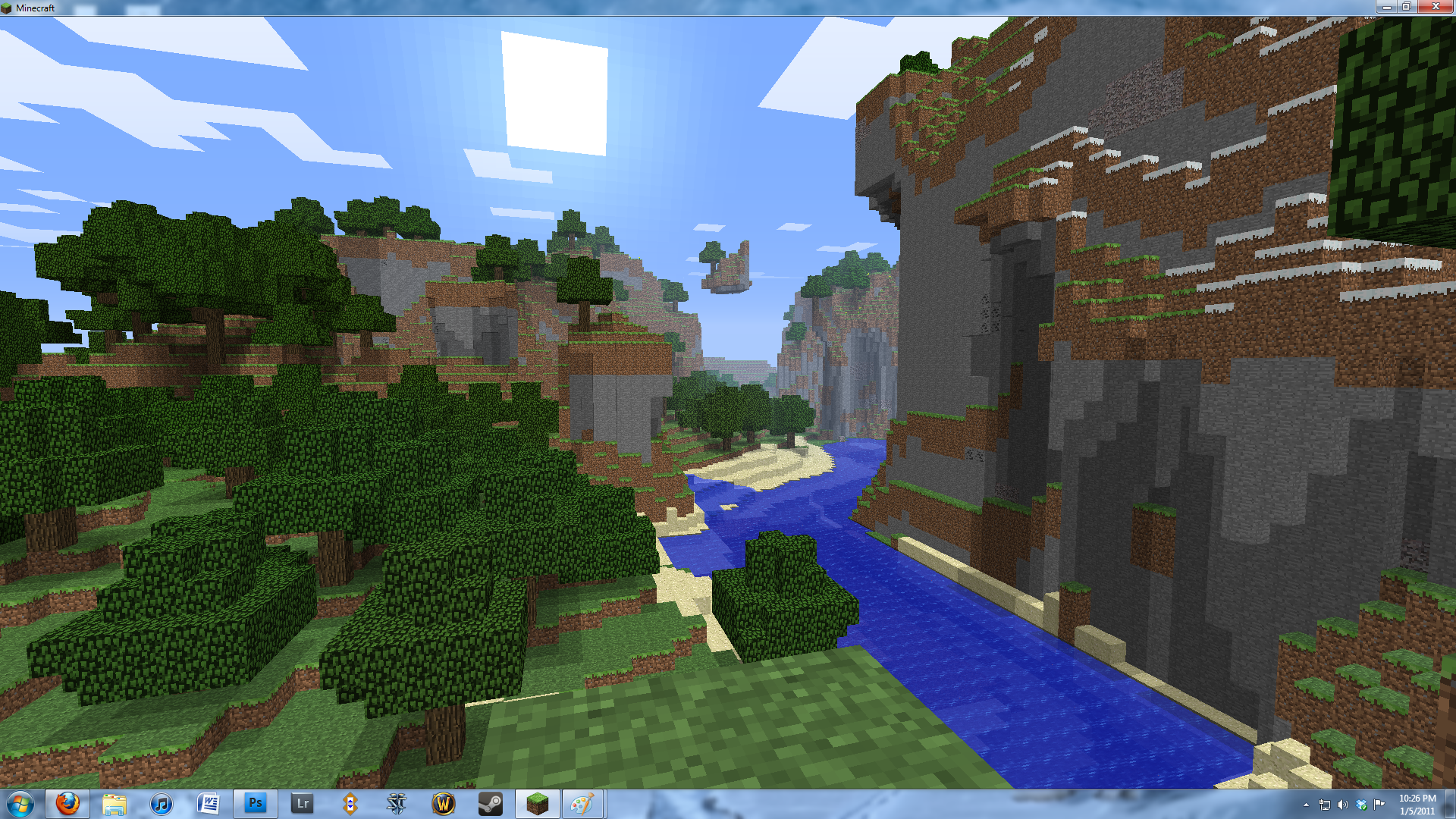
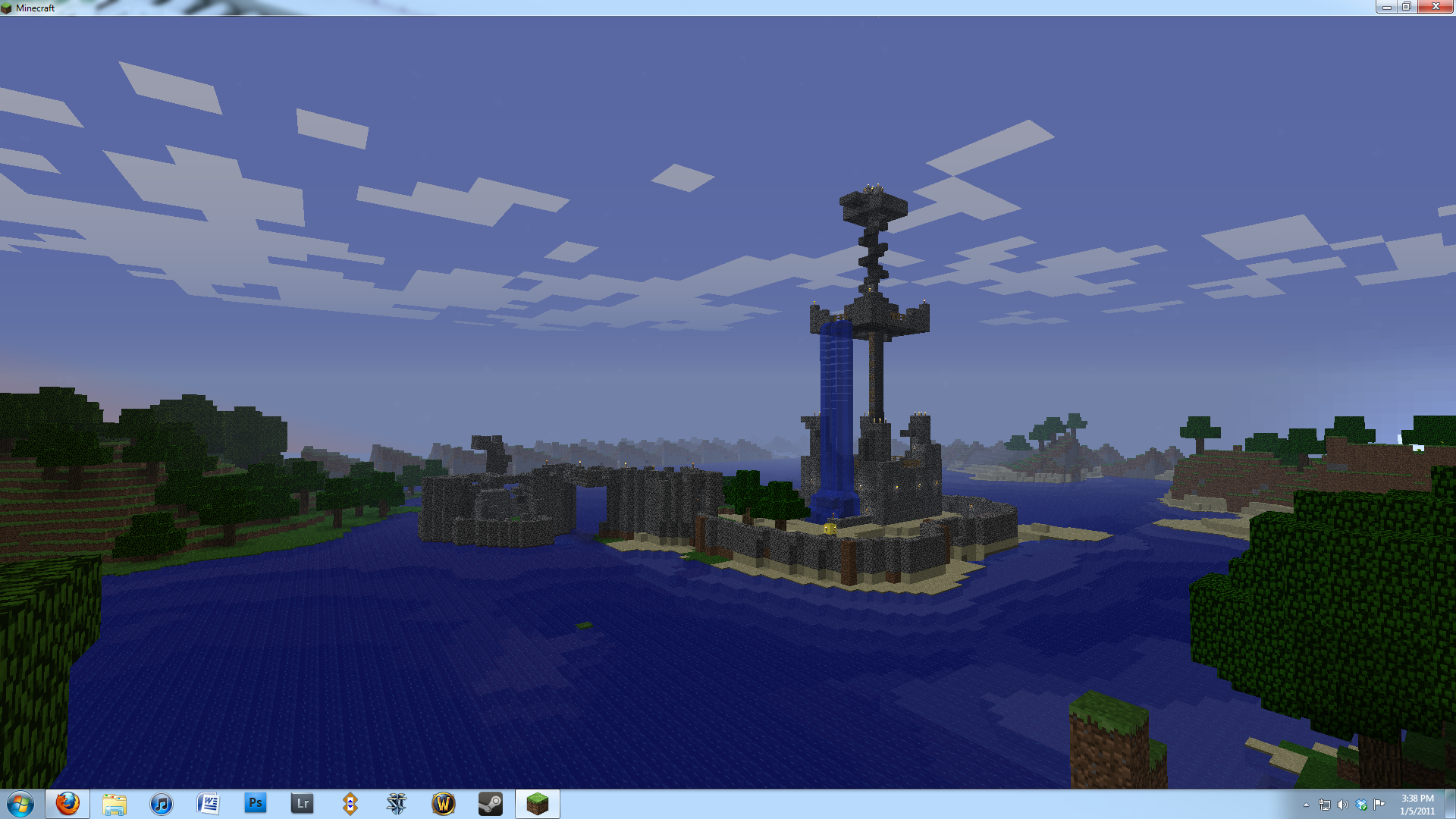
(click images to make them screen-sized, forgive my toolbar)

I am smitten with Minecraft. I can’t stop playing it. I am addicted in a way that feels good—like people are “addicted” to watching sports. You just want to do it, all the time, and you slowly draw away from people who don’t “get” it. It’s a passion that all right-minded people should have.

What can I tell you that would make you fall in love with the game? I can tell you that you stack blocks together. I can tell you that the goal of the game it to mine things and then to craft things. You mine dirt, you make a shelter. You knock down trees, you make a wooden pick. You use the pick to mine stone. Then the world opens up to you.

There is lava. There is water. There are zombies and ghouls and ghasts and spiders that jump ten feet in the air to ruin your life. All of these things come together to demonstrate the soul of Minecraft: it is a fear simulator. It is something that hates you, aggressively, but it creates a strange effect in me. It makes me want kick zombie/spider/skeleton ass. And the game gives you the tools to do that; it’s a game about making things from the ground up, and knowing that everything that you’ve made is a product of a process that you’ve commanded. It’s a little like seeing into the mind of a god—everything makes sense because you can track causality, process, even emotion, from beginning to end.

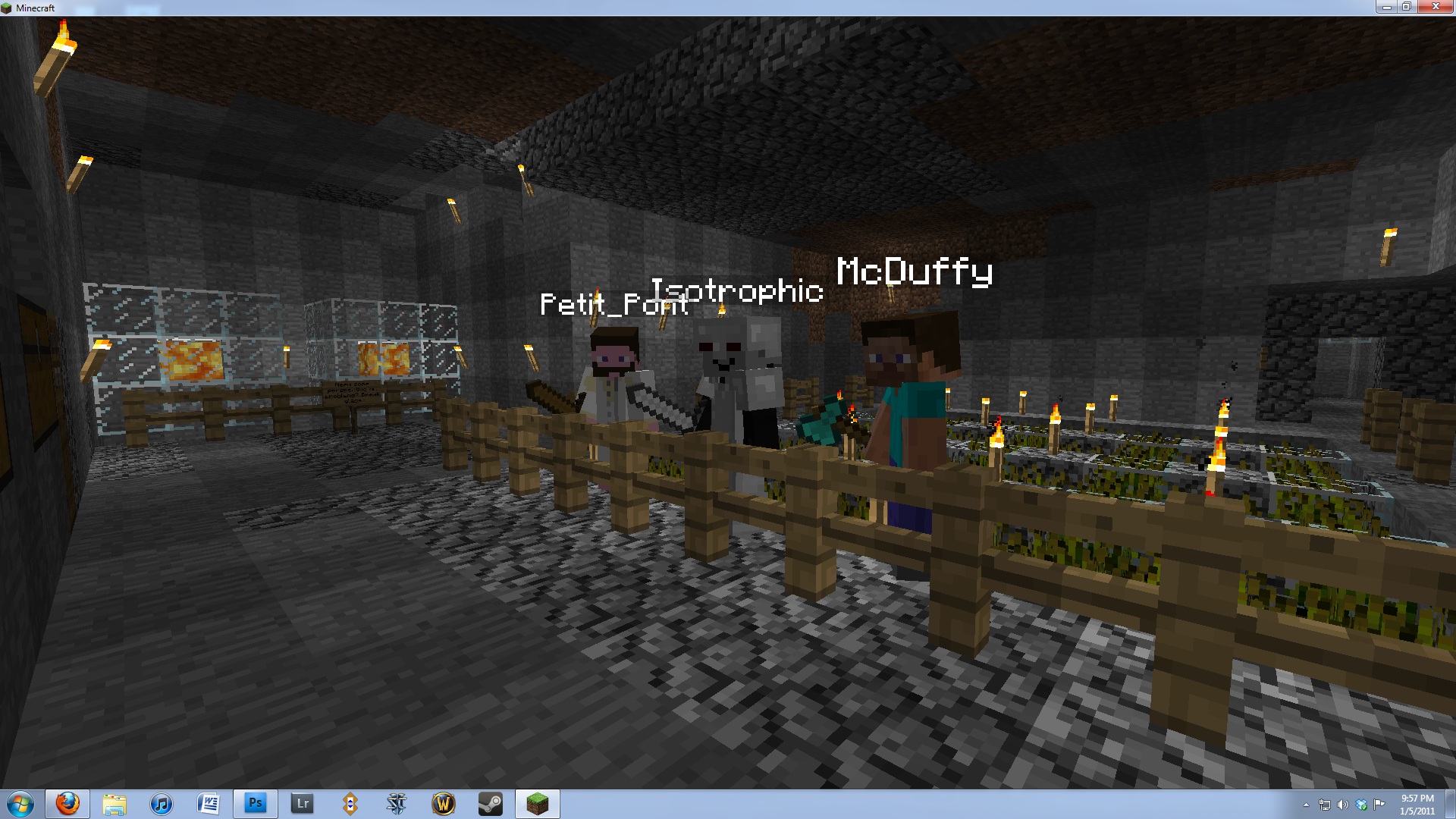
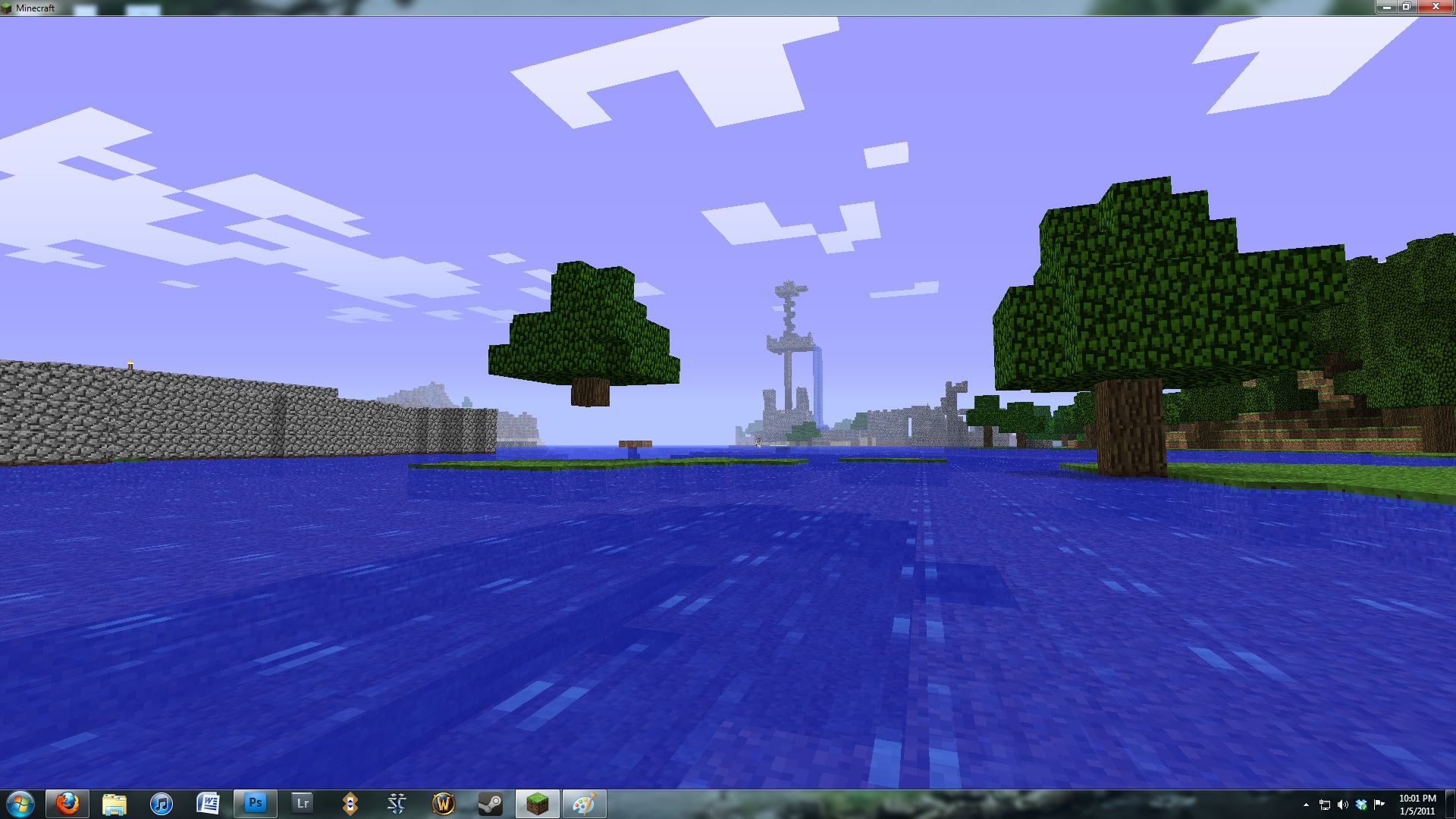
I want to tell you a Minecraft story. It involves several players: Isotrophic, Petit Pont, McDuffy, and DavidLynch (me). Over a couple days, we had created a large complex that stretched over about a kilometer square. It had several key areas: the Farm, the Mine (with Gate to Hell), McDuffy’s labyrinthine chambers where we were supposed to “play tag,” the Oubliette, Fort DavidLynch, and several other minor structures. Connected to that through tunnels were Fort McDuffy Sr. and Fort McDuffy Jr., two large forts connected by bridges. The McDuffy Forts were positioned in the middle of a bay, surrounded by several smaller islands of mixed importance: Fort Babyisland, Forward Tower, OP Restrepo, and Isotrophic’s “Seaaaa Laaaaaab,” an all-glass structure built below sea level.

Fort McDuffy Sr. and Jr.

All of these things were good. We had a Lava Display Case—we were really living the good life. But there was something missing, and one day Isotrophic spoke up.

“We need to pick up and move south,” he said. We were all quiet for a moment, but then the idea started rolling in our heads, and we all piped up. Emboldened, he described his plan. “We will move beyond this land, into virgin territory, with only what we can carry in our inventories.” Minecraft generates as you explore it—there is no “edge” to the world. If you get close to somewhere that no one has ever been before, the game creates the territory. When we moved to the edge of the map, it would literally be created in front of our eyes.

We ready for the trip.

So we did it. We gathered the diamond pickaxes, the bucket of lava, the iron ore. We gave a good look around, swam up the waterfall elevator, jumped the wall of Fort McDuffy Sr, and were off. The five hundred foot crow’s nest receded into pixels and fog behind us, adversity and hard time stood firm in front of us.

Home fades away.

If began to get dark as we crested a small mountain, and we built a shelter. It was only six feet high, however, and a spider jumped over in the dead of night, scaring the hell out of everyone until we beat it to death with pickaxes. We huddled under a dirt pile for the rest of the night, and at daybreak we broke camp, destroying everything we had constructed. “Scorched earth,” Isotrophic mumbled as we walked away, “total war.” Petit Pont giggled.

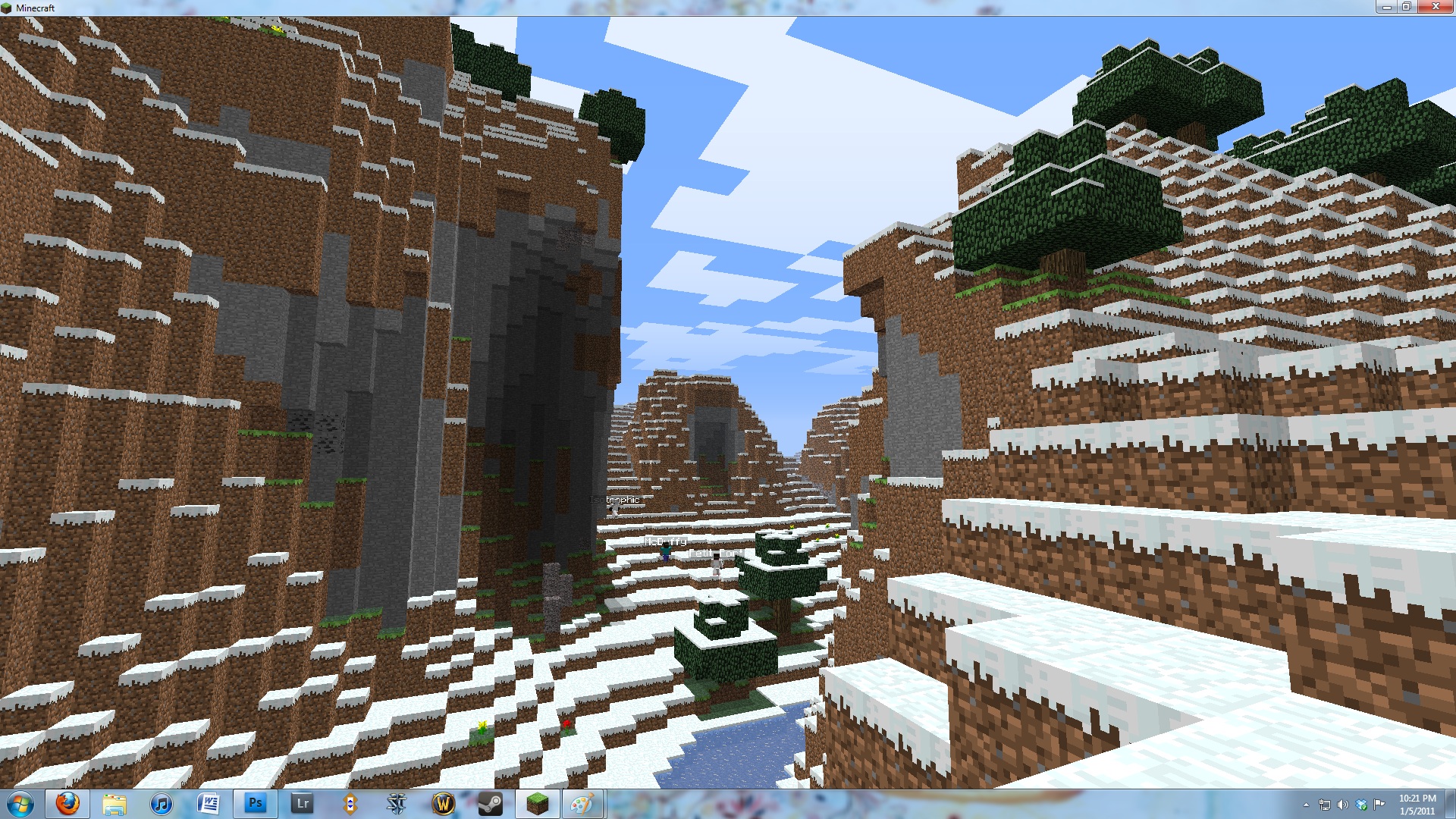
A range we walked through

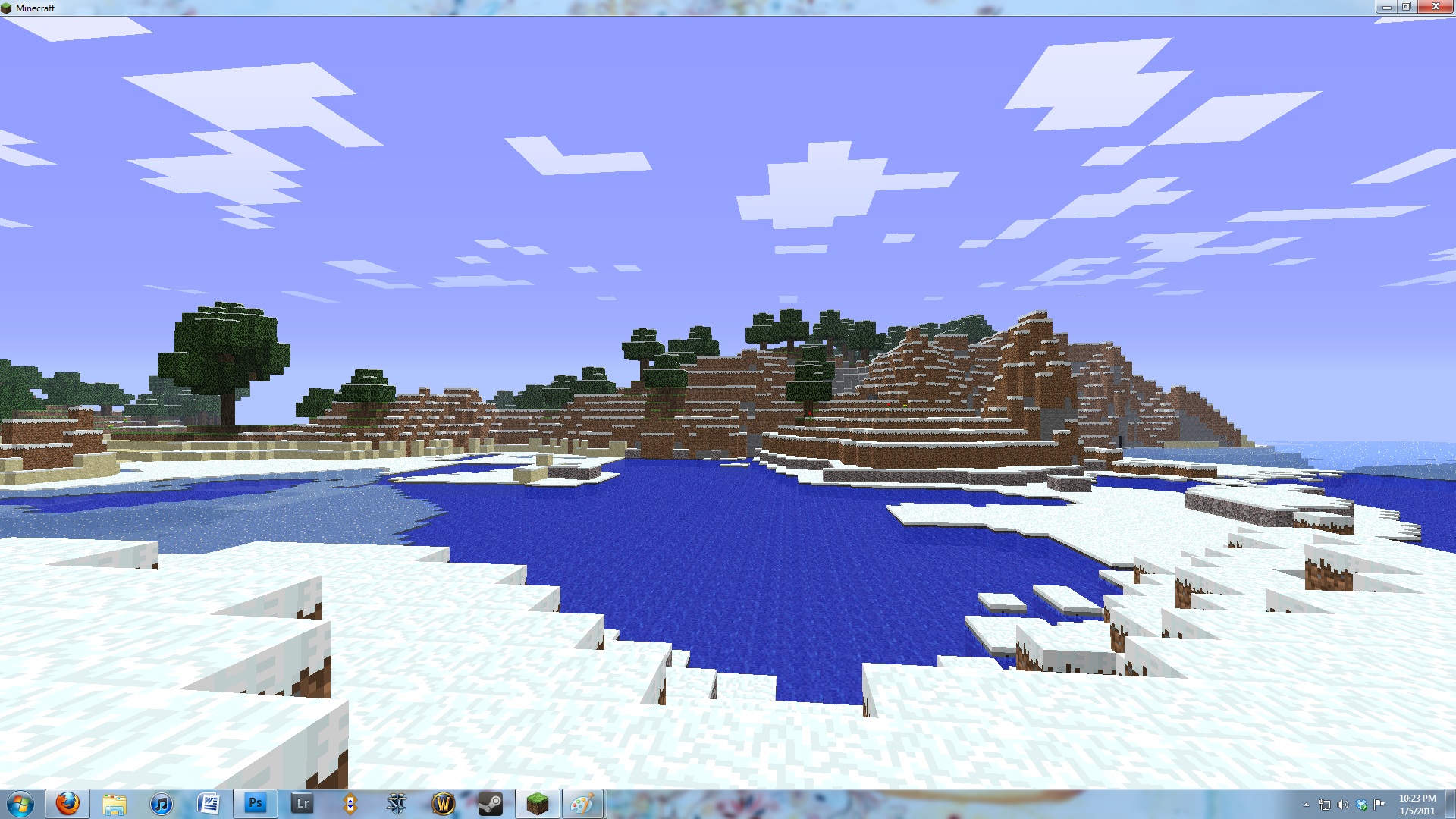
We traveled until the grass turned to snow. It was gradual, a patch here, a patch there, and then it was full-on artic tundra. No wildlife for miles. We walked across a frozen lake. “It’s slippery,” McDuffy said. “Careful,” Petit Pony cautioned him, “the first time I ever played this game I chipped through the ice and was swept underneath it. I drowned.”

A treacherous land.

“Quiet,” Isotrophic hissed. “Over this mountain, this is it. New land.” We trudged up, wailing on the jump button to get up the giant mound. Past that, there was a plain. It didn’t look particularly new, but we took it on faith. The faith proved itself. We found our Promised Land.

The Promised Land

It is a small valley overlooked on three sides by giant, needle-like mountains. On the non-mountainous side, there is a forest, and then a body of water with an island. We live there now. On my mountain, I have crafted a stone-and-glass overlook. Isotrophic coined his mountain Tyconderoga Point; the addition of a lavafall and intimidating gate has changed the name to Tyconderoga Citadel. Petit Pont put a ceiling over a chasm in his mountain, creating a home where everyone can see him all the time. McDuffy made a treehouse in the forest.

That is the story of Minecraft. It’s really fucking serious, and more than that, it’s beautiful. It rides the line between real and fake. It bleeds in and out of me.

Posted in General Features, Video Games | Tagged , | 2 Comments

The Decaying South

So I come home about once every six months. “Home” is in the northern part of Georgia, between Chattanooga and Rome. It’s that dead space that’s riddled with bypasses and completely avoided by the age-old I75 that runs down to Atlanta.

What I see when I get here is decay. I see trees cut down in numbers, showing the ruts and treeless hills rolling over themselves, trying to escape. There’s buildup everywhere, detritus and rotting wood mixed with plastic bottles and Budweiser boxes turned to mush by rain. I drive by a lot of that. There’s one recycling center that I am aware of, and I drove by it, all of the equipment sitting outside and rusting. There’s no recycling here.

There is abandonment, though. I wanted to take pictures, but the pictures don’t show a damn thing. The industry has leeched away. The bus factory has closed and the denim mill is going broke. Everyone works weeks that aren’t full, and you can tell. There’s a sense of quiet disrepair over the whole area. It’s a slow collapse.

Of course, the process accelerates whenever possible. Last year there was a flood. This year there was snow on Christmas, more than there has ever been before, or at least more than anyone can remember. I think of what old man Wade says in Child of God, a book that I’ve read and re-read recently. He says that there might be some places that people weren’t meant to live. Everytime I come home I think of that. The Appalachian foothills are a frightening place–there’s years of terror and heartbreak and violence and rage down in the ground here.

The things you hear about here feel different than the tragedies that I hear about in other places. Urban violence feels necessary. People living in close quarters, the heat and the stress. I understand that, to some extent. But the violence that happens in isolation here is amazing. It’s like it springs from nowhere. I mentioned Child of God up there, and it ties me to this area even more; McCarthy is writing about eastern Tennessee, but the murders in that novel are partially based on things that happened mere miles from where I’m from.

Maybe it has always been decaying. I’m hopeful. I’m waiting for something to come in and really fix things. But I experience a sinking feeling when I’m here. There’s so much hope. There are so many family stores, shops, thrift stores, ventures that take sacrifice and faith to even attempt to start. But my mother, who works in a thrift store, says it best: “After our store opened up, seventeen other thrift stores opened. Now there’s just us and one more.”

The hope dies. The family store, newly opened, will probably disappear, replaced by nothing, and the shopping center will rot. Like the barns on backroads, padlocks on their doors and holes in their roofs. Every time I come here, I wonder what could have made it different. Is it anything?

It’s in the dirt here. It’s in the blood.

Tagged , | 2 Comments

On Eisner/Miller

Eisner/Miller is the most important book ever written about comic books. It’s probably more important than 95% of the comic books that are being produced, honestly. The book is just an interview, a long one, where Will Eisner and Frank Miller talk about history and comics and culture and everything else under that sun.

And it’s brilliant. Both creators have things that I agree with, but for the most part, I come down on Miller’s side most of the time. On some emotive level, I think that we need to rethink our relationship with the way that comic book publishing works, especially along the lines of the ghettoization that comic books have really worked into.

Sure, I think, you can talk about the recent works that have transitioned into the “real” book world, like Craig Thompson being printed by Pantheon, and Satrapi being printed by another company that really matters. But Miller is right. Those books are still shelved in the “comic books” or “graphic novel” section. And comic book fans love it that way.

I think that it has to do with content. Miller and Eisner work it out perfectly. We’re very comfortable with what comics do already, and we’re very unwilling to let them do different things. Miller says that he wants to speak to pop culture, and I think that he’s doing that, especially in his more “mainstream” comics work. Sure, he pisses fans off a lot, but he’s doing a lot of work to contemporize his comics. Talking heads, fashion design, and the feeling of the current era—these have been critical in all of his Batman comics.

More and more I am moving away from the belief that superhero comics are a good genre of comics. I just don’t think there’s enough inherent in the genre. Sure, more and more there are some brilliant superhero comics. I think of Hickman doing Fantastic Four or Fraction doing nearly anything. Those are good superhero comics. But at the same time, those aren’t really superhero comics; those are science fiction comics that happen to have superhero main characters.

There is some wiggling about the genres, sure, but I firmly believe that superhero comics are a place where you are generally forced into telling very specific stories. There are goods and there are bads, and it’s rare that we have a mainstream supe comic that isn’t that way; The Punisher is one of the only characters that has stories that are consistently grey.

I like the idea of grey stories because I think they’re more real, and what Eisner says about telling stories means a lot to me. Eisner had two reasons for writing: to “witness” and to convey an emotion; he wanted to make people weep. To witness, in this case, isn’t to tell you about Jesus; it’s about showing exactly how the world really is.

I think that both writers have/had something brilliant going on. There’s an awareness of contemporary art that Miller has that is at the heart of how I think of writing, that it’s a product of the present, and that sometimes the best art of now is left to rot, because it doesn’t speak to anything other than the now. But Eisner only cares about history, about telling you the past to make you weep now. Eisner needed you to care.

It’s all great stuff. Read the book.


Posted in Comics | Tagged , , | 3 Comments

The End of Proust

The body immures the mind within a fortress; presently on all sides the fortress is beseiged and in the end, inevitably, the mind has to surrender. – Proust, Time Regained p. 512

There’s something bitter about an ending. I’ve had some endings recently, and it seems poetic to think that I’m reading the end of a novel that a man wrote at the end, the very limit, of his life. I remember being told at the beginning of the semester, by my professor, that if you read Proust your life will change forever.

I don’t know if the reading of Proust did that, but my life certainly changed, and I saw the things in Proust that I saw happening in myself, around me, and that was weird. It was like looking in the mirror, to some extent, and seeing something strange and deformed but fundamentally familiar.

Proust wonders, in the penultimate page of In Search of Lost Time, if he made the people that populate his novel “resemble monsters.” Maybe so. Maybe everyone resembles a monster–and maybe it just takes  a careful observer to see the face of the monster itself, hidden in everyone, making its way in the world.

I don’t think that I have any giant, holistic things to say about it, and that might be why I find the idea of a final paper to be so terrible. I can’t imagine what I have to say that will operate outside Proust; maybe to read Proust is to know that you will forever be polluted by the knowledge that Proust has thought about things that you have thought about, and more than that, his thoughts were better.

I’m so glad that I read it. I will probably never read it again. It’s haunting.

Posted in General Features | Tagged , , | 1 Comment