Shaviro’s Redux of The Cinematic Body

It’s rare for academics who work in the realm of critical theory, or poststructuralist theory, or other such things in the humanities, even to polemicize against cognitivism: either because they are naively unaware of its institutional power, or because they (rightly) feel that it is too intellectually flimsy even to be worth arguing against. I think that this sort of attitude — in which The Cinematic Body shares — points up, both our failure to pay attention to the broader social, political, and institutional coordinates of our debates, and to the futility of polemics per se when confronted with the exercise of power and authority in ways that are not matters of, and that indeed are not even subject to, polemic and debate.

For all these reasons, it now seems to me that the polemics which play so prominent a role in The Cinematic Body lack pertinence. This is a matter, not just of particular arguments or assertions, but more crucially of the book’s tone or style. The Cinematic Body has a certain air of self-congratulatory celebration, a smug pride at being so (supposedly) radical and transgressive and subversive, that I now find exceedingly unpleasant. Today I would not presume to enthuse over “ecstatic complicity at the convulsive point of danger and violence” (61), as I do in a discussion of Dario Argento’s Terror at the Opera. And I certainly would not dare to assert that this particular film, or film in general, has a “radical potential to subvert social hierarchies and decompose relations of power” (65). Lines such as these can only have been the result of a lamentable confusion between aesthetics and politics; and also between action and passion, and between labor and jouissance. For films quite evidently don’t have this sort of “revolutionary” or “subversive” potential at all. To claim that they do diminishes them aesthetically, even as it trivializes politics. Today I love Dario Argento’s films as much as I ever did, and certainly as much as I did when I was writing The Cinematic Body. But I would not claim that Argento’s beautiful, terrifying violence has any political efficacy whatsoever.

– Steven Shaviro, “The Cinematic Body Redux

Posted in Quote Time, Theory | Tagged , , , , | 2 Comments

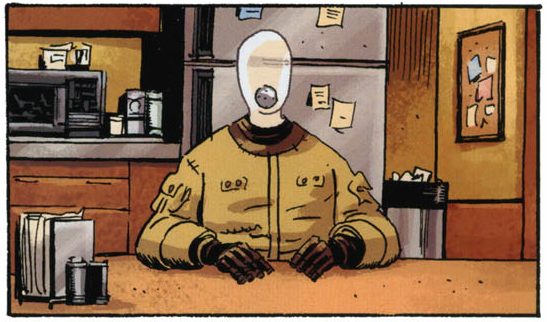
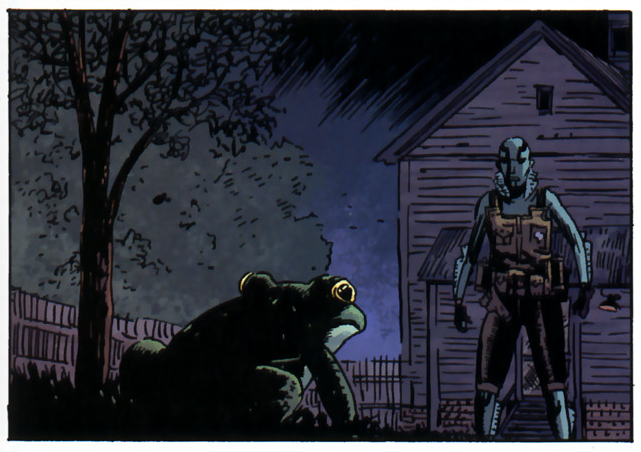
Abraham Sapien and the Frog

1 - plagueoffrogs3 - 2

Posted in Comics | Tagged , | Comments Off on Abraham Sapien and the Frog

Interview With Killer Mike and El-P at The Passion of the Weiss

You guys are hitting a point in your careers — especially now that you’re doing Run the Jewels together — where you could be filling that superhero role for kids growing up. What do you hope kids listening to the Run the Jewels record will get from it?

EL: What I want for them to get from it is a feeling of rawness and rebellion that I think has been missing a little bit. You’re listening to a record where we’re taking absolutely no prisoners, but we’re not taking ourselves too particularly seriously. And at the same time, we’re just basically saying, “Fuck you” to everything. That energy is really mischievous and important, and that shit really formed who I was as a person, looking up to people who were not in the strongest positions in society, they weren’t rich, they weren’t in control of the world, but at the same time they were saying, “Fuck you, I’m the shit.” And there was something to aspire to as a kid with that shit. I wanted to feel that. I wanted to be that way, y’know? I wanted to be the type of man that could say, “Fuck you” if I didn’t like what they were saying. And so these rappers became my heroes. Nowadays, there’s no real rebellion, is there? There’s danger. There are people saying, “I’ll hurt you,” but there’s not anyone saying, “Fuck your idea.” There’s not anyone saying, “Fuck your plans, fuck your sense of grandeur.” And those are more important to me than, “Fuck you, if you try and take what I have, I’ll hurt you.” That shit’s cool, too, but this is a different zone, this is something that isn’t always being tapped into. There’s no one better way than the other, but it has to be there. There’s a balance. Me and Mike felt like we knew what that was. We knew what a group was. The last great group was probably… Part of them is sitting in the fucking room right now. [El gestures at Kool AD, formerly of Das Racist] Straight up, you know? Das Racist was a big deal to people like me because it was a group.

read the interview here

Posted in General Features | Tagged , | Comments Off on Interview With Killer Mike and El-P at The Passion of the Weiss

On Why I Will Never Play The Castle Doctrine

RPS: You should never hold a press event at your house. I don’t think many people would want to come.

Jason Rohrer: [Laughing] You guys are in England, you don’t understand what it’s like here in America. [from this interview]

Jason Rohrer’s newest game The Castle Doctrine is simple. You play as a man who has a home and a wife and kids. You have money in that home. There are other players with their own homes, wives, children, and money who will come into your home to attempt to steal your money. They can kill your wife and children. It is in their best interest to do so, in fact, because allowing the wife to live actually decreases the amount of money that they can steal from your home.

In order to prevent other players from invading your home and killing your family, you set up an elaborate but solvable series of traps designed to kill those invading players. The game has permadeath–if you die invading a home, you are forced to start over from scratch. The core loop of the game is this process high-risk burglary that feeds into defense of your own home. You invade others so that no one can touch your possessions; you have to do violence to others in order to make yourself impermeable.

Some obvious issues with this setup: women and children are property that are essentially resources in the male-on-male violence that makes up the game; this is yet another example of the “dadification” of games where you play a grizzled man who has to do what he has to do, which is invariably killing other people; this is one more example of the infinite apologism around the fetish of violence in games. All of these things are true and they’re wrong and they each deserve a bit of longform writing all on their own (and if there’s anything about these subjects RE this game, please forward it along to me.)

[Note: Rohrer actually posted some “clarifications” around some of these issues as I was writing this post. You can see them here.]

In any case: I am not going to play The Castle Doctrine, and I don’t think that you should either.

I think it is important to read some things from the designer of the game, Jason Rohrer, in order for the argument that I’m making to really hit home. While I’m going to be quoting from these interviews, you might want to read them in their entirety. The first is a two-part interview with Alec Meer at Rock, Paper, Shotgun [part 1, part 2] and the other is with John Brindle over at his website [here].

In an attempt to head off some reductive responses to my argument, it is important to note that Rohrer has very plainly stated that The Castle Doctrine, despite being a massively multiplayer online game, is a personal work on the level of his previous game Passage. The game’s design is explicitly simulating Rohrer’s feelings about home invasion and personal safety, and in response to a question about why the default character is necessarily a male head of a nuclear family, Rohrer responded

“Well yeah, but then it wouldn’t be my personal art. It would just be this pandering product. This is a game that’s from my perspective, just like in Passage the main character is me. “

This might be a little too Games Studies 101, but it is important here to note that Rohrer isn’t splitting hairs about the content and framing of the game: this is personal art, the game’s possibility space is strategically centered on personal sovereignty, and everyone who plays it will be thinking through this particular frame in order to succeed at the game.

On one level, I understand the desire to claim that the game is a valuable object in the world because it allows for us to think through the ideology of someone who believes that someone has given up their right to life by entering a home unannounced. Daniel Joseph, in a response to some preliminary stuff I said yesterday on twitter, basically makes this point. He (and I) as academics can find value in the game because it is showing us something about the violence of the world as it is, and by unpacking that, by laying it all bare on the table, we can learn something from it and maybe work to defang or at least acknowledge the systems that have structured the world in such a way that Rohrer can have this opinion. I’m partially in agreement, at least to the point that I do believe that we could probably learn something about inherent violence of white, patriarchal, American power and how it sets up the conditions for, commits, and justifies violence all at the same time.

There’s also a second level here that I can’t get past. Jason Rohrer made The Castle Doctrine because he began “living in a place where [h] didn’t feel safe for the first time in [his] life.” Part of that was, as I understand, a string of burglaries in the neighborhood, including the house next door being broken into twice within a single year. Additionally, his wife was attacked by a dog, which spurred him into carrying a riot-style baton and pepper spray.

In the interview with John Brindle, Rohrer explains the encounter with the dog:

To me, after facing the reality of these things, when your dog is attacking me and my pregnant wife, the dog has crossed the line, you’ve violated your contract with me. At that point all bets are off, that’s it: if I kill your dog to save my family, your dog doesn’t have any grievances with me, because your dog is already in violation of contract. Given a proper argument in favour of that point of view, most people would agree with that. The same is true about someone coming into your house. They didn’t have to break open my window!

In Rohrer’s model, you are justified in doing anything you want to someone who breaches your personal sovereignty, whether that is your house or your person. You can kill someone for breaking your window and coming into your home.

I think it is important to pull out the quotation that I used a little bit earlier. Rohrer was “living in a place where [he] didn’t feel safe for the first time in life.” In this model, Rohrer’s safety and the safety of his family trumps the right to life of another human being. Any perceived threat to him or his family is met with a swift judgment on the offending party–he can kill the dog, he can kill the invader. Despite the fact that human beings are capable of speech and therefore can yell things like “get out of my house” or “fuck you” in order to force a would-be burglar to leave, for Rohrer, none of that matters. In the interview with Alec Meer:

When you’re faced with it, when the rubber hits the road and you have to defend your family… I’ve had conversations with other game developers which are like ‘if a guy came into your house, and he had a gun, and you were standing in the kitchen would you pick up a knife and try and defend your family?’ And they said ‘no, I’d try to talk to him first.’ [Laughs in disbelief.] So someone’s coming into your house and threatening to kill your family, and you’re going to try to talk to him. For me, as soon as you stick your foot across my windowsill I just feel like that’s it. You’ve violated the contract, right. I’m not sticking my foot across your windowsill.

For Rohrer, the person who could break into your home and steal your things is the worst kind of media villain that we’ve been trained to be afraid of. This person is coming into your home to take everything that you love, and more than that, he is going to murder your entire family and hide them in the attic. This doesn’t seem to be upheld by actual crime statistics, however, especially here in Atlanta, which is the sixth most dangerous city in America as of 2012. Apparently, in 2011 there were 7,499 burglaries in Atlanta–that’s the classic model of home invasion that Rohrer is fantasizing about, which is where a person comes into your home, steals your Xbox, and runs away while you’re out at WalMart or whatever. Against that, in the same year there were 88 murders.

I’m not bringing up numbers to argue with Rohrer’s perception of the violence that could happen to his family, and I acknowledge the that data itself is purely anecdotal and only specific to me. I am sure that he believed, and believes, that his family was in danger. I do think that the numbers show the push of the likelihood that I would be burgled and murdered and how absolutely unlikely it is in most places in the United States, but the point I want to illustrate is that ideology doesn’t care about the numbers. Rohrer’s beliefs about the intentions of the perpetrator who will put their foot over his windowsill is absolutely immune to any kind of reason. There are people out there and they could get him, which puts him both in a position of feeling like he is justified in killing that intruder with a knife and feeling like he needs to justify his murder of that intruder.

That’s why I won’t be playing The Castle Doctrine. The very act of playing, of buying into the core conceit and then living that world with other players, is one of either justifying or utterly eradicating an acknowledgment of the system that is implicitly justifies. Castle doctrines, as they exist here in the state of Georgia and elsewhere, are based on upholding fundamental exclusions that undergird American society. When Rohrer explains that the justification for killing another human being is based on their violation of a social contract, he’s absolutely ignoring that the social contract doesn’t extend to huge parts the American population.

At the core, The Castle Doctrine focuses on the legitimacy of violence of white men in the United States against those who are seen as interlopers against those white men–it is all based on the fact that for the first time in his life, Rohrer felt unsafe. We should take this seriously–no one should be forced to feel unsafe–but also take seriously that there is a balance here in our ethical commitments in games.

Playing through a simulation of Rohrer’s safety and unsafety elides over the fact that there are so many subject positions in the United States whose baseline states of safety are far below Roher’s baseline safety level. Rohrer won’t be murdered for holding hands with his partner in public. Rohrer won’t be fingered for a crime he didn’t commit because a witness can’t come up with anything other than a caricature as a description. Rohrer will never be profiled into a county lockup.

And Rohrer’s self defense? He’ll reap the benefit of castle laws. They’re designed with him in mind. The Marissa Alexanders of the world will continue to be imprisoned. The CeCe McDonalds will too.

This isn’t at the feet of Rohrer, but it is at the feet of the ideology he’s explicitly embracing and working through. I don’t want to play it. I don’t want to have any part of it. After I post this, I’m going to do my best to never talk about it again. That’s my stance here, and I sort of believe that it is the only ethical one. I want to educate people, I want to talk to them about the variable axes of oppression that have rendered terms like “social contract” null since before Enlightenment thinkers conceived of them, and I think a key step in that process is outlining why we should be so highly critical of The Castle Doctrine that we pretend like it doesn’t exist.

Posted in Video Games | Tagged , , , | 5 Comments

I’m busy here is some art

20130723-205638.jpg

Posted in General Features | 1 Comment

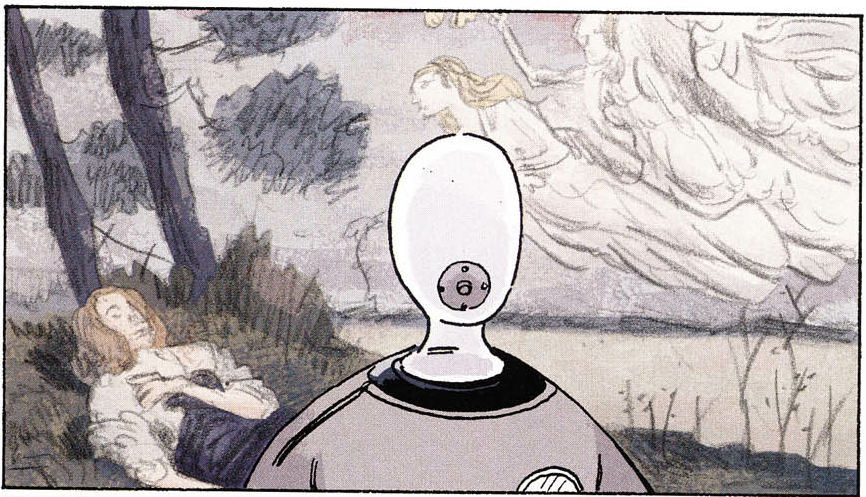
Three Portraits of Johann Kraus

1 - plagueoffrogs1 - 2 4 - theuniversalmachine - 1 5 - gardenofsouls - 1

Posted in Comics | Tagged , , , | Comments Off on Three Portraits of Johann Kraus

Nick Briz Profiled At Rhizome

Do you actively study art history? +

Do you read art criticism, philosophy, or critical theory? If so, which authors inspire you?

yes && yes. I’m xtreamly interested in the parallel/perpendicular + complementing/contradicting + fringe && mainstream narratives that make up the histories of the conversations I’m invested in: media art histories, computer science histories, digital folk histories, Chicago histories, activist histories, piracy histories, etc. I read lots of criticism/philosophy/theory… I’m inspired by lots of folks: lots of contemporary/mainstream digital culture folks (LessigShirkyJenkinsBenklerStallman) + netstream new media art folks (LialinaGalloway, the “software studies” crowd) + academix/bloggers/podcasters I follow closely (Katie SalenLarisa MannYoani SánchezAnita Sarkeesian) + the writings of many of my collaborators like Rosa Menkman && jonCates. And then of course the theoretical giants that influence most of us, in particular ideas like Martin Heidegger’s notion of ‘enframing’, that rather than looking at technologies simply as tools, we’re better served by considering how they are symptomatic of our particular world view. This has been key to my understanding of technologies as indicative of prevailing ideologies >> McLuhan’s perspectives too, specifically the medium-is-the-message angle, rather than getting lost in the content the media carries (and similarly the utility a technology provides) we should consider how the technology itself changes (often completely turns on its head) our relationship to each other and the world.

Half of me is glad that philosophy and theory really gets integrated into the art world. Half of me really mourns the fact that it has to be fucking Heidegger.

Read the entire interview here (it is good.)

Posted in General Features, Theory | Tagged , , , , | Comments Off on Nick Briz Profiled At Rhizome

On the Inhuman Drama of Pacific Rim

SPOILERS FOR PACIFIC RIM AND OTHER DEL TORO FILMS WHOOPS

A reading of Pacific Rim:

Right off I want to say that I enjoyed the movie while cringing and being hugely disappointed every single time a character said the word “bitch” or repeated the name of the main jaeger, “Gipsy Danger,” which is a huge ethnic slur toward Romani people. Everyone involved in the production should be ashamed of these things, and we should all speak up about them, especially because it didn’t matter at all. None of the language was integral to the plot or characterization; the people working in design, directorial, production, and screenwriting capacities should be ashamed about it. I’ve actually been looking for a post that goes deeper into this issue, but I’ve not found one yet; if you do, please let me know so I can put it into this post as further reading.

Beyond those issues of representation, which are both glaring and important, I want to talk about what Pacific Rim is doing as a film. Guillermo Del Toro almost exclusively makes films that carry explicit political messages within science fiction or fantasy contexts–Mimic is about the fundamental horrors of urban life, Hellboy II is a manifesto on social destiny and difference, and Pan’s Labyrinth personalizes the sacrifices and casualties of the Spanish Civil War. So when I say that I believe that Pacific Rim is political, I don’t just mean it in the way that I teach my film students: “Every film has a politics,” I tell them, “and part of our job in these classes is to parse what a film does, how it does it, and why it is doing anything at all.” Part of this is breaking my students of classical auteurist models of understanding art or communication in general; the idea that communication is transparent and that every media work carries  the explicit intentions of an author (the favorite right now being Christopher Nolan) is very, very strong in the freshman mind.

BPgMvXzCQAAE7MV

This is death of the author 101 kind of stuff, but I think it is important to lay out this idea that films (or art in general) have lives outside of their creator so I can immediately turn around and say that this film is a profoundly personal Del Toro film. Where I said above that every film that Del Toro makes is political, what I really mean to say is that Del Toro’s politics are written in giant red block letters all over the screenwriting and directorial choices he makes.

While Mimic is certainly about urban life, it is also about what makes us human when the conditions around the very concept of “humanity” are altered. “What is a human?” haunts all of his films, even when the question is reduced to abstract questions of sameness and difference. For example, Blade II presents the vampire community and its unthinkable, mindless other that is nonetheless the perfect form of vampire. A quick flip of vampire and human brings us back to a familiar Del Toro question: are we, as a species, simply the aggregate of our worst qualities? Hellboy II certainly suggests it, with Hellboy finally taking Prince Nuada’s claim that humans will never accept a demon among them seriously. He quits the human world. The lights come up, we walk out of the theater. The enemy is beaten, but the outcome is bleak.

I’m not going to go into the trauma of political “winning” as it is presented in Pan’s Labyrinth.

In essence, Del Toro’s films are all ritournelles, finite loops that come back over and over again to the same point. They are all concerning the same anxieties about what it means to be included in the category of human. He is also concerned about the limit of that category, by which I mean that he is interested in these inclusions and exclusions as well as the pure accidental nature of the human. There is a reason that he keeps attempting to adapt Lovecraft–for Del Toro, humans are weak, finite beings at the hands of an indifferent universe. When the Angel of Death tells Hellboy that his existence comes at the cost of all of humanity, the lives of humans don’t really factor into the struggle. In Blade II, humans are weak, corruptible, and barely present except in their capacity to be consumed by more powerful beings. Pan’s Labyrinth features a fantastical world in which humans are merely bit players in a fantastical drama played out by opaque and ancient beings.

It is in this capacity that I want to talk about Pacific Rim. It is a continuation of Del Toro’s general philosophy of the human condition, but it is also an evolution of the movements he was clearly making in Pan’s Labyrinth. The difference is that Pacific Rim isn’t a fantastical drama; it is an inhuman one.

The immediate objection that comes to mind, I’m sure, is that Pacific Rim IS ALL ABOUT HUMANS. It trades on simplistic tropes borrowed from anime filtered through a Hollywood summer blockbuster machine, which means that we get lots of people saying literal nonsense about digital vs analog giant robots while intoning each other’s super ridiculous names and having very serious emotional looks all the time. It hammers content atom-thin and papers over the film’s central concept.

The central concept is giant robots punching giant monsters.

It makes a lot of sense that the movie can be literally nonsensical at points because the point of the film, or at least the point of access that it is presenting the audience with, isn’t based on your enjoyment of the plot. I thought that what little there was was enjoyable–the narratives of loss and fear of loss that powered every non-comedy character worked well enough that I didn’t immediately recoil. It kept me in the movie, I was minimally invested, and it chained together robot and monster fights.

Despite the fact that the camera lingers and the plot meanders around the human characters, it isn’t really about them. They’re all sketches of people at best. We often talk about movies or games with barebones plots that merely exist to chain together action pieces, and that is exactly how Pacific Rim works. More importantly, that is the strength and purpose of the film.

BPfJTutCIAAfeRG

I think the standard reading is something like this: there are alien horrors in a parallel dimension who fight a proxy war with humanity via giant monsters. We also fight in this proxy war, but we have giant robots. The aliens control their monsters through a hivemind connection that makes them operate as giant puppets; the humans do the same. Therefore, the movie is about the struggle of the plucky human spirit against alien invaders, and that’s the end of it. Additionally, there’s a subplot where Charlie Day has to go the the middle of Hong Kong to ask Ron Perlman, a monster war profiteer, for a monster brain with which to fight back with. Ron Perlman is shown to be an evil capitalist who lives in billionaire luxury (he has an anti-kaiju bunker, after all) in the middle of the slums. He shows some hubris and is mean to Charlie Day, he gets violently eaten, and we’re satisfied. Big puppets fight big puppets, the credits roll, and a postcredits scene shows Ron Perlman is alive after he cuts his way out of the monster. He quips. We laugh. The lights come up.

Watch this short interview with Guillermo Del Toro. Listen to him talk about Godzilla.

What’s immediately apparent to me in this interview is that short of that one moment where he remarks on an actor, there’s no mention of people here. He presents Godzilla as a profound, existential film focused on war and destruction, but never as a film about the human relationships in the wake of Godzilla (of which there are plenty). Pacific Rim is for me like Godzilla is for Del Toro–it is about the inhuman drama playing out between huge nonsensical machines and (sometimes larger) mutating, organic monsters. It is about having a sense of wonder at these giant creatures that cannot make any sense to us. It is about being caught up in a flow of spectacle that is not merely spectacular but also profoundly political in that these monsters and robots have no regard for humans as a species.

Sure, the human controllers do–the trauma of the opening sequence is derived from two people in a giant machine caring for a few individual humans. But much like the Spanish Civil War in Pan’s Labyrinth, it is something that merely exists on the surface of things. It is a plot to keep us watching, to keep us from realizing the paralytic horror and nihilism behind the structure of the filmic world that we are seeing. The world of the faun in one that doesn’t need human beings, and actively takes glee in their temptation and murder (I’m thinking specifically of the monster who eats children.) The parallel universe geneticists of Pacific Rim drive the same point home: if you peek behind the curtain in this film and think about the structure of the universe we’ve been presented with, there’s something infinitely creepy about it.

We are not alone. More than that, we are not special.

I think it is easy to imagine Del Toro being allowed to run free and break with blockbuster sentiment and take the premise of the film to its horrible conclusion. The world goes dark. The exterminators come through. The jaegers fail one by one. The slow creep of nonexistence overrides everything, and as Charlie Day explained in the film, we deserve it. We made the world perfect for them. Why wouldn’t they come?

So it is an inhuman drama in that it isn’t about humans, not really. It is about the posthuman world, the world of climate change and oversaturated carbon, the world where the only politics possible is the politics of the impossibly complex and unexplainable robot that, despite not being explainable at all, nevertheless has political agency. It is a swarm of nations and capital and metal and nuclear energy. It is an assemblage made as explicit as possible. It smashes up against another assemblage, slightly more organic, but assembled and machinic nonetheless. What matters is how they smash. What matters is what pieces fall off.

What can a giant monster body do?

Despite the fact that my suspicions of Del Toro’s real Lovecraftian nihilism are not verified, I still find the end of Pacific Rim to be bleak. After all, the existential threat to the human species is eliminated. The world can finally repair and rebuild. The transnational efforts of the wall programs and the jaegers can be discontinued, and business can continue as usual. The fact that the closing scene of the film, the last bit of screen time, is devoted to the evil, selfish, violent businessman being birthed from the body of the prime antagonist of the film is profoundly bleak. This international cooperation is over. The desire to break across any number of identity lines in order to achieve something that had to be achieved is abandoned. We get a white man asking for his shoe.

There’s a part of me that wonders which outcome was worse: total extinction or business as usual?

Posted in General Features | Tagged , , , , | 8 Comments

Steven Shaviro on Lost Highway

That’s why the first half of Lost Highway is so brooding and mysterious. It pushes up against the limits of what can be seen and said. So much is hinted at, and so little is shown. Even the event upon which the whole film turns, Fred’s apparent murder of Renee, does not take place on screen. We see what comes before, and what comes after. But we do not–cannot–see the act itself. It is missing from the body of the film, just as it is missing from Fred’s own consciousness. The murder drives the story, but it stands apart from the story. It is like an intrusion from another world.

– Shaviro, “Lost Highway

Posted in Quote Time, Theory | Tagged , , , | Comments Off on Steven Shaviro on Lost Highway

Ticketing After the End of the World

This is just a quick thing.

I’ve watched several seasons of the show Parking Wars. The basic conceit of the show is that it follows parking authority officers around during ticketing, booting, and release procedures. Generally it is just about the malaise around parking and ticketing that’s accented by the ways in which these private enterprises work to financially punish the lower class. It is an object lesson in the class struggle, and if you care about that kind of issue in the least, I suggest checking out some episodes.

The show’s first season was all about Philadelphia, but later seasons also added Detroit into the mix. I’ve never been to Detroit (I’ll be going at the end of September), but the show generally portrays it (I think on accident) as sort of a ghost town. Where Philadelphia is full of cars driving around in packed streets with hundreds of pedestrians, Detroit lacks any kind of urban pedestrian traffic. The residential areas, which the ticketing officers often travel to, are full of abandoned homes. It seems like 1/10 houses are occupied on the streets that we get to see. Visually, it is confirmation of the narratives of flight from the Detroit area that we’ve been hearing for the past twenty years.

What is interesting about this whole thing is how the expectations of the ticketing officers and the people receiving the tickets are so far from one another. In some ways, it is the best lens into the authoritarian state that I’ve seen in a long time. The people who live in on the abandoned streets are materially connected to the reality of the situation: they live in a radically depopulated world where jobs are scarce and people are just barely getting by. When a ticketing agent issues something for a car being over the curb on a block that has maybe one or two occupied houses, the people who are being ticketed come out of their houses screaming. “The city is going to ticket me!” they scream “Why doesn’t the city mow these abandoned lawns?!”

This is postapocalyptic ticketing. The material reality that undergirds the relationship between normal people and the state structure–the idea that these people will be getting basic services in exchange for taxes or just generally following the rules (and paying the financial price when they don’t)–is laid bare. These people are getting nothing from Detroit and they know it, but the ticketing system has to disavow that information to keep on living.

“The law is the law.” I keep hearing it from the people towing and ticketing. But the law, in this case, has been reduced to a particular kind of financial subjugation.

I know none of this is shocking or new or anything, but this is just a place where all the ideological mess is wiped away and you can see the machinery of the state grinding so hard that is strips every social gear.

Posted in General Features | Tagged , , , | 2 Comments