Sara Ahmed Starts Feminist Killjoys

Awesome scholar Sara Ahmed has started a research blog called feminist killjoys

She has a brilliant list of qualities to let you know if you could be interested in the blog:

  • Are told you are angry no matter what you say
  • Witness people’s eyes rolling as soon as you open your mouth as if to say: ‘oh here she goes!’
  • Are  angry because that’s a sensible response to what is wrong
  • Are often accused of getting in the way of the happiness of others (or just getting in the way)
  • Have ruined the atmosphere by turning up or speaking up
  • Have a body that reminds people of histories they find disturbing
  • Are willing to make disturbance a political cause
  • Are willing to cause unhappiness to follow your desire
  • Will not laugh at jokes designed to cause offense
  • Will take offense when it is there to be taken
  • Will point out when men cite men about men as a learned social habit that is diminishing (ie. most or usual citational practice)
  • Will notice and name whiteness. Will keep noticing and naming whiteness.
  • Will use words like ‘sexism’ and ‘racism’ even if that means being heard as the cause of bad feeling (and are willing to cause bad feeling)
  • Will refuse to look away from what compromises happiness
  • Are willing to be silly and display other inappropriate positive affects
  • Are willing to listen and learn from the work of feminists over time and refuse the caricatures of feminism and feminists that enables a disengagement from feminism
  •  Are prepared to be other peoples’ worst feminist nightmare
  • Are prepared to be called a kill joy
  •  Are willing to kill joy

Check it out here!

Posted in General Features | Tagged , , , | Comments Off on Sara Ahmed Starts Feminist Killjoys

Mark Fisher on Nick Land

Land was our Nietzsche – with the same baiting of the so-called progressive tendencies, the same bizarre mixture of the reactionary and the futuristic, and a writing style that updates nineteenth century aphorisms into what Kodwo Eshun called “text at sample velocity.” Speed— in the abstract and the chemical sense— was crucial here: telegraphic tech-punk provocations replacing the conspicuous cogitation of so much post-structuralist continentalism, with its implication that the more laborious and agonised the writing, the more thought must be going on.

Whatever the merits of Land’s other theoretical provocations (and I’ll suggest some serious problems with them presently), Land’s withering assaults on the academic left – or the embourgeoisified state-subsidised grumbling that so often calls itself academic Marxism – remain trenchant. The unwritten rule of these “careerist sandbaggers” is that no one seriously expects any renunciation of bourgeois subjectivity to ever happen. Pass the Merlot, I’ve got a career’s worth of quibbling critique to get through. So we see a ruthless protection of petit bourgeois interests dressed up as politics. Papers about antagonism, then all off to the pub afterwards. Instead of this, Land took earnestly—to the point of psychosis and auto-induced schizophrenia—the Spinozist-Nietzschean-Marxist injunction that a theory should not be taken seriously if it remains at the level of representation.

 Mark Fisher, “Terminator vs Avatar

Posted in Theory | Tagged , , , | Comments Off on Mark Fisher on Nick Land

I Need You To Be Way Too Scared!

Hello! This is a weird thing, but here I go:

So if you follow me on Twitter, you know that I’ve finished 90% of the development of the game that I kickstarted last month, which is now titled Catachresis: A Way Too Scary Game. The people who have played it so far have enjoyed it, I think, and so I’m looking at a few different ways to make the launch of the game a little more “official” than the previous games that I’ve made.

That means that I want to make lil press packet as well as a launch trailer, which is where this post comes in. I want to make one of those awful youtube videos of reactions to horror games, and because I do not live in the physical bodies of more than a single person, I need some help here.

WHAT I NEED FROM YOU: If you want to be in the launch trailer for Catachresis, take a short reaction video of yourself being WAY TOO SCARED. Interpret this however you want. You can do it on your phone or with a laptop or whatever. Then figure out some way to send that to me at robot dot kunzelman at gmail dot com. I will edit these things together with a track from the soundtrack and some awful footage from the game and then I will have a trailer built on the back of your labor. Yay!

OH and the game will be released September 4th, so please send me these videos by August 31!

Posted in A Game I Made, Video Games | Tagged , , | Comments Off on I Need You To Be Way Too Scared!

“It’s like Call of Duty”

The Defense Department has a secret state-of-the-art control center in Dubai with an IMAX-size screen at the front of the main room that can project video feed from dozens of drones at once. The Air Force has been directed to maintain capability for 65 simultaneous Combat Air Patrols. Each of these involves multiple drones, and maintains a persistent eye over a potential target. The Dubai center, according to someone who has seen it, resembles a control center at NASA, with hundreds of pilots and analysts arrayed in rows before monitors.

This is a long way from the first known drone strike, on November 4, 2002, when a Hellfire missile launched from a Predator over Yemen blew up a car carrying Abu Ali al-Harithi, one of the al-Qaeda leaders responsible for the 2000 bombing of the USS Cole. Killed along with him in the car were five others, including an American citizen, Kamal Derwish, who was suspected of leading a terrorist cell based near Buffalo, New York. The drone used that day had only recently been reconfigured as a weapon. During testing, its designers had worried that the missile’s backblast would shatter the lightweight craft. It didn’t. Since that day, drones have killed thousands of people.

John Yoo, the law professor who got caught up in tremendous controversy as a legal counselor to President George W. Bush over harsh interrogation practices, was surprised that drone strikes have provoked so little hand-wringing.

“I would think if you are a civil libertarian, you ought to be much more upset about the drone than Guantánamo and interrogations,” he told me when I interviewed him recently. “Because I think the ultimate deprivation of liberty would be the government taking away someone’s life. But with drone killings, you do not see anything, not as a member of the public. You read reports perhaps of people who are killed by drones, but it happens 3,000 miles away and there are no pictures, there are no remains, there is no debris that anyone in the United States ever sees. It’s kind of antiseptic. So it is like a video game; it’s like Call of Duty.”

Mark Bowden, “The Killing Machines

Posted in General Features | Tagged , , , , | Comments Off on “It’s like Call of Duty”

There Is A New Memory Insufficient

As you may know, I’m deep in the development of two things right now, so the blogging is light for a little while.

It might help you to know that there is a new issue of Memory Insufficient out. It is a free zine that Zoya Street edits, and I can honestly say that it publishes some of the best games writing out there, period. It is amazing and looks wonderful and everyone who works on it and contributes to it should have an immense amount of pride.

In any case, the current issue is on “Histories of Games Hardware,” which is a thing that I think is super interesting, so go check it out.

Posted in Video Games | Tagged , , | Comments Off on There Is A New Memory Insufficient

A Collection of Criticism About Gone Home

So Gone Home is 400% more interesting to me than Bioshock Infinite, but I did that collection of criticism about Infinite a while back, so here we are again. I’ll be updating this every time I read something that I think is interesting about the game, so feel free to tweet me links to whatever is good. Note that I am totally cool with any form of criticism–what I’m starting with is written, but video and podcast stuff (especially because those media are off my radar to some extent) are welcome.

This is just a list of things that I’ve read about the game that made me nod my head. I’m not contextualizing each piece–this is just a list I’m curating of things that I think were worth my time.

So, without more prefacing, some criticism.

——————————————————————————————-

1. merritt kopas – “on gone home

2. Ben Abraham – “Jump Scares and Ludonarrative Harmony

3. Nick Shere – “Gone Home: “Finally, a story about an upper-middle-class white family with angst!”

4. Nick Horowitz – “Gone Home: Picking Up the Pieces

5. Anna Anthropy – “gone home

6. Brendan Keogh – “Notes on Gone Home

7. Sophia Foster-Dimino – “Here Are Some Disorganized Thoughts About The Game Gone Home

8. Imran Khan – “Relating to Gone Home

9. Austin Walker – “The Transgression: You Can Do Better

10. Correlated Contents – “Gone Home: Dramatic Irony and Other Stuff

11. Leigh Alexander interviewing Steve Gaynor – “How Gone Home‘s design constraints lead to a powerful story

12. Mattie Brice – “Ghosts

13. Mark Stevens – “Gone Home: 72 Hours Later

14. Grant Howitt – “Gone Home: Your Mother’s Bookmark

15. Cameron Kunzelman (hey there) – “On Gone Home

16. Kim Delicious – “You Can’t Always Go Home

17. Maddy Myers – “Growing Up Riot Grrl: The Nostalgia Lie of Gone Home

18. Ashton Raze – “23 Reasons Why Gone Home is the Most Important Game You’ll Ever Play

19. Naomi Clark – “Not Gonna Happen

20. Todd Harper – “Went Home

21. Patrick Lindsey – “On time and space in Gone Home

22. Nich Maragos – “Gone Home: Coming to See the Light

23. Matt Burns – “Creative Restriction and the New Realism

24. Robert Yang – “Gone Home and the Mansion Genre

25. Joel Jordon – “Gone Home: Forms of Subversive Creation

26. Colleen Morgan – “Gone Home: Materiality & the Enchantment of the Mundane

27. Justin Keverne – “An empty house through a looking glass

28. Zoe Quinn – “I’m dying my hair today because of a video game.

Posted in Video Games | Tagged , , , | 2 Comments

On Gone Home

I’m going to try to keep this post from being jumble of words and thoughts and feelings that don’t communicate anything at all. I’ll say here, at the top, that all of those feelings are good feelings, the sounds and noise would all be praise, and if you don’t particularly care about what I have to say then you can just know that I think Gone Home is wonderful and definitely worth spending the $18 or so that it is on Steam right now.

SPOILERS FOR THE GAME BELOW
232430_2013-08-16_00013

If you’re a frequent reader, then you already know that I’m no stranger to what I have been calling “first person experiencer” games. I’ve written on Dear Esther a number of times, I’m a huge fan of Robert Yang’s work, and Thirty Flights of Loving worked for me in a way that a lot of other games simply can’t manage. There’s something powerful about walking through a 3D environment as an implicitly embodied person, touching things, talking to people, and listening to the world around you. The best parts of the Bioshock franchise are the times before the fights–the opening of Infinite, devoid of the ability and necessity of slaying hundreds of citizens of a flying city, was the high point of the game for me.

Gone Home fits a particular niche in the first person experiencer genre. It should go without saying that there isn’t any combat, but I feel like I need to point that out precisely so I can make the point that the act of playing Gone Home never degrades. It never switches gears in a bid to become more exciting or more pleasurable to a wider range of the gaming audience. There is a way in which Gone Home isn’t about you. Fullbright has done a phenomenal job of quickly pushing the player out of the spotlight. There isn’t any spectacle or careful nods toward the player’s agency or complicity in the world. There is just a house and you use your sensibilities about how houses and the objects in houses work to make your way through the game.

232430_2013-08-16_00016

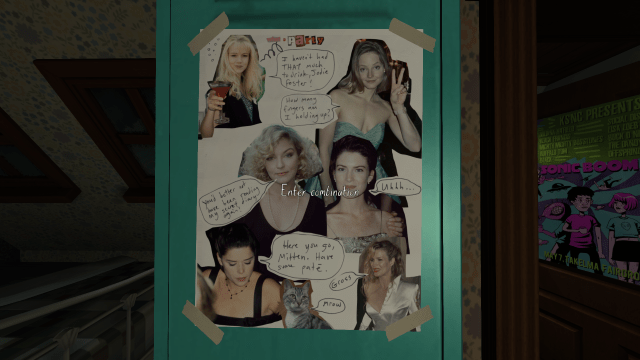
This shouldn’t be so amazing, but in the same way that Dear Esther rethought the very act of walking in a video game, Gone Home rethinks interaction. Everything in the house is there to add to the story, whether implicitly or explicitly. Dad is a failing and flailing novelist who is turning to alcohol often, and we know this through the placement of objects of his in relation to bottles of booze (and the booze in his office, high on a shelf, placed there precariously). Mom is flirting with another man, attempting to have him moved into her local branch office. Kaitlin, the character the player is acting through, was a star student who paved a heteronormative, Eurotrip-having, Upper Middle Class 101 path that younger sister Samantha (Sam) wouldn’t, and couldn’t, follow. All of this is communicated through objects and their relationships to other objects.

[There’s an alternate history where this entire post is about objects and how relations are bound through the nonhumans in the game and that the very concept of mystery only comes to us because of the opacity of objects and their relations.]

Samantha Greenbriar, the younger sister of the player character masterfully voice acted by Sarah Grayson, touches me through objects. The game gives up the central conceit of the traditional audiolog in games. There’s no record players or voxophones or tape recordings you to approach and listen within a predetermined radius that forces you to stand around and wait. All it takes is a notebook or a panel or a ticket stub and Samantha is there, speaking with so much exuberance about life and love.

232430_2013-08-16_00020

Gone Home is a game about exploring a house and finding out what happened in an intervening year while you were away, but that pales in comparison (for me) to Samantha’s narrative of queer discovery, love, and escape. The house is riddled through with compartments and secret passages. It is weighted down with history, with servants quarters, with the memory of the uncle. Against all of this, Samantha speaks in my ears, telling me about finding love with Lonnie in these rooms, these passages, these hidden places that her Average 1990s Nightline Parents can’t seem to find or understand. In unmarked rooms, she comes to understand and craft herself into who she wants to be. She builds herself in the hidden world of her own house, and then she makes a choice to fly.

I wept for beauty and for everything Gone Home can’t encompass in the narrative. The abuse. The difficulty. The fact that is is all so precarious and can fall apart. But against this, the absolute uncertainty of it all, she just goes. She’s out there being who she needs to be.

And this is groundbreaking, right? Gone Home is one of the few games that I can think of where a young woman character makes a choice for herself and we are not intended to sit in judgment of her as some kind of social transgressor. It is the opposite of the dadification of games–it is the sisterfication of games. Gone Home has constructed a character in such a way that we cannot help but feel immense love and respect for her decision. It isn’t just about sympathy or empathy–when Samantha says that I have to understand in that closing monologue, I cry a little because she’s exactly right. I do understand.

I guess that my takeaway, if I have to have one, is that Gone Home proves that we don’t need photorealistic sweat drops to become emotionally attached to someone. Danger doesn’t equal the most powerful relationships.

I want my games to have fewer dads and more sisters.

Posted in Video Games | Tagged , , , , | 1 Comment

On Jenn Culp’s “Makeup Mondays”

This blog has variously, depending on my mood, been about comics, video games, and my various academic concerns, and most recently that has turned into my writing about art that I’ve cared about on the internet. For a quick recap, stuff I’ve cared about recently would be A Cups Podcast, Ann Hirsch’s performance art, Darius Kazemi’s new bot, and now Jenn Culp’s “Makeup Mondays.

1

Jenn (I’m familiar because I know her) has been doing her makeup in some interesting way every Monday for a little more than a year now. That’s the core conceit–she’s just doing her makeup. On the surface, “Makeup Monday” is yet another instance of photo-a-day or photo-a-week projects that seemingly everyone cool was doing five years ago; with the creation of Instagram and the concept of iPhonetography, it is ubiquitous with smartphone ownership (I don’t want to suggest that it is now accessible and possible for everyone. On the contrary, the capability to make this art is still locked behind an economic wall for a your average person–it is just more common now than it was five years ago.)

3

The form of “Makeup Monday” isn’t what gets me excited–it’s the content (although these things are always mashed together in a way.) Jenn writes in an amazing post on the tumblr:

Life is much more satisfying when I feel like a wizard who has the power to control and alter the fabric of reality, and never do I feel more like a wizard than:

1. When I am in the act of creating or have just finished creating an object from simple raw materials. (e.g. Behold! I have taken heat and a hammer to this sheet of copper and now it is a large serpentine neckpiece!)

2. When I use cosmetic products to alter my appearance.

This aesthetic alchemy is what I’m interested in. On one level, Jenn is doing an amazing project that solidifies what a significant amount of feminist art has meditated on over the last thirty years–makeup is literally a process of making up a self. Makeup is a subjectivation machinem and it can be liberating or violently oppressive depending on how it is deployed, depended on, and applied. Anyone who has ever worn makeup in their life is nodding and saying “of course” under their breath so I’m going to skip to the second level, the one that I find a little more interesting.

2

On this second level, “Makeup Mondays” is a project of Jenn making herself inhuman. This isn’t every picture–I don’t want to suggest that wearing makeup makes someone less or more than human–but rather that some of the “sketches” that Jenn deploys on herself are actively pushing outside of the aesthetic space that we normally associate with humans. And I love it.

I know that there’s a human there–I know there’s an indexical Jenn Culp living somewhere and doing things–but the images themselves have particular lives. Jenn uses the language of “sketches” to talk about her work, and I’ve even used it above, but I’m not sure that “sketch” captures what is happening for me. I feel like Jenn is crafting a fiction in a frame with her body, using glitter and dye and skin to generate something wonderful for a moment. Then it goes away. That’s the inhumanity of it for me–there’s a synthetic, cooperative body between some purely aesthetic inhuman thing and Jenn’s actual body. She becomes written on, becomes with an image or an idea.

4

Addendum: I don’t enjoy cosplay or looking at cosplay. I feel like there’s either too much artifice (“Isn’t it funny that I am this thing!?”) or too much seriousness (someone being in-character the whole time), and as someone who experiences an immense amount of anxiety around people acting near me and people being ironic around me, cosplay has just never fit for me. But “Makeup Monday” isn’t on either end; I don’t feel like I can ever see “behind the curtain,” and I don’t ever feel like Jenn is being too self-serious. There’s a playfulness about them, a total acceptance, and nothing-being-forced that is truly amazing to see.

So go here to look at “Makeup Mondays

Posted in General Features | Tagged , , , | Comments Off on On Jenn Culp’s “Makeup Mondays”

Craig Perko on Bot Fandom

Like any kind of automation, it’s not that the human is written out. It’s that the task of believing, of being a fanboy… is being augmented. Fewer humans can accomplish more of the “fanboy” task. The fanboy robot does not replace humans, but it augments them such that vastly more task can be done. Not every gif is worthy of use, but a human can easily go through 100 gifs and choose the best few. It takes no expertise. And, in fact, it actually makes that person MORE of a fan than they probably were before, because they are partaking in an act of creation, no matter how indirect.

So… what I’m trying to say is:

Everyone who creates a TV show should probably pay Darius to do this for them. It won’t create fans out of thin air, but it does allow the fans to produce vastly more “fan culture”. It allows your fans to be more effective.

We’re not at the stage where the “fan culture” task is maxed out. I think we’ll see it evolve a few more times before we get to the point where humans are “fired” from being fans because there’s too much fan labor and not enough fan tasks that need doing.

But, hey, I look forward to that future. It sounds amazing.

Craig Perko, “The Nature of Fans” also responding to Darius Kazemi’s newest bot

Posted in Theory | Tagged , | 2 Comments

On Darius Kazemi’s “Scenes From The Wire”

Earlier today Darius Kazemi released his newest project which is a bot that makes animated GIFs from a video file and its paired subtitles. In its current form, the bot is working through S2E1 of The Wire and is located at the very appropriately named Wire Scenes tumblr (note: The Wire contains lots of scenes of offensive language and so the tumblr does as well.)

I’m mostly writing this post to signal to you that this thing exists, but I also want to say a little bit here about the way that I think the bot gives us a way of thinking about labor in the contemporary period. I’ve talked with Darius about the project, and he’s spoken about it in terms of “automating fandom.” My understanding of that, or at least my way of thinking about it that might be totally unrelated to what he means by that, is that fandom is largely produced through a particular form of labor.

I’m not saying anything that fan studies as a field hasn’t already said over and over again. I think it is generally accepted that there’s a loop around all media artifacts–producers feed consumers who produce for consumers. It all feeds back and forth any any Frankfurt-style understanding of a hierarchy of media (I’m grossly simplifying all of this, I’m sorry.)

The way that I understand the creation of fandom (and I’m just spitballing, this isn’t my field) is that it is wholly a labor process that proves a familiarity with the thing that the fandom is around. So half of it is the task of finding the perfect scenes, the reaction shots, the moments that those who love the show all laughed out loud at the moment they saw them. Then there’s the labor of downloading, of cutting apart, of subbing, of pirating, of camming, of optimizing to get around Tumblr (or, long ago, Livejournal) file size limitations. There are hours of collective and personalized labor in each GIF dump. Then there’s the commenting, the reblogging, the saving, and everything else to make sure that these image files get properly circulated in the fandom.

That labor is half of an equation, though, because part of the process of proving oneself to be a part of the fandom is knowing where to look. Making the GIF is proving that you watched; reblogging is a form of “yes, me too.”

The bot makes me rethink a lot of things I take for granted about this short narrative I just spun. The labor, the time invested in the creation of the object, happens quickly. It isn’t painstaking. The bot creates based on a predetermined quality threshold–it is cutting and pasting without any discretion about what the actual content would be. It isn’t proving that it is in the “know.” It isn’t being a part of fandom in any way that I understand fandom to exist.

And yet the products are indistinguishable from those made by fandom for me.

andyou

My relationship to the various fandoms are basically the same as my relationship to the inner workings of the bot: they are totally opaque to me. I don’t understand the production of lots of different fandoms that pass through my various feeds every day, but eventually a signal emerges from the noise–I start to understand that there are Doctors instead of just Christopher Eggleston or whatever. What amazes me is that the bot is tapping into that same apophenia–eventually, a pattern will emerge here, not because there is one, but because I found one. The “and you” up there is amazing in this way. It isn’t a GIF that anyone would make and yet it still works in the same way that all of these GIFs do. You can still use it to express, it still signifies The Wire in some way, it still matters. But all the intent, all of the direction, goes away.

I’m not sure I’ve said anything worth saying here, but there’s a total excitement that consumes me when I look at the tumblr. This is the singularity of cultural production. Everything is sliding into everything else. It is wonderful.


Posted in General Features | Comments Off on On Darius Kazemi’s “Scenes From The Wire”