Oil Spills In Peru

Read the account here.

The logic here is astonishing yet unsurprising: destroy the ecology of a place and then subsidize the correction of that destruction by making agents who live in that ecology take care of the problem. If, in any moment, they suggest that they don’t want to, capitalism can merely say that they aren’t bootstrapping themselves enough. It’s a rock and a hard place.

Posted in Theory | Tagged , , | Comments Off on Oil Spills In Peru

Joanne Barker on Cuts to the College of Ethnic Studies at SFSU

The truth is that ever since the formation of Ethnic Studies, public officials and university administrators have been trying to “roll back” the changes. They have not used striker and subsequent critiques of higher education as an occasion to question university curriculum or the function of public education more broadly. Instead, they have indulged false nostalgia in attempts to get back to the day when those critiques were seen to be silenced or at least inconsequential.

[Joanne Barker, “The Beginning and End of Ethnic Studies“]

In an infinitely depressing move, the College of Ethnic Studies at San Francisco State University is having their budget slashed by 40%. Barker lays out the political stakes and programme as clearly as possible in the piece, so click over and read it, but I also want to just hammer home that this is budget-as-bludgeon.

The continual eroding of education, especially around issues that the COES addresses, is 100% part and parcel of a public opinion that sees institutions of higher learning as sites of training and discipline for an economic system that began going extinct about 30 years ago. I fully understand college as a place of learning and expansion of the self–it’s one of the few places in the world where one can take a hot minute to nurture things like compassion, and that happens through particular kinds of readings and coursework that the college-as-service model never really manages to take as important. And, honestly, even if we buy the neoliberal language of college as job training, it is a total failure on that level if you were born poor.

In any case, go read Barker’s post and think about doing some of the things suggested at the bottom.

Posted in Theory | Tagged , , | Comments Off on Joanne Barker on Cuts to the College of Ethnic Studies at SFSU

Imran Khan on Gamestop in Puerto Rico

Part of the problem is the Jones Act, also known as the Merchant Marine Act of 1920. It is profoundly dry reading, but its profundity to Puerto Rican retailers is hard to understate. The Jones Act essentially requires that all U.S. territories, such as Guam and Puerto Rico, only receive trade from the mainland with U.S.-built ships, entirely U.S. crew, and only to U.S.-owned barges. Even in the best situation, this massively increases the cost to get products into Puerto Rico, but the lack of usable and safe barges adds time as a factor as well. Shipments can queue for weeks at a time, which stops imperative videogame releases from reaching store shelves until well after launch.

Imran Khan, “Gamestop’s Vanishing Act: How Videogame Retail in Puerto Rico is Dying

A fascinating look at the game retail industry and how it interacted with laws in Puerto Rico.

Posted in Video Games | Tagged , , , | Comments Off on Imran Khan on Gamestop in Puerto Rico

Pee-Wee’s Big Holiday

I enjoy Pee-Wee Herman. I have no further statement.

Posted in General Features | Tagged , , | Comments Off on Pee-Wee’s Big Holiday

30 Years of Trinity Islands

trinity

Earlier today Twitter user @PointlessDude reached out to me to show me the abomination he has created in Rollercoaster Tycoon.

He’s played Trinity Islands, a level in the game that I recently completed myself, for a long time. I think the normal mission time is 3 years. He went the full thirty, and the results are monstrous. Every piece of land is covered in snaking, colored tracks, with other rides peppered in where they can fit. The sound is a horrifying cacophony of laughter, screams, and machinery. It’s the logical conclusion of funtimes capitalism spread across time, a Disney with the reigns handed over to Clive Barker.

It’s really great and you should watch the short tour of the level.

Posted in Video Games | Tagged , , , , | Comments Off on 30 Years of Trinity Islands

Pro Tour Oath of the Gatewatch

I went to the latest Pro Tour event, and you can read my write up of the event over at Paste.

Posted in Video Games | Tagged , | Comments Off on Pro Tour Oath of the Gatewatch

On Jessa Crispin’s “The Dead Ladies Project”

dead ladies

The Dead Ladies Project is a collection of essays centered around Jessa Crispin’s travels in the shadows of the writers she’s fascinated with. The subtitle, “Exiles, Expats, & Ex-Countries,” almost doesn’t manage to touch what’s actually going on in the volume, which is nothing less than Crispin coming to terms with the afterimages of these literary figures that she’s tracing across a couple continents.

This isn’t a review so much as it is a recommendation. The literary essay as a form, steeped in reference and argument and confession and affect, is almost a lost art. Not lost as in “no one can find it” but lost as in “taken by a tidal wave.” The thinkpiece, the confessional, and the linear argument/college term paper published as cultural criticism have all become so dominant that they’ve pushed out more considered (hell, more elegant) essayistic forms.

I blaze through reading all of those genres, but Crispin’s book was maybe the slowest read that I’ve had in a long time. That’s not because it’s difficult (it’s not easy, I will say), but rather because it requires the reader to think along with it. Crispin is profoundly open about how she feels about herself, and she gives us many scenarios that frame those feelings: being a mistress, crying in an airport, taking taxis, becoming fascinated with black magic, and on and on. She hands all of this information over, and she evaluates it, and you listen to her. And you decide how you feel about it.

There’s emotional labor in that decision. I slipped over into care, into worry, about how the trip around the world to these sites of literary worship would end. I’m reading a Dragonlance novel at the same time, and they’re on a similar quest: Jessa has to make this pilgrimage in order to establish sense in the world; Tanis Halfelven has to do the same. I know how the latter will end, but the former has real danger in it. Real-world emotions are much scarier than dragons and their masters, but no less powerful.

In any case, read the book. It is good.

Posted in Books | Tagged , , , | Comments Off on On Jessa Crispin’s “The Dead Ladies Project”

On Broken Age

broken age tree

A few weeks ago I played through Broken Age, the “Double Fine Adventure” that went through a rollercoaster of development, release, and fan-relationship troubles.

It’s an adventure-game-ass adventure game, and being true to the lineage of a very particular time period in adventure games, it is profoundly frustrating. My own experience of the game went something like this: I stumbled through the first half generally understanding what I was supposed to do, and the second half seemed to be something akin to the experience of slamming into a brick wall at 400 miles an hour.

I have no idea how one would solve the puzzles in the back half of that game without randomly using objects on various characters and locations until the problems solved themselves. It is not a good time, and I ragequit the game (something I think I have done maybe three or four times in my entire life) after reaching a puzzle that continually reset itself in the last ten minutes of the game. The sequencing kept getting mixed up, and I just straight-up turned it off and uninstalled it from my console.

I wasn’t going to write about this experience at all, but I saw that Mathew Kumar had written this about the game:

I don’t think that in the “twenty-tens” or whatever we call them we should really accept games where you know what a character has to do, and it would be easy for them to do it by themselves, with no items or whatever, and yet you can’t do that. This is a game where you have to work out which specific person will lick icing of a cupcake (even if the hero Shay doesn’t want to eat it, he could just scrape it off!) Where you can’t give someone a Heimlich manoeuvre, you have to do something that is actually totally counter-intuitive screens away (which I won’t spoil.)

Now, I get it. It’s a puzzle game. You want to have puzzles to solve. But could they be… better? And the game’s “dual” nature—you can switch between two heroes, Shay and Vella—is totally a wash. There’s none of the interaction that made Day Of The Tentacle so incredible, and the mechanic is used to give characters information that they would never know without the invisible hand of the player-god. It’s actually sort of immersion breaking, so that blows.

I enjoyed, pretty much, none of the puzzles in this game. But I’m fond of Broken Age. It’s too pretty, too well-acted, and too charming to totally discount. It’s just weird to almost recommend the game saying “just play the whole thing with a direct, spoiler-free walk-through.” Or even worse, “watch a long-play on YouTube.” But it feels like what I’d like to do; it’s worth experiencing, sort of.

That’s the real conundrum at the heart of Broken Age. It’s a game that has all the trappings that might make me like it, but the actual execution drives me away from it. It’s like a beautiful painting hanging in the most hostile museum space.

Posted in Video Games | Tagged , , , , | Comments Off on On Broken Age

Oath of the Gatewatch’s Most Interesting Cards

nissa writing

I’ve been writing lists of the most interesting cards of the most recent Magic: The Gathering sets, and the articles are somewhere between useful and total frivolity. I just wrote another one about Oath of the Gatewatch. I’m literally writing about the cards that I find the most interesting, and while the positive feedback I get is a general enjoyment of the commentary I provide about the cards that I find interesting, the negative feedback is really strange in that it demands that I do the normal labor of just ranking the cards of the set. And those power/applicability/playability rankings are literally everywhere and have been for a couple weeks now, so I’m really not sure about why every entertainment list (and to be clear, this is an entertainment article) needs to be so serious and chock full of info.

In any case, conundrums aside, you can read The Most Interesting Cards in Oath of the Gatewatch.

Posted in Video Games | Tagged , , | Comments Off on Oath of the Gatewatch’s Most Interesting Cards

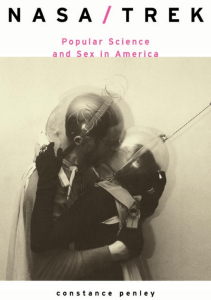
Constance Penley on Fan Fiction and NASA

nasatrek

I got back into space and its fictions in the mid-1980s by hanging out with some very interesting women from around the country who write homoerotic, pornographic, utopian romances that take place in the Star Trek universe. Fellow academics have suggested that my “hanging out” with these female fan writers was really “doing ethnography,” but I cannot bring myself to put that more scholarly grid over the wondrous tangle of experiences and relationships that I found in that fan culture. In the “/TREK” chapter and the ones that follow I talk about everything I learned from this underground group of pseudonymous amateur writers who have ingeniously subverted and rewritten Star Trek to make it answerable to their own sexual and social desires. But what I learned most from them was an attitude that I later developed into a critical stance, a method of addressing what had become for me the increasingly entwined issues of sex, science, and popular culture. If the “slashers” (as the fans call themselves for reasons that will be revealed later) could rewrite the massive popular phenomenon that is Star Trek, why couldn’t I write NASA itself? After all, NASA has by now become popular culture–an issue I address in the “NASA/” chapter–making it without a doubt an object available to cultural criticism.

Constance Penley, NASA/TREK pp.2-3

I love the argument being put forward here (despite not really thinking that Penley rewrites NASA in the book). The idea that cultural existence equates to a kind of canon or lore that can then be reinterpreted in the same way that Spock and Kirk’s relationship is is another way of talking about speculation, and I’m 100% into the idea of speculating about the conditions of things in the world.

Parroting Marlo Stanfield (recognizing the baggage that comes with quoting The Wire in any form: “You want it to be one way, but it’s the other way.”

Posted in Theory | Tagged , , , , | Comments Off on Constance Penley on Fan Fiction and NASA