On Fictional People, Lies, and Underlying Processes

This is just a quick thing in order to get some tabs I off the top of my screen.

Something I think about a lot is fiction and our attachment to it. Why do we like it? Psychoanalysis would give us something about investment and identification; affect theory provides us with a resonance that co-creates us; more traditional and storied theories would just ignore the question and go with the given fact that we, well, just do.

We also have a cultural fascination with the fiction that cannot be distinguished from the truth (by “we” I mean humans because I think that every culture has a concept of lying). Conspiracy theories, talk shows about cheating spouses, and the “real” people behind internet pseudonyms are all outcroppings of this same core feeling–why is there something unreal behind something that we perceive as real?

What brought this up recently was a Parliamentary investigation of the practices of undercover police officers (which, I gather, is about tracking the people who track dissidents). This investigation has focused on officers who would live with women who were attached to the groups that they were monitoring, working their way into intimate relationships with them.

I will let the article speak for itself:

It was not unusual for undercover operatives working for the SDS or its sister squad, the national public order unit, to have sexual relationships with women they were spying on. Of the 11 undercover police officers publicly identified, nine had intimate sexual relations with activists. Most were long-term, meaningful relationships with women who believed they were in a loving partnership.

Usually these spies were told to spend at least one or two days a week off-duty, when they would change clothes and return to their real lives. However, Jenner, who had a wife, appears to have lived more or less permanently with Alison, rarely leaving their shared flat in London.

It was an arrangement that caused personal problems for the Jenners. At one stage, he is known to have attended counselling to repair his relationship with his wife. Bizarrely, at about the same time, he was also consulting a second relationship counsellor with Alison.

“I met him when I was 29,” she said. “It was the time when I wanted to have children, and for the last 18 months of our relationship he went to relationship counselling with me about the fact that I wanted children and he did not.”

The article ends with a message from Alison:

“This is not about just a lying boyfriend or a boyfriend who has cheated on you,” she said. “It is about a fictional character who was created by the state and funded by taxpayers’ money. The experience has left me with many, many unanswered questions, and one of those that comes back is: how much of the relationship was real?”

I think it is both interesting and tragic that the article ends on this note– it deflects away from Alison’s point. Yes, a popular fascination with liars and lies is an easy hook for the article to cling to, but I think this fascination takes away from Alison’s broader argument: the British government is directly responsible for emotional trauma for these women.

In this way, there isn’t a fiction going on at all. Everything is on the surface of things–everything is true. The government has a well-documented program of infiltration that has trauma as a policy.

So what am I saying? The British government has a policy that uses women as tools in order to enact Cold War-era civil spying tactics. On top of that, the press desire to package the story as one about “the lie” instead of one about governmental procedure and police practices and specific kinds of governmental “acceptable” abuse that is specifically gendered is a move to cover up or to mask the problem.

The fact that this isn’t a new process, and that it continues to this day, is really disturbing.

Posted in General Features | Tagged , , | Comments Off on On Fictional People, Lies, and Underlying Processes

Bob Plant on Foucault on Sadomasochism

Let me be clear, I am not suggesting that S&M necessarily involves malice (or that its practitioners naturally harbor some ‘deep violence’), but rather that the possibility of such non-strategic eventualities has a productive function here. That a specific game could degenerate into mere domination — where the other stabilizes the power relation by barring one’s ability either to instigate role-reversal or to halt the game–is not merely always possible, but also pleasure-generating in its possibility. In other words, the possibility of transgressing the rules of the game–or of letting the game ‘play us’ –brings its own special pleasure to the proceedings.

Bob Plant, “Playing games/playing us : Foucault on sadomasochism”

Posted in Quote Time | Tagged , , , | Comments Off on Bob Plant on Foucault on Sadomasochism

Released: My Rage is a Cloud that will Cover the Earth

title 1

The other day I was lamenting the fact that my rage at reading comments, articles, and the internet generally did not manifest itself into a physical cloud that could consume the earth.  Jeremy Griffith asked if this was going to be my next game.

It is.

You can play it here.

Brian Taylor did the music.

The game is a rage simulator. You press the Z key in order to make the cloud grow. It covers everything.

At risk of interpreting myself, the “point” of the game is to show how these small, sexist comments are absolutely rage inducing for me. It is a purely personal game in that sense.

Another “point” of the game is to make the process physically exhausting, overlong, torturous. That’s what it is like reading these comments all the time–exhausting and draining. I can’t imagine what it is like being on the receiving end of them constantly–I respect anyone who has the bravery and fortitude to put up with it and steel themselves to make it through the dudebros of popular video game website comments.

Remember that March is Women’s History Month. You should probably use this month to think about what you are doing in order to not be a shitty person toward women. It isn’t something passive; it requires active thinking and actions to match.

So spend this month being a better person.

In any case, My Rage is a Cloud that will Cover the Earth.

Posted in A Game I Made | Tagged , , , | 2 Comments

Culture Ramp is Gone

Back in November, I wrote a series called “Press Publish.” While I didn’t trumpet it as such, one intention behind its four parts was to clarify the problems that stand in the way of a more constructive, equitable, and robust online culture. The longer-term ambition of the site was to foster solutions to those problems. The current poverty of that culture is not responsible for the death of Culture Ramp—that blame falls solely to me—but it does mean that, for the foreseeable future, nothing both so ambiguous and ambitious as Culture Ramp stands much chance of surviving, let alone thriving. For now, you need a hook.

L. Rhodes, “End of the Road

Posted in Quote Time | Tagged , , , | Comments Off on Culture Ramp is Gone

Josephine Saxton on science fiction

What I would really like is for readers to read my work, not only SF fans, who have, like rubber fetishists and gourmets, Special Tastes, and often cannot enjoy anything outside their label. Let me put in a plea, not just, as is sometimes necessary with Fantasy and Science Fiction, for a suspension of disbelief, but for a suspension of strictly labeled parameters. . .

Josephine Saxton quoted in Sarah Lefanu’s Feminism and Science Fiction 31

Posted in Quote Time, Theory | Tagged , , , | 3 Comments

You Buy It I Write It: The Polynomial

Is there a game you think I should write about? If you buy it for me on Steam, I will write about it. Check out the information here.

There was a flurry of activity when I announced that I would play anything that someone purchased for me. The Polynomial was actually the third game to come in, but because of time and space limitations, I gave it a go before the second one. 

Do you remember when you could put a cd in the original Playstation and it would play and you could show some sweet visualizations while the music played? There were some bars that would hop up and down while the then-contemporary Marshall Mathers LP sold shit right into my teenage brain.

And during those strange days at the ending of the 20th century and the dawn of the 21st I would often flip through those visualizations that sometimes matched up perfectly to whatever weird emotion I was feeling along with The Wall and think “I wish this was a game. I wish I could just fly through this.” I’m not kidding–I would see these visualizations and the ways that they came onto the screen, both predictable and surprising, and dream about someone creating a Quake game that melded infinitely with the same tech.

I aged and visualizers changed and soon I could watch as many as I wanted with Winamp. Playing Caesar III with the sound turned off and Pearl Jam jangling away wasn’t the visualization mashup that I had been dreaming of, but it was something, and if the patterns and the desires and the emotions matched up, all the better.

2013-02-24_00001

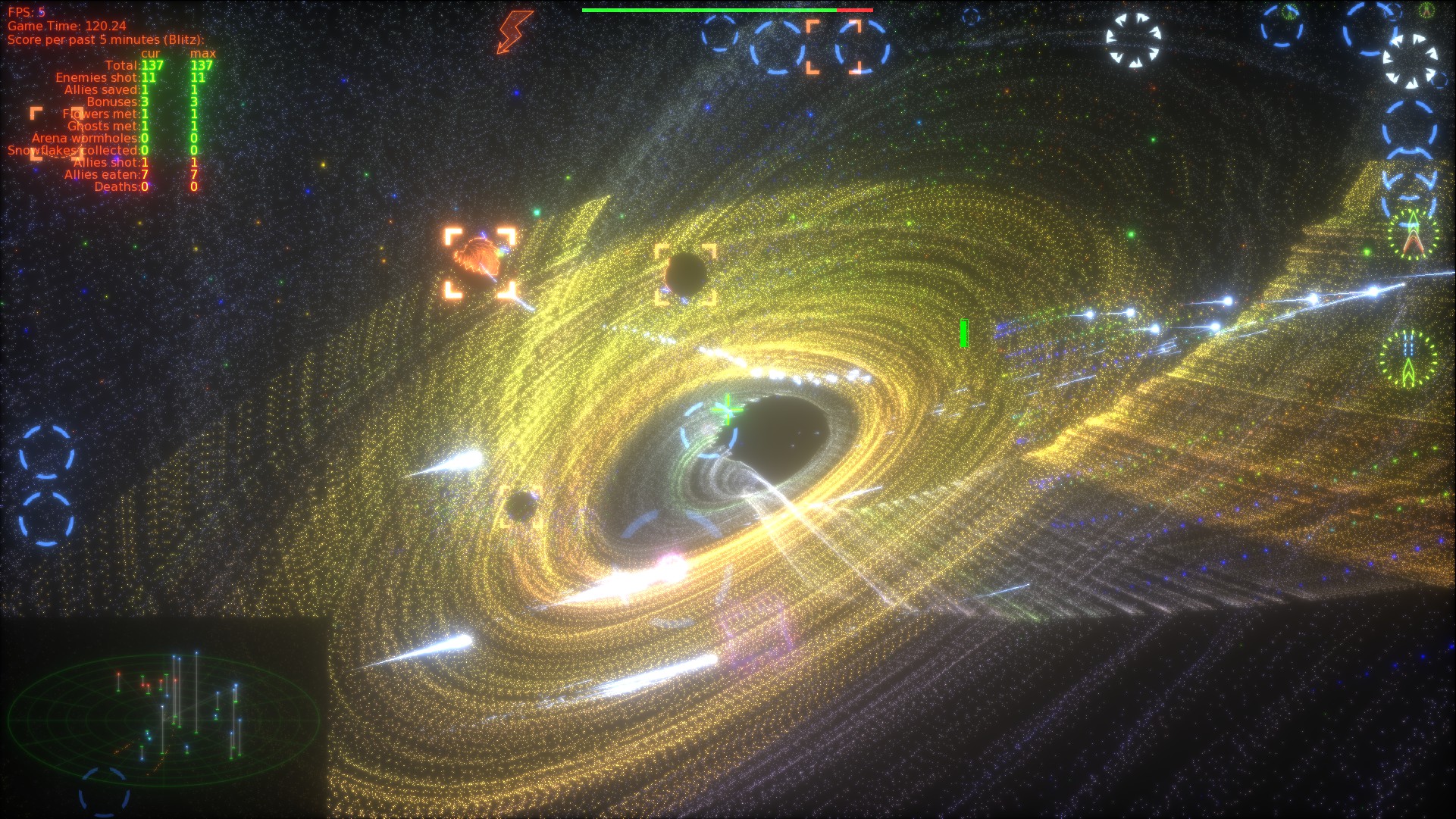
Now, years later, The Polynomial sits in front of me. The initial screen has information on it, but it is the kind of information that I cannot parse to save my life. It tells you to set the difficulty up very high so you can get points, but it doesn’t warn you that there is a reason that “very hard” is very hard. 

I start the game. I launch into a world with distant glows. They are indifferent to me. They don’t do anything–there is a low technotronica score that doesn’t seem to mean anything. “I thought there would be music,” I think that then a giant black ball with teeth shoots me to death with glowing blue lasers.

This isn’t what I wanted when I was a kid.

The menu system is packed with options and filters and choices of visualization. A few menus down, there is a plainly-labeled “Music” that allows you to pump the world full of the sounds of your choosing. I flipped through my music for a while, trying to find something appropriate, although I can’t tell you what kind of music is appropriate for flying around in nonspace doing nonsense things until the screen goes glitchy and you have to start all over again.

If you can’t tell, The Polynomial was disappointing me. It wasn’t delivering the kind of experience I had thought that it would deliver. I wanted worlds rendered based on my music choices, and after plugging a few mp3s into the system, I figured out that wasn’t what was going to be happening. At best I was changing the pulsing of the rendered galaxy/christmas tree/big tube that I would fly through and be killed by angry Pac Men.

I played for ten minutes and stopped.

2013-02-24_00002

I didn’t play for a couple days. I came back to it.

I tried to launch the game and realized that a driver update had, for some reason, killed the ability for my graphics card to actually do anything in OpenGL. I took two hours to fix it, silently raging against the system, the world, the techno-obfuscation that made every solution I could find into a ridiculously strange system of interactions that I couldn’t parse.

The short of it: I fixed it and I was in a bad mood.

I launched The Polynomial and prepared myself for an hour of suffering through it in order to write this. I queued up an album that I have been getting a lot of mileage out of lately, Zola Jesus’ Stridulum, and started flying.

Then it clicked. The Polynomial, in sharp contrast to its technical substrate, its bones, played seamlessly. I flew through space and pulsing clouds of light. Some numbers went up and I dodged c-beams that glittered in the dark. I wasn’t awed as much by the game as I was the kind of masking that was going on, something that is always apparent to me but was thrown into such deep and explicit contrast over the past few minutes that I couldn’t ignore it; the game, mere numbers and algorithms, achieved an aesthetic and affective linkage that I can’t possibly do any justice to.

There’s a beauty to watching numbers proliferate onscreen. To see the world reduced to figures and then reborn as a unrecognizable representation of itself. When I changed Zola Jesus to Riff Raff, I understood that the world itself was about to change–Riff’s deep beats and 808s vibrated the reality, the body, of The Polynomial.

So what do I think of the game itself? I think it is a fun visual experiment more than it is a game I am interested in playing for an extended amount of time. I think it does wonderful things to bring what I wanted as a weird teenager into the world while also denying that dream, that absolute procedural generation of things in the world based on music, which is both perfectly fine and sort of sad.

2013-02-24_00005

The Polynomial rides a line both beautiful and disappointing.

Posted in Video Games, You Buy It I Write It | Tagged , , , , | Comments Off on You Buy It I Write It: The Polynomial

Interviews with Steven Shaviro and Anthony Paul Smith

So two people I think do great work have had interviews come out in the past little while and I wanted to provide some links.

First, Steven Shaviro was interviewed at Figure/Ground (which is the place for rad interviews these days, it seems.) F/G does interviews that seem to solely be focused around the role of the academic in the university, and I’m glad to see smart people who are in the actual trenches (rather than administrators or the educational equivalent of lobbyists) talking about education. A sample:

In the context of new materialism, do you see any similarities between thinkers like Whitehead/Simondon with other thinkers in speculative realism/object-oriented philosophy, or is there a fundamental difference between them?

I think that there are both similarities and differences. For instance, Graham Harman, the founder of object-oriented ontology, both praises Whitehead for his non-anthropocentrism, and criticizes him for his privileging of relations over fixed substances. Whitehead’s insistence upon the primacy of “experience” and “feeling” puts him at odds with speculative realist thinkers like Quentin Meillassoux and Ray Brassier, both of whom tend towards the sort of scientism and eliminativism of which Whitehead was severely critical. But at the same time, Whitehead is also severely critical of what Meillassoux and the other speculative realists call “correlationism” (although, of course, Whitehead never uses and did not know this term). I think that it would make sense to develop a Whiteheadian strain of speculative realism — and this is part of what I am attempting to do.

Whitehead’s ontological and cosmological concerns put him in connection with the speculative realists; but pragmatically, he is closer to those contemporary thinkers who have been called new materialists. Jane Bennett’s “vital materialism” and Karen Barad’s “agential realism” both seem to me to have resonances with Whitehead’s thought, even though neither of them mentions Whitehead directly (as far as I know). Donna Haraway, on the other hand, has spoken specifically about the importance of Whitehead for her ideas about companion species. None of the new materialisms are based on Whitehead’s system or his technical terms, but they share his project of reconciling phenomenal experience with natural science, without rejecting either.

Second, Anthony Paul Smith has an interview at The Charnel-House on the uptake of Laruelle’s work in the English language. A sample:

C.D.V.: What do you see as primary limitations to the development of Non-philosophy in the English speaking world?

A.P.S.: I think the primary limitation to the development of non-philosophy has been the lack of primary source material for English-language readers. I think that’s going to change now that so many of his works are being translated. But I’ve never thought that Laruelle was “the next big thing.”  In part because his work is very abstract and difficult, but also because the sorts of institutions that support that kind of work are shrinking. It is difficult for me to see working non-philosophically landing someone an academic post, of Laruelle’s works fitting within the ways philosophy survives in the academia as the guardians of ethics subject to the whims of the business school or medical school.

Posted in Theory | Tagged , , , , | Comments Off on Interviews with Steven Shaviro and Anthony Paul Smith

On Anne and Beanie

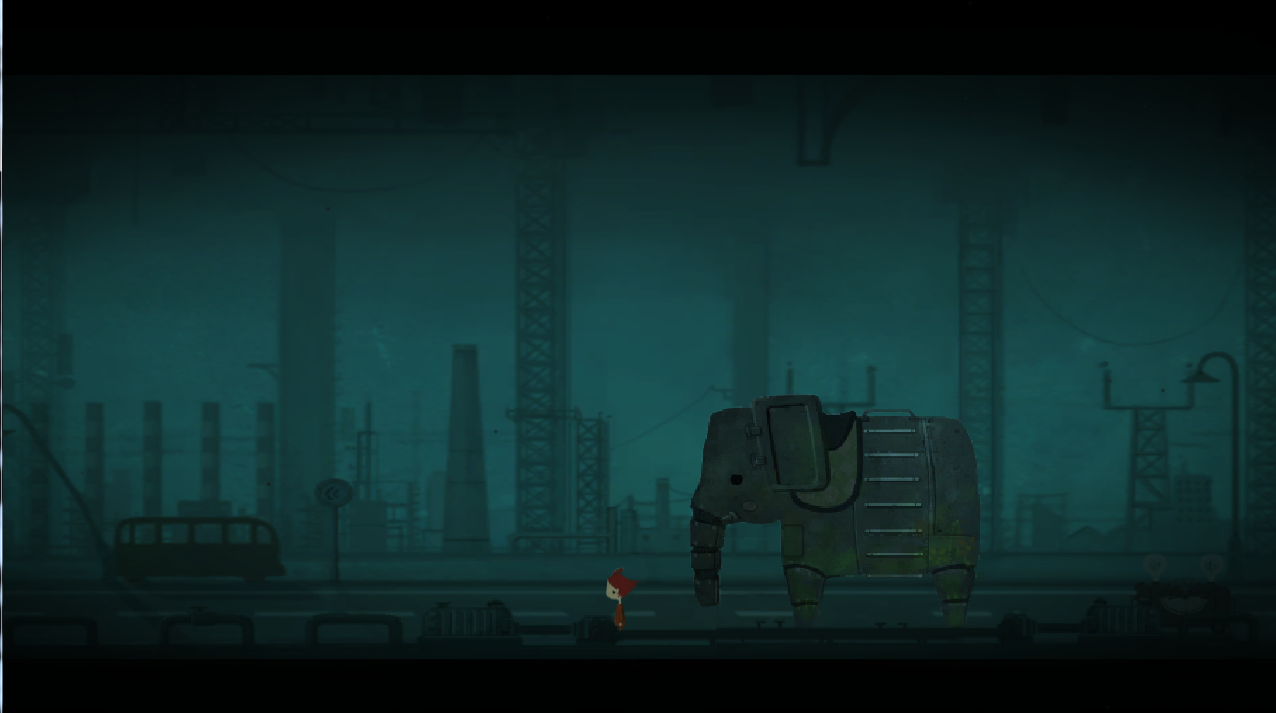
This is a quick bit to match a quick game. Anne and Beanie is a short adventure-ish game (and by short, I mean the credits sequence might be longer than the game).

1

It was made by a team of people headed up (if I am reading correctly) by Jason Yi Kai.

It features small cutout-looking people. There is power, and power is collected and stored and follows a small girl and her giant mechanical animal around. The visual aesthetic is the “core” of the thing, being more like a koan or a Dickinson poem than anything else, but I think the power of the game comes from Casey Hartnett’s score.

2

I’m not going to spoil it. You should go play it. It takes ten minutes, tops, if you are the slowest game player. It is point and click. There are smiles.

3

Posted in Video Games | Tagged , , , | Comments Off on On Anne and Beanie

Alan, Wake Up

2012-12-31_00004

Posted in Photography | Tagged , , | Comments Off on Alan, Wake Up

You Buy It I Write It: Fortix

This is part of my policy of playing anything someone purchases for me. You can read more about that here.

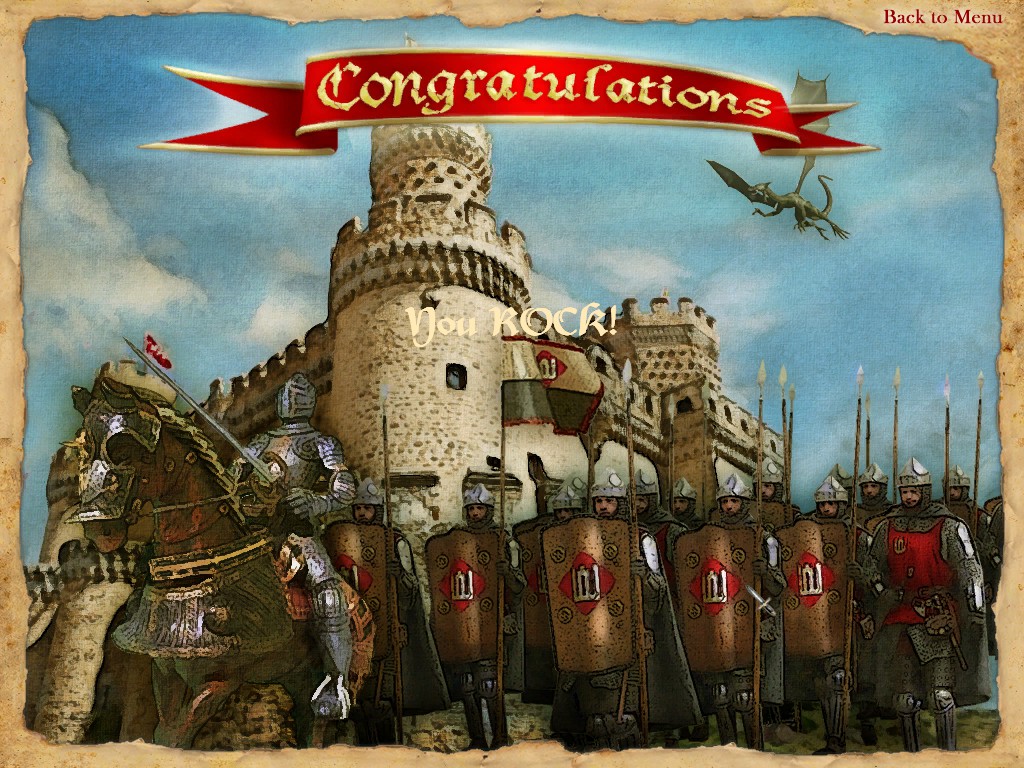
Fortix is a game about capturing territory. If you want to split hairs, it is a game that is all about cutting smaller squares out of a much larger square.

The setup is simple enough. You are a knight who wants to recapture the world from the evil sorcerer-dragon-winged villain Xitrof, who has driven all of the “good” from the world. I will let the game’s description speak for itself:

Can you reclaim your ancestors’ land? Evil forces have taken over the once fertile land of Fortiana. You are the only one who can storm the castles and claw it back from the hordes of dragons. Experience a new type of strategy and arcade game. Fence off parts of the battlefield to corner your enemies. Collect catapults and power-ups to besiege the fortresses and take on dragons. But beware! As you progress through the levels it gets harder and harder. The fortresses become much larger and the monsters more vicious. Can you emerge victorious and reclaim the land of your ancestors? You are knight Fortix, the sole hope for the desolate and tortured land of Fortiana to become the fertile land that it was before.

Fortix works his way across the map, taking back the twelve shires of the king from the villain who has invaded the land.

All of this is window dressing for what the game is: it is about using the mouse or keyboard to make cuts in the map in order to “reclaim” territory from the enemy. The enemy territory generally has two things: dragons and towers. These dragons and towers can only hard the player when the player is “inside” of their territory. When Fortrix walks from the bounds of the map into the enemy territory, he leaves a colorful line behind himself. If a tower shoots a cannonball and it touches that line, the player loses a life. If a dragon touches that line, the player loses a life.

The goal of the game, as I said before, is capturing territory. After the player makes an incursion into the territory, she has to hurry back to another point on the map in order to capture the territory that was bounded in by the incursion. It is hard to explain. Watch this video.

I’ll be totally honest here: when Jonathan told me that he was trolling Metacritic to find middling, cheap games to make me play, I was really dreading it. When he linked Fortix to me, I literally groaned out loud.

I installed the game and booted it up and roughly 100 minutes later I had completed it.

2013-02-17_00010

Let me try to tell you why I liked the game so much: the risk and reward involved is very, very rewarding. The enemy variations, and how they respond to player actions, mean that the game gets harder because the capture of territory becomes increasingly more brutal. I found myself slipping out into enemy territory and flipping back almost immediately, capturing a small amount of territory. As I got more confident, I started splitting the territory I needed to capture in half–I started running straight up the middle, clipping through the fortresses, quickly closing out my missions as the cannonballs flew.

This doesn’t sound exciting, but it is.

Sort-of-sadly, the game doesn’t have much else to it. I don’t have a brilliant read on the game. I don’t think it does anything amazing, although the core gameplay concept is novel enough. There isn’t anything else there, though, which is why this is sort of short. I liked the game for what it was, and it is definitely worth $1.

I think I probably had more “fun” playing Fortix than I did playing through Dishonored? I don’t know. That’s a tall order, and a weird thing to say, but it might be true.

You can purchase Fortix on Steam.

Posted in Video Games, You Buy It I Write It | Tagged , | 2 Comments