Stuart Elden on V For Vendetta and Guy Fawkes Masks

It is a curious combination of images, histories, politics and symbols—a Catholic revolutionary, executed for treason, a peculiar heritage in British popular commemoration, a right-wing blog site, a graphic novel, a Hollywood film disowned by the graphic novel’s writer, a mass-produced commodity, internet hackers and a myriad of protest groups. But it is precisely this lack of tangibility that has proved to be part of its appeal. It is hard to pin-down, to locate, to detach from its multiple resonances. As V says in the graphic novel, “Did you think to kill me? There’s no flesh or blood to kill. There’s only an idea. Ideas are bullet-proof”.

Stuart Elden, “V for Visibility

Posted in Comics | Tagged , , , | Comments Off on Stuart Elden on V For Vendetta and Guy Fawkes Masks

On Bioshock Infinite

SPOILERS FOR BIOSHOCK INFINITE

8870_2013-03-26_00026

“There’s no point in asking.”

“Why not?”

“Because he doesn’t row.”

“He doesn’t row?”

“No, he DOESN’T row.”

“Ah, I see what you mean.”

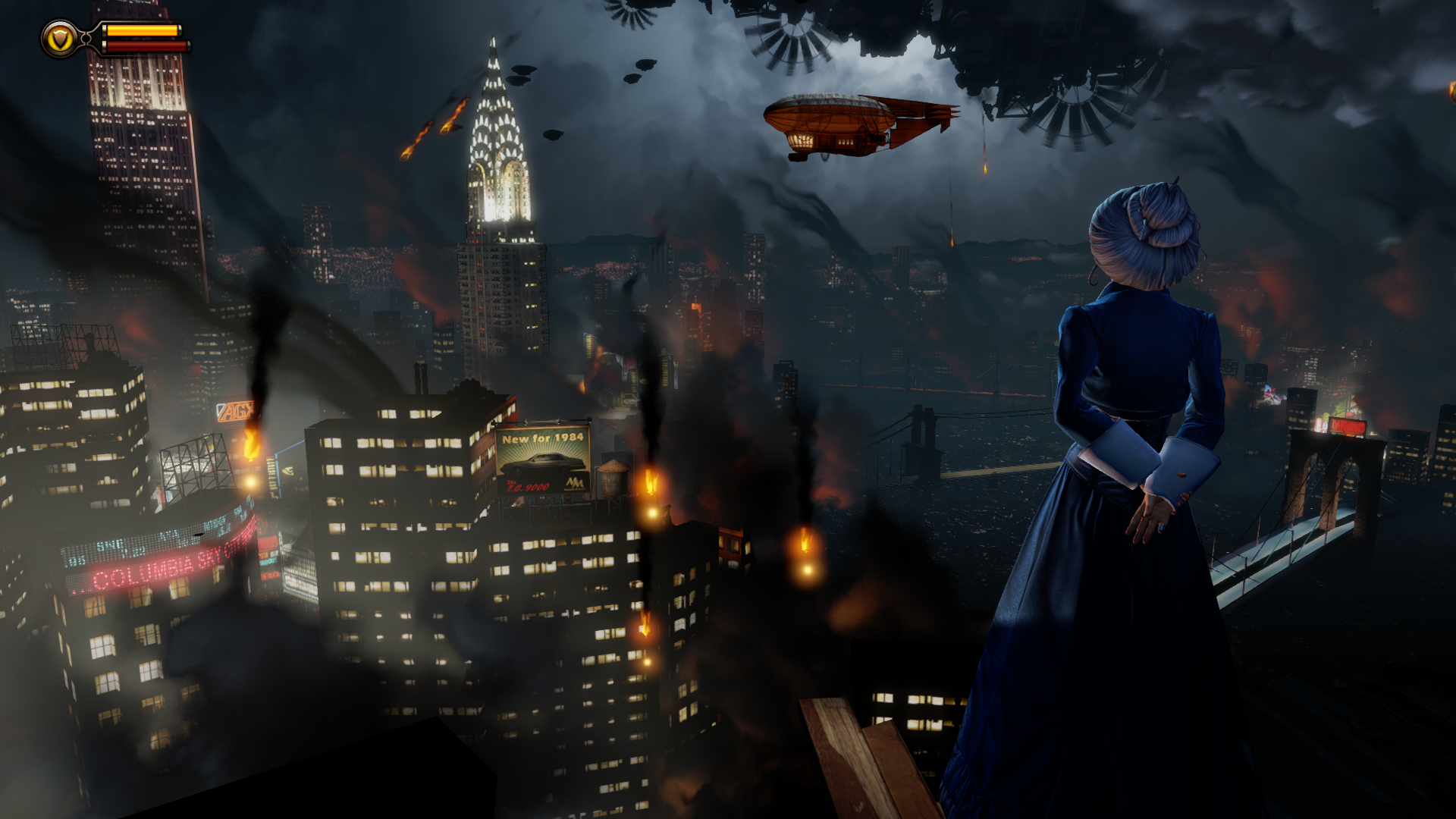
My appraisal of Bioshock Infinite sits roughly in the same place that it did when I finished it a couple nights ago: it is a game that should be praised. There are peaks and troughs–after all, it is a game that lasts for hours and hours, and an expectation of pure and unadulterated quality is a ridiculous thing to put onto any experience that lasts for a minimum of seven hours by default. My final calculation tries to have some fidelity to this reality: did the peaks outclass the troughs? Were the highest points so well done that I can forgive the missteps?

My experience with Bioshock Infinite started before I even plugged the Steam key into my client. I imagine that most of you reading this are in the same boat. I played both previous Bioshock games, and I enjoyed them. Years after the fact, I think the twist of the first game is worth the player’s time, and the development of Rapture in the sequel with its political move into a communitarian cult of personality and redemption has sadly been ignored. So I went into Infinite with goodwill toward the franchise. More importantly, I went into the game knowing nothing about it.

This is a new thing for me as far as games are concerned. Over the past year I have made a significant effort to avoid information about films that I am interested in seeing. Take 2012’s Prometheus as an example–while the release of that film featured various videos made by characters from the film, “sneak peeks,” and enough teasers and full trailers to choke a xenomorph, I avoided all of it. I think I saw an initial teaser before a film during the previous year–Transformers: The Dark of the Moon, maybe?–but other than that, I was radio silent. I had no idea what the film would be about. I thought it was great. I did the same with The Dark Knight Rises and The Avengers.

I’m getting back to games, I promise.

8870_2013-03-26_00040

So I watched those movies, and I formed opinions about them. In the case of all of them, I immediately went home to watch the trailers and videos that I had purposefully been ignoring. The trailers absolutely ruined them. Plot developments, action scenes, and even jokes were all deflated by being telegraphed–and even sometimes just directly stated–in the trailers. Our current time period is characterized by a saturation of images (thx Baudrillard lol). More than that, and maybe more harmful for my enjoyment of media, is that we are also saturated by Youtube videos. And I think that isn’t so great. In response, I have pulled (with AAA games) the same move that I have with films. If I hear about something I might be interested in, I wait it out. I don’t read previews. I don’t watch promo footage (and holy shit was there a lot of that for Infinite, as I have learned today). I don’t do anything that puts a sales narrative in between me and the game.

To be clear, this is less a move about “you gotta play it to really know it, mannnn” as said in a faux Tommy Chong (although there is some of that in there.) It is more that we are all being burned constantly by the promises that are being made to us by video games. The sales narrative fueled by the desire of huge companies to sell millions of copies in a very small window is actively selling us on concepts and images that cannot ever be delivered on. We are being sold a dream that can’t ever match up with reality. We’re being given a taste of wonder via prerendered trailers that will never be present in the game.

I’m purposefully, methodically trying to get a little of my wonder at video games back.
8870_2013-03-26_00077

Bioshock Infinite has given me a little bit of faith. And this, mind you, is really a case of a game coming up from behind–every single time I have ever read an interview with Ken Levine over the past few years, I’ve cringed. As a friend said over gchat, Levine is our Spielberg or our James Cameron; he’s constantly selling us the bullshit of video games as magic, as being some privileged medium that delivers something wonderful right into the hearts and minds of players (the end of this video is a prime example).

Despite my gut reaction to Levine having his directorial thumb right in the middle of the Infinite pie, I enjoyed it immensely. There are three primary reasons. I will try to get all of them without ballooning this post up to 3,000 words.

1. The narrative

This is a painful admission to make: Bioshock Infinite might be the first time that I was not embarrassed to explain the plot of a video game to my partner. Even the most special of critical darlings have stories that are painful to explain to anyone who doesn’t hold Warhammer 40k novels to be the peak of writing in the world. To reflect: Spec Ops: The Line literally turns on the ableist trope of “welp, you were crazy the whole time!” Braid is “you are an asshole, time traveling Mario!” Hotline Miami? “I bet you feel really bad about doing all of that stuff that you had to do in order to play the game, DON’T YOU!?”

I understand Infinite as (ironically) the completion of what Brendan Keogh has called a post-Bioshock game. In Killing Is Harmless he writes:

The Line delivers what is almost a post-Bioshock commentary about videogames. That is, a commentary that only works because of the previous commentary Bioshock itself made. Whereas Bioshock’s protagonist mistakenly thought he had a choice, Walker mistakenly thought he did not. As long as Walker stayed in Dubai, it was true that he didn’t have a choice. But could’ve he just left Dubai? As long as I played The Line or Bioshock, I didn’t have a choice, but could’ve I just stopped playing the game? Unlike Rapture, Dubai is not at the bottom of the ocean. It is a system and a society that Walker can walk away from. “There’s always a choice,” Lugo once said. Perhaps not. But, at the very least, we have a responsibility. I may not have always had a choice in my actions in The Line, but I was still responsible for being present in those choice-less situations. Or, put another way, what I chose to do doesn’t matter so much as what I did.

For Keogh, a post-Bioshock game is one that understands the formal qualities of games that are on-rails and then holds the player accountable for the actions that she took, even if those actions were forced on her with no alternative other than turning off the game. I like to think about the concept of post-Bioshock in a different register, however. Instead of the “post-” meaning a trope trap where players are constantly implicated, I instead prefer to think about it as a recognition that we’ve had these games and that maybe, finally, we can start to get away from them. Keogh’s post-Bioshock ultimately views the player as the real enemy–without him, none of this terrible shit would have happened. Infinite is a moment of reconciliation and cooperation–not “we are glad you are here to save us all” in a classic (and non-reflexive) games sense, but instead a “we are all in this together” mode.
8870_2013-03-26_00081

Infinite, by overcoming its predecessor, ultimately gets to where so many games gesture toward and fail: maturity. I don’t mean that the narrative is covered in blood and guts or sexual violence or whatever the hell else the word “mature” has been coded as over the past twenty years in shitty AAA game development (and all of that is there in any case.) Instead, I mean that it is very apparent that someone spent time thinking about what was going to go into the game. The plot’s central focus around Booker Dewitt and his possible becomings is all internally consistent (although hotly contested) and foreshadowed throughout. This shouldn’t be shocking and it shouldn’t feel like someone gave me a present in the form of a considered plot, but here we are.

That isn’t to say that it isn’t predictable. Somewhere around the halfway point of the game, I realized that Booker was probably Comstock. When Elizabeth opened a tear into 1980s Paris in the world of the player, rather than the Rapture or Columbia world, I knew that dimension hopping and time travel were up for grabs. A prophet who can see forward in time and a man with a troubled past seemed like something solid to connect up to, and anticipating the Bioshock-style twist keyed me into the whole affair.

But that doesn’t mean that it is bad. I’ve read enough Philip K. Dick and other New Wave science fiction writers for this to be the kind of plot device that I am attuned to in some way, but that doesn’t mean it is bad. I want to stress that a 1960s/70s-science fiction style plot executed well in a video game in like manna from heaven, and when the end game and the power of all those Elizabeth’s dunked me underwater, I appreciated it.

Wipe away the debt. Everything was right in the multiverse.

I don’t want to give the impression that I am in love with the narrative here. Like most games, Infinite falls far short of the narrative capabilities of older, more solidified storytelling media. The reveal of infinite possible worlds didn’t make me gasp, and I didn’t find anything especially profound about it, but I also want to be real here–the fact that this game grasped at something more than “we killed the terrorists” or “fuck those space aliens” deserves to be pointed out and appreciated on some level.

8870_2013-03-29_00001

2. Elizabeth

Bioshock Infinite only works because Elizabeth exists. I don’t mean that in a purely technical sense–the narrative is all about her after all–but rather that everything in the game operates through its proximity to Elizabeth. I’ll try to explain.

If the player is close to Elizabeth, which is most of the game, everything works smoothly. Darius Kazemi commented the other day that the combat in Bioshock Infinite feels very close to Doom (I think Quake, but same thing, really). Most of this has to do with speed. Unlike the slower Bioshock and purposefully clunky Bioshock 2Infinite allows the player to actively be moving at all times. Being mobile is rewarded–only by being mobile can you jump from skyline to skyline to cover to freight hook dodging ten enemies, a Handyman, and an enemy who is made of pure fire.

This mobility is only possible because of Elizabeth. From the standpoint of mechanics, she dodges and dives and searches tears for objects to help the player. It operates like a dance; there are moves, but there are also hard rules, and one of those is the finitude of resources. At some point during crow summoning and fireballing, the player is going to run out of salt; chaining thirty headshots with the pistol will eventually lead to running out of ammo. When that happens, Elizabeth is there. “Booker, here!” she yells, and you press the button, turn, and she’s throwing what you need to you. There’s no down time. There’s no pause. Just a short animation and you are back to doing what you were doing before: shooting people.

I felt the lack of Elizabeth when she wasn’t around. In the few story segments when Elizabeth was away from me (when she is running from Booker and when Comstock has captured her), I was constantly scrambling from cover to cover. My mobility was hampered and I was always in the red on ammunition. Maybe this is a personal problem on my part–it is no secret that I am terrible at video games. For some reason, I don’t think so. Elizabeth is a part of a tapestry that is laid out for a player, and when she is missing, it resonates throughout the work. I think this is a significant achievement for games, period.

8870_2013-03-29_00035

3. The politics

I’m going to come out with this at the very top here: the politics of Bioshock Infinite are bad.

Daniel Joseph has succinctly pointed out, via tweet, that those politics rely on some tried and trite poses: everyone gets their day in court, the new boss is the same as the old boss, etc. Politics in Bioshock Infinite aren’t interested in change. Rather, they’re interested in mixing things up to prove something that’s taken as a law of the Leviniverse: power, when gathered, is abused.

The Bioshock games can’t help but repeat this mantra over and over again. To be fair, it could be that Levine and the writing team are making a point about humanity; in a multiverse in which things could shake out in a number of ways, people will always abuse power.

However, the actual moves that are being made by the writing team suggest a foregone conclusion. I think it is safe to say that Infinite acts, in some capacity, as a critique of conservative culture both in the past and over the past ten years. Father Comstock is a prophet, a man of God, an imperialist war hero, and has a penchant for portraying history in a very particular way in order to frame the terms of existence. It is a American Conservative greatest hits, as has been pointed out.

It is amazing to me that in a game where the developers are able to think something to the effect of “there are infinite worlds in which anything could occur” it is impossible to think of a world in which an underclass of people of color could successfully revolt against their oppressors and rule a flying city of which they already seem to have a extensive control over.

Instead of that, we get a revolution that is absolutely divorced from any real history of racial and political revolt at the time (other than anti-labor nods via Booker’s job history). We don’t get research and reality mixed into our fantasy of revolt, or at least not to the degree that we get it in the case of Columbia and its founding narrative. Instead, we essentially are presented with Ken Levine standing on a hilltop with the sun rising over his back screaming “straying too far from the norm in any direction is baaaaaad, brrrrooooo!”

And that’s bullshit.

So why does the politics make this short list of peaks? Bioshock Infinite sets the stage for games to begin performing better critiques of ideology. I think that Infinite makes people a certain kind of angry–not just angry at representation, but angry that Irrational could clearly do something amazing and chose not to because of a fidelity to some grand, internally consistent finger-wagging narrative. I hope there will responses to the ideological posturing of the Bioshock series as there was to the narrative climax to Bioshock itself: “Hey, we can do this choice thing better than that, can’t we?”

Infinite‘s position as a AAA game, and the most AAA of AAA games, means that its spillover effect is going to be huge. These systems of play are going to be coopted and perfected by both the indie and AAA worlds, and I hope (probably foolishly) that some team, somewhere, will look at the successes and failings of Infinite‘s conclusions about humans and their politics and think “we’re doing that, but better.”

8870_2013-03-29_00050

It is a high hope.

——————————————————————————————

This has gone on far longer than it should have; I’m sorry. There are plenty of things that I didn’t like about the game. Here’s a convenient list!

  1. Almost every scene of Dewitt touching Elizabeth was disturbing. She says she wants him to kill her before she is captured, and she puts his hand around her throat instead of verbalizing it. He also tightens up her corset for her, which is a particularly disturbing and bodily form of imprisonment.
  2. There is an asylum level where mentally ill mask wearers attack the player. Why? Who knows?
  3. Daisy Fitzroy becomes a savage child murderer for seemingly no reason.
  4. Vigors make absolutely no sense in the context of the setting.
  5. It is very clear that some sections of the game are the product of “hey, we need to extend gameplay for a little while.”
  6. It is also clear that other sections of the game are the product of Ken Levine saying “yeah, but THIS IS PART OF MY VISION.”
  7. It is impossible for me to believe that Elizabeth is a seventeen year old girl.
  8. There is very little internal consistency with rules of tears–some people exist in both worlds and are ghosts, some people are half dead, some people get to fly around with their memories. There’s no rhyme or reason to it.
  9. The balance of the vigors is strange–the first one you get is expensive and overly-useful; the last one is nearly pointless. You are rarely rewarded for altering your tactics.
  10. Elizabeth kills a person after watching Booker murder dozens of people and immediately takes off some of her clothes and cuts her hair. I understand the symbolic move to maturation, but I don’t know why that translates to more cleavage and a bob.

——————————————————————————————-

I will write more about specifics at a later date. This is my broad strokes move, my way of trying to get as much down right now as I can.

Bird?

Or the cage.

Or perhaps the bird?

Nothing beats the cage.

Posted in Video Games | Tagged , , | 4 Comments

Review of Alien Phenomenology at Itineration

So I reviewed Ian Bogost’s Alien Phenomenology for the online journal Itineration.

You can view it here.

It should be viewed this way:

1. read the review proper

2. listen and watch the computer performance of the review

3.  read my review of the review as read by the computer.

Posted in Theory | Tagged , , , | Comments Off on Review of Alien Phenomenology at Itineration

On The Manhattan Projects 1-10

Jonathan Hickman decided to create a comic book that told the secret history of science in the United States. The Manhattan Projects tells this story, but with an injection of fiction. I don’t mean “it is fictionalized,” because obviously it is, but rather that the comic itself is about injecting the history of science with a healthy dose of magic.

mp1

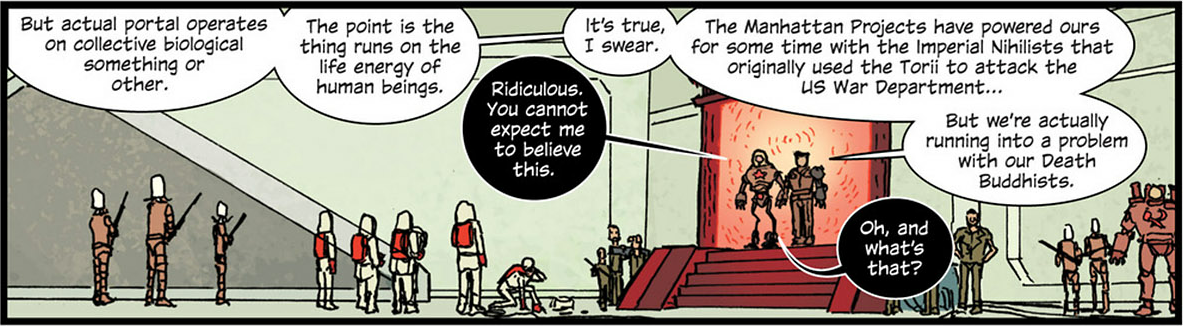
That’s the conceit, really. While there is a heavy dose of radiation and parallel dimensions and space ships, MP manages to play in the realm of fantasy as much as it does in the world of science. The conflict of the first issue centers around a Japanese invasion of the Manhattan Projects labs via a gateway powered by death cultists. Robert Oppenheimer is murdered and eaten by his mentally ill and superpower-possessing brother Joseph. His superpower? Eating people in order to have them live inside of him forever.

This is used as a plot device more than once.

My relationship with The Manhattan Projects can be summed up pretty simply: I like the concept, but I don’t understand why Hickman isn’t doing more with the concept.

m2

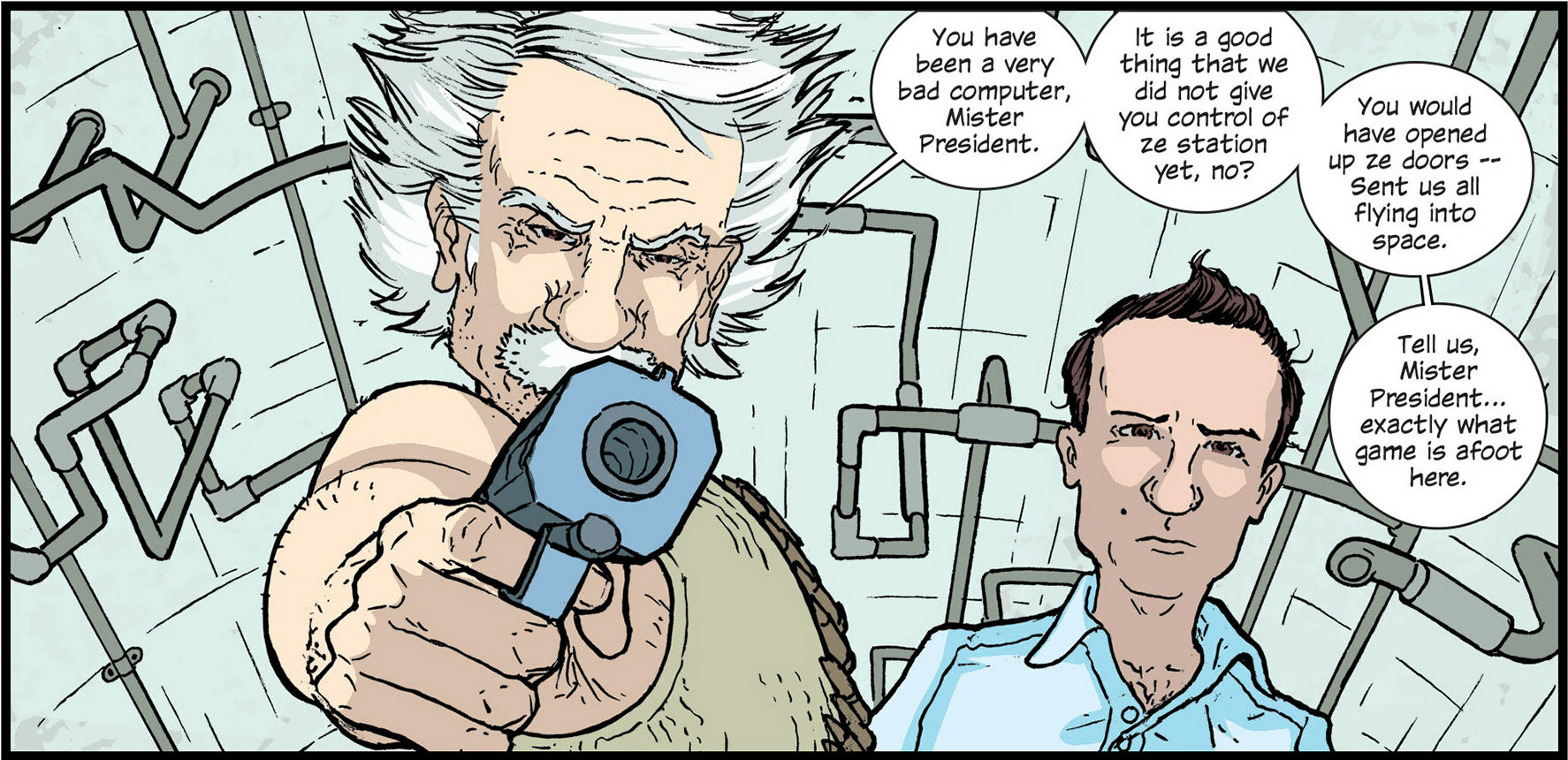
To be clear, I think that the scope of the comic is brilliant. FDR is turned into a superintelligent AI after his death, Enrico Fermi is revealed to be some sort of nonhuman or alien lifeform, and Harry Daghlian will live for 24,000 years as a skeletal weapon of mass destruction because he accidentally touched the Demon core. As entertaining as these reimaginings of science and history are, I can’t help but feel that they all fall a little flat.

Part of this is that these ideas are the kinds of things that you come up with after four beers at a table with friends who actually know a little bit about the history of science (or people who fall down Wiki holes.) “Yeah…but what if FDR became a rogue AI!?!” “Or wait, what if Albert Einstein wasn’t really himself, but a slightly-less smart version from another universe who just wants to get home?” It isn’t so much that everything is predictable or trite, but more that in the post-League of Extraordinary Gentlemen and Once Upon a Time world, you have to step your game up if you want to pull the “superteam from famous figures” card as the basis of your comic.

m5

I don’t want to give the impression that I don’t like the comic. It isn’t among my must-buy comics right now–those are The MassiveFury MAX, and Godzilla: Half Century War–but it really does excel at some things. There’s a beauty to Hickman’s ability to present us with a cast of characters who are willing to do anything it takes in order to achieve scientific breakthroughs. Former Nazi Wernher Von Braun, with a huge cyborg arm, is presented as equally heroic, despicable, and driven. Daghlian, whose body emits deadly levels of radiation, is deployed as a weapon to commit genocide against an entire race against his knowledge. The pain of that, of learning what a body can do, is plainly painful for him. These moments are few and far between, but worth hooking into the series to witness.

m3

I will close with a huge, gaping problem. In a world of fiction, where you have the opportunity to blend fiction with fact to make something unique, why would you choose to completely eradicate women? There have been ten issues of the comic so far. There are around 30 pages in every issue. In 300 pages of a fictional history of science, there has not been a single woman. I will be up front with it: that’s fucked up, and it is wrong. I mean, holy shit, at least take a look at Wikipedia to find the massive number of women who have made significant contributions to science during the time period that the comic is set. Additionally, I don’t think there have been any people of color short of Japanese death cultists.

m4

In a comic that is about imagination and characters taking what they want from the universe, folding and bending it under their will, there has been a sad lack of that on the part of the writer. So while I love it, I hate it, and I hope that Hickman will do better in the future.


Posted in Comics | Tagged , , , | 1 Comment

Post-American Elf American Elf

amelf

James Kochalka posted a new American Elf strip the other day. As you may know, American Elf was Kochalka’s more-than-decade long daily comic book diary. He ended it when 2012 went out the door, and has now been working on other things (a graphic novel about fungus, for example.)

But here he is American Elf-ing again. The death of the daily strip has very clearly been a boon–this newest strip breaks the square format of the previous comic, and it is a choose your own adventure kind of thing about being hung over. I understand that, and I bet you do too.

Kochalka is also involved with making a game about Glorkbot and adventure, which seems very low-fi Metroid, and I am very excited about that.

Posted in Comics | Tagged , , | 1 Comment

On Jacked: The Outlaw Story of Grand Theft Auto

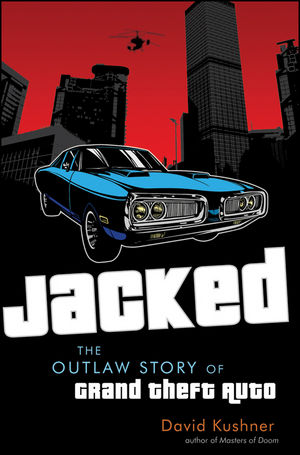
9780470936375_cover.indd

Before anything else: Jacked: The Outlaw Story of Grand Theft Auto is a book written by David Kushner that sets out to tell the story of the Grand Theft Auto franchise from its beginning to its end. It succeeds in that if “succeeds” means that it gives the reader some information that can causally be strung together in order to create an origin story. The book follows Sam and Dan Houser (and various other figures who I could never manage to keep straight) along the path from relative obscurity to massive success and massive mental breakdown while making the claim that the Grand Theft Auto series of games might be the most significant one in games history. Parallel to this, the book follows well-known game hater Jack Thompson, the Floridian lawyer who took Rockstar to task for their games until he was finally disbarred. 

The story is interesting. Or rather, the story should be interesting. It has all the trappings of something amazing–a cast of developers who are hell bent on making something new and risky pitted up against a smart antagonist that seems to have had it out for them from day one. However, this conflict is robbed of any potential power through the way that Kushner characterizes the players in the book. Rather than giving us two equally pitted opponents, Thompson is presented as an immature religious zealot who uses scare tactics and the rapid expansion of television coverage of games in the early 2000s as a way of politically maneuvering himself. For Kushner, Thompson doesn’t seem to have any real argument; instead, he has rhetoric and lawsuits, all of which are presented as groundless. So instead of a battle between giants, we are told that a big battle is going to happen, and then presented with the infinitely cool Rockstar crew against the massive incompetence of Jack Thompson. Take this anecdote about Thompson’s political leanings from the opening biographical section of the book:

But Jack had a Ripper growing inside. When a Black Panther student replaced the school’s American flag with a Black Power flag, Thompson confronted him. “What are you doing?: he asked. “We share the American flag!” The guy pulled a machete on him. Thompson recoiled, literally and philosophically. “It was a radical time, and you had to choose sides,” he later recalled. “I became a conservative over the lunacies of political correctness.” [12]

1. Why the first sentence? I’m quoting the paragraph in full. There isn’t any explanation of why Jack is a “ripper” here, other than clever wordplay and rhetorically painting Thompson as someone who is unreasonable, violent, etc. Frankly, this is par for the entire book–Kushner has a way of presenting people and events with clever language that either never gets delivered on or just straight-up doesn’t make any sense.

2. Jack Thompson only exists in the book because he is the other side of a First Amendment argument. In order to protect children, Thompson believes that certain sexual, violent, and linguistic content needs to be limited in media that children could possibly see. So why this anecdote? Thompson apparently becomes a conservative because “political correctness,” but then spends the rest of the book waving the flag of censorship high. The anecdote is against both Thompson’s characterization and message for the remaining 230 pages. So why include it?

I don’t have any love for Jack Thompson, but I do think that he deserves a much fairer shake than the one he’s given in the book. Thompson is presented from the start as a villain while the culture and designers at Rockstar are treated like true heroes of the people.

My larger problem with the book is that latter point: Rockstar are a perfect distillation of all of my issues with the video game industry. Near-constant crunch on core titles eventually lead to lawsuits against the company. Employees were internally ranked by being given patches, jackets, and sweaters to signify their importance. The years of development of the Grand Theft Auto series are punctuated by huge, expensive celebrations with strippers, booze, and cheese ball eating contests where participants are encouraged to vomit to remain competitive. People are literally chewed up by the machine–one chapter of the book explains that there was a stabbing and two suicides at Rockstar during a single year.

None of this is questioned. It is all presented, probably not intentionally, as casualties on the road to progress. Every game gets a multiple page explanation of why it is qualitatively better than the games that had come before it, and never do we get a sentence to the effect of “were those parties and those accolades worth destroying the lives of hundreds of unnamed developers?” For the most part, everyone who was never a corporate head at Rockstar or a lead designer is left unnamed, and while we’re told that there is roughly a 50% gender split at Rockstar (I am incredulous of this), I don’t believe there is a single woman developer or designer named in the entire book.

So if you want to read another sycophantic book that explains why some white, male, overpriviledged multimillionaires are geniuses, you could do worse than reading Jacked: The Outlaw Story of Grand Theft Auto. I wouldn’t bother.


Posted in Video Games | Tagged , , , | 2 Comments

Nick Briz’s Apple Computers

Ben Syverson: That’s part of getting yourself in another ecosystem. It’s about adapting and the constraints and they force you to do this thing that you don’t necessarily want to do but you have to do it because if you want to play in their garden you have to jump over the walls.

Jon Satrom: Yeah, and you have to wear their costume.

B.S: And you have to dance their dances. You have to drink their punch.

J.S.: And their punch tastes horrible.

I’m absolutely enchanted by this video. Briz is making an argument in this video re: the general artists relationship with Apple products that I have made about video games, but I’m less concerned about calling it an ecology and more interested in calling the whole assemblage a body that has particular sensory and affective experiences.

However, Briz really made a lightbulb flick on in my thinking about this whole thing. It isn’t just about material and software compatibility; the whole thing isn’t about making things fit together, disciplining the ill-fitting parts into compatibility. Instead, we have to think about foreign insertions, or maybe what Deleuze and Guattari would have called immaterial transformations. Think about software as a virus that attaches to the host cells of an OS–an Apple update doesn’t change the shape of things, challenging the virus by rendering itself immune. Instead, it just eliminates the ability for that software to make connections, to speak. Imagine the human body responding to HIV–imagine a bodily OS update that simply wipes receptors out of existence, or changing them so much that they cannot be recognized in their original function.

An Apple OS update is a process of creating vestigial organs that we can never trace back to their original usage. Or maybe not. Rephrase: Apple OS updates are processes of generating holes where organs used to be, where they could have been, and all we can do is look at the ecology around the holes to guess at what could be missing.

[thanks Alex Myers]

Posted in Theory | Tagged , , , , | 2 Comments

On Astrid’s Animation

There aren’t many positions for characters to be in when you are playing Skyrim. They’re walking, they’re standing, they’re fighting. The Jarls, basically the lords of the different holds, have an pose where they lounge far back in their chairs. But that’s about it. There isn’t a lot of variety in the ways that people exist 

The opening of the Dark Brotherhood questline is the guild leader, Astrid, kidnapping the player and forcing her to make a choice. There are three people with bags over their heads, and the player has to decide which one has an assassination contract out on his or her head. The player chooses and the questline starts and whatever.

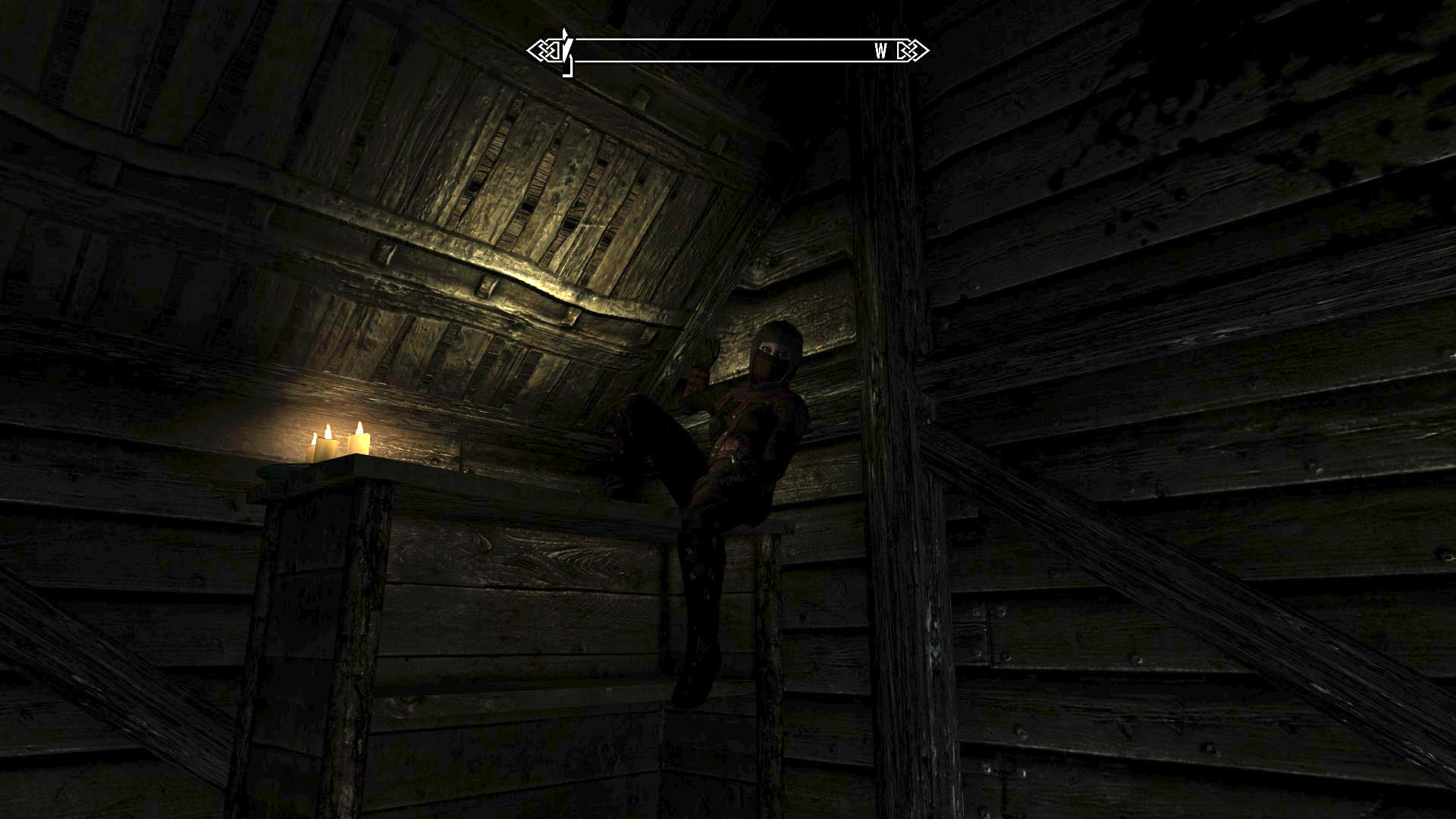
That doesn’t really matter. When Astrid speaks to you, she is sitting on a shelf in the corner. Like this:

2013-03-22_00016There is a choice in this encounter, like most encounters in Skyrim. You can reject Astrid’s proposition and attack her. She jumps down from the position, her animation seems to reset, and then she goes right into attacking the player. This leads into a questline where the player kills off the entirety of the Dark Brotherhood. Good wins out. The world is at peace.

When I played the game the first time, I was paralyzed by the choice of which of the captured people to kill. I didn’t want to do it. It seemed mean and much more explicit than other video game. I didn’t want to kill them for the same reason that I have never performed a “curb stomp” on purpose in an action game like Gears of War or Spec Ops. It isn’t just killing; it is execution, and the “game feel” difference for me is very distinct.

In any case, I never thought that it was even possible to attack Astrid. It was her unique animation, the pose that no one else in the game has, that made me feel that way. It is a unique form of visual rhetoric–digital body language, maybe. Astrid’s uniqueness in the world gives her a gravitas that is so great that I assumed I could not interact with her.

I thought that was at least worth noting.


Posted in Theory, Video Games | Tagged , , , , | 1 Comment

Some Preliminary Thoughts on Spawn

For some reason I thought it would be a good idea to read the first fifty issues of Todd McFarlane’s Image series Spawn. You might be familiar with the material through its strange saturation into American culture via action figures, anime, the comics speculation market, and a fantastically terrible movie made in the late 1990s in which John Leguizamo plays a demon clown.

I haven’t been able to read all of the issues yet. In fact, I’ve only read three or four, but nonetheless I already have some thoughts about the series that I want to get down in preparation for the long haul. In no particular order:

1. Spawn is horribly written. The protagonist, Al Simmons, is a man who died, went to hell, and made a deal with the devil so that he could return to Earth in order to…something that isn’t very clear yet. He returned as Spawn, the masked semi-superhero who is, like, so 90s.

spawn4

Every issue so far has followed a very specific plotline: Spawn is angry about the deal he made, he does something vaguely action-oriented, and then laments the fact that he is a demon thing now (instead of a human) who his wife could never love. Let me tell you: Al Simmons misses his wife. Spawn contains Harrison Ford levels of lamentation about his wife. On its own, that isn’t something to mark the writing as bad–the loss of a loved one, the sacrifice of normalcy and life, all of that could be interesting (if heteronormative, masculinity-in-crisis-y).

McFarlane’s strength isn’t writing, though, and so reading the comic literally becomes a process of waiting for the next lamentation that Simmons’ life is no longer what it used to be. An interesting concept that could be profoundly tragic is robbed of any emotional resonance because of how by-the-number it feels. On some level, it is like the ten page rule as applied to comics–McFarlane seems to think that the reader can’t hold Spawn’s motivations is her head for more that 10 panels max.

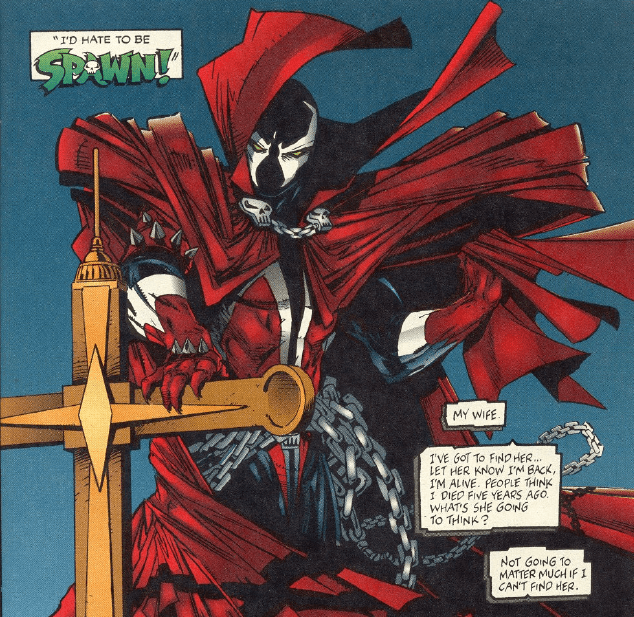
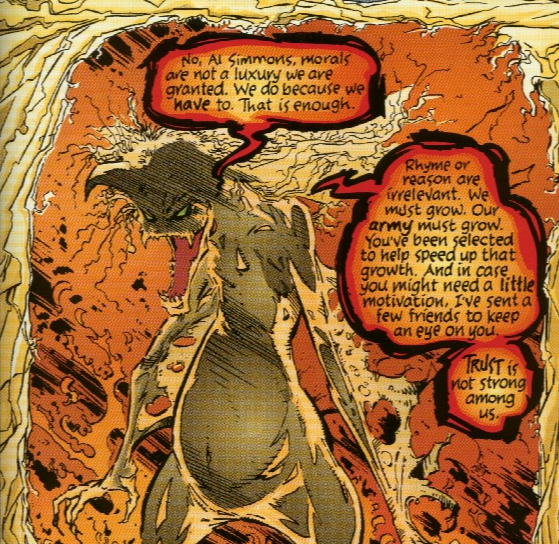
Check out this sweet exposition from supersatan:

spawn1


2. The design is sometimes really nice. Check out the following panel:

spawn3

That said, just as often as McFarlane does something interesting, he does something either boring or blatantly ripped off. There are multiple devices and panels that are ripped straight out of Frank Miller. The narration is delivered via television talking heads in a very network news, The Dark Knight Returns kind of way (the composition is much worse.) There are also explicit references that hit a little too on-the-nose: Spawn on a church, Spawn backlit with lightning strikes, and so on.

What has actually struck me about the visual style, both compositionally and artwork-wise, is how hurried everything seems to be. It makes sense–the Image partners all have a rough style that looks hurried (and is sometimes great for that quality.) I guess my limited interaction with the Image books from that time period has distanced me from the absolute lack of design in favor of just getting all of the story elements onto a page. Rarely does it seem like a page was designed at all, but rather McFarlane just started at the top left of the page and drew until he ran out of room. Panels are ignored or broken or brought in at convenience.

All of this lends to a strange communication of affect or emotion. It seems like McFarlane is basically saying “who gives a shit?” with every page, and I really feel it coming through to me. I look at it and say “well, that’s comics, isn’t it.” That’s a poisonous thought, and it makes me wonder how much of the bubble was less about economic accumulation and explosion and more about a nihilism surrounding the comics themselves.

3. Al Simmons can shapeshift from Spawn into a human form. That form is a white “beach bum” standard comics dude for the time period. Al Simmons is a black man.

spawn2

I think this is actually a really interesting turn in the comic: it is used as a punishment, a way of alienating Al from his humanity, turning him into a generic person of another race. I assume this is also meant to deprive Al of “uniqueness,” which is a little bit racist in that is exoticizes blackness, but it is hard for me to condemn McFarlane’s attempt to create a character who isn’t a white person like 97% of comics characters.

———————————————-

That’s all I have so far. There will be another post when I have read more. Hopefully the comic will get better! Protip: I bet that it doesn’t.

Posted in Comics | Tagged , , , | 1 Comment

Parikka on material incompatibility

Forget smooth, start with the rough. What if we assume a fundamental incompatibility?

What if we assume that by their nature, things don’t fit in? Not with the world, not with themselves; incompatibility is not a contingency or if it is, it is the fundamental contingency of the world from thoughts to things, ideas to devices. Furthermore, incompatibility is not only a cognitive category, or an object that just does not fit in – the anomalous, the incongruous, the thingy without even a proper name.

More closely, what is material incompatibility?

This could be the plug that does not fit, or the software that does not load, the installation that works only to halfway of the process. Whereas such experiences characterise digital media culture as a culture of standardised and constant frustration, material incompatibility can be seen characteristic of discarded and obsolescent technology as well. Not only a field for media archaeologists dedicated to excavating archives and ideas of outside-the-mainstream, this extended-media-archaeology is more like media garbology: it tracks the material in/compatibilities of components, chemicals and such raw, even bad materiality with our lungs, skin, the soil and other organic inscription surfaces.

Jussi Parikka, “Material Incompatibility” 

Posted in Quote Time, Theory | Tagged , , , | Comments Off on Parikka on material incompatibility