Ranciere on Life

I finished Jacques Ranciere’s newest book Aisthesis the other day, and I wanted to get a few notes out about the way that Ranciere thinks about the concept of life in the book.
aisthesis

If you’re familiar with Ranciere (and if you’re not get a primer here) you know that he generally writes about a singular phenomenon: the distribution of the sensible. In simple language, this is the organization of what is understood as seeable or experientially available to (almost always humans) in the world. For example, the way that European and North American liberal democracies have decided that rights-based discourse, reason, and democracy are all key human values and have agreed to only work within those frameworks is the contemporary distribution of the sensible. When these things are working smoothly, it is business as usual; you vote, to reform institutions, you make the machine work cleaner.

In our day-to-day discourse, we would call the act of voting “politics.” In our contemporary world, that is the way that we do politics. However, Ranciere reserves that word for a radical disruption of the distribution of the sensible–for him, politics isn’t voting; it is abolishing prisons or abolishing private property or freeing primates from the zoo. What is political is what breaks us away from what we think are the possibilities of the world. It gives us new ways of framing everything.

Aisthesis is a book about the distribution of the sensible in the art world, particularly how it was created during the Modern period. More importantly, each chapter picks a specific moment in that time period and “reads” it through its politics; what breaks occurred and why and what happened to the distribution of the sensible because of that.

All of that is well and good, but if you read your Ranciere you’ll notice that he’s a little bit cagey about setting up stable terminology or concepts. He has big, commanding themes that are expressed in his major words on education, the political, and representation. However, inside of these works you find him just sort of flailing around. I don’t mean that he’s out of control, but rather that Ranciere’s language often feels like a grab bag of concepts that are rarely attached to a specificity. They are used in service to the larger point and then we’ve abandoned them in the next book, essay, chapter, or even on the following page.

I care about the concept of life. When the word shows up on a page, I perk up, and when I saw it in the introduction to Aisthesis I flipped to the index and I saw that there was actually an entry for the term. I got excited.

What I came out the other end with is that “life” is shorthand for the force that allows for politics to occur. I’ve always had a very hard time dealing with Ranciere’s anthropocentrism, and here’s the root of it: “life” is human life because it is through the human the politics occurs. I can’t help but think that this is just some shortsighted, willful ignorance on Ranciere’s part. When Topsy kills her trainer and sets into motion a bizarre chain of events, that’s politics–the world changed around her. It might have been for the worst, but it did change.

So “life” is a word for the force of change in the world, the motor of difference, which brings Ranciere strangely close to the Deleuzian uptake of Bergson.

Here are some choice quotations:

Life is not without reason. It incessantly creates thoughts that are in search of their formulation and gestures that have not yet become singular. – 168

and I think “chance” is a synonym for “life” here

It is by focusing on each part of the surface of each object, on the quality of each sensible event, that we can grasp this conjunction of art and chance that raises the clothing of the poor, the body wearing it, and the hand that mended it to the height of the sun and the stars. – 254


Posted in Theory | Tagged , , , , | 2 Comments

Bifo on Imagination

We continue to use old forms of action but we will have to begin to imagine new forms that are capable of actually struggling against financial dictatorship. In my opinion, the first task – which we have begun to experience over the last year – is the reactivation of the social body that I have already described. But as I have said, this will not be enough. We will also have to begin to learn to create new forms of autonomy from financial control and so on. For instance, in Italy we have been talking increasingly of “insolvency.” Of course, insolvency means the inability to pay a debt but we don’t think of it strictly in monetary terms. There is also a symbolic debt that is always implied in power relationships. Imagination might mean the ability to create the possibility of insolvency – to create the right to be insolvent, the right not to pay a debt – at a semiotic and a symbolic level. We need to imagine forms of social relationships that escape monetary exchange or invent new forms of exchange, like time banks, new forms of currency, community currency and so on. Do you see what I am trying to say? The process of imagination begins with the reactivation of the social body but next this body has to create new levels of social interaction. Escaping financial dictatorship, in other words, means imagining new forms of social exchange. I don’t know what form emancipation will take in the coming years. I can only propose this little methodological starting point from what we already know.

Franco “Bifo” Berardi, “Reactivating the Social in Insurrectionary Times” interview

Posted in Quote Time, Theory | Tagged , , , , | Comments Off on Bifo on Imagination

Riff Raff’s Favorite Ethan Hawke Movie

On his favorite Ethan Hawke movie:

Reality Bites and Tremors.”

Riff Raff has been reviewing movies lately.

Posted in Critical Riff Raff Studies, General Features, Quote Time | Tagged , , | Comments Off on Riff Raff’s Favorite Ethan Hawke Movie

I Had A Post At W.A.R.N.

I just realized that I never said anything about this on the blog: I had a post go up about Riff Raff over at We Are Respectable Negroes a couple weeks back.

I talk about the recent Hot 97 interview with Riff Raff and try to incorporate that into the larger body of Critical Riff Raff Studies.

Posted in Critical Riff Raff Studies, General Features | Tagged , , , | Comments Off on I Had A Post At W.A.R.N.

Released: Resolving Conflict

New game, this time with Tara Ogaick, called Resolving Conflict by Acquiescing to the Overwhelming Violence of Time. I think it is best to play the game with headphones on.

time

We created it for the “Your Enemies Don’t Have To Die For You To Win” Jam, aka the #creativeconflictjam. The basic idea of the game is that you can win most conflicts by just waiting until the conflict goes away, possibly until to shuffle off the mortal coil. I think we thought it would be funny to begin with, but after building it and playing it, I can just say it is super dark and depressing and not at all what I thought it would be.

Tara sums up our design thesis for the game:

Once upon a time, Cameron and Tara were talking about haunted ketchup bottles and the way that games can often be the same. Suddenly! Cameron said there was a game jam for conflict-solving sans violence and they thought, HEY! what if the conflict resolution was to do nothing at all? This game explores that thought!

As very astute game critic Maddy Myers pointed out:

I feel like a lot of people solve conflict in this way. By, y’know, not solving it.

So maybe we aren’t very clever at all.

Posted in A Game I Made, Video Games | Tagged , , , | 3 Comments

Room of 1000 Snakes

Go here and play Room of 1000 Snakes

Play it with headphones on.

snakes

It is the best game I have played in a very long time. When the snakes appeared I just started laughing uncontrollably.

Ben Esposito and Yuliy made this.

Posted in Video Games | Tagged , , | Comments Off on Room of 1000 Snakes

The Most Wonderful Part of Remember Me

Remember Me came out earlier this week and I marathon’d it over the last two days. I don’t have a good read on the final product–my short review is that the first third of the game is amazing and it really tapers off from there.

The reason that I’m making this post is that an incredibly beautiful thing happens around the 70 or 80 minute mark. I talked a little bit on twitter how the androids/gynoids of Remember Me triggered some kind of teary aesthetic sublime for me, but that was a creeping feeling that sat around me like a cloud for the entirety of the game. The moment that I’m talking about wasn’t like that–it only happened once, and when it happened I smiled the biggest goofy smile. Then I did it over and over again.

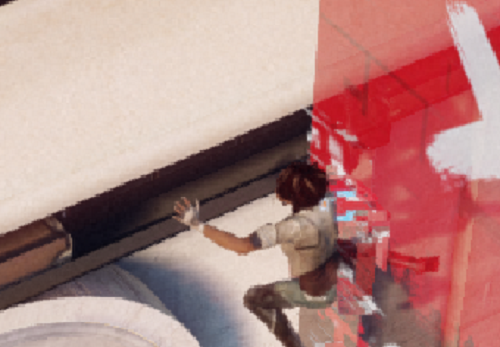
Nilin, the protagonist of the game, is climbing along some ledges in the upper levels of Neo-Paris. It is typical Assassin’s Creed and Uncharted mashup climbing, Tomb Raider-style, and my focus during the section was less on the climbing and more on the sweeping Neo-Parisian landscape that I could sometimes see in the background.

Then Nilin jumped through a sign. I made a gif–watch:

smalljump

You can also see it in this video right after the 29:00 mark.

I like this because it is the kind of realism that Robert Yang was talking about in his Let’s Play video of the first room of the first Half Life. While I enjoy the environment design of Remember Me‘s Neo-Paris, it is mostly working on the level of Yang’s broken lightbulb–when you show me the Arc de Triomph in the middle of a slum with buildings all around it, I’m supposed to feel a kind of shock and awe; it is a cyberpunk future predictive realism based on the shared genre assumption that the future will be the same but a little bit more shitty. The “realistic” feel is coming from my relation to the genre, not from how the character is relating to the environment or how the environment is relating to itself.

I’m making a (hopefully) productive link here between Yang’s video and Daniel Morgan’s rethinking of Andre Bazin’s theories of realism in his “Rethinking Bazin: Ontology and Realist Aesthetics”. The short of Morgan’s argument is this: we associate Bazin with a naive realism in film that privileges long shots and a strong indexical attachment to the physical, material world. Morgan’s intervention in the past 60 years or so of film people reading Bazin is that a close reading of Bazin’s body of work reveals that he was less concerned that naive realism and much more concerned with an internal consistency of the world. Bazin doesn’t want a 1:1 reproduction of world on film. Instead, there is a desire for a realism of relationships, of parts to wholes, of actors to actors and objects to objects.

When Nilin jumps through the sign, an event that only occurs in this one moment despite the game being filled with ledges and billboards, I really felt the internal relationships of Remember Me were being demonstrated. It was real.

I will probably have a proper review of this at some point? Who knows.

Here’s another ZOOMED IN PICTURE of the jump from the other direction.

nilin

Posted in Video Games | Tagged , , , , | 10 Comments

You Can Listen To Me Talk About Horror Games

A few weeks ago Tara Ogaick asked me if I wanted to do some kind of vlog or podcast or whatever about horror games, and after fumbling around for a few weeks we finally arranged schedules to get some words out into the air.

We played through Home and Lone Survivor (or in my case, played 47 minutes of the game and then watched a LP of the rest of the game) and then we talked about how we think the horror genre works in video games. I’m really building on my Designing Horror game series in the podcast, so you might want to check that out here.

I think I come off like a total asshole in the thing, so be aware of that. PODCASTS ARE NOT MY STRONG POINT. We also travel far afield of the topic and I end up making a weird defense of the films of Michael Bay at the end.

Here’s the link to the podcast!

Posted in Video Games | Tagged , , , , | Comments Off on You Can Listen To Me Talk About Horror Games

Leopold Lambert on the Explosion

What is an explosion at the pure physics level? A bomb is an apparatus that contains folded within itself the potential liberation of an important volume of energy in the form of an exothermic reaction. Such a volume of energy and the speed with which it gets released provoke a sudden disaggregation of the material bodies (animate or inanimate) that surrounds its center. Insisting on the suddenness or the violence of the explosion would be another anthropocentric way to consider it as it would necessarily associate the scale of time in which it occurs to the scale of time of human perception. In other words, the Big Bang could be considered as a sudden explosion at a certain scale of time even though, 14 billions years later, the universe is still affected by its original release of energy. In a materialist interpretation, the speed to which an explosion is effectuated is therefore irrelevant and such an “event” can be compared to any other modification of matter like erosion or entropy. If we define destruction by the operation in which physical bodies are being “broken down” into smaller material assemblages, we can however define an explosion as a destructive transformation of matter without being anthropocentric.

Now that we read explosion at a materialist level, we can go back to what our bodies make us, humans, and maybe for some of us even, designers. What does such a materialist knowledge (only very briefly sketched here) mean in terms of design. The bomb, as we know it, is an artifact and a very precisely designed one. In his Entretien sur la mécanologie (Interview about Mechanology, 1968) about which I will write much more some other day, Gilbert Simondon explains that a machine, in order to exist, needs to be stable i.e. that it does not have any self-destructive characteristics – he refers to the very first engines that often tended to explode. The design of a bomb, a grenade, or any other explosive apparatuses does not apply this definition as it needs to control the precise moment of its self-destruction. The latter is likely to trigger the destruction of the other material bodies around it and therefore accomplish the goal that its creator has imagined for it.

Leopold Lambert, “Designing Volumes of Energy

Go read this entire post, it is really great.

Posted in Quote Time, Theory | Tagged , , , , | Comments Off on Leopold Lambert on the Explosion

The Silk Pavilion

silk worm


The Silk Pavilion explores the relationship between digital and biological fabrication on product and architectural scales.

The primary structure was created of 26 polygonal panels made of silk threads laid down by a CNC (Computer-Numerically Controlled) machine. Inspired by the silkworm’s ability to generate a 3D cocoon out of a single multi-property silk thread (1km in length), the overall geometry of the pavilion was created using an algorithm that assigns a single continuous thread across patches providing various degrees of density.

Overall density variation was informed by the silkworm itself deployed as a biological “printer” in the creation of a secondary structure. A swarm of 6,500 silkworms was positioned at the bottom rim of the scaffold spinning flat non-woven silk patches as they locally reinforced the gaps across CNC-deposited silk fibers. Following their pupation stage the silkworms were removed. Resulting moths can produce 1.5 million eggs with the potential of constructing up to 250 additional pavilions.

I always prick up my ears when labor is being extracted from the nonhuman.

Posted in General Features | Tagged , , , | Comments Off on The Silk Pavilion