Joe Culp on Halo 4

You walk into this place and you know it’s time to put on the Vai. It’s like a crazy alien cathedral with a laser floor that you can see through. Reminds me of Lego space sets or Super Soakers in the 90s. In the 90s, everything was made of see-through neon plastic (likely hearkening back to translucent neon Forerunners of the 1980s).

As you can see, this floor is scaled tastefully back from neon into a beautiful rosy red, which contrasts nicely with the teal atmospheric lighting. The Forerunners probably designed it like this so that the player can find their way to the elevator up there. Pssshhht, yeah right! THE BOSS walks these floors; THAT’S why it looks awesome.

FOR THE LOVE OF GOD GO READ THIS.

Joe Culp writes some of my favorite games stuff.

Posted in Quote Time, Video Games | Tagged , , | Comments Off on Joe Culp on Halo 4

David Lynch on Criticism

MC: I remember when I first saw `Fire Walk With Me’, at the Cannes film festival, there were loud boos – how does the apparent failure of a film like this affect you?

DL: `Dune’ was a failure to me, because I didn’t feel I did, you know, the `Dune’ I should have done. This was not a failure to me, because I felt it was a film that I did the way I should have done it. And so we learn that we can’t control anything that happens after a film is finished, and sometimes things go well in the world, and sometimes they don’t. But if you believe in the film, and you’ve done your best, they can’t take that away from you. There’s this thing – there’s the doughnut, and there’s the hole, and we should keep our eye on the doughnut and not on the hole. Everything that happens after a film is finished is maybe interesting and it can be, you know, very hurtful, or exhilarating in certain ways, but it has not much to do with the work. And so I would like to go back to work as quickly as I can or do, you know, painting or work on music. And be separate, you know, from those things I can’t control.

thanks to this website for transcribing this whole interview

Posted in Quote Time | Tagged , , | 1 Comment

Lynn Margulis on the artifice of microbiology

The first thing to remember is that nearly all bacteria are multicellular in nature. when microbiologists put them in the laboratory, they want to grow them rapidly. They put them in pure culture — nature abhors a pure culture — and they end up selecting for single-cell existence; in other words, they select against all of the social interactions of bacteria. They select against the extracellular slime. And they end up with the freaks. Microbiologists form the worst religion of all, if you know them well, because they don’t admit that you cannot name a new bacterium without growing it in pure culture. Only if you eliminate so much of its interaction, and very often its multicellularity, will you be able to name them. Which means that many things are not named, because they are not allowed to be named. There’s so much nonsense in microbiology that was based on mixed cultures and slime and cheek cells and looking in your eyelashes for the origin of life, it’s incredible. The reason that there is no amateur group of microbiologists, like you have with the mycologists who study the shells, or the botanists who study the gardens. There is no amateur community in microbiology, so you have nutsiness cubed, because nobody can watch these people; there’s nobody with any reality orientation.

“The Basic Unit of Life: An Interview with Lynn Margulis” in The Politics of the Impure

Posted in Quote Time, Theory | Tagged , , , , | Comments Off on Lynn Margulis on the artifice of microbiology

Designing Horror: 5 Days a Stranger

After a long pause, I’ve decided to start doing these Designing Horror posts again.

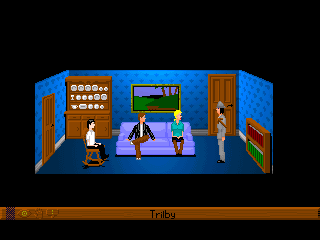
This time I played Ben “Yahtzee” Croshaw’s 5 Days a StrangerThe game is a basic point and click adventure game with some inventory management. You play as Trilby, a strangely-named and pseudoridiculous cat burglar who becomes trapped with a number of other characters in a haunted house.
1

There’s an early 20th century vibe to the game’s writing. Being a story about a haunted Victorian mansion, the game has all of the trappings of that time period. The basic plot of the game: a bog standard upper class man from the late 1900s spends all of his free time hunting and adventuring in nameless African countries. He brings a number of trophies home, including a cursed idol (he didn’t know it was cursed at the time, I guess.) His wife has twins, and according to a journal, the second is deformed in some way. She dies while delivering this child, and he chains it up in a hidden chamber. Fifteen years later he decides to kill this “monstrous” child, but the child escapes, puts on some Jason gear, and murders his father and brother.

Welp.

That’s all background, though, because the actual gameplay is the player guiding Tribly around and talking to the other people trapped in the house and being haunted by the ghost of the manacled, murderous #teen.

1.Why Is It Horror?

The central narrative conceit of the haunted house is augmented by the fact that the haunting is possessive in nature. Even though the cast of characters who are trapped in the house with Trilby is small, the fact that any of those characters could become the “monster” at any time is a source of narrative horror.

Of course, there’s a distancing process that goes on here; when I am playing the game, I know that the murderous creature isn’t going to pop out at any moment. The horrific narrative bits are all just that–narrative, rather than random or procedural, and so they’re predictable in the sense that if a conversation didn’t happen that gives context for a scary bit, a scary bit probably isn’t going to happen.

This changes the context of NPC conversations. Instead of information dumps, as they are in most adventure games, they become possible horror triggers. The content and context of a conversation alters ever so slightly when you realize that the only possibility for actually being scared in a game is if you speak to another human.

A flashback/sideways that features all of the characters dead on the floor? The end result of a puzzle being solved. The monster walking forward, slowly, bearing down on the player in the most dread-inducing scene in the game? The end result of a conversation. The design constraints of the game associate any progress forward with an inevitable march toward horror, dread, and death. Violence is progress into the future.
2

2. How Does It Work?

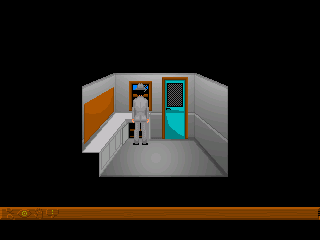
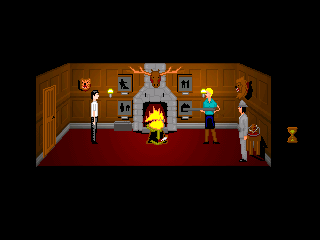
Not much to say here other than there are scary noises, musical cues for when you should be scared, and “creepy” background design that is cramped and sometimes shifting.

3. What Did It Do To Me?

I genuinely enjoyed this game, but I was ripped out of any kind of feeling when the horrific 19th century tropes got trotted out for the last half of the narrative. From an “African” totem that allows people to be possessed to a child trapped in a dungeon so long that he was “no longer human,” the horror game tropes just kept coming up over and over again. I think the politics at the base of these things are bad, and I also think that they shouldn’t be used over and over again in horror games. On top of that, I think they’re lazy, and it is precisely that laziness that pulls me out of enjoying it–you don’t have to write well if you can depend on colonial and ableist narratives that have been replicated over and over again in the horror genre. If there’s anything that this series has been about, it has been this: stop doing the same things over and over.

None of these thematic and design tropes are surprising, of course, and I will leave you with a quotation from Yahtzee about the development of the game:

5 Days a Stranger is a horror game. Was it difficult to get the horror theme across to the player?
Not really, I mean, dark corridors, murders, eerie music, funny noises, suspense… horror is easy enough to create if you follow the right rules. [x]
3

Posted in Designing Horror, Video Games | Tagged , , | 1 Comment

GIFs Made the Week of 9/30 to 10/7

skategif grind stengers

Posted in General Features | Tagged , , , , | Comments Off on GIFs Made the Week of 9/30 to 10/7

Anne Anlin Cheng on the Modernist fascination with surface

To this day, from aerodynamic teats to the glass wall, modern design and aesthetic philosophy remain absorbed in the idea of “pure surface.” Contemporary designers continually manipulate the relationship between the inside and outside of objects, garments, and buildings, creating skins that both reveal and conceal, skins that have depth, complexity, and their own behaviors and identities. Of course it can be said that all these moves to the surface are not really moves to the surface and in the end reconfirm the surface-depth binary (by, for instance, reproducing the surface as essence.) Yet I want to suggest that, for a brief period in the early 20th century, before cultural values collapsed back once again into a (shallow) surface and (authentic) interior divide, there was this tensile and delicate moment when these flirtations with the surface led to profound engagements with and reimaginings of the relationship between interiority and exteriority, between essence and covering.

Cheng, Second Skin: Josephine Baker & the Modern Surface p.11

Posted in Quote Time, Theory | Tagged , , , , | Comments Off on Anne Anlin Cheng on the Modernist fascination with surface

On The Ricky Litany

I’m a huge fan of Trailer Park Boys, and I was rewatching the movie this afternoon while I was doing some writing. Being that I was writing about the weird things that I write about, the “Ricky says fuck a lot” scene at the very end of the film tricked an alarm in my mind. Here is the scene–it is very not safe for work.

A transcript that I’ve lifted from IMDB says that Ricky says something like this:

Fuck this court. Fuck Jim Lahey. Fuck Randy. Fuck those two idiot cops right there. Fuck suit dummies; as a matter of fact fuck legal aid. Fuck Danny and Terry’s Buffalo Chicken Wings. Fuck all the old wood in here. Fuck the moon, fuck corn on the cob, fuck squirrels. Fuck me, fuck you, fuck everything!

To me, this reads a lot like what Ian Bogost calls a “Latour Litany,” named after Bruno Latour and his writing tic of placing things that are seemingly unrelated in sequence to one another in order to point out connection and (maybe more important) apparent disconnection between those things. These litanies have been used as rhetorical “proof” of a number of things in the internet spheres of OOO and speculative realism–a list of random things (dumptruck, swallow, tearduct, wheat, walrus, photon) is a very on the nose demonstration of Delanda’s flat ontology, for example.

I want to position what I’m calling the “Ricky Litany” up against the much-loved Latour Litany as a way of being totally honest about the way that I see litanies existing in the world.

First, a Latour Litany is never totally random or totally arbitrary. There is always an intentional choice being made on the writing agent who is crafting the litany, and even in the case of Bogost’s “Latour Litanizer,” the possibility space of the litany is delimited by the pages that the human editors of Wikipedia have decided are “solo page worthy.” The Latour Litany always positions itself outside of easy selection or the proclivities of the human, as “revealing” something outside of regular human experience, but that’s merely a mask–it is really specific rhetorical choice inside of the possibility space of what is thinkable to the author at any given time.

Second, the Latour Litany is always political. It is always acting. A list is never merely a list–it is a hierarchy that positions some things in relation to others while purposefully drawing dis/connections between things in the world. “Wagon wheel, car wheel, skateboard wheel, hamster wheel, scooter wheel” meets all of the bare requirements to be a Latour Litany, but it isn’t flashy enough–it doesn’t catch the eye. The drive toward the spectacular litany means that the humdrum (rather than the ironically chosen humdrum) always fails to be included. There’s a lack of a lack of excitement in the Latour Litany, and those purposeful erasures and exclusions ground a politics where philosophy work outside the human takes the shape of the analysis of volcanoes, panda bears, and hot wings instead of blue pebble, red pebble, yellow pebble.

The Ricky Litany owns up to the political agenda that the Latour Litany is forced to disavow. The addition of the verb “fuck” before every object betrays the intentionality behind the act of choosing what is included in the litany. The act of inclusion in a set is never arbitrary. It is always targeted; it is always about rhetorical use value. In addition, the Ricky Litany points to the fact that it is impossible for the speaking subject to speak outside of that subject position. The choice of objects in the Ricky Litany are not chosen from the set of all possible thinkable discrete objects in the human lexicon. Instead, they are chosen from specific histories, from the space around the speaking body, spiraling outward into everything.


Posted in Theory | Tagged , , , , , | 2 Comments

Rodney Mullen on being taught the kickflip

Tony Hawk: How did you create the kickflip?

Rodney Mullen: It was an accident is what it was. I had just learned ollies, and you know sometimes you bring it up and you get it away from you because you’re gonna get a shinner. And I just pushed it away and the board it was like slow mo and it just landed. And I just stood there scratching my head, it’s like it taught me.

Posted in Skateboarding | Tagged , , , | Comments Off on Rodney Mullen on being taught the kickflip

Nathan Altice on Fashion and Games

I don’t think I need to convince you about the videogame industry’s constant pursuit of more better processors with more better memory in the service of more better graphics which apparently translates to more better realism and somehow more better stories. But how does technology play into fashion? Fashion has a longer history than videogames, fabrics are nearly as old as humankind, and even sewing machines have been around since the end of the 18th century. Certainly RAM improvements aren’t affecting Chanel’s spring line in any meaningful way. All true—but technology is a concept we often take for granted when it settles into a quiet cultural ubiquity, when it recedes from our immediate view, like a pair of glasses, a pencil, or a hammer. Fabric, too, is a technology. Cashmere sweaters certainly do not fall off of goats, no matter whatMinecraft might lead you to believe, not to mention the extreme processing necessary to transform wood pulp into the purified cellulose fiber we know as rayon.

Nathan Altice, “Prêt-à-Jouer and Videogame Couture

Posted in Quote Time, Video Games | Tagged , , , | 1 Comment

Art Games Talk at Detroit Digital Humanities

This past weekend I gave a talk as part of a panel with Alex Myers and Skot Deeming about art games. My portion of the talk was about the history of French Pantomime and how the “debate” around art games parallels the movements in pantomime during the 19th century. I promise that it makes sense.

I will eventually put this paper up online somewhere, but for now here is the video. I start speaking around the 24:00 mark.

The person in the preview is not me. That is Skot.

Posted in Theory, Video Games | Tagged , , , , | Comments Off on Art Games Talk at Detroit Digital Humanities