Sam Stoddard on the Philosophy of Reprints in Magic The Gathering

The philosophy behind why we reprint cards is not simple. Sometimes it’s because we really like what the original card was doing and see no need to try and improve on an already strong design. Other times it’s because the card in question fits perfectly in a setting and goes a long way to making players happy. Reprints are an important part of nostalgia, and I think allowing people to use the exact pieces of cardboard they used a decade or more ago is a great thing when we can do it. It’s not always going to be the case—sometimes old cards have really wonky wording, name problems, or have some slight problem that leads us to make a new card to fit the role.

– Sam Stoddard, “Reprints in Magic Origins

Posted in Video Games | Tagged , , | Comments Off on Sam Stoddard on the Philosophy of Reprints in Magic The Gathering

Amiibo Wave 7 Review

I reviewed some new Amiibos.

Posted in Video | Tagged , , , | Comments Off on Amiibo Wave 7 Review

The Social Obligation of Fantasy

devry

We see it less now, but we had almost a solid decade of thinkpieces and academic arguments about the role of fantasy in the post-9/11 American landscape. They all land somewhere around this point: the rise of fantasy media in a post-9/11 landscape correlates to a general malaise that Americans had around realistic politics. The didn’t want The Sum of All Fears anymore; they wanted orcs and unpronounceable place names. Americans needed somewhere to offload their new kinds of anxieties, and fantasy media provided a space for mental investment that wasn’t as stressful as the constant CNN footage of a smoking hole in New York City.

Now we’re through it, or beyond it, or the politics of the post-911 world are so brutally ingrained into us that we’re no longer shocked into shapelessness by the rah rah militarism (in the domestic police version as well as the world police version) as we once were. Politics have safely returned to the realm of pure spectacle in the run up to a new election. Fantasy fiction has more power because of market inertia, but we have the distinct feeling that it isn’t because of escape any longer. Superheroes are coherent, but they’re also brutally “real world” political in a way that we can’t really imagine The Fellowship of the Ring being (at least on its surface).

I say all of that to point out two new advertisements that are plainly attempting to lure the generation who grew up in that glut of popular fantasy. The political dramas of my 1990s were, as the critics claimed, supplanted by a fantastic double aughts, and the kids who began watching films in a broad way around the year 2000 have left or are leaving high school. The ones after that are in the prime horror of their teenage lives.

These ads:

The first is a very traditional anti-smoking ad, but instead of the “hey, peer pressure isn’t cool!” of my youth, we have A LITERAL ARMY OF ORCS FLYING INTO THIS KID’S MOUTH. It’s impossible to imagine that kind of commercial in any time other than this one since the dawn of moving images. The literacy requirement is so high that breaking it down seems unbelievable: you have to understand the scene; you have to know what orcs are; you have to get that orcs are bad; and you need to be afraid of the horde itself. It requires a significant amount of overhead information about the genre of fantasy, and it buys into many of the assumptions of those generic constraints.

The first ad required literacy and some implicit ideology: you have to know that orcs are bad for it to work, which is a particular form of baggage. But this DeVry ad is so much more explicit. There are heroes and normal people, and you want to be a hero. They can train you to be a hero. Nevermind that this is a hero who will explicitly defend the hardware and software of international corporations. And who are you protecting them from? What enemy do you define yourself against as the hero?

When I was in a high school, a friend was banned from using computers in the high school for accessing the registry on his computer to try to figure out if Deep Freeze software was preventing his online course software from working correctly. The network administrator stormed into the room and began screaming at this teenager who was doing nothing wrong, and instead of listening to the kid, the administration stuck with the “responsible” admin who had clearly been surveilling this kid.

Go to school to become a lord of the digital domain who always has the Divine Right of the Network on your side. See yourself as a champion. Stomp over the weak, or the weak-willed, or anyone who couldn’t be what you managed to be.

Fantasy was an escape from one overbearing political into a more abstracted one. Americans avoided X politics and normalized Y politics. Slowly, over the past 14 years, we’ve brought those things in line with one another–the “dog eat dog” world of Game of Thrones is just as much “medieval fantasy” as it is The Walking Dead postapocalypticism. Fantasy itself has become middle of the road political expression, and all of the conservative ideology in Tom Clancy has been resurrected in Tolkien and his legacy authors.

But you can be a fantasy warrior reskinned for the coming cyberwar.

Posted in Theory | Tagged , , , | 4 Comments

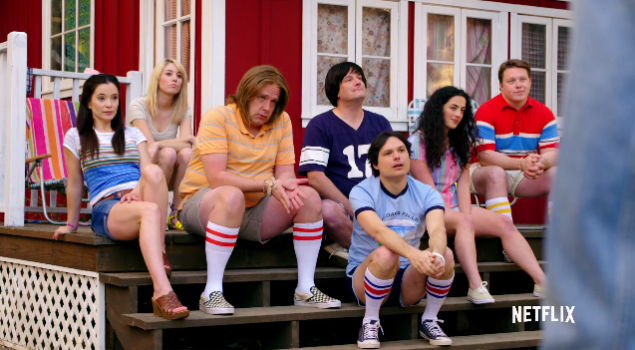
On Wet Hot American Summer: First Day of Camp

whas

I’ve been down with Wet Hot American Summer for something like a decade. I think that I might have learned about it via a weird daisy chain of really liking Reno 911, learning about the connection to The State, and then finding out about what all of the members of that troupe had done when their media deals had imploded. My best friend and I found some kind of digital copy (probably shared through illegitimate Livejournal communities), and we watched it over and over again.

I’ve watched it on and off pretty much constantly in the years since then. I’ve weathered the best and worst of the David Wain films from The Ten to Wanderlust, and there were moments when Wain’s sensibilities met a State-esque script in order to hit a high note that felt like we were back at that camp during the last gasp of summer.

So when First Day of Camp was announced, I was over the moon. It was going to be a serious follow-up that took all the gags from the original film to their conclusion. The actors would be the same, totally ignoring their age like in the original. It would be a prequel rather than the promised sequel of the film (the most Wain joke possible). They would have money, and time, and creative control.

So, finally having watched First Day of Camp as the most core of core viewers, what did I think?

It’s the same, but it’s stretched out. The joke content is all there, but it has time to stretch its legs. And I don’t know if it needs to be.

David Wain is the master of the 90 minute comedy. He hits target length, and the jokes don’t wear out their welcome because they’re coming at you a mile a minute. His strategy is always “set up a scene with strange logic and then play that logic as far as it will take you,” and generally that strange logic is literally just genre film mirrored back to itself. When Wet Hot American Summer becomes brutally parodic, it isn’t because the creative team is actually doing anything particularly out of the ordinary; they’re just producing the ordinary-as-story rather than the ordinary-as-material which inevitably points out how strange the cultural stories we have actually are.

First Day of Camp, like everything that comes out of this team, is built on that basic scaffolding. The journalist pretending to be a counselor story. The lost rock god story. The hidden military man story. The conspiracy narrative. The motley crew creating a work of art story. They’re all fully-baked genre experiences, and we can imagine each of them being deployed in the way that they were in the original Wet Hot American Summer film: each shows up in a tight two-minute scene that then recedes into time after we’ve had a laugh.

The format of First Day of Camp fights against that impulse. It rolls the plots across several episodes, and that just Does Not Work when the plot can’t sustain in that way. For example, Elizabeth Banks’ plotline is about her being a journalist who pretends to be a teenager to get a hot scoop about weird things happening at this camp. She finds out that there’s a reclusive rocker who lives in a cabin, and she helps him create his masterwork. And it’s funny in concept because this crowd is exceedingly good at purely conceptual humor to the point that the gag doesn’t need to actually exist. First Day of Camp drives forward, continually giving us the next step in the gag, and it does not pan out into anything (the rocker story does, but the journalist/mystery doesn’t). It peaks as a joke immediately and never goes beyond that initial impulse.

I think it’s a formal problem. They wanted to make the concept humor of Wet Hot work in this format, and it just straight-up doesn’t in some cases. Even when it is as its best, such as a the “sad-sack teenager is eternally sad,” it is a constraint that doesn’t seem to quite fit with the impulses of the writing team. You can tell that something that should be a three-bit gag turns into something that’s present in five different scenes across episodes, which really robs it of some punch that it could have had.

Overall, I think the show is excellent, but it drags in some small parts and I think it’s completely because of a weird mismatch between what the writing team has been doing for the past decade and what they (or Netflix) needed First Day of Camp to be.

Posted in Film | Tagged , , , , | Comments Off on On Wet Hot American Summer: First Day of Camp

A Document of Trash Talking

The video says it all, but this is a document of trash talking that I have made. It is a weird thing.

Posted in Video | Tagged , , , , , | Comments Off on A Document of Trash Talking

“Against Flow” and Beyond

seaside

Lana Polansky has written a really excellent article titled “Against Flow” and I suggest that you go read the whole thing in its entirety before reading this post. If you can’t be bothered, at least read this excerpt:

This is all well and good if we’re trying to make a specific kind of object, evoke a specific kind of experience. But more than that, it works as a kind of ideological container. “Flow” evokes a certain set of aesthetics—minimalism is readily apparent, but so are certain articulations of soft futurism, New Age-y transcendentalism, and a variety of naturalistic modernist approaches. We think of water. We think of the cosmos. We think of pure mathematics. On the other hand, it works as basically synonymous for the kind of “escapism” offered in so many F2P games, and the kind of intense, aggressive focus (or “immersion”) demanded of many “core” AAA games. Flow works both as the desired affective experience for most games, as well as an aesthetic container. How fortuitous that it finds its root not in any specific heritage of art, but in psychology.

This is the frustration. None of the games which achieve flow are necessarily, individually distasteful. The problem is that the form of “game” as we understand it currently implies an extremely limited set of subjective experiences which are fundamentally mechanistic and affectively numb. The celebrity of “flow”, among other things, in games discourse has encouraged a situation where games which are ideologically (and aesthetically) confrontational or self-aware don’t make it through any of the culture’s major value systems.

Polansky is right on the money when she’s calling out the “ideological container” of flow, and I want to take this critique slightly further than she does in her already-long-and-comprehensive essay.

When we talk about flow in game design, what we’re almost always talking about is a series of unexamined assumptions coming out of Mihaly Csikszentmihalyi’s Flow, a book that is about half study and half philosophical pondering about the nature of experience. And this latter part is sort of strange, because “flow” gets evoked as a state that can be reliably evoked through specific design parameters. There’s no shortage of Gamasutra posts and industry talks to at least get you in the ballpark of replicating a particular kind of subject state.

That’s all well and good until you start really trying to pin down the understanding of experience that the flow adherents are actually talking about. The problem with “going with the flow” as an argument is that it comes with quite a bit of baggage as far as how we understand experience to be. Some people will describe flow as a discrete psychological state where players are engaged to such a level that there are no physical or mental blockages between their perceptions and what is happening in the game. Some might describe it as a blending of one’s understanding of self into a coexistence with a game avatar in order to treat flow like a synonym for the ruthlessly nonsensical “immersion.” Still others might signal it as a state-beyond-experience that draws the human into a beautiful relationship with the beyond in a weird mimicry of the Hegelian sublime.

Flow is a concept that is so vague from conception to execution that you can fit anything under its common usage umbrella. It’s a marketing term for the design class, only a few notches higher than the fan favorite “visceral” in its ability to say nothing at all.

The over- and nonspecific use of flow isn’t really anyone in particulars’ fault. It was a wiggling concept from the beginning, and that’s an attractive thing when you’re working in as wiggly a field as game design. It has enormous breadth, and its existence as a qualitative and quantitative (without privileging either significantly) metric surely enables a designer to do some kind of theoretical work in that wiggly field without being beholden to pure data-driven design methods.

Flow is a political wedge in a lot of ways, a term that industry and designer can at least agree on, but it’s also an unstable one. The more weight the industry puts on flow, the more “wiggle” gets stripped out of it, and the more it looks like a conservative metric, the “ideological container” that Polansky so accurately identifies.

And I think it comes down to the vagueness. The more void a concept is the easier it is for power to bend it to its ends. Maybe it’s time to abandon flow altogether as a way of talking about design (alongside “affordances,” perhaps, another design theory hand-me-down term with an immense amount of baggage). Say what you will about game feel (which at least can account for purposeful friction) or the MDA model (which can deal with disconnections between the mechanics and aesthetics within the dynamic paradigm), but at least they have room for negativity in a way that the purely positivist “you have it or you don’t” flow model cannot embrace (it can tolerate it at best).

But we need new models, new ways of thinking, and not just those that come into being through the measurement of response time and the amount of sweat a player produces when shooting enemies.


Posted in Video Games | Tagged , , , , | Comments Off on “Against Flow” and Beyond

A Rifle, a Helicopter, and a Jet

I literally screamlaughed when this happened, and I thought that it was important to capture it and package it for the YouTube audience.

Posted in Video, Video Games | Tagged , , , , | 1 Comment

On “Android Whores Don’t Cry”

“Android Whores Don’t Cry” is a short story by Natalia Theodoridou published in Clarkesworld. You can read it here.

One of the things about William Gibson‘s work that I have always loved is that the cyberpunk dystopia came with a strong aesthetic move. The world might be shit and you might have to live in the trauma, but at least you can patchwork your skin or polish yourself or cut your body into whatever shape you please. The personal aesthetic is the political.

Theodoridou’s story hinges on the aesthetic, and where Gibson always has a kind of political individualism* involved in the “exist how you like” personal aesthetics, “AWDC” instead leans into growth. In this world, androids grow nacre, or mother of pearl, all along their bodies. They become rigid, they become fashion statements, and their aesthetics infiltrate the rest of society. “AWDC” is this slice of Gibson done better, and it’s an excellent experience to read a story that surpasses a great in a very specific way.

The nacre is an assertion of non-death. The world that Theodoridou has crafted is vague. We’re in a country where images of death have been outlawed. A Massacre Market exists for the sale of religious objects, photographs, films. The General leads them all, and they slaughter the students, and the only way you would know is from the black market.

It’s a weird intersection of concepts, and I’m not sure it all congeals into something coherent in the end, but I’m a sucker for a distributed narrative told in fragments from different sources.

This has been a weird conceptual summary. I like the story. Go read it.

*I’ve edited this to say “individualism” instead of “libertarianism” because it’s more specific and closer to what I actually mean there.

Posted in Books | Tagged , , , , | 1 Comment

“gameplay loot” and “story loot”

Earlier today I made a tweet that said “I increasingly want games with a ‘story loot’ versus ‘gameplay loot’ option.

I got some agreement and some comments, and it seems like most people read me as saying that I wanted more items that function as story, which isn’t exactly what I meant (although I do love that and have written about it here a little). And at that moment I could have laboriously tweeted fifty tweets or I could have written this. Here we are.

Crach_an_Craite

What I mean is that there is often a massive disconnect between how important and powerful an item is in a narrative and how important it is statistically in a game. It really isn’t the biggest problem in the world, but it is one that I find eternally annoying.

What flipped my switch into thinking about this was a moment in The Witcher III when I was given the ancestral sword of Clan an Craite, the Winter Blade. It is a big moment. Crach an Craite tells you that he cannot offer physical aid, but he can help you by handing over this sword, and in my playthrough I even had Geralt be all “no, please do not give me this.”

He forces Geralt to take it, and it’s a heavy moment, and there’s this story implication that Geralt might take this sword into battle with extraplanar enemies that destroy it for good. A sword that has lasted for generations might disappear forever.

It’s tropey and the most high fantasy of high fantasy, but it also works. I immediately equipped it and prepared to do the Big Mission that was coming up.

Then I killed some rando monsters in a side quest and found a sword that was so much better, just phenomenally better, that I had to stick the Winter Blade in my inventory.

There’s a disconnect there. It’s story loot. It drives the narrative along and helps generate some genuine affect in me, but at the end of the day it’s always going to be transplanted by gameplay loot. Story loot helps you invest in the character and the world; gameplay loot helps you mechanically progress in the game. They aren’t inherently opposites, but they are often deployed that way in the open-world games of today. That level 33 mission reward has to be more mechanically effective because it comes later in the total chronology of the player’s experience, and it doesn’t much matter if that makes sense from a player perspective or not.

These are just some thoughts, but I think I would like to see a “story loot” toggle switch in the same way that The Witcher III or the latter Dragon Age games have difficulty settings that allow you to frontload the story experience over the mechanics of the game. It should be fairly simple: if an item is a legendary, plot-bombshell piece, just lock its stats sky high. It breaks the standard mechanical progression ramp, but that would be the point: the item matters so it matters that you now own it.


Posted in Video Games | Tagged , , , , | 2 Comments

Rocket League Pro Strategies

I made a video showing off some of the best pro strategies in Rocket League. This video was super fun to make and I find it completely hilarious. Maybe you will too! Or maybe you won’t. What you will think is a mystery to me!

Posted in Video, Video Games | Tagged , , , , | Comments Off on Rocket League Pro Strategies