On Cinders

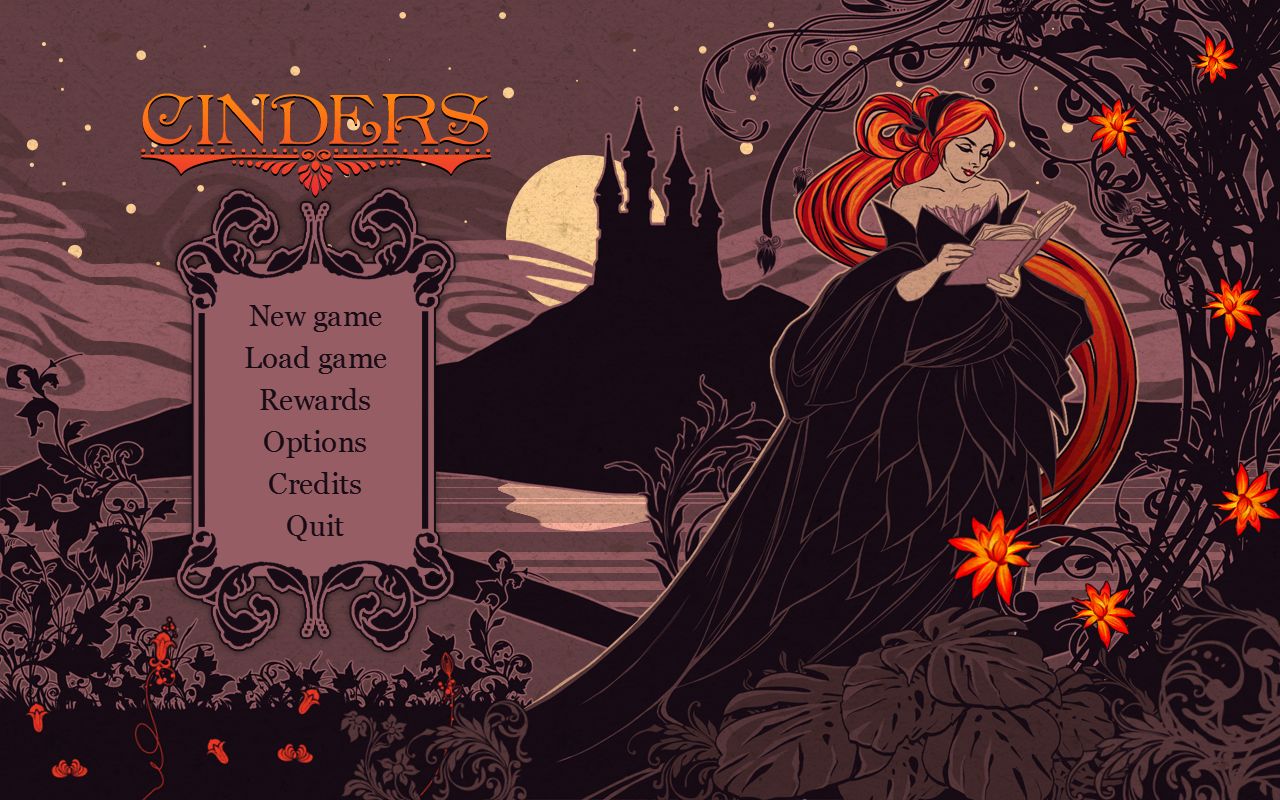
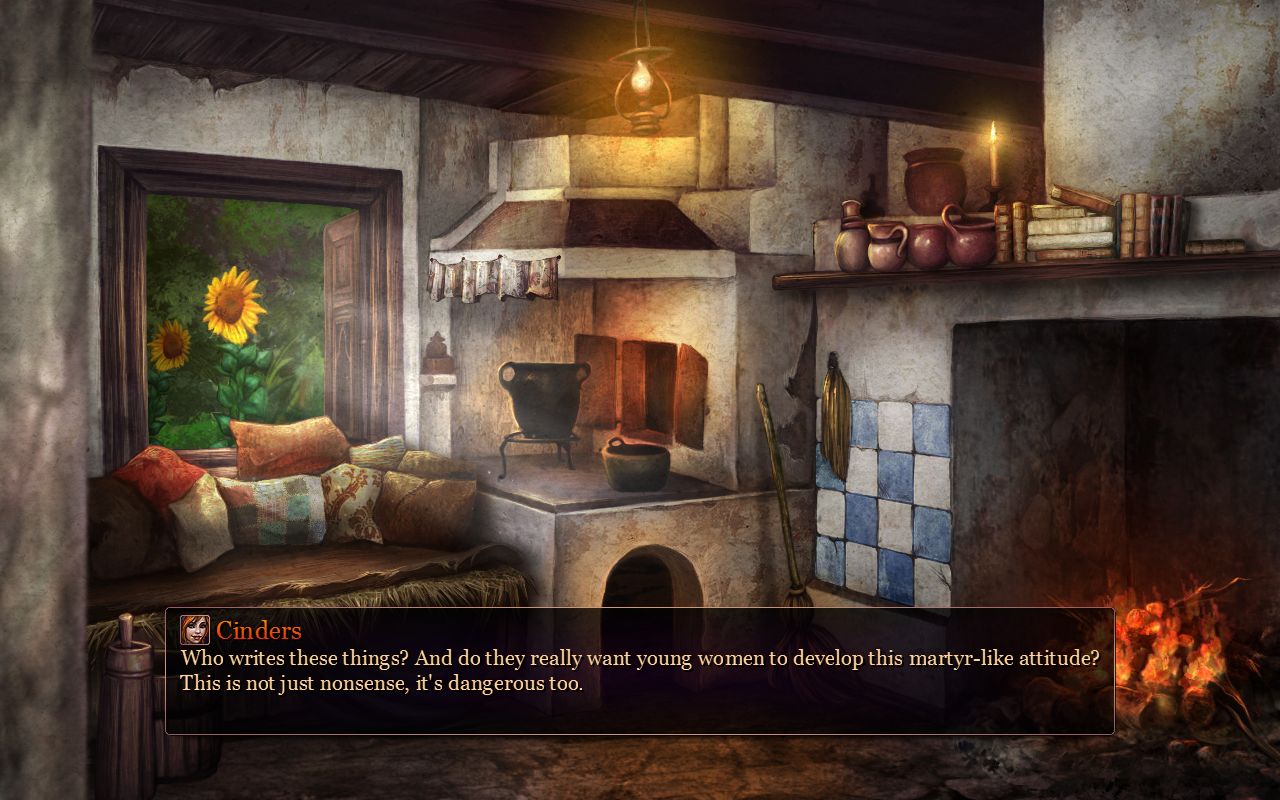
I first came upon Cinders via a Rock, Paper, Shotgun mini-article about the game. It is a visual novel created by the team at MoaCube, and for some reason, the little article (which is the same size and shape as a hundred other articles I skim through in my daily reading of my RSS feed) really captured me. In preparation for this post, I have been trying to think what separated Cinders out from the rest of the crowd for me; it must have been the art. The panel in the RPS article is representative of the entirety of the game–Gracjana Zielinska‘s illustrations really do make the visual in “visual novel” pop in a way that I’ve never seen happen in the various trailers for visual novels in the past.

It is here that I should come clean: I don’t play visual novels. Hell, I’m not even sure that the word “play” should be used for them, but what I am saying is that I’ve followed the train of visual novel popularity over the past couple years from afar (by this, I mean Christine Love’s work). Cinders was the first time that I watched a trailer for a visual novel and thought “I think this is something that I want to experience.”

So I played Cinders.

My experience with the game was thus:

I played through the story of Cinders, a young woman who is the essential character in the Cinderella narrative. Her step mother and her step sisters are all mean to her. There is a prince. There are fairies. But none of those elements met up in quite the way that I thought they would in my playthrough. My Cinders was a manipulative libertarian who did everything she could to leave the life she was living, even though that life didn’t seem to be so bad the further I dug into it. The characters who I thought I would sympathize with turned venomous; I was also able to relate with the ones who were on-face despicable. Most often they were merely pitiable. What I am trying to say here is that when the MoaCube website says that Cinders is a “serious take on a classic fairytale story,” it isn’t a mere “maturation” that equates to sex, violence, and language. Instead, it takes the Cinderella take very seriously and offers the player the ability to work through the varied problems and traumas that come with being the center character.
I don’t want to push too much on telling specifics of the story–being a visual novel, most of the tricks that the game has up its sleeve are narrative based, and there were moments where I was genuinely surprised about where the story went. I can tell you, however, that Cinders has very high replayability. I completed the game in around four hours of play, but I had only unlocked 33% of 1/4 of the possible endings to the game.

With that comes choices. Frankly, I was surprised by the number of choices possible in the game. At several moments I expected to be railroaded into a scenario, but more often than not the quick-thinking Cinders had a series of options to choose from. More than that, the choices were not presented at mere dichotomy. Often there were three or more, with some real nuance in between them. All of these different aspects to choice combine together to create a strong, braided narrative. Early in the game, the player is introduced to a visual mechanic that signals when the current dialogue and situation are reflective of a previous choice. This is shown through a tiny branch displaying in the top right corner of the screen; by the end of the game, it was just sitting up there, blinking constantly.

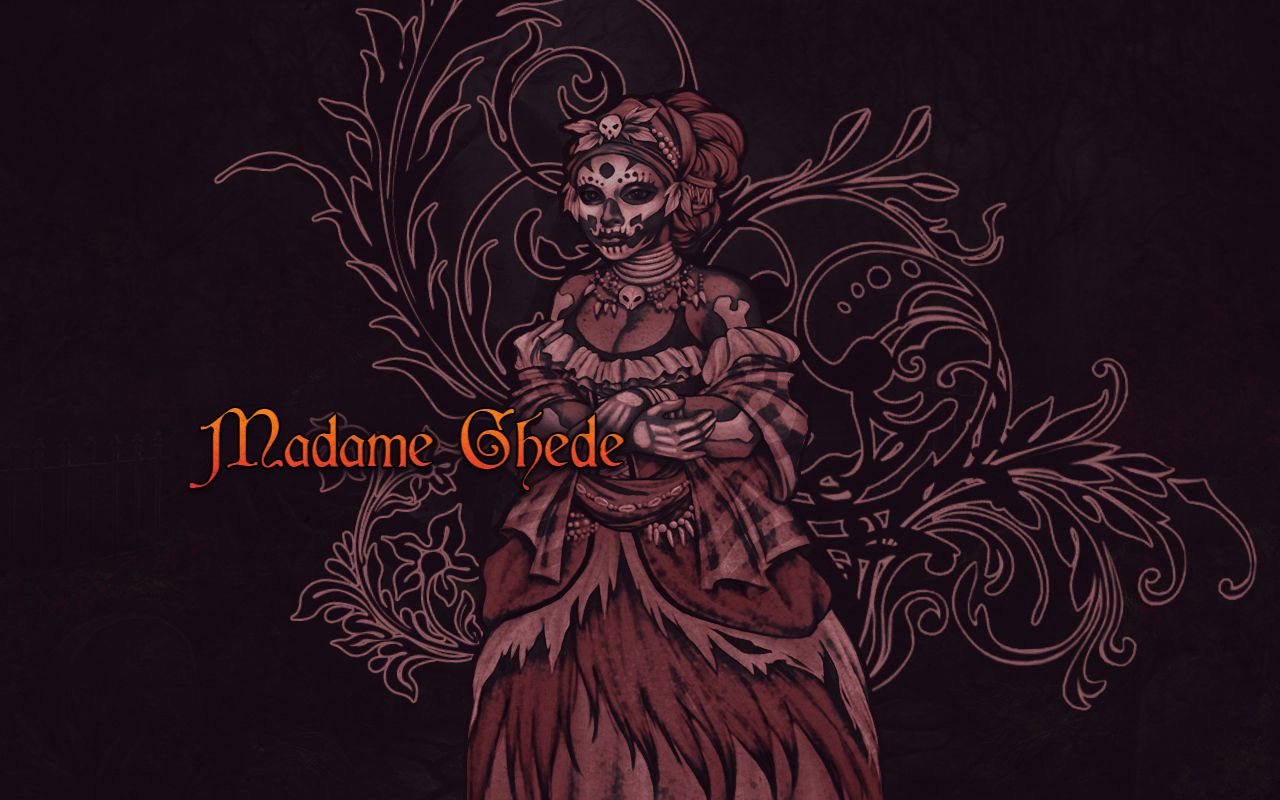
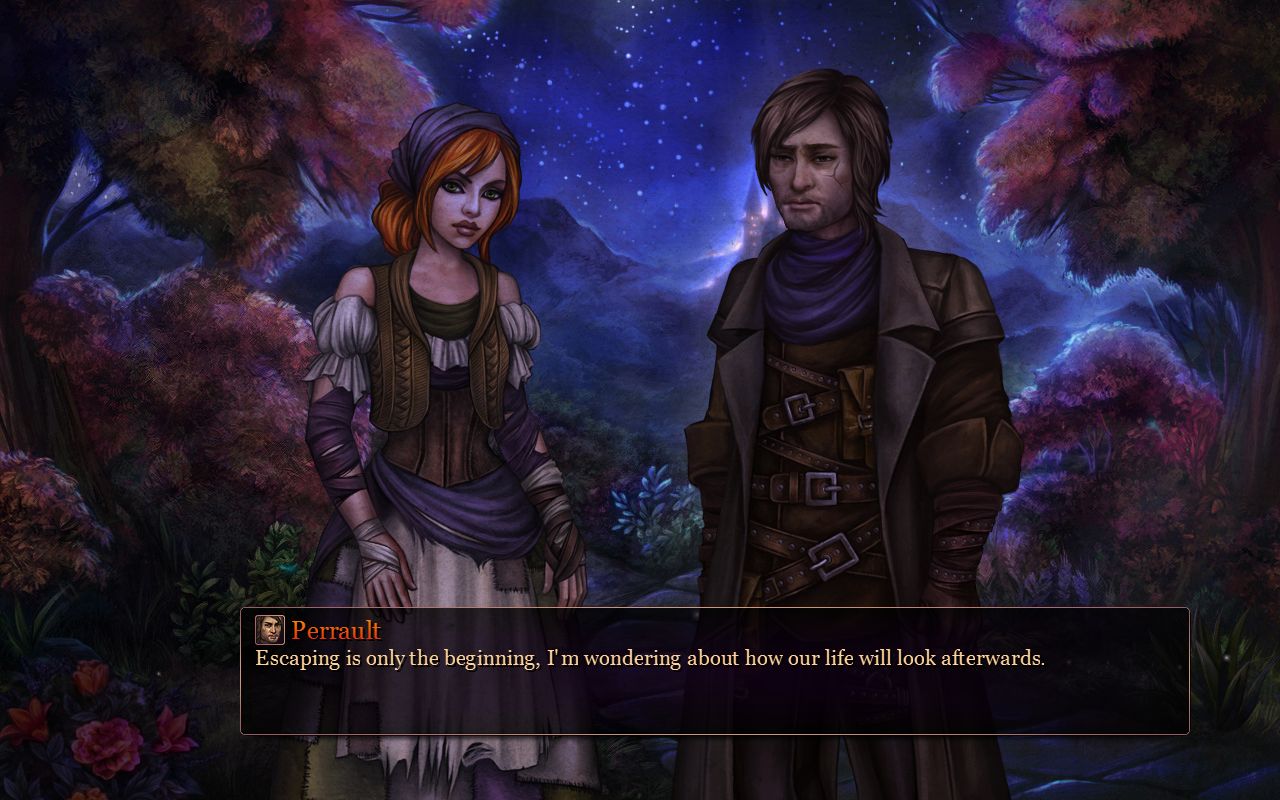
Beyond the narrative, there is the visual realm. The backgrounds and characters are beautiful, though sometimes they can be a little static; the mouths move when they talk and they sometimes gesticulate, but they mostly just stand there and pontificate at you for long periods of time. That said, I loved looking at the character designs and the backgrounds. The colors pop, and I was genuinely moved by the depth and color spectrum of the Lake that Cinders goes to often. There are, however, some weird missteps in the art: the only person of color in the entire work appears to be of African heritage and is a witch. Her face is painted in a skeletal way–she resembles early 20th century representations of “witch doctors” (and, sadly, like the goddess of the sea from Pirates of the Caribbean). Even though we are presented with the witch as a strong female character who actively works to dispel myths about normative power structure, it is still sad that the only person of color in the world is someone who is scary to the general public in the story.
Beyond these formalistic statements, Cinders also positions the game player in an interesting way. I said above that I wasn’t sure if I could call Cinders a game, but it certainly passes the most broad, shorthand definitions (I prefer Anna Anthropy’s: a game is when a player interacts with a system). Is merely making decisions enough to constitute a game? In any case, the way that the player is created as an entity in Cinders should draw interest from game critics. The player begins the game as both “inside” and yet apart from the character Cinders. I made a number of decisions for her, and it seemed that I was looking out of her eyes a lot of the time; I was able to hear her thoughts most of the time. But yet, I was not Cinders totally–she was distinct from me; I don’t say “I” when referring to her. There is a subtle balance struck in the design, and I think that it deserves parsing out by the same critical eyes who turned to Christine Love’s work.

One more note: this “being in Cinders’ head while also being distinct” makes for some weird encounters with the game world. There are stretches of time where you are reading an internal monologue in front of an empty room. In these moments, Cinders is absent from the visible world, but still encompasses all of the player’s real experience of the game world. In the empty space created by the background art, a true discovery of Cinders’ self is possible. This is contrasted with the conversations that Cinders has with the characters in the world. Painted figures dominate the landscape then, huge and domineering, taking up a lot of screen real estate. Though it doesn’t sound like it, Cinders is actually doing a bang-up job of presenting a phenomenology of communication. Those who speak and are spoken to take up huge amounts of time and space; these things even begin to swirl and focus around them like they have their own gravity. In the absence of these, personal experience proliferates. Internal narratives and the unspoken are absorbed into the character, and the player, without interruption from the outside.
Hopefully this has convinced you that there is something to Cinders. I can’t do it justice. You should buy the game. To be honest, it is pricey, and the major criticism that I have to impart to the creators is that they should charge $15 max for the game and try to get it on Steam. So I liked it, it was worth my time, and you should at least try it out by playing the demo.
Posted in Video Games | Tagged , , , , | Comments Off on On Cinders

On Cloonan’s Wolves

This post contains spoilers for Becky Cloonan’s comic Wolves. I suggest that you go buy the comic and read it here. It is ninety nine cents; being tax-free because of magical internet money, it actually costs less than anything else you could buy for ninety nine cents. Go buy it.

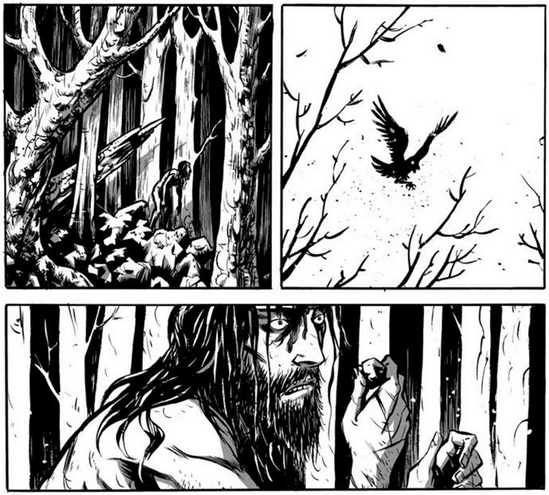
The comic is a 24 page affair. It is a simple story, a fragment of a fairy tale, without a clear beginning or an end. It is a short story in the most pure sense of what that means; it begins as close to the end as possible. It places the reader in a constant memory, a looking-backward that forces us to ask the question “What happened?” and then making us feel sad and empty for finding the answer.

The story itself is simple: a hunter, sent by a king, kills his own love because she is a werewolf. There are surface-level things that we can say about the story: it is about doing what has to be done and the pain that comes with it; it is about loss and how one deals with it; it is about carrying the dead with you forever, both literally and metaphorically.

But it is also about the reader reliving memory. I was recently lucky enough to read an in-progress essay that Brendan Keogh is prepping for an anthology. The essay is concerned with memory and prosthesis: Where does memory come from? How do we deal with the complex syntheses that are formed when diegetic memory is inserted into narrative spaces by non-diegetic actors? (It is smart stuff and I look forward to reading the final product.)

In any casecomics and video games both excel at putting us in event spaces shaped around memory–video games make us play them, but comics, through closure, make us insert them into our own memory. The combination of image and text puts the reader into an ethereal space where she is actually building the memory itself. Cloonan realizes the power of comics here, and her storytelling techniques serve this memory implantation: short, declarative sentences combined with moving, ethereal images of closeness and comfort jar against repeated shots of blades and violence.

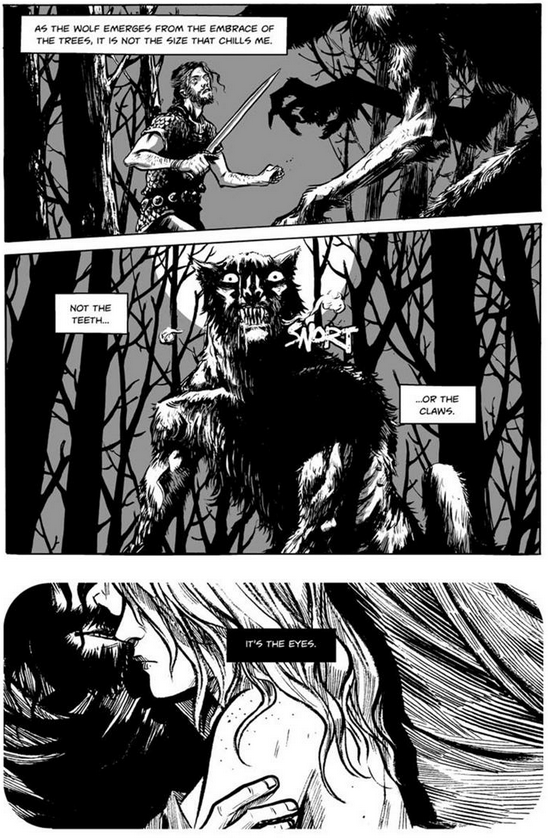
I think this page is one of the most beautiful I have ever seen in the comics medium. The top panel is separated from the middle by a slightly diagonal line–it signals that things are abnormal, that this is not a normal hunt, but something more terrible. The werewolf’s eyes, wide and staring at us from the center of the page, draw us into them. The use of white and black there is pure genius work. The whiteness of the moon, like a halo, contrasts with the black face; from inside the face, the eyes gaze out. The third panel drives it home with the inverted colors of the text box and the obscuring of the eyes of both male and female.

It is important to notice that the first two panels are a memory and the third is a memory-inside-a-memory. The reader is creating the chronology of the first two panels-there is a man and a quick cut to a monster who is dominating both the man and the page. But the third panel forces the reader into an act of memory; on the previous pages, what did her eyes look like? When I read the page, I thought hard, and couldn’t remember, even though it was mere seconds since I had read the previous pages of the comic. Both the memory of the character and the memory of the reader is drawn into question, and complicity, with the comic.

I think that is beautiful and brilliant.

So read Wolves. It costs as much as half a cup of coffee or a bag of Cheetos.

Posted in Comics | Tagged , , , , | Comments Off on On Cloonan’s Wolves

On Crogan’s Gameplay Mode: War, Simulation, and Technoculture

Patrick Crogan is concerned with the future. First and foremost, he is concerned with how the future is created, and more importantly, he is concerned about the myriad ways that high tech society has developed to control the future. Gameplay Mode is a tracing of the genealogy of computer games to their roots in the post-WWII Cold War technologies that deployed simulation as a way of understanding the possible conflicts of the future. Additionally, Crogan argues that this isn’t merely a history, but a present as well; simulation technology in video games informs ways of making war just as war continues to inform the construction of video games (I think about the Black Ops 2 advertising campaign).

Crogan latches onto Paul Virilio early and deploys his thought and concepts often in Gameplay Mode, often to brilliant effect, most particularly when Crogan analyzes the logistical mode that simulation often works in. Logistics, in its root sense, is concerned with organization and war. This organization is not limited to troops and strategy, but also food trucks, medical supplies, and mail systems of support. The art of logistics is the art of a complete management of all possible parts of an assemblage that makes up a conflict.

Simulations, in broad form, serve the purpose of logistics. They create populations who are deep in conflict before the conflict begins; they generate data for mapping an unmappable future; they create predictive models for decisions to be based on. Simulations are necessary for neoliberalism to exist in that they can continually produce a space to be colonized; a population can be mapped as anything the simulator wants–free markets are made not out of empirics, but out of possible, simulated futures.

While the book is ostensibly about video games, games are really only a touchstone for understanding the broader critical project that Crogan is embarking on, which is a reading of Bernard Stiegler combined with Virilio in order to understand the concept of “the future.” It is brilliant writing, and if you care about the ideological and material conditions from which video games sprung from, it is necessary reading. There are too few books on the subject. This one is masterfully researched and written. That said, it is hard to read, and I really had to buckle down and struggle through some of the chapters–Crogan selectively provides background to terms and concepts. Sometimes there will be ten pages of literature review on a concept; sometimes you get nothing.

That said, I want to write a little about some of the motivations for simulation. Crogan outlines that training and mapping are reasons for the development of simulation–fighter pilots had to be trained quickly; the battlefield had to be understood broadly so strategists could understand the conditions of victory in any given battle.

What I want to touch on, for just a moment, is secrecy, a concept that is never really discussed in Gameplay Mode. 

Secrecy seems like it would be a critical point of creation for simulations. Simulations, like experiments, are a mapping of the world–experiments tell us about actual conditions where simulations tell us about possible conditions that are accurate insomuch as the programmer of the simulation has included all possible scenarios of the “possible.” An experiment on the level of the kinds of things that we simulate–war, mostly–is impossible in secrecy. In the Cold War, an era that began with spies and moles and ended with rockets and satellite imagery, the only way to keep the modeling of a war secret would be to simulate it. And keeping this model secret it important–it is a nation’s specific view of the future; if an enemy had access to your planned future, they could nullify it.

The purpose of simulation is to keep something small, secret, and safe (just like Gandalf would.)

Gameplay Mode is a good book. Buy it and read it.

Addendum: after I wrote this post, it came to my attention that the USS Iowa is going to be used as a space for gameplay. Deep in the belly of a battleship you will be able to simulate playing a game. Polygon explains:

The ship’s below-deck digital theater will drop museum-goers into a virtual video experience from the bridge, recreating the ship’s role in supporting the American landings at Okinawa in 1945. The virtual recreation, which will include the turrets and 16-inch guns tracking and firing at targets, was created by Wargaming America, the U.S. arm of Wargaming.net. The developer is responsible for World of Tanks and the upcoming World of Warplanes and World of Battleships. Perhaps more interesting is the game room that Wargaming created on board the ship. The 15 gaming stations will be running a special version of World of Warplanes, letting visitors fly Grumman F6F Hellcats as they defend the USS IOWA from attacking Japanese Mitsubishi A6M Zeros.

For Crogan, this is the logical end of the technoculture and the technology of war; these things, which were never far from one another, interact and combine in odd ways these days.

Posted in Video Games | Tagged , , | 1 Comment

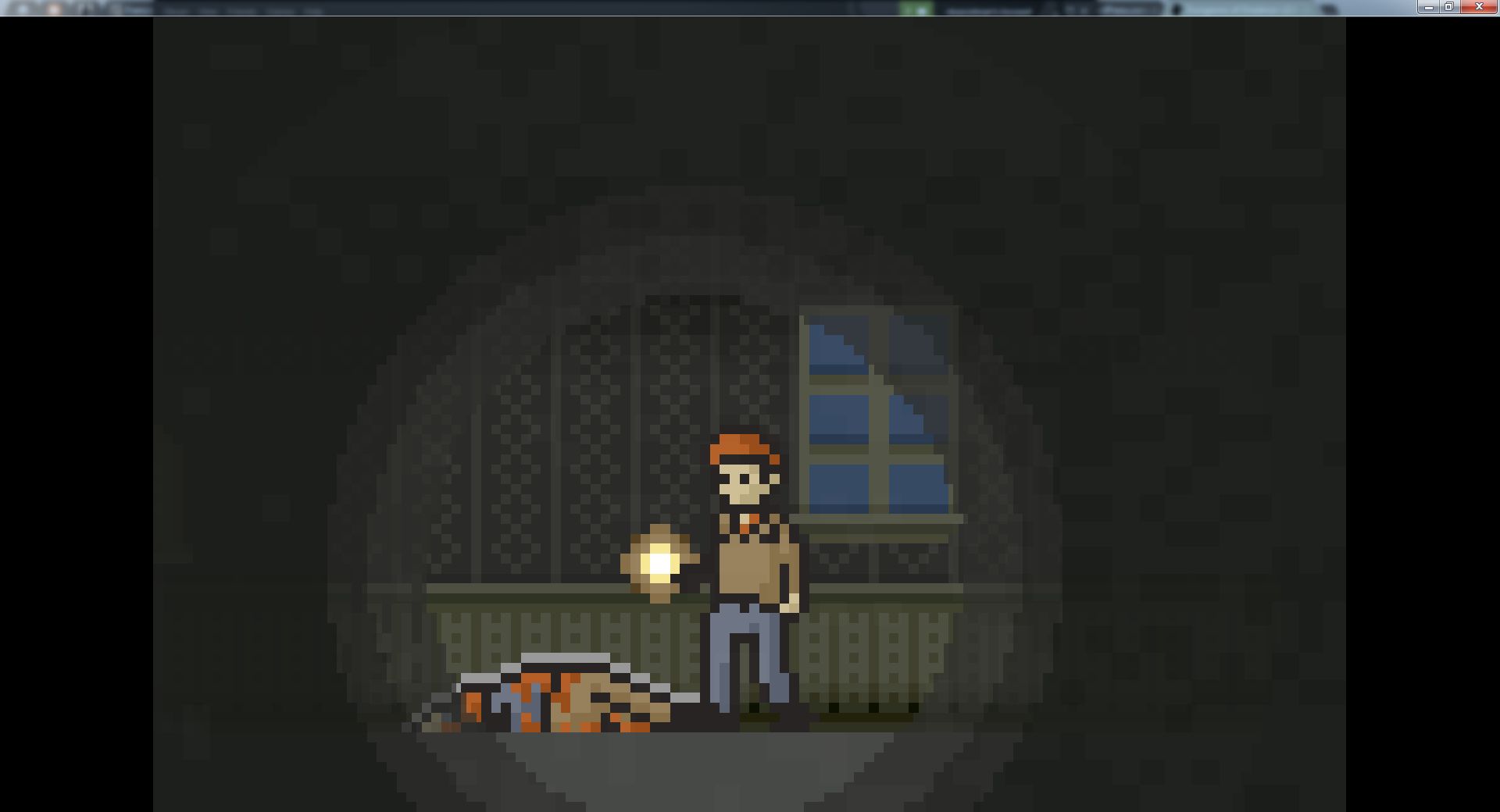
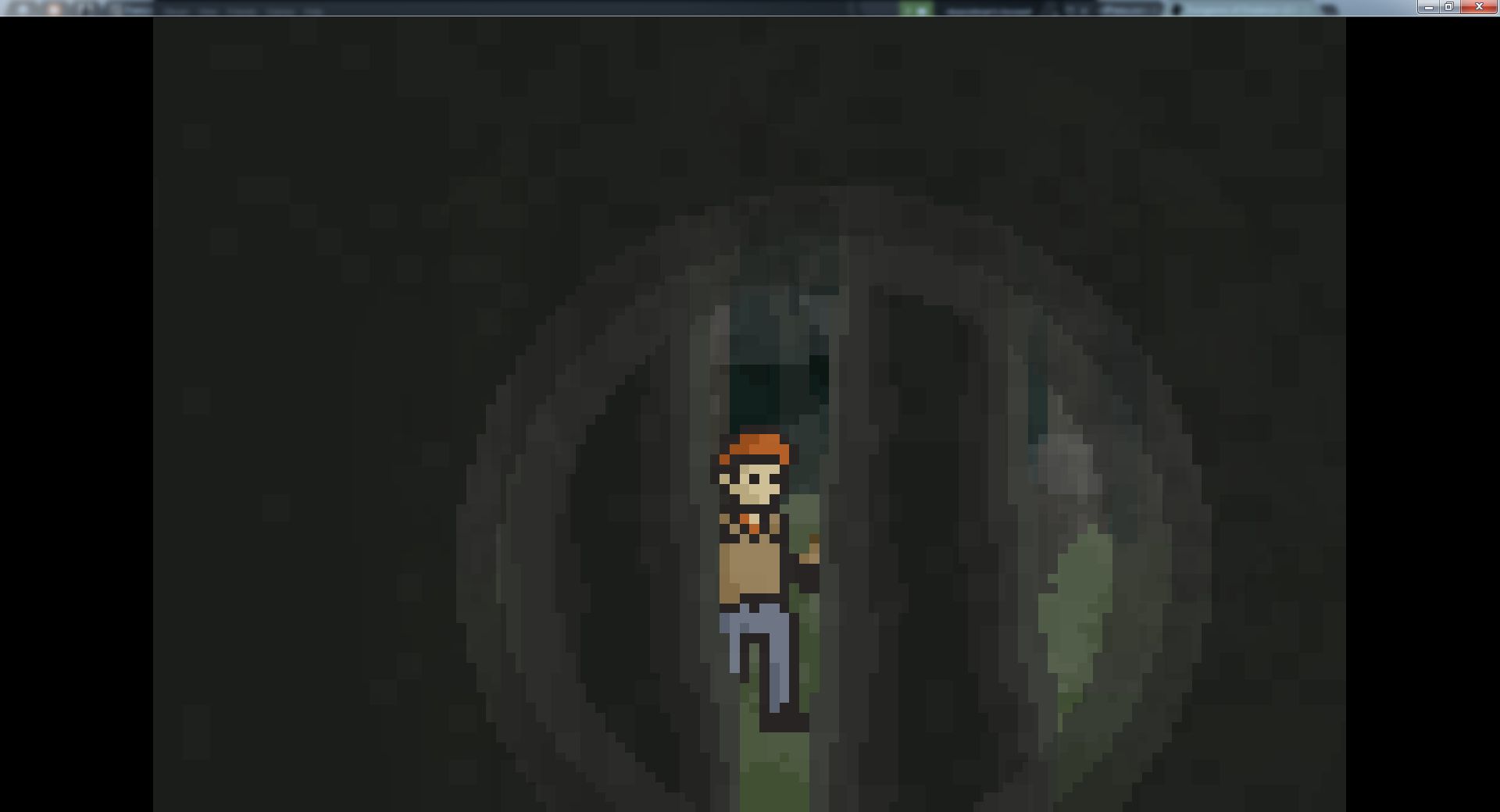
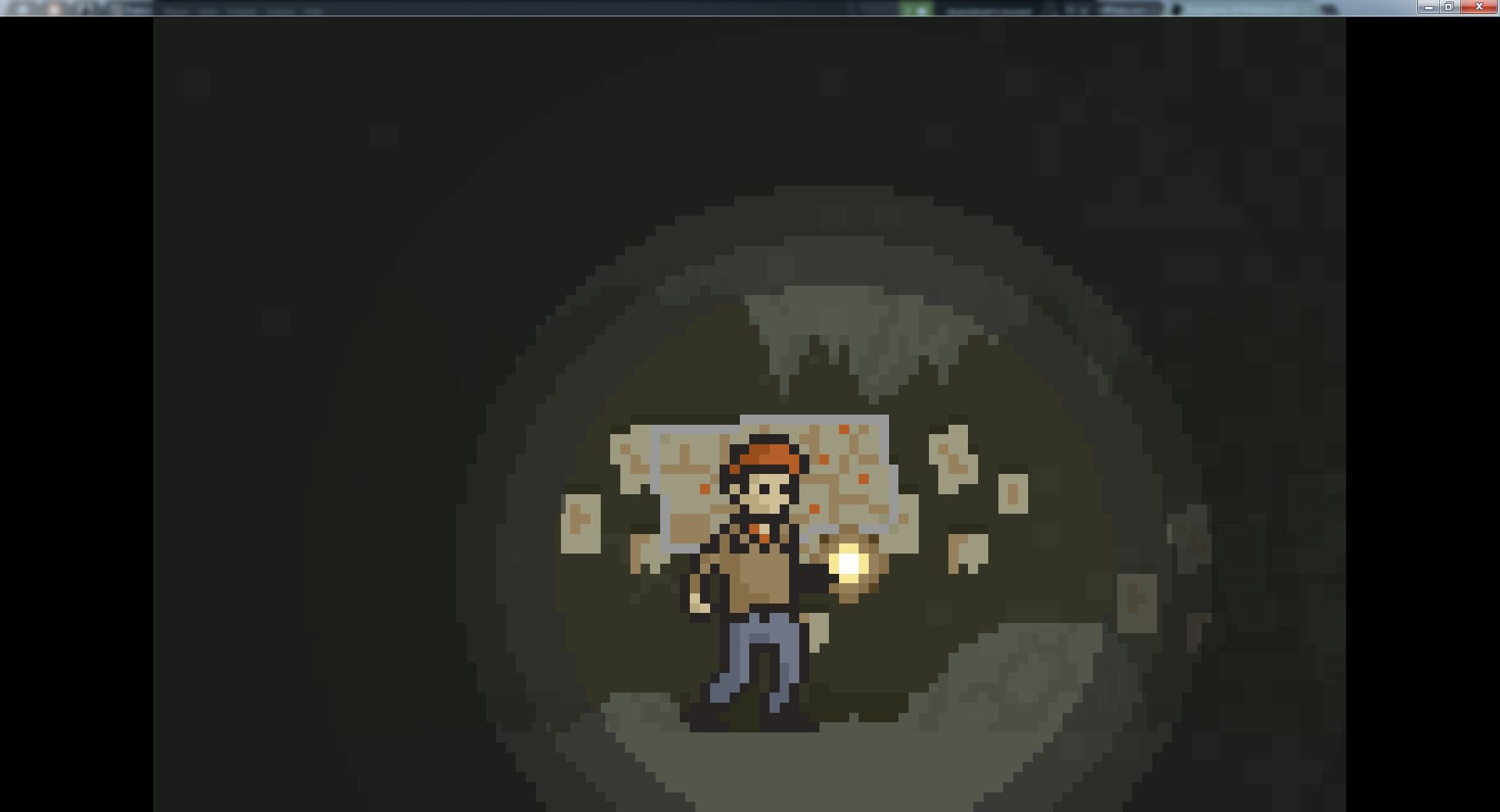
On Home

I didn’t like Home.

There are lots of reasons that I didn’t like the game, and in my traditional “look, this is where I’m coming from” preface to every post, I want to tell you these things: I enjoy survival horror games. I enjoy adventure games. I understand where Home is coming from. I understand its video game genealogy.  It is also a short game, and since I’m digging on short games so hard right now, I thought I would pay my $2 and play Home.

The game begins, like so many other horror games, with the player character waking up somewhere that he doesn’t recognize (and it is often a he, sadly.) By walking through hallways, the inevitable sewer, and being a witness to the invariable garbled video tape and dead body, the player character comes to some kind of peace with the world he is in. Cue credits.

I just described the plot of so, so many horror games, and Home is no different. I would speak more specifically to the points of the game, but I don’t want to spoil it for those who still want to play it. The game is so short that giving out even small amounts of the plot would be giving away a small part of the story that someone might care about.

The draw of the game is based in the combination of the pixel/retro look, the horror genre, and the story itself. As the copy on the Home website says:

Awakened by an oncoming storm, you open your eyes to discover yourself in a strange, dark room—tucked away in a house that’s not yours. As you play the game, it changes—subtly, almost imperceptibly—to reflect your perspective. It’s a horror game unlike any other, and as you’ll discover, its truths are entirely subjective.

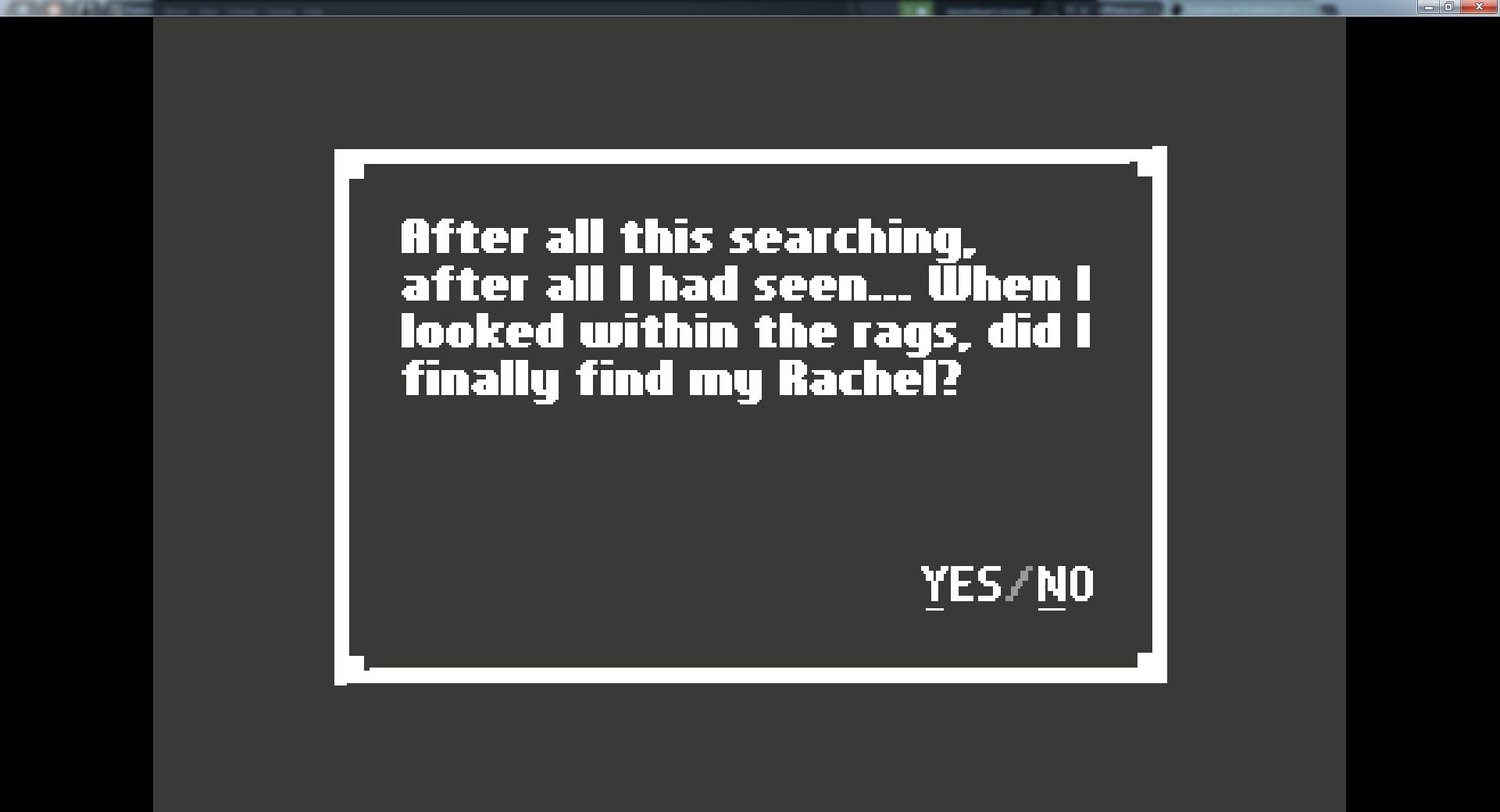
The “changes” in the game seemed mostly blunt to me, with the actions that change the course of the story being clearly telegraphed to the player so that she can make the “right” decision, or at least one that makes sense. The “subjective truths” work in the same way. There is a point in the game where the player is asked, via [Y/N] prompt (spoiler here if you want to see), if she thinks that certain events happened or not. The ending monologue to the game (which feels like a cop-out in a lot of ways) is directly influenced by your answers to these questions.

GLTCHD ran a preview of the game, and talked about the dynamic ending of the game as “meaning Home could be the genesis of some really exciting “what happened to you?” type discussions post-release.” Coming out of the game, I can’t imagine I would care about how other people ended the game. Subtly allowing the player to influence the narrative of the game is different than allowing the player to very clearly decide how the game plays out; the former is like dancing with a partner, while the latter is bludgeoning with a hammer. There’s no grace in it.

Beyond that, there are basic issues with the game’s programming that shouldn’t have made it into the final release. The final monologue contained references to things that my character did not see or do, and there were multiple spelling and grammatical errors in the text boxes that the player is constantly assailed with.

That said, there are some things I enjoyed about the game. I did feel real tension initially, and I do think that the text boxes, which cover the screen and force the player to read them, are a good innovation for this style of game. It evokes silent films–I like that.

So I didn’t like Home, but you can always check it out for yourself.

Posted in Video Games | Tagged , , , | Comments Off on On Home

Getting Some Clarity on Prometheus

I watched Prometheus this last weekend. I liked it a lot, a whole lot in fact, and because of that I have decided to do a write-up on some of the most confusing parts of Prometheus and its connection to the larger Alien franchise. This isn’t a comprehensive review or analysis of the film–that will come later, I assure you. Instead, this is more like a personal FAQ; it is a way of getting all my facts straight so I can talk about Prometheus in a different way, later. It is also for everyone else–lots of questions about the film are answered inside the film itself, but they take a little work to get through. This is the fruit of a day’s research on Prometheus.

THERE ARE SPOILERS FOR THE ALIEN FRANCHISE AND PROMETHEUS BELOW

1. Does Prometheus take place on the same planet as Alien and Aliens?
No. Alien and Aliens take place on and near LV-426. Prometheus takes place on LV-223, a distinct and different planet.

2. Is the black goo that the Engineer at the opening of Prometheus drinks the same black goo that the crew of the Prometheus discovers later?
I believe so. The Engineer at the opening of the film drinks a substantial amount of the black goo. The Engineer’s body immediately begins to dissolve, breaking down on the level of DNA and then recombining with other bits of whatever in the water to make human DNA. The black goo that the crew of the Prometheus finds on LV-223 has different apparent characteristics, but has the same long-term result. The black goo dissolves the Engineer because of the massive amount that it intakes, but has the same result that we see later–it fundamentally alters the Engineer, morphing it radically on a genetic level. We are not shown the same level of exposure in any of the members of the Prometheus’ crew; Holloway ingests a tiny, tiny spot of black goo, which makes him violently ill and is obviously turning him into something other than human. Interestingly, when we see Holloway being carried back to the ship after collapsing, the same black “rot” is moving throughout his body that we saw in the initial stages of the Engineer’s decay at the beginning of the film. So what can we say about the black goo? It takes up shop in a host and mutates toward a specific form. The geologist character, who collapses in goo, goes through a process of skull lengthening and increased size–a kind of proto-xenomorph.

3. How does this film connect up with Alien?
This works in a couple ways. The ship that takes off from LV-223 is clearly the same style ship that is found by the crew of the Nostromo in Alien. Another explicit connection is that the antechamber in which the black goo is initially found has both a green shrine and a giant carving/mural that is clearly an Alien-style xenomorph. These connections are apparent, but there is a deeper connection. During a credits sequence in Prometheus, we are shown a small xenomorph emerging fully from the body of the dead Engineer. Its physiology is different from the Alien film xenomorphs–it has a more angular head, no secondary internal mouth protrusion, and is slightly skinnier. From my reading online, the attempt by many has been to explain how this xenomorph reached a ship that then crashlanded on LV-426. Instead, I think the focus should be put into context. The xenomorph bursts out of the Engineer after being implanted by the fully-grown Trilobite that Shaw “gave birth” to earlier in the film.
There isn’t a lot to be certain of here, but I am going to venture out on a limb here and say that the sidestep of Shaw’s pregnancy, the Trilobite, and then the Trilobite implanting the xenomorph into the Engineer is just ballet. I believe that the black goo, when ingested in small doses, creates an implanting creature–a creature who, morphologically, is equipped to invade the orifices of other creatures and reproduce in their bodies. Facehuggers and the Trilobite are these kinds of creatures. What is then born from that implantation–the traditional xenomorphs–begin their own life cycle, with the egg-laying queens coming from that. As the android David says in the film, “sometimes to create you must destroy.” The act of “creating” the xenomorph species is one of systematically corrupting other species and then bringing the xenomorph out in a multiple-stage process.
It also gives us some interesting things to think about–the giant xenomorph mural in the room with the big head means that the Engineers knew that xenomorphs are the end result of black goo “insemination.” It also makes sense why the xenomorph that comes out of the Engineer at the close of the film is similar, but not quite the same, as one that comes out of a human–the Engineer DNA and human DNA are a “match,” but obviously there are differences in the two. That would mean that combinant DNA, like what the xenomorph comes out of, would be very close but not 100% the same.

4. Where did the eggs come from in the ship that crashlanded on LV-426?
An in-flight problem occurred. The black goo got out somehow, made it to full xenomorph status, and infected all of the Engineers on the ship. The fact that the Space Jockey is “chest bursted” implies that that particular Engineer knew that he was implanted with a xenomorph and crashlanded on a barren moon to prevent a larger contamination that could occur if the ship drifted through space for untold millennia. It also explains the lack of xenomorphs or a queen on the crashed ship–since there were not other hosts on the planet, those creatures would have died, but the eggs could have stayed viable. The xenomorph similarity to viral actors is important to think of here–viruses can render themselves dormant for extended periods of time in cold temperatures.

5. What did David say to the Engineer after the Engineer woke from stasis?
Unless the director or the script writer tells us explicitly, there is no way of knowing. David speaks in a fictional language, and people have tried to parse what he says here.

6. Was the black goo a weapon?
I didn’t think it was to begin with, but as far as the audience is concerned, it is. It is probably something much bigger, programmable, and outside the ken of human knowledge (that’s my critical take on the whole thing.) But yes, as far as it matters, it is something that can be deployed as a weapon. Additionally, apparently Ridley Scott, in speaking about the ship from Alien, has said that it was a kind of “bomber.” So while the black goo might not totally be a weapon–it seems to have other applications–it certainly can be used that way.

7. Why are there so many plotholes in this movie?
I don’t think there are plotholes in the film. There are definitely gaps, and I think that most of them are on purpose. Not being told something by a film is not the same as a plot hole. As Damien Lindelof, the scriptwriter, said in an interview with Popular Mechanics:

We wanted to be purposefully vague, [but steer] the audience towards some conclusions as to what that stuff was supposed to do: Is it supposed to kill you? Is it supposed to transform you—which seems like the most obvious choice—and to what end? Like, why in God’s name would the engineers want to create abominations out of mankind? Some of these questions we wanted to answer directly and some of these questions we didn’t want to answer directly, which sets you up for a certain level of frustration and disappointment that I am well familiar with, but I’ll take it any day of the week because I also feel like it forces you to fire your own imagination.

Obviously, there is more to say about the film, but these are my answers to some of the lingering questions about the film.

Posted in General Features | Tagged , , | 1 Comment

Why Short Games?

As you might have noticed, this blog hasn’t really been “up to par” over the past couple weeks. I’ve been, at best, doing reviews and sharing links. There’s nothing wrong with that, I guess, but that isn’t what I normally do. The only explanation that I have is that post-graduation and post-move, I really just wanted to turn my brain off, churn out content, and play silly video games for a while. That isn’t fair to my noble readers, all fifteen of you, and so I want to talk about why short games have such an appeal to me.

A quick list of all the games I have played over the past few days:

  • Limbo
  • Bastion
  • Team Fortress 2
  • Dungeons of Dredmor

Out of these four, I have completed three (I am including TF 2 as “completed” since I have played lots of full matches).

A quick definition: when I talk about “short games” here, I am talking about games that can be beaten within ten hours. That isn’t purely arbitrary–a ten hour game can be marathoned on a Saturday by people who sleep normal hours. Twelve hours is certainly too much, and the 18-hour play sessions that people go on after big releases like Skyrim are purely impossible for most people.

Of the list of four above, two are gameplay-driven and two are narrative-driven, and they each provide access to something interesting.

1. Narrative-driven short games

In my mind, the comparison of a narrative-driven short game to a short story is accurate. Some evidence of this is the fact that Kurt Vonnegut provided a list of eight rules for writing short stories, and all of those rules apply to the best short games. There is a way in which the short game needs the player to “buy in” to the fiction that is already at hand–suspension of disbelief reigns heavy in a short game. As Vonnegut writes, we have to immediately understand the motivations of the player character in order to have any bond with her. Additionally, since the short game/story often begins in medias res (or as Vonnegut puts it, “as close to the end as possible”), we need to understand a desire for continuing to the end of the game. What I am saying is that a player must immediately know “why does it matter?”

These reasons don’t always need to be understood fully, though. Take the opening of Bastion as an example:

Proper stories supposed to start at the beginning. Ain’t so simple with this one. Now here’s a kid whose whole world got twisted, leaving him stranded on a rock in the sky. He gets up. Sets off for the Bastion, where everybody agreed to go in case of trouble. Ground floats up below his feet as if pointing the way. He don’t stop to wonder why.

The story and the gameplay become enmeshed here–the ground floating up and pointing the way serves the plot because it provides a clear path for the player to move “forward” on. The narrator fills the player in as the game world itself is completed, explaining that the goal is making it to the Bastion. Gameplay and narrator craft a path, and ultimately, they make a full narrative together. The meshing of the two are also important when we consider Limbo, a game with no narrator or cues to tell the player what is going on.

The narrative in Limbo is purely based on the player’s knowledge of side-scrolling games. It makes no apologies about that. You understand, intimately, that you need to travel to the right, and it is only at the end of the game that a puzzle actually uses “going to the left” as a solvency mechanic. In that way, the narrative of progression, of achieving something that the player/Boy is striving for, is based on removing the obstacles that would prevent you from traveling even further to the right. It is brilliant game design–where Bastion takes the moment to get the player situated in the world, and thus making sure that she is comfortable, Limbo merely presents the player with a situation and allows her to react in the way that she is trained to act in a 2D sidescroller–travel to the right.

Bastion puts the player “as close to the end as possible” by placing them in a world where the only possible way of existing is listening to the narrator, paying attention to the actions of the world that are currently going on, and then progressing from there. Limbo takes us even further toward “the end,” cutting out the narrator and the creation of the world, and reducing player action to going right at all times. This structure underneath the aesthetics of each game is the same as the strong, silent cadence of Hemingway or the verbose, note-laden writing of Wallace. It is a way of constructing the very experience of taking in the game in order to bring the player closer to the end of the story.

And that might be a special power of short narrative-driven games as opposed to short gameplay-driven games. There is a story and getting to the end of that story is important. In the same way that “Hills Like White Elephants” just kills as a short study in melancholy and abuse, both Limbo and Bastion are small experiences that show facets of the diamond that is loss and redemption. The short game, in trying to tell that story, is forced to enmesh ludic and narrative elements in order to give a full game experience in a short time. Because of that, it might be more powerful that large-scale epic story games (I can think of all the complaints I have heard about Skyrim‘s ending being pretty anticlimactic.)

2. Gameplay-driven short games

It is rare for me to be sucked into an arcade-style or pure gameplay game, but when it happens, it is some rough stuff. I get competitive and weird.

But Dungeons of Dredmor and Team Fortress 2 don’t do that to me. I don’t get competitive or weird about them, and I don’t get particularly involved. In my mind, I play them to fill up time. They are both good thinking games, not because they make you think, but because I can play them and turn my brain off completely. I can work through other issues while playing and there is zero consequence to ALT TABing out of either game and jotting down some notes or writing a blog post on something I just came up with.

I have to admit, though, that there is some valorization going on when I play those games. Coming out of a hard situation in a roguelike is a special feeling, and I have had my fair share; the same goes with blasting a bunch of comedic enemies who are attempting to do the same dumb and pointless goal that you are. There is something valuable about losing the self in these game, about annihilating the thinking brain in favor of muscle memory and pure adrenaline. I don’t use a microphone, of course, and I listen to music over the sounds that the games make. They are purely technical adventures for me; I move about in a pure ludic environment, striving toward a goal.

I compared the narrative-driven short game to a short story; the gameplay-driven short game is a haiku. It takes all of our energy. You don’t leave it feeling changed or emotionally involved, but you do have a smile on your face, a spring in your step that came about because of a certain way that elements worked together to make the whole thing enjoyable.

This section really isn’t very long compared to the first one.

CONCLUSIONS

I just needed some way to separate these broad claims at the end from the numbered point above.

I’m not trying to become embroiled in narratology vs ludology here. That ship has sailed–good games deploy both as strategies for pulling a player into a world. Short games makes us reframe the debate a little bit, though, because of their pointed nature. They are short stories and haiku. They are violent insertions into lives–they don’t take much time, but they do radically alter our immediate existence in time and space. I was enthralled with Bastion–I sat in front of my computer from start to finish. Team Fortress 2 will pull me in for a match or two at any time, and normally it is when I am supposed to be working.

The point I am trying to make is that short games are different from your standard long-form video games. They transgress, in small and large doses, into your life. They want to integrate themselves into your workflow. That is partially why Facebook games are so damned violent–though they weasel their way in through a demand for constant maintenance, rather than the narrative or ludic devices that that games I have mentioned above. iPhone games, too.

We need to theorize these games. They need to be properly thought through. Not merely aesthetically (Limbo‘s aesthetics) or narratively (what does Bastion‘s story tell us) or purely ludically (what makes level design in Team Fortress 2 so good), but rather temporally. I’m not sure we need more online essays about the 50 hour RPGs, five game long series, or handheld games you have to play three times to get the right endings.

We need to look to short games–that is where the next generation of gamers is going to come from.

Posted in Video Games | Tagged , , , , , | 1 Comment

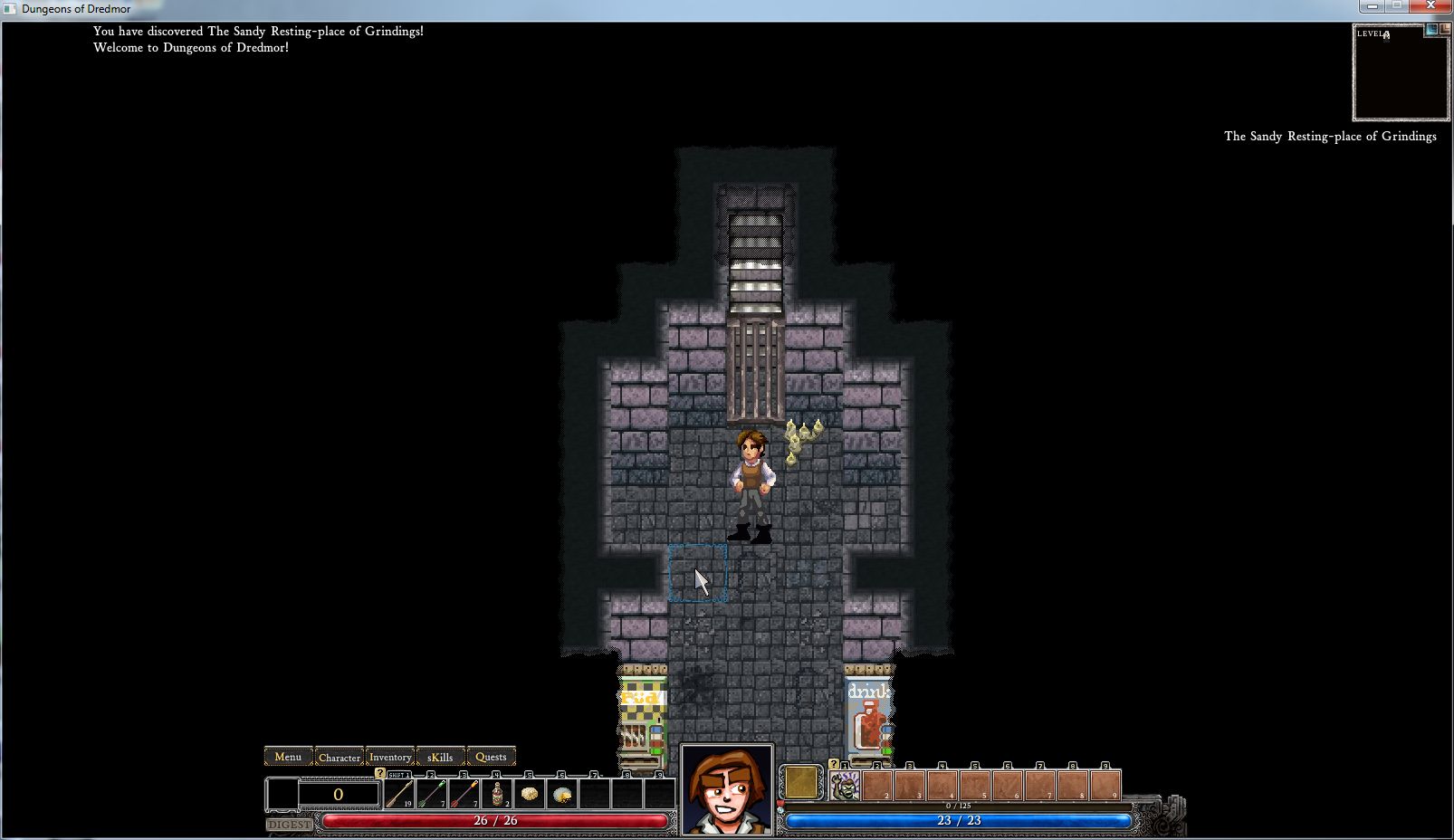
On Dungeons of Dredmor

Ben Abraham’s “Permanent Death” is one of my favorite bits of video game writing. Ben is both doing a design exegesis and a phenomenological account of what it means to play Far Cry 2, and if you haven’t read through it, you are doing yourself a disservice.

Cut to me. I am sitting in my chair, yesterday, and I fire up Dungeons of Dredmor for the first time. Ah, I think, this game is a comedic game and a roguelike. I will die a lot. I will make a parody of Permanent Death on the blog. It will also be funny. 

I talk a bit like a caveman in my own head.

If you don’t know what Dungeons of Dredmor is, here is the quick recap: it is a roguelike where you make a character by choosing name, sex, and skills. Then you are off. You click on things to kill them. You craft items. You go deep into the dungeon to kill this Dread Lord named Dredmor. It is remarkably simple, actually, and I thought I was going to rule the game.

I was mistaken.

The short text that follows is a journey through less than ten minutes of Dungeons of Dredmor. In case I don’t get around to saying this later, I liked the game (I am beginning to think that if I play a game for more than ten minutes, I probably like it).

*****

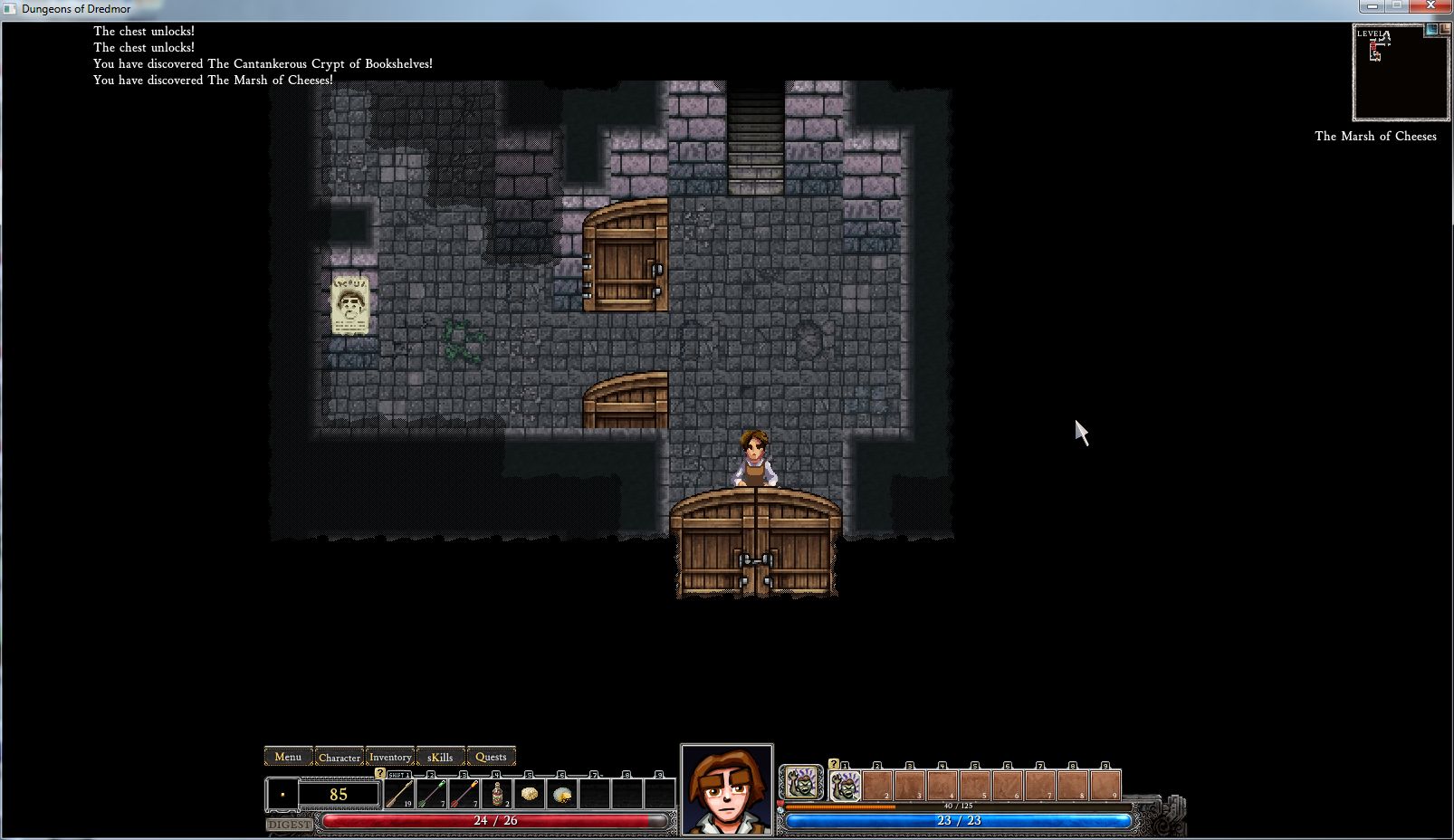
Larry O’Punchy was created to be an unarmed fleshmancer, a guy who would beat enemies to a pulp and then craft that pulp into a cool bro who would follow him around until the end of his days. That was the plan, anyway. I entered the dungeon by stairs, which is a lot more of a friendly entryway than most dungeons. A grate crashed down behind me. I saw some vending machines.

Larry wasn’t scared, I don’t think, and neither was I. We knew what we were up against. Larry was ready to punch things, and I was ready to help by clicking on little monsters. I opened a door and saw a diggle, a weird little pear-shaped creature that spouted off some b-movie science fiction quote from the 1980s. These things can talk? I thought, and then they were wailing on Larry. He was a solid fighter, though, and he wailed back. He accidentally summoned a zombie, too. It was a violent battle, and at the end, Larry O’Punchy had won his first fight.

I wandered south some. I took a screenshot of those wanderings. I found a stairwell leading deeper into the dungeon.

Now, at this point, I might have been having a conversation with someone or I might have been reading something. I don’t quite remember. I do know that I kicked the door open and there were more than two monsters inside. Larry O’Punchy was ready to go, and he went to town, punching the hell out of basically everything.

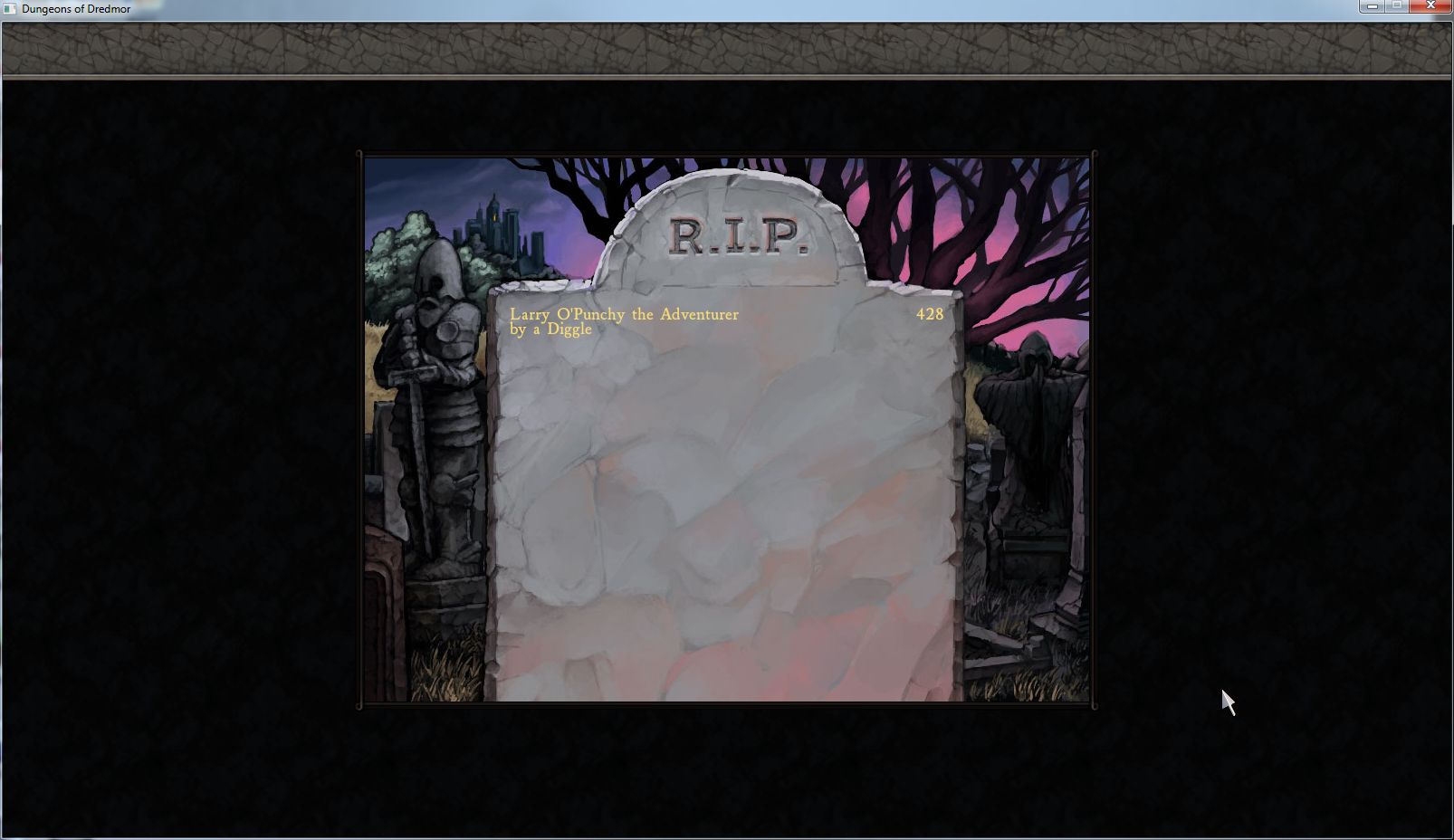
Then something went weird. It was a turn-based blur. Larry might have been surrounded on all sides. In any case, there was a message that basically said “you’re dead.” I clicked something (a wrong something) and then I had a score screen.

So my game might have lasted five minutes. It was weird, I didn’t understand much of anything, and I didn’t really do much. But I liked it. It was welcoming. Dungeons of Dredmor is the Chewbacca of video games–it seems means, but when you are its buddy, you’re its buddy for life. That is why my third playthrough (the second was much like the first) has been ongoing for about three hours now.

This time Halloweena the fighter is going deep in the dungeon.

Posted in Video Games | Tagged , | Comments Off on On Dungeons of Dredmor

On Limbo

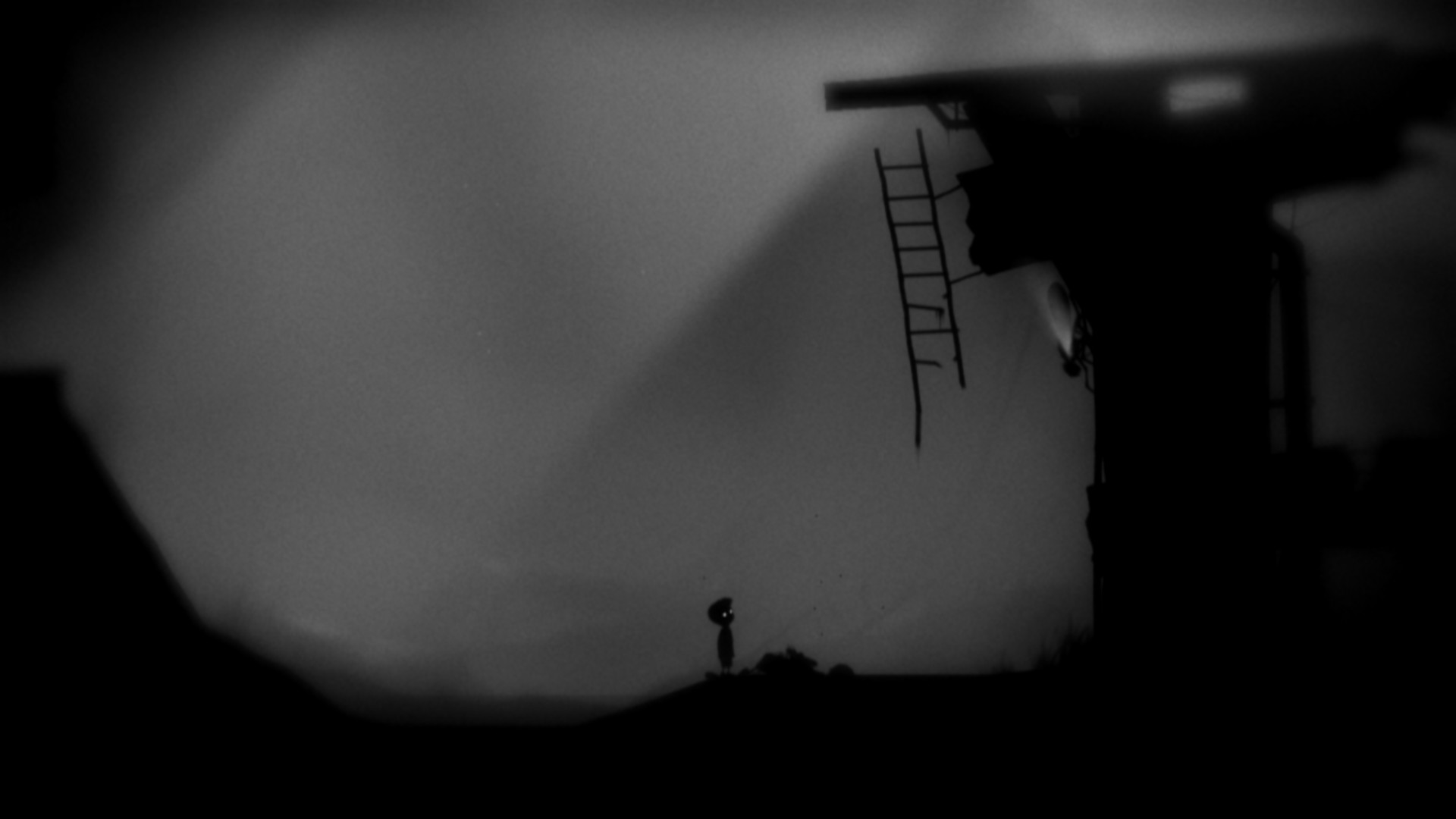
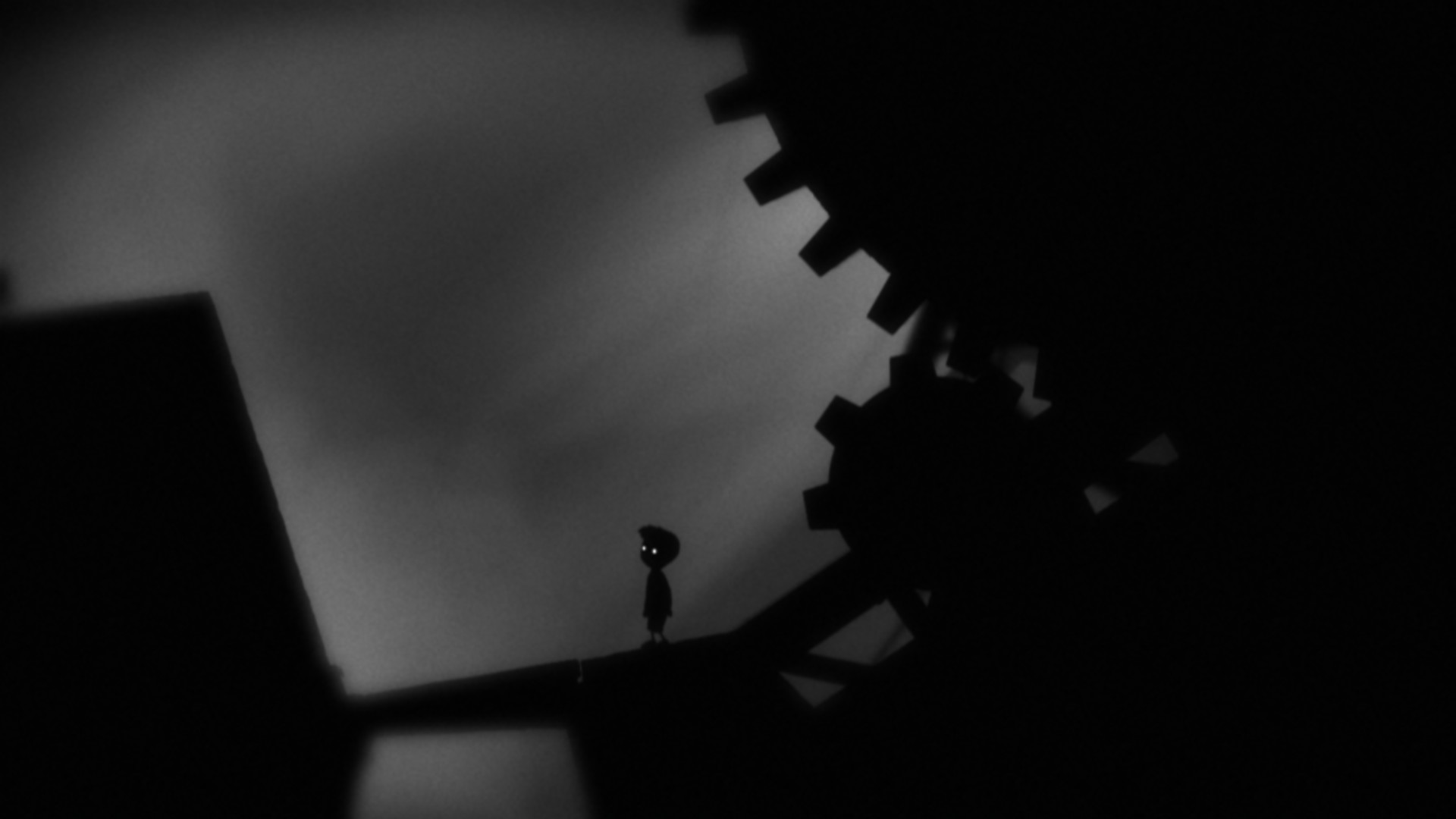
I am behind the times. I got Limbo as part of the Humble Bundle V, and I took this morning to play through it. My opinion? It is a mediocre puzzle game with a heavy dose of Tim Burton-esque aesthetics. I understand that there is a lot of praise for the game, but most of what I have read is summed up quite readily when you look at this article. Limbo is a hole without meaning that people fill with their own pseudo-intellectualism, which is something that, 99% of the time, I enjoy doing. Not this time. I think the writing of the game is lazy and the whole thing felt like two semesters worth of game design coursework. That said, I enjoyed the act of playing the game, and when the puzzles were clicking and not punishing me for lacking absolute perfect timing.

But neither the design of the game, nor the aesthetic, got me. Instead, I was pulled in by death. As you may well know, failing a puzzle generally ends in death. The player takes on the role of the Boy, a nameless child who is making his way through a dark, surreal world in search of his sister. Well, that is what I have heard–having played the game, I can’t tell you that was what it was about with any certainty. In any case, when you fail the puzzles, the Boy dies. Below I have five moments when the Boy died. I don’t have screenshots of the deaths. Most of it happened in my head–but I remember how they felt.

1. The Boy moves silently between trees. A slight wind moves through the trees, barely strong enough to rustle the grass that covers the forest floor. There is the slightest movement ahead. There is something in the trees. There is nothing in the trees. The Boy stops. The Boy takes two steps. It isn’t safe, but he doesn’t understand the consequences. There is quick movement. The Boy, impaled on long limbs, thinks of spindles and thread as his eyes go dark.

2. The Boy comes upon a hole. He can’t see the bottom, can’t see more than a couple feet actually, but he knows he can jump it. He knows that he can run and make a small hop and that will be the last time he sees this hole. More holes will be in his future, sure, but this one will be in the past with the dark and blurry creatures and species he has left far behind. He runs and makes his hop, but something goes wrong; a falter in his step or a lack of confidence make him hold back. The edge of the pit slips past his fingers. He falls far into the dark. He blinks out looking up. There are no stars in the sky.

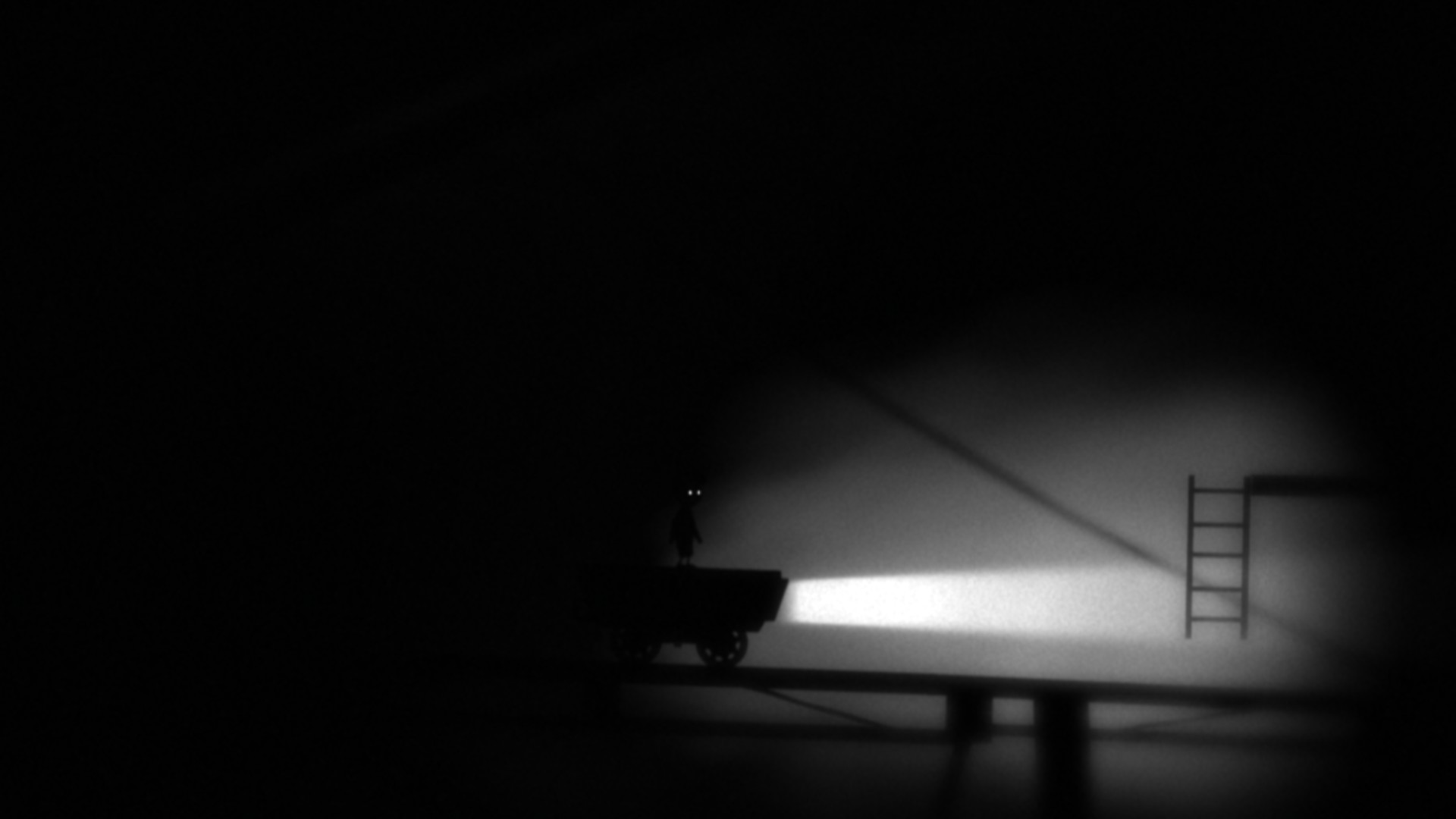
3. There isn’t enough light. There won’t ever be enough light again, the Boy thinks. He rides on the minecart, the cone of white flashing out ahead of him. He hears saw blades in the distance. He hears a deep thrum that could be the heartbeat of the world. He hears gears and electric crackling and boxes falling and yelling, he hears yelling, and water rushing and flies buzzing around bodies turned flesh then sludge. Something is coming in the dark, and he jumps, his feet no longer on the cart but on hard groud. He runs, trying to catch up, and he jumps into the darkness, hoping he will land with sure feet. The curvature of the blade comes up to meet him. Ground up, turned to chains of gristle and faded light.

4. The sign says something, but the Boy can’t read it because he stands beside it, not against it, so it changes into something different from a sign. It lights up, electrified by unseen hands, and he leaps through the air from point to point. He will be frustrated to die, of course, but this one is a better death. No sliding down spikes or having trees ground through his belly or being crushed by pneumatic slabs that press on, over and over again, without knowledge of his young body smashed in their grip. The electricity makes him jittery and fall and go dark in an instant. Just a little tingle. He jumps.

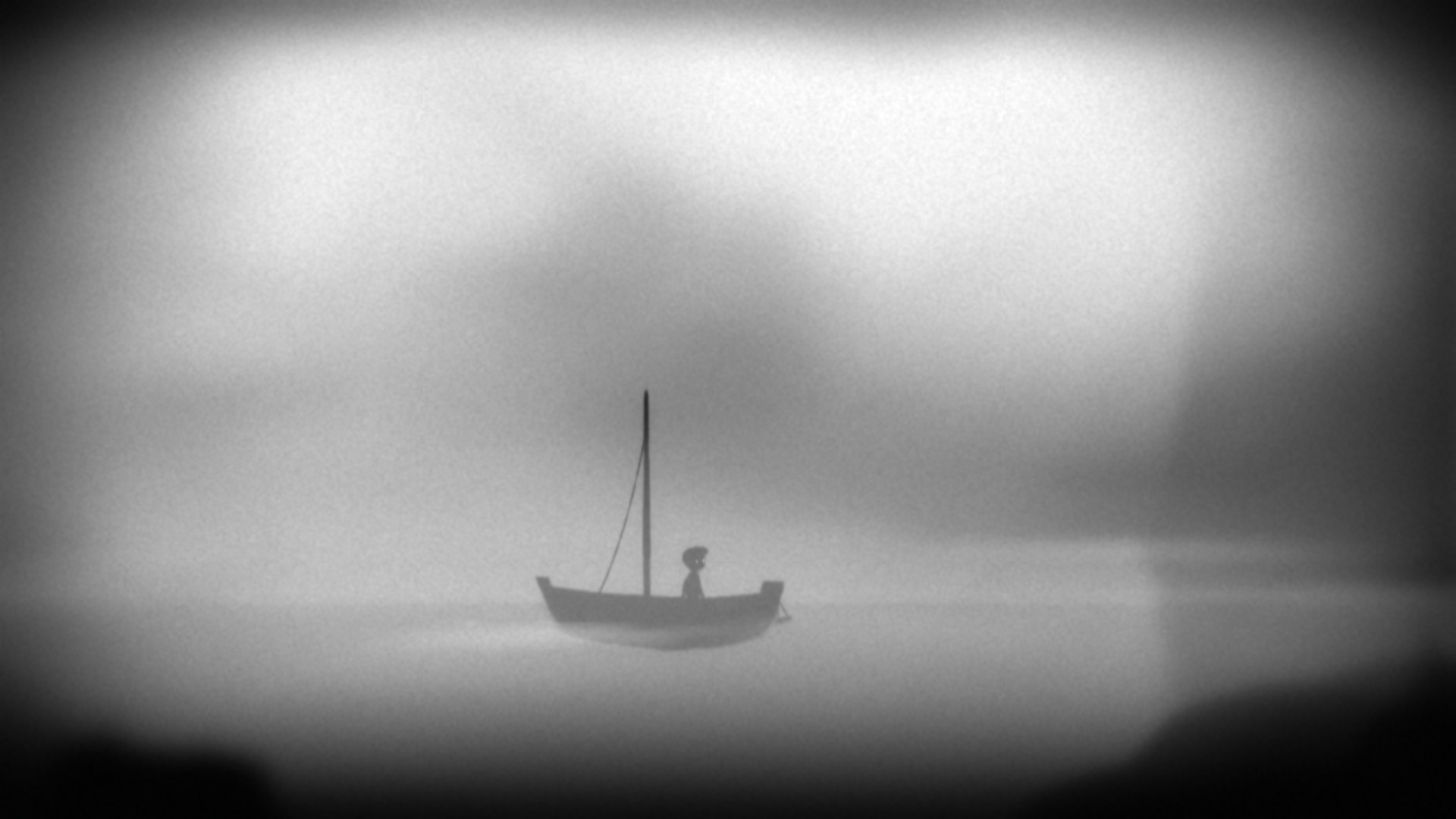
5. The world falls apart over and over again. The Boy smashes into the world with his body. A part of him thinks that all the dead bodies, the drowned corpses, the carrion-food for animals and maggots, all of that might be him. Would he remember all of them? It has happened so many times already. If I could go back, but he doesn’t finish the thought. No point in trying to go back. Did it matter if he took the boat across the ocean? Is there any way of getting back? Gravity changes again and again, and by the time he crashes through glass and lands in a field of black and white, he has mostly forgotten about the stillness of the water and the breeze that shook sail and grass.

(If you liked this, I did a similar thing with GTA IV )

Posted in Video Games | Tagged , , , , | 1 Comment

Chris Ware Interviewed by Fear No Art

This is an amazing interview. I always like reading and hearing Chris Ware speaking in his own voice rather than through the multitude of characters he has created to hyperbolize and diffuse his personality through. There is something deep in me that loves Ware’s humility and bleak outlook about the earth. It isn’t nihilitic, and he rarely looks back with any kind of serious nostalgia. For instance, what I got out of Jimmy Corrigan is that the world is kind of shit and it has always been that way, so the best thing you can do in life is to be nice. Also, everything you do will be forgotten and lost. That’s my kind of bleak–pragmatic, smart, introverted, even if I am none of those things.

So watch this ten minute interview. You get a good feeling about how Ware lives in the world.

A pull quote that I liked:

One of things I like about comics is that its…I know that whoever is going to read it, if anyone reads it, it’ll just be one person, its not going to be a lot of people at once and that its a very solitary kind of private experience, because comics are about the only medium that a reader could expect to go to to get a very particular emotional reaction for decades. That was one of my aims as a young cartoonist, to try to bring other emotions to comics rather than just laughing or derision.

I would add “white muscled dudes punching one another” to that list. Also, remarkably similar to Warren Ellis’ idea that you “come in alone” when you read comics.

Posted in Comics | Tagged , , | Comments Off on Chris Ware Interviewed by Fear No Art

On Bastion

So I didn’t like Bastion the first time that I tried it. It was last summer, I think, when the demo showed up on Live. I read all of the push about the game, about how it was beautiful, about loss and gain, and that the Narrator was adaptive to what the player did. All of that sounded great. I downloaded the demo, played the thirty minutes or so that was included, and then deleted the demo. I didn’t like that I fell off the bloody map trying to dodge cheap enemies over and over. I didn’t like my shitty hammer. I wasn’t good at blocking (this is a common thing for me across all games). I dismissed it and went back to playing whatever the hell I was playing at the time.

That isn’t the end of my Bastion story, though. Last week, Humble Indie Bundle V came out, and all my dreams came true. You see, I am cheap. Way cheap. It is super-rare for me to buy a game on launch day–I can think of three in the past year that I have purchased on launch (MF 3, ME 3, and Dear Esther). I will normally wait for some kind of sale to buy most titles, be they AAA or indie or whatever. Of the new Humble Bundle games, the only one I owned was Amnesia, which I played about ten minutes of and turned off in a joint boredom and complete terror. So I paid my $10 and went indie, getting Bastion as part of the sweet deal.

Maybe I’ve grown as a person. Maybe I like the PC controls more than I like the Xbox controller. In any case, something clicked with me this time, and I just spent four hours of my life playing through Bastion. I don’t have anything particularly amazing to say, but I do have some thoughts that I will enumerate below. I can say here, right at the top, that I liked the game. If all you want from this is my stamp of approval, [Y/N] text adventure style, then [Y].

As always, there are SPOILERS for the game here.

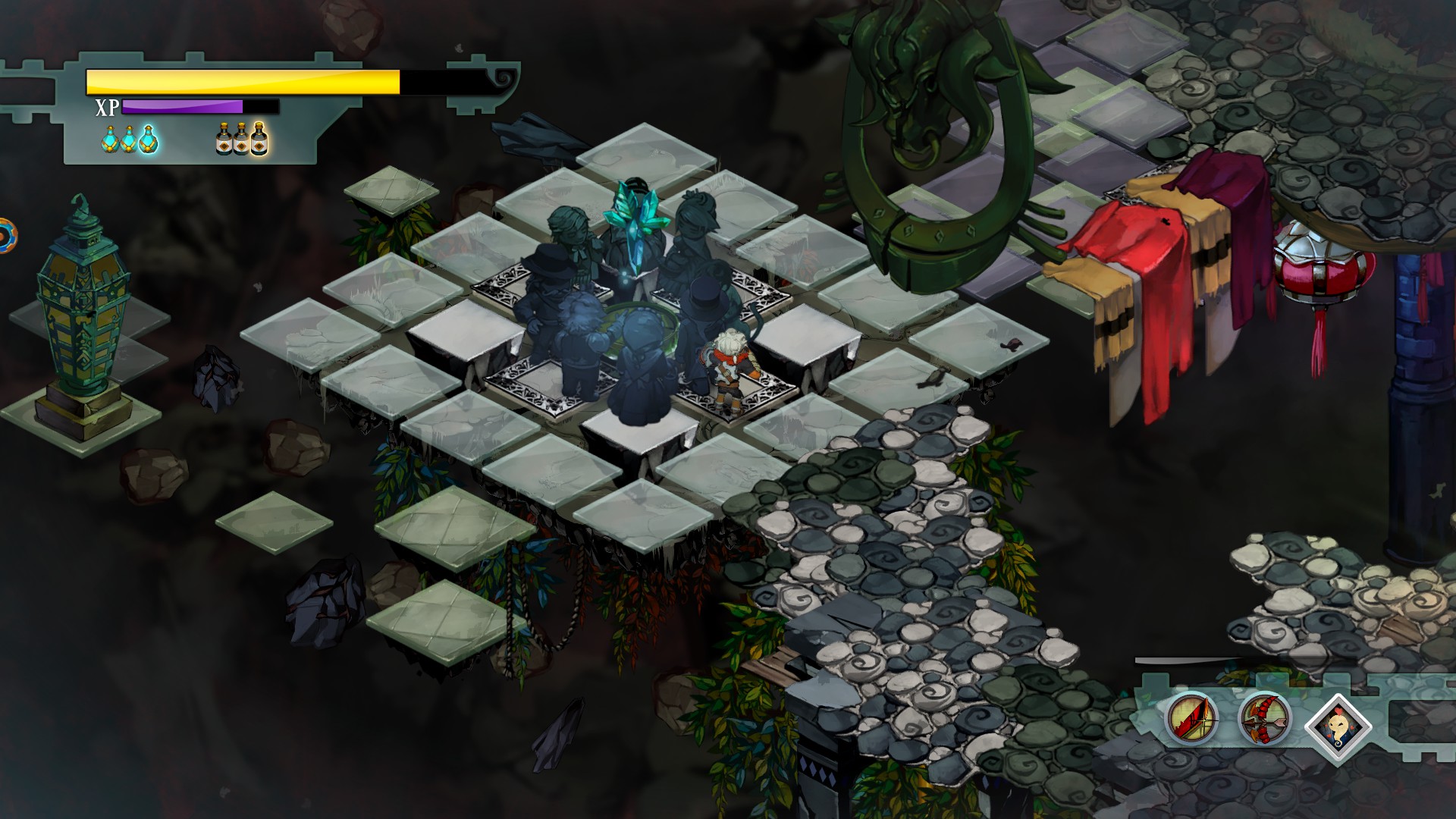
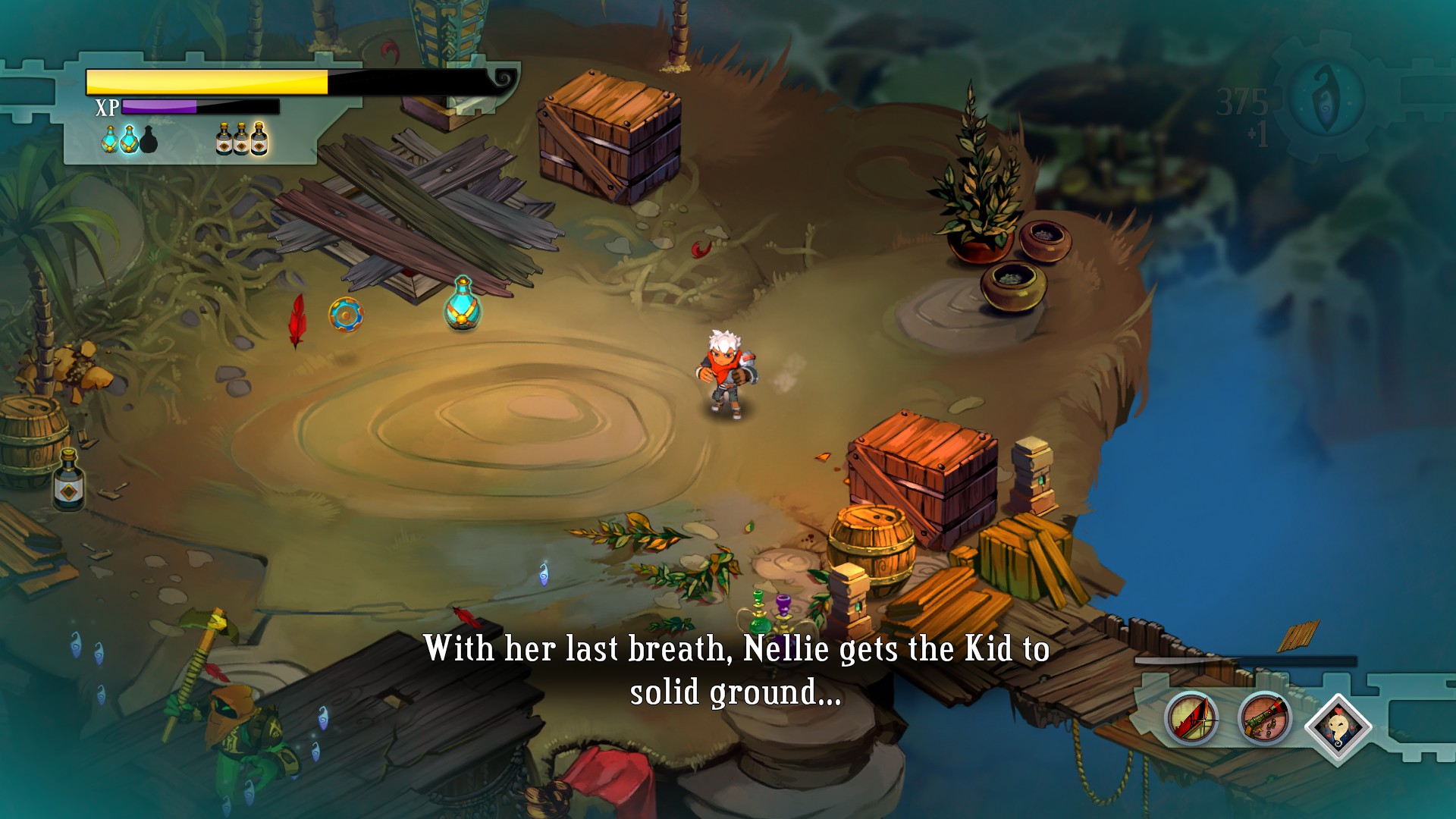
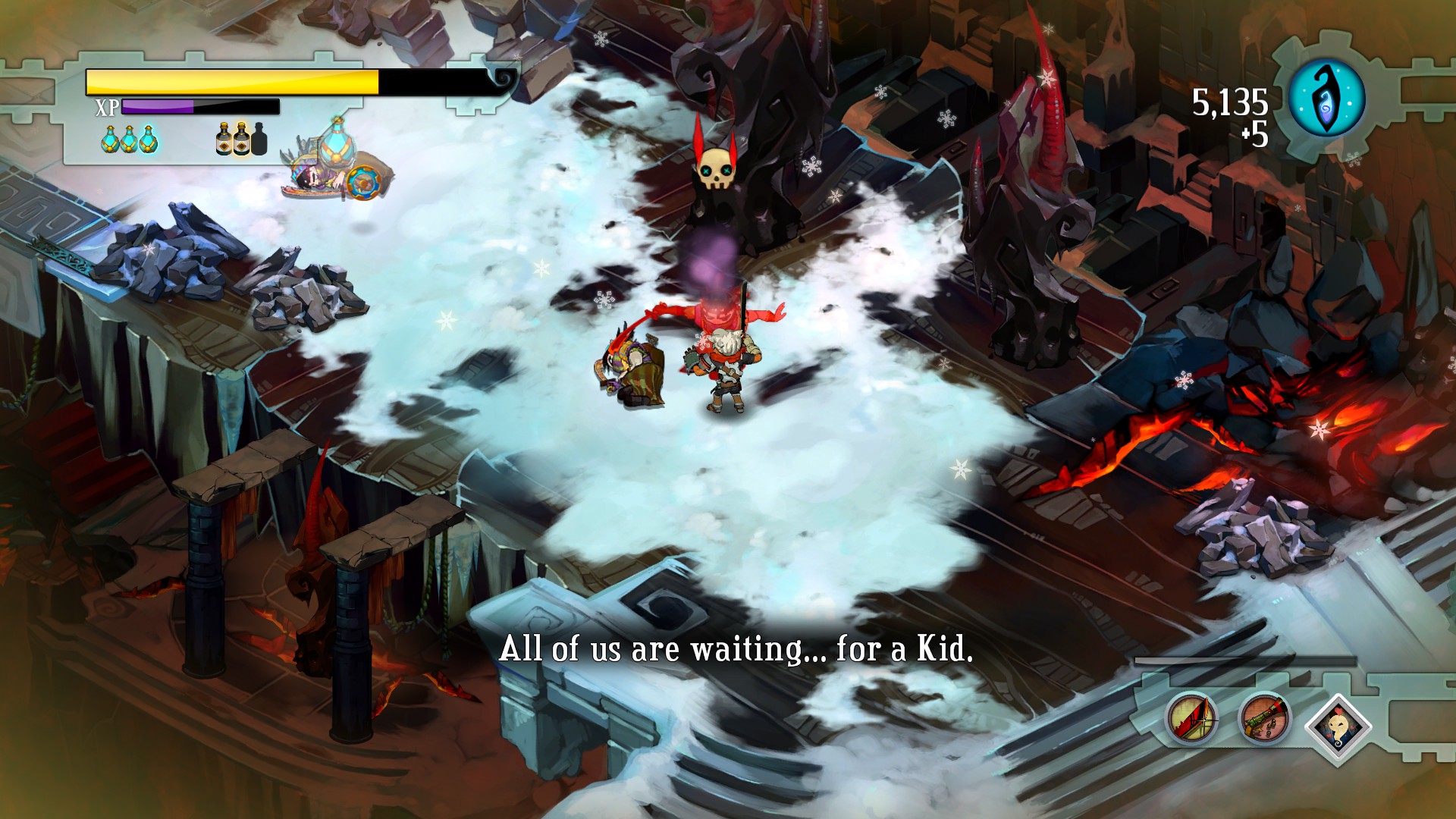
1. I was perplexed by this moment. It is fairly early in the game, maybe a quarter through. The Calamity, a disaster that destroyed an entire civilization, did so by fracturing the ground and reducing the citizens to ashes. The protagonist, known as The Kid, is searching for things called Cores in order to render The Bastion powerful. The Bastion is a giant machine-space that serves as the central hub for all the game’s missions. What sets me off about this is that the people, in their dying moments, thought that the Core might save them. It didn’t, of course, and in order to get to the Core the player has to smash through these ashes. Before this moment, the ever-present Narrator told you the names of numerous victims of The Calamity that The Kid had come upon. Smashing through these people would be difficult for The Kid, since he knew them, but for me it was merely another click in a series of clicks. I’m not invoking player action versus diegetic action to talk about why story is bad in games (there is too much of that shit already). Rather, this is a brilliant moment in the game’s design. The Kid, so enveloped by his mission, will do anything to get to the Core and make sure it reaches The Bastion.

2. The world is very much alive in Bastion. Nonhuman objects have agency and presence attached to both their physical, material being and their “spirit” or something like it. For example, Nellie is a skybarge who is very much treated like she is alive. She takes off and moves on her own, and when she dies in flames, the music gets sad. Nellie is a character as much as anything else. Similarly, a rail line in a later level is described in the same way. We talk about video games as being ways of telling new stories or at least allowing people to branch out into new narrative spaces–here is a game where nonhuman objects are given agency and action, in a universe where the physical laws allow that to happen. It is pretty special.

Additionally, there was also a moment of sadness about the nonhuman here. It is revealed in quarry level that the Cores and Shards are rocks with memories, and while it isn’t stated explicitly, I took that to mean that the power source of the Cores comes from the vitality of the stones. The inability to acknowledge that those stones might not want to live the life they have been sold into is interesting (and probably something for an object-oriented ethicist who cares about video games to cite as an example).

3. That said, there is some fucked-up logic going on in one stage of the game. When searching for a Shard, which is a powerful artifact thing, it is explained by the Narrator that the animals of the wilderness have decided to make their own Bastion. They need objects of power in the same way that The Kid does. So the player has to go in and take it from the animals, which really just means committing mass murder against them so you can steal an artifact that is, by all rights, totally theirs. This is the justification that that Narrator gives for the invasion (thanks to this script for the whole thing):

There’s no more mountains now…there’s no place left for the beasts of the wild to go. So they figure they’ll hold out right here, on a slab a’ mountain the calamity forgot. We only found their little lair ’cause they found themselves a little shard. The creatures of the wild, they’ve been buildin’ a Bastion of their own. but they ain’t yet prepared for any company. They even drag their children into this. Best things we can do for those beasts right now, is put ’em down. Quick and clean. Look at it this way, it’s either them or us…but if we win, they win too. Our Bastion is everybody’s game, not just ours. Unfortunately, there’s no explainin’ that to a simple beast. Those beasts been hard at work fixin’ up the place. They’ve rounded up their survivors just like we have. They’ve been searchin’ for cores and shards, just like we have. Maybe they’ve thought about turnin’ back, just like we have…we just really need their shard. Kid got it fair and square. He don’t need to keep tangoin’ with all those things. He’s done what’s best for ’em, don’t you worry…

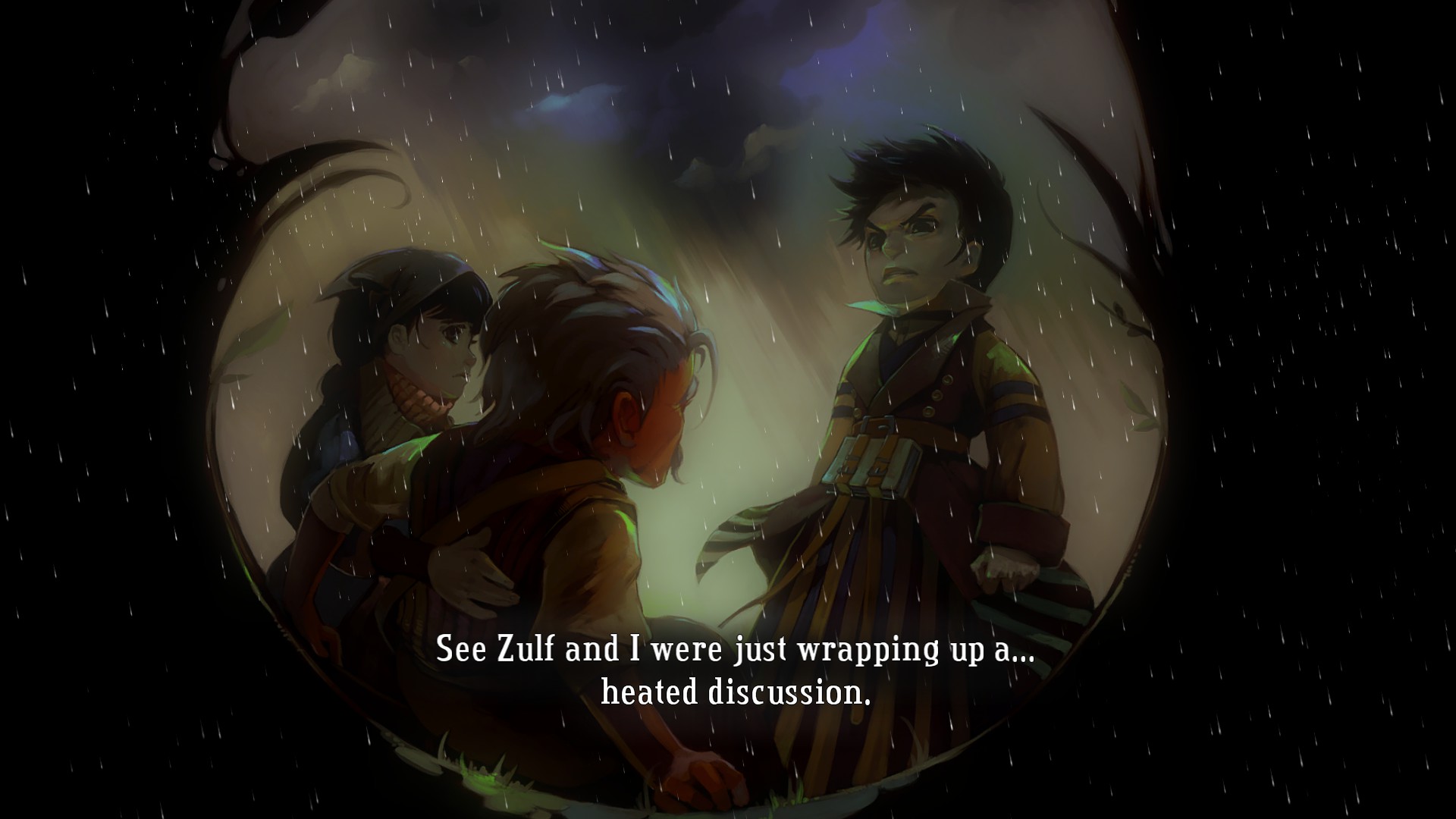
4. That isn’t the only thing I felt was problematic about the story, though. As you get further along in the game, it is revealed that The Calamity was caused by an attempt to ethnically cleanse the world of the Ura people. They are essentially the indigenous group of the in-game New World. We find out through the Narrator that The Calamity was really an attempt to collapse the tunnel homes of the Ura people. Of the four characters who are in the game, two are Ura. The first one that The Kid finds, Zulf, seeks revenge after he realizes what caused The Calamity. He wants to make sure that it could never happen again, and he hopes to destroy The Bastion so that time could never be rolled back, which would also mean that the tragedy could never occur again. Zulf then becomes the villain, but I honestly didn’t understand. I totally think that if my people had undergone a genocide attempt that I would probably not want to roll back time to allow it to happen again. And again. And again.

5. The end of the game features two decisions. The first is a branch choice about the fate of Zulf: do you let him die or do you save him? I saved him. The second is a choice about the Bastion: do you want it to activate and roll time back to some time before The Calamity or do you want to blow up the Cores and fly away? I went with the second one. It seemed like the most ethical. It meant that the Cores were no longer slaves and that the technology that enabled ethnic genocide was lost forever.

I enjoyed Bastion. I think that it did a great job of blending gameplay and story together (I agree with Yahtzee on basically all points about the game). It was retro-feeling in its simplicity. I’m kind of worded-out now.

Posted in Video Games | Tagged , , | Comments Off on On Bastion