Far Cry Primal Essay at Paste

When we write about the past we’re always writing about the present. That writing can take a personal tone, showing how a person got to the place that they are through the person that they’ve been. Ben Carson stabs a guy and runs for President of these United States. Jessa Crispin runs away from those same States and into a cavalcade of experiences across Europe. Everyone has to make it through time in order to get to where we are, and we shape the contours of that story in order to ground our current lives.

The writing can also take a cultural form. The stories take the same shape as the personal ones, but the stakes become higher and broader. This is the realm of Manifest Destiny and the triumph of American ingenuity. This is where we learn that we have to make America great again, like all we need to do is dive into the pool of the past to grab the pearls of a long-gone triumph.

I wrote a short piece about Far Cry Primal for Paste. Of late I’ve been interested in what kinds of stories games are telling and why (this isn’t something I’ve always cared about), and I think that’s because there’s such a wide range of popular and accessible games with such a wide range of types of storytelling. There was a point where you could say something about “game narrative” as a monolith, and even though an enthusiast could tell you that you were wrong, the broad strokes might not have been far off. At this point, I think it’s (at best) disingenuous to say “narrative game” or “game story” as a monolith, and that’s an excellent thing.

And so from Carson to Crispin, Firewatch to Far Cry, I’m interested in how framing stories about a “back then” influence the narratives about the now. It’s a necessary mechanism for every story, and the minutiae of how that shuffles out is my jam right now.

Posted in Video Games | Tagged , , , , | 1 Comment

On Firewatch (2016)

1.
When I finally, after weeks of not being able to get to it, launched Firewatch, I was struck by how beautiful it was. One hundred and fifty Ubisoft hands can’t make a European capital city, with its iconographic shortcuts to awe, as beautiful as a goofy pickup truck in the opening ten minutes of this game.

2.
I’ve been incredibly lucky to see the “grammar” of the first-person experiencer genre grow. From Dear Esther to The Stanley Parable (and its brood lineage of Langeskov and Guide), from Thirty Flights of Loving to Room of 1000 Snakes, you can see this great, strange tree of family resemblance among all of these things. I’ve been paying attention to all of them, commerical and non-, since the time that I realized that I definitely should be paying attention. It’s paid off in some ways, because I can see the little pieces: the opening scene feels half Blendo Games and half Twine game; objects are framed against clear sky in Half-Life to Dear Esther style; the animations have a springiness to them that has a glimmer of Langeskov‘s telephones; objects fit on shelves correctly in that uncannily perfect Gone Home way.

It’s almost embarassing to admit that there’s something emotional to seeing those connections. In a few short years we’ve gone from both the public and prominent critical voices openly disparaging these kinds of games, and yet here we are. There’s a whole wide world of people making them in the broadly commercial sphere as well as the indie one (thinking of sometimes-collabo Connor Sherlock and always-excellent Kitty Horrorshow amongst a dozen others). To see a genre bloom and really come into its own is a special thing.

3.
There’s been dissatisfaction in the wind about Firewatch‘s story. Delilah and Henry fall apart. The conspiracy that comes to a head in the middle of the game peters out into nothing. I’m not unhappy with it. I’m on the other hand at complete enjoyment. Firewatch is a window into an asymmetrical relationship that depends on its distance. It’s the 1980s version of an internet romance, telling the story of someone who can always be with you but can never be with you.

Hank and Delilah can share plot points, but they can’t share experiences, and that comes to a head when Hank discovers the years-dead body of young Brian. The game could have easily thrown the parallels between Hank’s and Brian’s relationships with Delilah in our faces. She knows their plot points, but she doesn’t know they experiences, and the lack of the second part gives over directly to the circumstances of Brian’s death. Instead of performing the “ah ha!”, the game just lets Delilah internalize that realization.

It shouldn’t be narrative innovation to allow a woman to turn away and reflect on her life at the expense of the plot development of a leading white (very white!) man, but it is. And it’s excellent work.

4.
I never saw the turtle that was in the trailer.

5.
Henry getting knocked out halfway through the game made me and the person I was playing with jump. I’m not surprised that it happened, especially since part of the first-person experiencer lineage is predicated on the creepy emptiness that comes with the genre.

Myst has an eternal “I will be killed here” feeling that was capitalized on several times by the denizens of its sequel, Riven. Dear Esther gave us the “ghosts” that watched the player move about the island, driving home the dread that rested at the core of that game. Gone Home had the shock of red in the bathtub that went alongside feeling like you were going to be murdered at any moment. Firewatch takes that feeling and delivers on it, horror-movie style, and I thought it was going to be much worse than it was. In a few years’ time, when the history of these games is written, it will be incomplete without a theory of anxiety and fear.

6.
I don’t know what Henry should have done. I don’t know that he should have taken the summer job, and I don’t necessarily think he should go to Australia after the whole thing is finished. Firewatch hits the rock-and-hard-place relationship of the contemporary novel so impossibly well that I’m left with the same feeling I have at the end of, say, a Don Delillo novel. Things occurred, and plots were resolved, but to what end?

I am invested in games that have this kind of open-ended relationship with the player, and it feels good to see someone succeeding at that model of game with Firewatch.

Posted in General Features, Video Games | Tagged | Comments Off on On Firewatch (2016)

Let’s Play Cities: Skylines – Friendship Village

I recently finished my first series of videos about Cities: SkylinesI built a really great place called Friendship Village, and I took it from turnpike to minor berg. It’s a fun little series of videos, and I hope that you like them.

Posted in Video, Video Games | Tagged , , , | Comments Off on Let’s Play Cities: Skylines – Friendship Village

You Buy It, I Play It: One Way Heroics

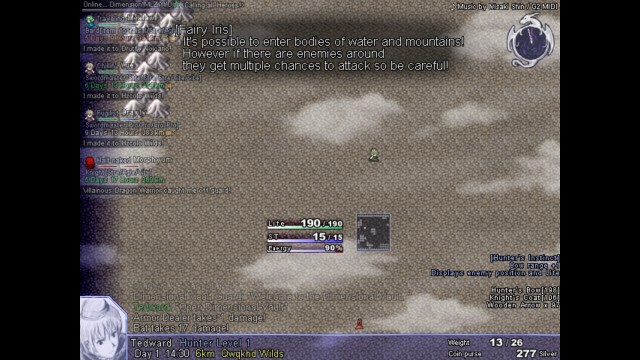
One Way Heroics holds two things in tension: progress and annihilation.

2016-03-03_00002

That’s not surprising given that the game exists somewhere within the family resemblance of the roguelike genre. Procedural generation of terrain, item drops, and enemies sets the boundaries for the kind of experience that you can have with One Way Heroics, and in that we it is very familiar to anyone who has played an indie darling on the PC platform over the past couple years.

On the other hand, One Way Heroics has several unique properties that make it a very special enterprise. One is the time limit. Instead of navigating a maze or traveling ever-downward in a dungeon, the player makes their way toward the right side of the screen. As the player moves, things scroll off the left side. When something disappears, it dies to the evil forces that are warping the land behind you. One Way Heroics is putting you in the position to run away from the end of the world.

Another special property that makes this game so unique is that you can play with other people. You and several others wander around this almost-JRPG roguelike attempting to kill a Demon Lord and dispel the darkness that is destroy the world. Even more interesting is that the time I’ve  of “multiplayer” I put into the game never produced a single other player. I was assured by the game that there were people here, and sometimes I could hear them dying or fighting off screen somewhere. But maybe they were kilometers away. Or maybe the game requires that you be a little more intentional than I was being. Either way, I played in this giant world that I knew was populated by other people, and yet I couldn’t ever have access to them.

2016-03-03_00003

Progress and annihilation. Always moving forward but questioning what the value of moving forward really is. No other roguelike or -light has that kind of feeling to it. When you play Caves of Qud, you feel a particular inevitability, but there’s also this pure joy of knowing that you are creating your own story. When I gave a talk at the International Roguelike Developer Conference last year, a lot of comments and questions I had were centered around games that afforded your ability to tell stories about what happens.

For some reason, the inevitability of annihilation, that scrolling screen and total isolation, doesn’t suggest to me a storytelling function. I find it hard to imagine a way of talking through a One Way Heroics that turns it into something more than a scraping, scuttling set of encounters with death. The left side of the screen, fading into blackness, keeps you from investing too much creativity into it. One Way Heroics destroys the future.

Posted in Video Games, You Buy It I Write It | Tagged , , , | Comments Off on You Buy It, I Play It: One Way Heroics

Trilogy Thinking and “Ernest Hemingway’s The Old Man and the Sea”

This is part of my March post over at my Patreon.

gamezone__0004_Layer-4

Cmrn Knzlmn Presents Ernest Hemingway’s The Old Man and the Sea is the finale of my trilogy of “water games” of On August 11 . . .  and 2015: A Year in Review. They’re all, in one way or another, about inevitability, and they follow a pretty familiar pattern of mine where I pick some arbitrary mechanic that drives home a point of futility. I feel like there’s something rhetorically powerful in the small/micro game format that I’ve been working in for the past little while, and the feedback that I’ve received (positive and negative) makes me think that the reception I’m trying to get is definitely what’s being felt by players.

Why “water games”? When I was working on Epanalepsis, I was reading a lot of interviews with Lars Von Trier, a director who works in what is broadly called “European art cinema.” Most of those interviews were about specific projects contextualized in his body of work, and he continually referred back to trilogies of work that had not been planned as them (the Europa trilogy, the USA trilogy, and his most recent depressive trilogy are all in there).

So, in that always-retrospective model, the three games I mentioned above are the Water Trilogy. I didn’t make any of them with the others in mind, and yet they cohere into something particular. It’s always a view from the side, and only in the latest one is there a glimpse into the water.

The first time I saw the ocean I was probably thirteen or fourteen years old, and the horizon just stretched out forever. It was this weird, 2D plane, and I saw in the sand and just looked at it for hours while the people I was with got progressively more annoyed at my lack of interaction with the landscape. I didn’t, and don’t, care to be in the ocean. The minute I got out to my neck and realized that I could just be swept out to sea was a hairline that I’m not willing to approach again. I didn’t spend much time in the ocean.

I haven’t thought about any of that until just now, the moment of writing, but there’s something about that teenaged moment of looking at the flatline of whatever is out there that has stuck with me. It’s the line that the boat waits on, headed toward the shore, or at least headed to somewhere. It’s a line that could give way unto anything, and yet so much can just rest on it.

Posted in Video Games | Tagged , , , , | Comments Off on Trilogy Thinking and “Ernest Hemingway’s The Old Man and the Sea”

On Nightcrawler (2014)

My friend John talked up Nightcrawler to me pretty much nonstop through 2015, so I felt like it was my obligation to eventually make my way to seeing the movie, and I wasn’t disappointed. While he has a pretty specific way of talking about the film (I don’t want to steal any of his thunder), I kept thinking about the way that the film frames anxiety.

nightcrawler

Anxiety is this kind of overriding force in the contemporary period, and I think that we (and by “we” I mean the cultural spot that I find myself in) is increasingly better at framing and understanding the role of anxiety in all of our lives. We’re ungrounded from the Greatest Generation, or from the gains of labor movements/the establishment of the welfare state, and we’re tossed into this horrifying neoliberal order where the only thing that supports our existence is a strange form of self-branding and constant promotion. While the New York Time op-ed set might suggest that that is a marker of the millennial set, as someone who has equal footing in academia, public criticism, and game development, I feel this ungroundedness pretty extensively.

Anxiety, then, is the mode of life.

What’s fascinating about Nightcrawler is that it presents us with a character who can totally manage that system. He is a subject without anxiety, with no connection to it, and he has fully absorbed the logic of contemporary capitalism as a kind of magical system that wards off fear and any lack of surity. He is able to peer into the network of connections that we are all sucked into and understand how to navigate them. Of course, the film comes down on the straight-up evilness of that action–he’s awful in basically any way that one can be.

In that way, he fits right into the logic that Adam Kotsko outlines in his Why We Love Sociopaths [a note: I’m fully convinced that the word ‘sociopath’ shouldn’t be used, period, but the analysis of this figure in television and film is profoundly on-point around characters such as Walter White and Don Draper]. Kotsko’s argument comes down to the idea that we love these characters because they lack the complications that many of us have. At the bottom, they are knives that are able to fillet late capitalism to their benefit.

Nightcrawler presents us with a world of achievers and of victims; people who can manage and people who cannot. Of course, we’re supposed to see them as the villain, but the film is so profoundly cynical when it comes to its relations. There are no middle figures–they’re eaten alive by protagonist Lou’s tactics. If this were a medieval play, Lou would be a cackling demon.

What’s fascinating is that there’s no utopia, no over the rainbow, for us to think about. Nightcrawler is a closed system of experience that offers no outs other than mourning for the victims run over by the plot. There’s no imagination, no “good side,” and not even different systems of management being presented. There’s only Lou.


Posted in Film, Theory | Tagged , , , | Comments Off on On Nightcrawler (2014)

Released: CMRN KNZLMN Presents Ernest Hemingway’s The Old Man and the Sea

hemingway

I have made a new, silly little game called CMRN KNZLMN Presents Ernest Hemingway’s The Old Man and the Sea. You can play it by clicking the link or the picture above. Please share it with friends, family, and everyone who loves the freedom of the ocean.

John Fio aka Audiosprite made the music and laughed at the idea when I told him about it so check his stuff out here and follow him on Twitter here.

Posted in A Game I Made, Video Games | Tagged , , | Comments Off on Released: CMRN KNZLMN Presents Ernest Hemingway’s The Old Man and the Sea

Meryl Alper on Citations and Elision

One could go deeper, reading Kaplan and Schulte’s work side-by-side. For example, Kaplan writes that in 1983, “The first laptop computers had barely hit the market; public Internet providers wouldn’t exist for another few years. Yet [national security decision directive] NSDD-145 warned that these new machines — which government agencies and high-tech industries had started buying at a rapid clip — were ‘highly susceptible to interception.’” Schulte similarly frames her story in relation to the general populace’s experiences, or lack thereof, with personal computers and the internet at time. She writes on p. 489 of her Television and New Media article that, “Although home computer ownership surged in the late 1970s and early 1980s, modem use did not. As a result, in the early 1980s most Americans learned about the internet through popular culture, like WarGames, and news media outlets, before they experienced it personally.”

Go read this article where Meryl Alper very clearly outlines a culture of absent citations where popular work is concerned.

Posted in Theory | Tagged , | Comments Off on Meryl Alper on Citations and Elision

Emily Short on the almost-remake of Galatea

Doing the conversion was a strange project. For one thing, I myself have a kind of weird love-hate relationship with Galatea at this point — a lot of people love the piece, but it’s pretty much the first thing I wrote that ever got any widespread scrutiny. I would write it differently now, in many ways and for many reasons. Parts of it strike me as flippant, parts clueless, parts overblown. I’ve gotten some great fan mail, art, and even music about that game, and also more creepy and bizarre email than about anything else I’ve written. And I’m also grateful, as that single piece is probably responsible for my career, a lot of my friendships, even my marriage. I remember it fondly but I almost never replay these days. So revisiting it long enough to reimplement all the text in a new context was strange. I disciplined myself not to change too much of the original dialogue, even when it wasn’t what I would now write.

Emily Short, “The Versu Galatea

Emily Short is one of the best people, period, when it comes to reflecting on work (whether it is hers or others). This essay says some interesting things about adaptation and about one’s relationship to certain kinds of work that I can 100% empathize with.

Posted in General Features | Tagged , , , | Comments Off on Emily Short on the almost-remake of Galatea

The Walking Dead: Michonne review at Paste

The Walking Dead: Michonne gives up all of the unique and interesting parts of the The Walking Dead adventure games in order to appeal to the television crowd, and it makes me sad. The formula is slightly different from top to bottom, but that slight shift on every level means that our starting and ending points eventually land far from one another.

Check out my review of The Walking Dead: Michonne over at Paste.

Posted in Video Games | Tagged , , | Comments Off on The Walking Dead: Michonne review at Paste