On 1996

1996 is a serialized comic by Chantal Montellier published in early issues of Heavy Metal magazine (also in this really expensive volume by Vertigo). It functions in much the same way that 1984 does, although there isn’t a narrative that stretches through all of the comics. Instead, we are shown hints of the world that the comic takes place in through short, often one-page narratives.

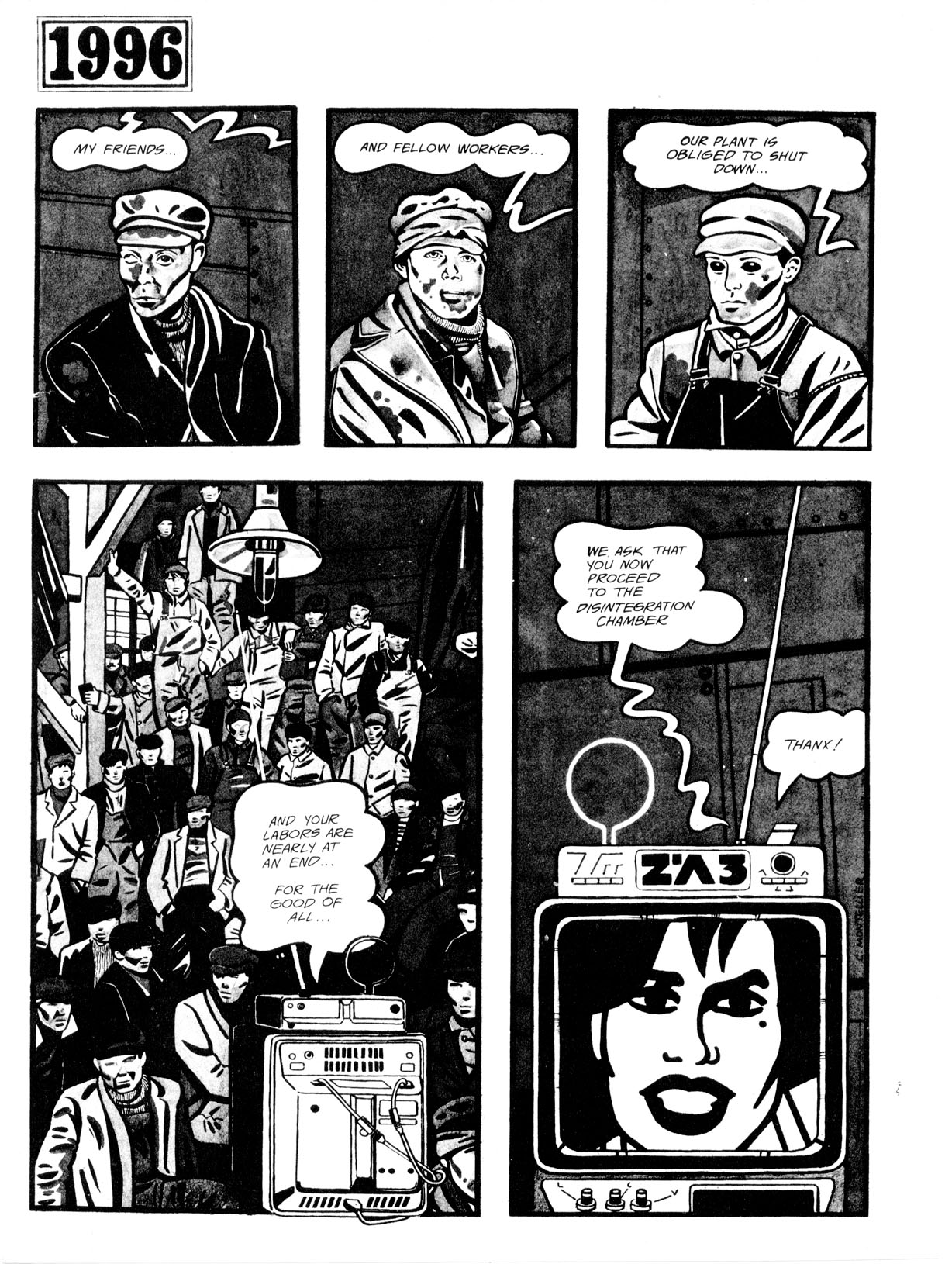
1996, also much like other dystopian works of fiction during the 20th century, has vaguely come to pass. CCTV in Great Britain carries a heavy weight of Big Brother; contemporary entertainment culture, Vice, and designer drugs that make everything a little bit better are only a short distance from Brave New World. Much more disturbing is the way that 1996 has seem to almost completely have come true. For instance, this page from May 1977 sufficiently explains the condition of the worker in the contemporary economic climate:

Heavy Metal V1 #2 - Page 47

“For the good of all we ask that you now proceed to the disintegration chamber. Thanx!”

Is there any better way to describe the global economic crisis other than “thank you for your work, we cannot support you, please die soon”? What is European except for a systemic death for those who are no longer useful in cognitive capitalism?

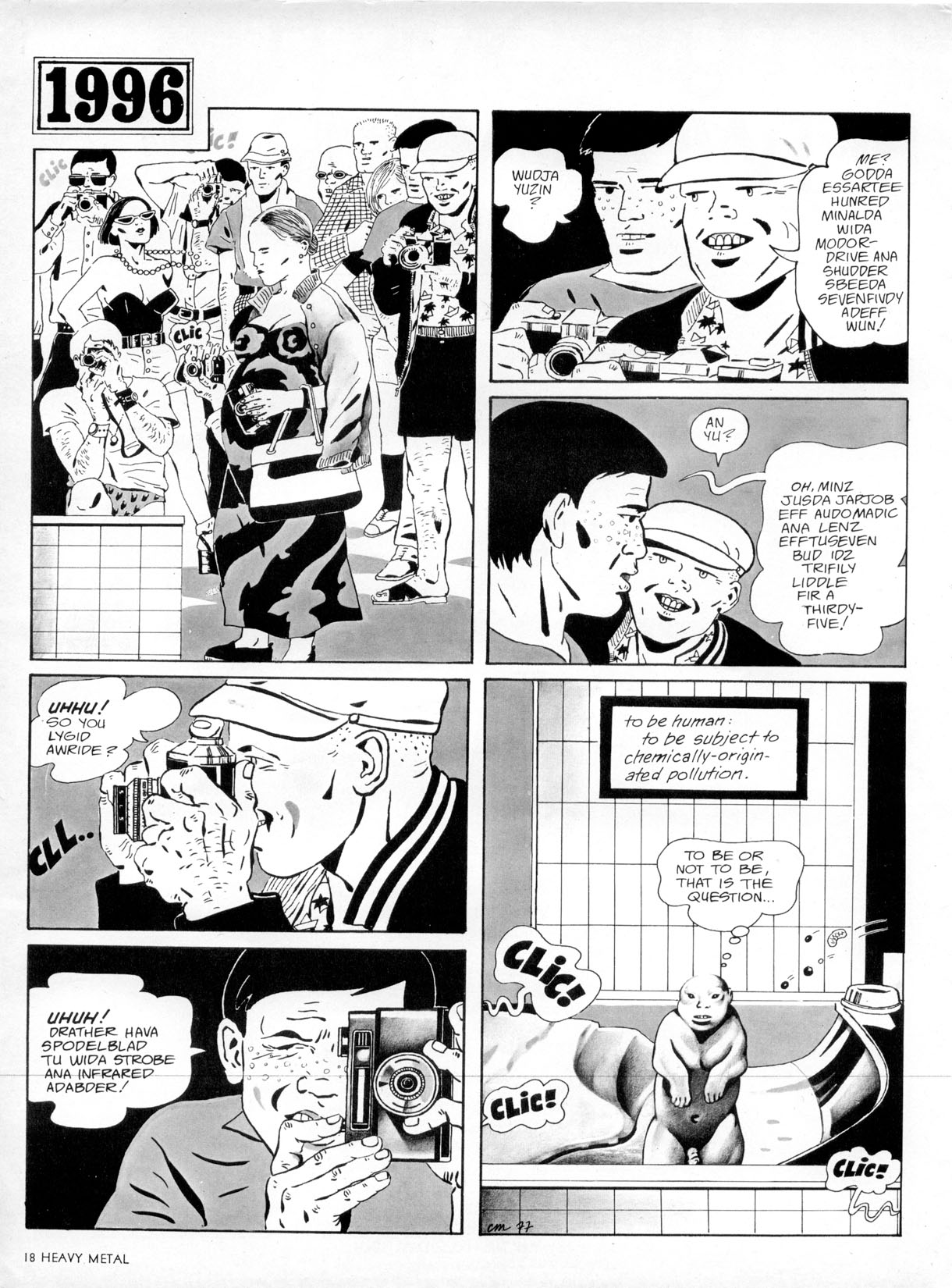
1996 is also strangely abstract sometimes. The language of the people in the comics is nonuniform and significantly different from the “media language” of the time period–it requires work to read through the vernacular of the people. Linguistically, people are alienated from the forces that control them–which goes along with the physical and emotional alienation that is shown in quite a few separate strips.

Heavy Metal V1 #6 - Page 20

“to be human: to be subject to chemically-originated pollution”

Posted in Comics, Heavy Metal | Tagged , , , , | Comments Off on On 1996

Halberstam on disciplinarity

Indeed terms like serious and rigorous tend to be code words, in academia as well as other contexts, for disciplinary correctness; they signal a form of training and learning that confirms what is already known according to approved methods of knowing, but they do not allow for visionary insights or flights of fancy. Training of any kind, in fact, is a way of refusing a Benjaminian relation to knowing, a stroll down uncharted streets in the “wrong” direction; it is precisely about staying in well-lit territories and about knowing exactly which way to go before you set out.

Judith Halberstam, The Queer Art of Failure p. 6

Posted in Quote Time, Theory | Tagged , , , , | 1 Comment

The Long Tomorrow

The Long Tomorrow” is a short story by Dan O’Bannon and Moebius that appeared in Heavy Metal in 1977. Serialized over several issues, “The Long Tomorrow” is (probably) one of the more influential pieces of future noir; Ridley Scott supposedly based the cities of Blade Runner around the images in the comic and The Fifth Element (designed by Moebius) also shares a number of aesthetic choices with it.

So what I am saying is that if you like cool shit you should check it out.

A warning: the comic is very NSFW. It becomes vaguely pornographic (there are exposed breasts and tentacles attacking penises and people getting shot throughout), which is to honestly to be expected from the creative team and the publication. I will have to say that the scene where that occurs (I don’t want to spoil anything for you) is my favorite in that comic, and maybe my favorite in comics, period.

I will probably make a post at some point where I read the two or three pages and justify that statement.

Anyway, here is a sample.

moebiustlt7

You can read the entirety of the work here.

Sadly most of Moebius’ work in English is woefully out of print. You can buy a copy of it here, and it only looks like it will set you back $20 or so.

Posted in Comics, Heavy Metal | Tagged , , , , | Comments Off on The Long Tomorrow

Editor’s Note to Heavy Metal v1 #8

In our local bookstore and yours, too, in the section where the self-help books were (replacing the women’s liberation books, which in turn had replaced the American Indian volumes after the Black Studies tomes), we now find shelves of science fiction fantasy paperbacks, hardcovers, fanzines, oversizes, anthologies, collections, serieses, reissues, and so forth.

There is a temptation on the part of science fiction fantasy fans (who thus resemble jazz aficionados, Trotskyites, nudists, and flat earth society members) to believe that our time has come–that we are no longer cranks and weirdos, but members of a majority: in the cultural mainstream at last!

Forget it.

We are not now, nor have we ever been, a mass movement. We are a conspiracy. Beware of conspiracies that become fads. Popularity can be fatal to the nicest of cults. Look at what happened to Christianity…

Heavy Metal editor’s note, November 1977

Contemporary nerd culture take note.

Posted in Heavy Metal | Tagged , , , , | Comments Off on Editor’s Note to Heavy Metal v1 #8

Lots of People Are Liking “Oh No”

So Oh No, my game about escaping Michel Foucault, has been enjoyed by quite a few people.

First there was this Metafilter thread.

Then there was this Paris Review blog post. It led me to a lot of people tweeting about the game.

This is the most flattering tweet I have ever read about something I made:

I’m glad people are enjoying the game!


Posted in A Game I Made, General Features | Tagged , , , | Comments Off on Lots of People Are Liking “Oh No”

Riff Raff and Haters

In an interview with VLADTV, Riff Raff was asked about haters. It starts at about 1:53 into the video.

How do you deal with haters?

I don’t. That’s the whole deal. I don’t deal with them. Because no matter what you do, on a however people want to take…a music level, whatever, somebody is not gonna like you. But then you want to go up to a higher category, talking about somebody like me, who’s somebody who is…EASILY to hate upon before you even listen to anything, do anything, hear anything I do. I don’t care!

Those are the people who are never my fans, who are never gonna buy my CDs, never gonna go to my shows–or they might even buy a ticket to go to my shows but they’ll just stand there in the back all mad and stuff. I can’t change that person’s life.

A hater is somebody you can’t change them, you can’t make them happy. They are unhappyable. You can’t do anything; if you gave a hater a ten billion dollar check they still ain’t gonna be happy.

‘Cause in their bloodlines, its in their generation after generations. They grandfathers was haters, his daddy was a damn hater, his momma’s momma was hatin’ on my damn grandma. They was trippin’ way back in the 1700s on a chariot. They on a chariot and they like “man look at that bitch on that damn chariot” and its my grandma–trippin’ ’cause she ridin’ on a candy chariot. ‘Cause they on a chariot, ’cause they got better horses and shit.

Don’t get mad because they got better horses and chariots.

Posted in Critical Riff Raff Studies, Quote Time | Tagged , , , , | 2 Comments

Druillet’s “Agorn”

Heavy Metal V1 #2 - Page 35


This is a page from Heavy Metal v.1, issue #2. It is from 1977. It is from the story “Agorn” by Druillet.

HOLY SHIT IS IT AMAZING

I am overworked right now. No proper post. Just this image.

Posted in Comics | Tagged , , | Comments Off on Druillet’s “Agorn”

The Opening Editor’s Note for Heavy Metal Magazine

Metal Hurlant means “screaming metal” — whatever that means. It was, and still is, issued by the Associated Humanoids. The magazine appears to be the work of an alien intelligence, as indeed it is.

It is French.

French is a difficult language to understand because of the large number of English words in it. Thus, when the French say “science fiction,” they are not, as you might thing, referring to H.G. Wells or “Star Trek” or even Jules Verne. “Science fiction” is a term which can sufficiently define Big Macs, South America, Methodism, or a weird neighbor. Vogue Magazine, anything Belgian, and pop-top cans are certainly science fiction. The Humanoid “Moebius,” writing in Metal Hurlant, describes how, while listening to a Johnny Cash album, he realized that science fiction is a cathedral. Are you beginning, dear reader, to sufficiently understand?

Editor’s Note, Heavy Metal Magazine, April 1977

Posted in Comics, Heavy Metal, Quote Time | Tagged , , , , | Comments Off on The Opening Editor’s Note for Heavy Metal Magazine

Released: Oh No

I made a new game called Oh No. Go play it.

So last night I was trying to implement a new combat system in RPG Maker VX ACE (which is literally hell to do). My idea is to make a JRPG where there isn’t any combat, but you do have to type out long sentences to defeat enemies.

Anyway, after screwing around with that for way too long, I thought about making a Construct 2 game where you had to do something like Travis Chen’s Typing Karaoke in order to stay ahead of a monster that was chasing you. An infinite runnertyper, basically.

The song was intended to be Rihanna’s “Diamonds,” fyi.

When I realized how much effort that would take, I immediately scaled back. I wanted to make something fast and fun.

What I ended up with is Oh No. The basic idea is that you are running and need to hit buttons, DDR-style, to always stay one step ahead of the terrifying wraith head of Michel Foucault. A weird cropped picture of a 19th century French artwork scrolls behind you.

3

Anyway, I think it is pretty fun, so you can play it here.

It is probably better if you play it drunk with a lot of friends.

You can see all of the games I have made at heylookatmygames.com 

Posted in A Game I Made | Tagged , , , , | 3 Comments

On Alan Wake

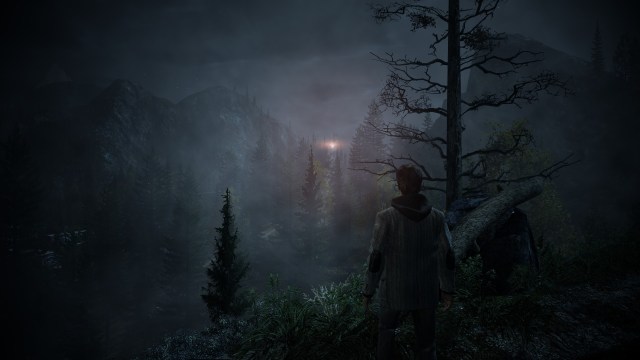
2012-12-27_00028

I spent most of my time with Alan Wake controlling Alan Wake and saying “Alan, wake up” in a silly voice under my breath. For some reason, I think that’s how the game should be played.

Alan Wake in short sentences: I went to a farm owned by aged heavy metal musicians and was attacked by a possessed combine harvester. I died over and over again, back against the wall, battery blinking out. I was whacked in the head with a shovel by three huge dudes simultaneously.

Everything is as it should be.

Alan Wake is immediately familiar to anyone who ever watched Agent Dale Cooper investigate a murder in the Pacific Northwest. It is also familiar, in an unrelated way, to anyone who has ever read a book by Stephen King, Dean Koontz, or (perhaps less) Peter Straub. In yet a third way, it is familiar to you if you have ever played a video game.

The first two familiarities are purely thematic–a quirky town in the Pacific Northwest is invaded by a dark secret. There is a diner with damn fine cups of coffee. The personalities of the town are both intriguing and undergirded by a darkness that is only hinted to the reader. This interfaces nicely with American horror writers like King and Koontz. For these writers, the world can always go wrong–the very things that we find familiar can turn on us and become dark; there is a reason why some of King’s most horrifying stories are ones with a very minor supernatural element.

The third familiarity based around games themselves is a little more of a stretch, but that’s what I honestly felt throughout my playing of the game. Let me remind you of the different things that happen in Alan Wake in case you haven’t played or have played and the forgot: Alan wakes up in a car–go find help; Alan has to go to the top of a mountain then down again; Alan has to run away from the police; Alan has to go to place.

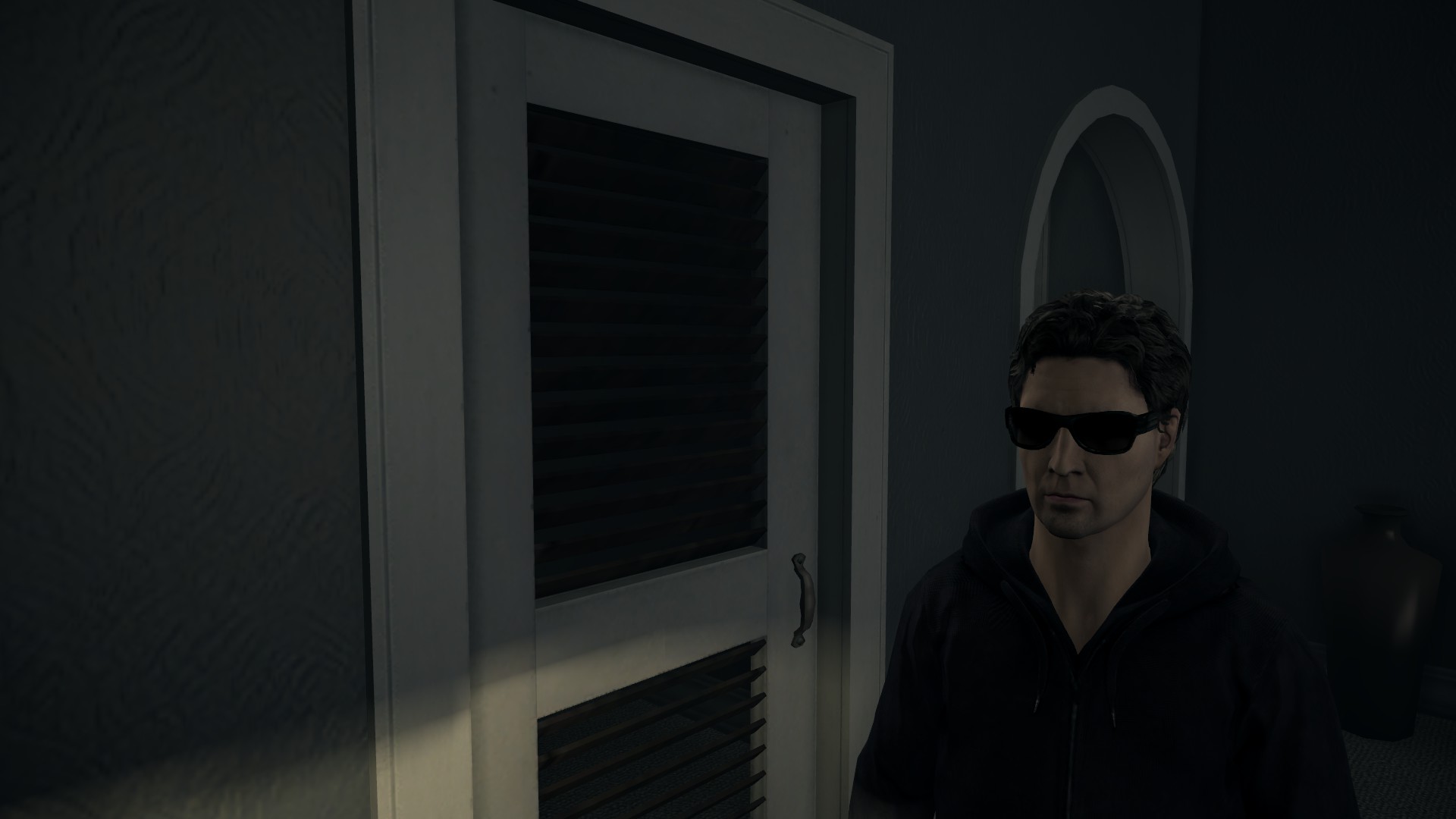
2012-12-30_00044

Alan Wake is a game that is about getting from place A to place B. In being explicitly about travel, the game also reveals something about a lot of contemporary video games–they are just about getting somewhere.

Alan Wake‘s mechanics are specifically geared toward this travel narrative. There are basically three things that Alan can do: he can shine a flashlight, he can shoot a gun, and he can dodge. Sometimes he can jump, but I found during my playthrough that he was basically trash at doing that about 75% of the time.

All three of these mechanics are about progress.

A flashlight, in a very literal way, shows the path. Sometimes it shows weapon caches, which make traversing the path easier. Most of the time, the flashlight is used to destroy “the dark presence” that surrounds and empowers the possessed townsfolk (and later, objects) of Bright Falls.

Then Alan shoots them. This combination, the light and the gun, clear a path from beginning to objective throughout the game.

[We could draw some interesting parallels about the history of light and gun, all the way back to Western expansion and manifest destiny. The game takes place in the Pacific Northwest. The dark presence tells Alan that it has been in Bright Falls since the time before humanity, and yet Alan killed it with some Enlightenment symbolism and a revolver. Hmm.]

So light and gun are two ways that work together to ensure that progress can be made. They require a little bit of skill, but so does jumping on heads in Super Mario Bros. And, from a design perspective, it boils down to a strangely similar impetus. There is a location, and you go there jumping/shooting/flashing the whole way.

Also, dodging. Alan makes his way around impediments sometimes, and it is shown in the most cinematic way possible. Sometimes, or a lot of the time, I fumbled the dodge and watched as Alan caught a hammer right to the side of the head. I guess that is how it goes.
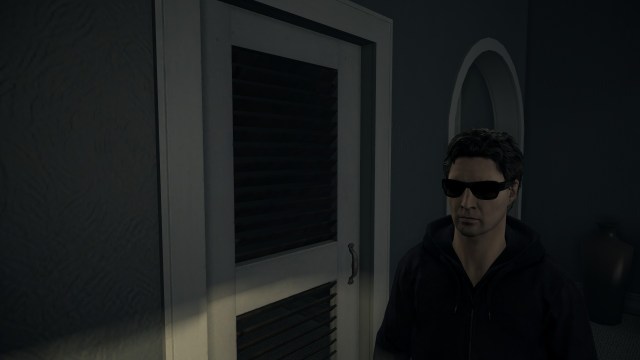
2013-01-04_00003

A turn: Rob Zacny wrote about how Alan Wake in an allegory for the development of itself.  I think askew from this a little–I take Alan Wake as an exploration of the nature of narrative. This is an easy, and incredibly non-risky thing for me to say in regards to the game. It comments on itself, and on the plodding nature of plot, through its vaguely epistolary system–during the chapters of the game, Alan picks up manuscript pages that tell the story that he is living.

This is the core of the narrative: Alan has already written everything that is going to happen, and we are just going through the motions; time is catching up to narrative.

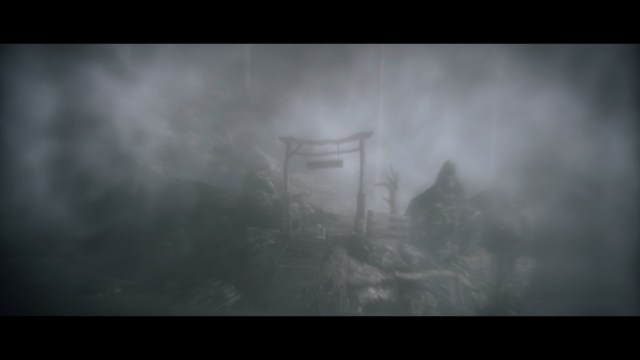
All of that is well and good up until the end of the game. Alan follows the tracks before him until he reaches the final page–it is unwritten. Instead of pulling punches, Alan Wake goes the other way–the player is robbed of a happy ending. The final scenes are impossibly bleak, with Alan’s wife Alice sitting, rescued and alone, on a dock. There is a quick cut to Alan, showing him typing furiously, and then the game ends.
2013-01-04_00017

Alan Wake writes us out of the story.

I love this because it is so simple–why does a narrative occur? A reader necessitates it. Materially, a reader moves time forward, and a player in a game does the same. We are chronologizing forces that intersect with games apparatuses. In a world where the dark presence will always return as long as there is a future, where a vessel can always appear in the future, where another Alan Wake will come, what is the solution other than ending time itself?

Things I Read About Alan Wake

Posted in Video Games | Tagged , , , , , | Comments Off on On Alan Wake