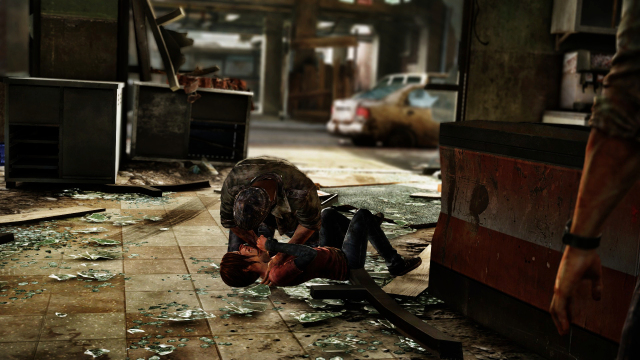
Steve Gaynor on Violence from 2010

GTA

Earlier today, Sparky Clarkson tweeted about this article from Steve Gaynor from a few years back. I re-read it and really latched onto this part:

Violence in film, literature or on stage can either be meaningful or meaningless. When it is meaningful, it resonates with the audience; when it is meaningless, it is largely (and rightly) derided. Consider the death of Shakespeare’s Hamlet following a duel, or of Sonny Corleone in The Godfather, or of Evelyn Mulwray at the end of Chinatown, versus, say, the nameless mooks mown down in Rambo II or Commando or Hard Boiled. The killing by the protagonist of those without identity devalues human life in the work, and thereby robs the violence of meaning (it being perpetrated upon human forms with no value.)

And so a metric for games comes to mind: violence performed by the player in a video game is only legitimate if the victim is a unique and specific individual.

The metric becomes a constraint on content: don’t remove the violence– remove the faceless masses of “enemies.” If every character the player interacts with is a unique and specific individual, then any act of violence committed by the player is invested with some amount of meaning: individuals have families, homes, jobs, friends, and most importantly, relationships with other characters in the game. The player’s act spiders out from the individual to those that surround them, even if that social web is for the most part only implied. There are no more broad swaths of generic violence, then; there are only discrete acts of specific violence, each of which has the potential to matter.

– “Specific Violence

I think of myself, in my most haughty moments, as someone whose work focuses on nonhuman ethics and how those ethics get parsed out. What does it mean to be ethical toward an inhuman thing? How are specific beings or objects plotted on the human-animal-object spectrum? Why?

Reading Gaynor’s post, I immediately think: when is an enemy faceless? When is an enemy lacking a face? And at what point, narratively or systemically, do we begin to understand a being in a videogame as “legitimate”?

Not foreclosing any possible answers here, but this is definitely part of my larger set of (academic and games criticism) questions.

Very curious about examples of things done well or horribly in games in the comments.

Posted in Video Games | Tagged , , , | 3 Comments

“amending the ways of nature”

In expert epistemology, nature was messy. Technology was the great orderer. “The real calamity in a thunderstorm,” explained William Crookes, commenting on natural unharnessed electricity, “is not that the lightning may kill a man or a cow, or set barns or stacks on fire. The real calamity consists in the weather being upset.” The practical electrician should aim at “nothing less than the control of the weather” for the sake of agricultural productivity. Practically speaking, Crookes did not wish “to reduce our rainfall in quantity, but to concentrate it in a smaller number of days, so as to be freed from a perennial drizzle.” What he called “amending the ways of Nature” justified an expert, or adversarial, relationship to it.

– Carolyn Marvin, When Old Technologies Were New p. 114

Posted in Theory | Tagged , , , , | Comments Off on “amending the ways of nature”

Steam Curation and a Group For Readers

Steam Curation was released a few days ago. The gloss on it is pretty simple: groups can now create lists of recommended games in an effort to solve the “there are so many games on Steam” discoverability problem.

steamcurators

With that in mind, I have done two things:

1. Created a Steam group for people who read this blog or generally follow my work around the internet. It seems like there’s no reason NOT to join the group, SO JOIN THAT GROUP.

Here is a link to the Steam group.

2. Created a curated list of games I really like. I will add to this as time goes on. I figure that if you’re reading this blog with any regularity then you might want to know what games I think you MUST PLAY or that are SUPER GOOD.

Here is a link to the Curator page if you want to follow that.


Posted in Video Games | Tagged , , | Comments Off on Steam Curation and a Group For Readers

A war photographer goes to The Last of Us

The Last of Usª Remastered_20140905150653

By the time I finished this assignment, watching the carnage had became easier.

– “A War Photographer Embeds Himself Inside A Video Game

Posted in Art, Video Games | Tagged , | 1 Comment

Agent Smith’s Reversal

I watched The Matrix Reloaded and I came away confused. In The Matrix, Agent Smith is this weird nihilist–he wants to scrub the matrix of free humans so he doesn’t have to be embodied any longer. When he complains about the sweat and the smell and the taste of humanity, he’s really complaining about the fact that he has to exist. In the world of The Matrix, the Agents are a security system that try to eliminate the free humans, and in a world without those free humans, Smith is free to shuffle off this mortal coil.

matrix

Killing Morpheus, Neo, and the others, then, is a very active nihilistic effort toward nonexistence for Agent Smith.

Then Reloaded comes along and Agent Smith is back again. At the end of The Matrix, Neo dives into Agent Smith and makes him explode. In Reloaded, Smith comes back, telling Neo that he “knew what he was supposed to do” and refused to do so. Because of some vague write/copy error, Agent Smith is no longer a security system in the matrix. Instead, he is a virus, and he’s real mad about something or other.

And that something or other is the weird, incongruous thing. Agent Smith’s was trying as hard as possible to hurtle toward death in The Matrix, but for some reason he stopped himself?

Even weirder is the speech he gives to Neo right before the “burly brawl” scene:

But, as you well know, appearances can be deceiving, which brings me back to the reason why we’re here. We’re not here because we’re free. We’re here because we’re not free. There is no escaping reason; no denying purpose. Because as we both know, without purpose, we would not exist.
[Several Agent Smith Clones walk in]
It is purpose that created us.
Purpose that connects us.
Purpose that pulls us.
That guides us.
That drives us.
It is purpose that defines us.
Purpose that binds us.
We are here because of you, Mr Anderson. We’re here to take from you what you tried to take from us.
[Attempts to copy himself into Neo]
Purpose.

A character whose entire being was formulated around a desire for death is angry because his purpose in life was taken away?

Ugh this movie y’all.


Posted in Film | Tagged , , , | 5 Comments

A Moment in Kitsch Nihilism

Pop nihilism is a real, active cultural force. We can see it so clearly in Eugene Thacker’s rise to prominence around In The Dust of this Planet. We can see it in the GIF walls of Rust Cohle’s brutal Ligotti-inflected philosophy in True Detective, and it is even more start when we realize that we, as a collective, can never be as “cool” as that character.

Earlier this week I wrote a post about contemporary nihilism and The Matrix, or at least I wrote around those things, and someone on twitter showed me this video for “Come Back” by the band Seeming.

seemingcomeback


The track is sits somewhere between ambiance, noise, and field recordings, and I really enjoyed listening to it. At the same time, I couldn’t stop smiling. The video itself is filled with words like the above, and it tells the story of a human species that has separated itself from nature. The text mourns that separation, claiming that we should shuffle back into some primordial state built on love rather than the accident of the human social. Predictably, the middle of the video has footage of animals doing animal things.

seemingcomeback2

I’m not drawing attention this just to slander the video, but rather to say that it drew a stark line in me. I’ve always been partial to the Ligotti/Paul Ennis/nihilist line of thinking about the world and the human relationship to it. That is to say that I think humans are profoundly destructive and the things we manage to do to one another in the same of our continued existence, our progress, and our drive for the new are all horrifying and seem to be driving us, as a species, to extinction. The causes for this extinction, of course, are created by a relative handful of the human population compared to the number of humans who live on the planet.

But this video puts me on the edge of pop nihilism and into a realm of kitsch nihilism. Is the video tongue-in-cheek and making fun of the Rust Cohle way of thinking? Or is it saccharine sincerity that advocates drawing humans back into some kind of pure love state of nature?

Maybe I just balk at the fantasy of nihilism as cultural drawdown (following from a kind of nuclear drawdown) rather than a dream of nonexistence.

Pop nihilism => kitsch nihilism = Zerzan-esque primitivism?


Posted in Theory | Tagged , , , , , | 1 Comment

On Lyotard and Thebaud’s “Just Gaming”

[I originally wrote this post in February 2014 and never published it for some reason. A lot of it, especially at the beginning, is written for a specific time and moment. Forgive me.]

As you may know, I am writing a thesis this semester, to my posts might veer toward the note-based or short-argumentative or whatever for a little while. I’m reading a taking notes constantly, and I would rather push those things publicly (and invite you to comment/discuss) rather than have those ideas live in notebooks forever.

I recently finished Jean-Francois Lyotard and Jean-Loup Thebaud’s Just Gaming, which is a transcript of a conversation that the two philosophers had about Lyotard’s then-current scholarly output like Libidinal Economy and The DifferendJust Gaming is pitched as a book of clarifications, where Thebaund attempts to wrangle Lyotard into some specifics about a set of theories and ideas that are purposefully nonspecific and are often attempting to prove that there is no “ground” for human life and language. In other words, Lyotard works in theories that are ontologically and epistemologically slippery, and Thebaud is working very hard to apply some friction to them.

That said, we can say that the large subject of Just Gaming is justice, where it comes from, and if we can ever truly attain it. Lyotard is generally responding to claims about justice that have haunted European models of political engagement since the middle ages, and his central claim is that because the entirety of expression is merely a game, then there is no firm ground for theories of justice to land on. In other words, there is no eternal concept of justice, and the act of appealing to it as if it existed only works to obfuscate the reality of politics — they are grounded in nothing and are ultimately arbitrary.

I don’t think it takes a lot to get onboard with Lyotard’s claims here, particularly in a political world that’s become just as much about the management of language as it is about the collective (or atomized) actions of people. Lyotard argues that the core of justice is the prescription, a demand from a figure to change the world. He writes that:

This means that all politics implies the prescription of doing something else than what is. But this prescription of doing something else than what is, is prescription itself: it is the essence of a prescription to be a statement such that it induces in its recipient an activity that will transform reality, that is, the situational context, the context of the speech act. [23]

A couple pages later, Thebaud clarifies this point on politics, and Lyotard comes down to justice.

JLT: In other words, justice can be understood only from the prescriptive.
JFL: It is the order of the prescriptive, in any case. [25]

To recap: a system of politics in the world, in order to justify itself, makes prescriptions based on its own self-preservation and proliferation. Those prescriptions enter into a large ecology of statements about the world and what it should look like in the future (and what it looked like in the past), which we could call something like a metagame of language in which there are competing worlds that are arbitrarily chosen between due to their power to assert themselves as the only prescription worth following. Lyotard’s key example here are the prescriptions of the Judeo-Christian god in the form of the ten commandments. While they are certainly rules for individuals, they are also rules for how a people’s conception of world should be shaped after they are handed down. In this sense, Lyotard’s statements about “language games” are eerily accurate, in that prescriptions make for a possibility space that cannot be escaped while still maintaining fidelity to the prescriptions themselves. In other words, prescriptions and the politics and concepts of justice that follow them are a neat, totally-designed game that we are constantly playing.

Lyotard contrasts these top-down prescriptions to an embracing of what he calls paganism. This paganism is an active rethinking of “metalanguage,” or “the famous theoretical discourse that is supposed to ground political and ethical decisions that will be taken as the basis of its statements.”[28] That metalanguage is the prescription that I wrote about up above; paganism is the idea that there isn’t a single prescription, but a multitude of them that are all equally true at one time: “we are always in judgments of opinion and not in judgments of truth.”[28]

Lyotard is pitting a metaphor of the Abrahamic tradition against a metaphor of the Greek tradition, neither of which map 1:1 onto a reality, but both of which are a helpful illustration for understanding the world as it really is. The prescription contains a logic of exclusion of all other prescriptions; to accept a prescription is to accept that there is a single path in life. Lyotard wants us to embrace a paganism that sees prescriptions always in conflict with one another, denouncing each other as false prophets, catching us up in their argumentative flows and demanding we heed their specific instructions. Accepting paganism means accepting that the prescription is not sufficient in explaining the world, and that one model cannot contain its outside.

Most of this might sound familiar, as contemporary debates around liberalism, religion, and secular life seem to at least agree that there are multiple narratives that run through the world. A conservative population of any sort will hold to their prescriptions (to name a few: neoliberals, capital-L Liberals, hardline Marxists, Christian fundamentalists) and declare any deviation of that some form of the dreaded relativism, whether it be of the moral or political type.

Relativism is a word that gets thrown around as this sort of paralytic recursive question about how we are supposed to act in the world: “if not X, then what?” the prescription asks, where X is a traditional account of political action. Lyotard’s response to pure relativism is to say that just because paganism exists doesn’t mean that we cannot act whatsoever. On the contrary, he calls up the Kantian concept of the Idea as a way of escaping a morass of political indecision. Lyotard reads the Idea as “a sort of field where one can run and let oneself go to see how far one can reach with a given concept.”[75] Later, provoked to defend himself by Thebaud, he reduces the illustration down to “a horizon.”[77]

An Idea is a concept that is never exhausted or taken to it limit. As Lyotard says, it is a horizon that structures thought, and ultimately provides something like a set of political bumpers that guide but do not overdetermine thinking or politics. An Idea is a way of structuring the world, but it does it through a certain endpoint, and it might not exist in the world when it is initially conceived. For example, an Idea might be “the abolition of zoos.” This certainly doesn’t exist in the world right now, but it can be thought to exist, and by using the Idea as a guiding principle, we can make active choices in order to reach that state.

The mistake that Lyotard warns against is turning this adherence to an idea into mere Liberal political strategy (my words, not his). He argues this by saying that taking the Idea as a starting point for politics presents us with a “field of ruses” and a “field of finality”[80]. In the case of the former, he is referring to the arbitrariness of how Ideas operate; in paganism, there are multiple truths, and so they wrap around one another, turning the space where they argue against one another into a field of argumentation and rhetorical dancing. In the case of the latter, he is hinting again at the horizon function of the Idea, that it presents an end point that always eludes us. In following the Idea, or using it as a guideline, we aren’t actually hoping to reach an end point. Instead, we want it to take us as far as it can, toward a point that might totally escape us, but toiling after it nonetheless because we conceive of it as a political and ethical good. As I mentioned before, the danger here is a basic Liberal acceptance and operation within these fields. In accepting that there is no truth, only opinion and that there is a possible finality to politics, it becomes very simple to work toward that end dialectically through structures like the courts. In that case, Lyotard claims, “there is no possible politics. There is only consensus.”[81] In the hunt for consensus, a more insidious process takes place: “the manufacture of a subject that is authorized to say ‘we'”[81]

A quotation from Lyotard, from the same chapter, before ending:

This is where the whole matter lies: one must not merely take into consideration all of society as a sensible nature, as an ensemble that already has its laws, its customs, and its regularities; but the capability to decide by means of what is adjudged as to be done, by taking society as suprasensible nature, as something that is not there, that is not given. [82]

I’m quoting at length here because it is one of the final places in Just Gaming where Lyotard sums up his position. For me, this paragraph is a useful and pragmatic way of thinking paganism. It is a mode of acceptance of what a society claims and what it has disavowed. Another way of putting it is to say that a society has an unthinkable part of itself that nonetheless can coincide with an Idea that might govern a particular set of political strategies.

My purpose in writing this wasn’t to come down on a side here. I think Lyotard is presenting an interesting argument, and I’ve done my best here to distill it into something that is readable and maybe useful as a way of building an argument out of Lyotard about a politics that is grounded in a specific ethical stance (an Idea) but which can take many forms and isn’t overdetermined by a set of strategies (the particular shape of society in time). The age of Twitter has proliferated these ideas — paganism has become more pagan, if that makes sense — and I like reading work from thirty years ago that seems to map onto and matter for our contemporary modes of engagement.

Lyotard might be helpful for thinking through these things or he might not, but I think there’s some useful thinking here that might be worth adding to anyone’s political and theoretical toolboxes.

Posted in Theory | Tagged , , , , | Comments Off on On Lyotard and Thebaud’s “Just Gaming”

The Matrix and the Nihilistic Impulse

1.

I’d like to share a revelation that I’ve had during my time here. It came to me when I tried to classify your species and I realized that you’re not actually mammals. Every mammal on this planet instinctively develops a natural equilibrium with the surrounding environment but you humans do not. You move to an area and you multiply and multiply until every natural resource is consumed and the only way you can survive is to spread to another area. There is another organism on this planet that follows the same pattern. Do you know what it is? A virus. Human beings are a disease, a cancer of this planet. You’re a plague and we are the cure.

– Agent Smith, The Matrix 

2.

I am a nihilist.

I observe, I accept, I assume the immense process of the destruction of appearances (and of the seduction of appearances) in the service of meaning (representation, history, criticism, etc.) that is the fundamental fact of the nineteenth century. The true revolution of the nineteenth century, of modernity, is the radical destruction of appearances, the disenchantment of the world and its abandonment to the violence of interpretation and of history.

– Jean Baudrillard, “On Nihilism” in Simulacra & Simulation

3.

A chemical explosion, to a flying particle, to a chain reaction, to a devastation. A scalar madness is etched in the brain and repeated by the creatures awakened. This is the indecision between continuity and complicity, in how much we take blame for ‘awakening’ the monsters but often seem forced to utilize the same technology, or other disastrous technologies, to combat them. Complicity is investigated by being scaled up and down. The scalar madness is folded outwards: we construct monsters to fight monsters. Nuclear solution twice over – reliable tech and nuking the breach in Del Toro’s Pacific Rim.

– Ben Woodard, “Nuclear Scale: Or, Only Godzilla Can Save Us

matrix

4.

I watched The Matrix again for the first time in years and I was struck by how much is packed into that film. There’s the brutal hatred of Agent Smith, the implicit nihilism of the literal “end of history” in an eternal, simulated 1999 where nothing new can ever happen. And there’s the lack of 9/11, which is bound up in this strange, eternal 1999–there will be nothing new, the world has gone grey, there are no more events and because of this there must be a real world where real events are happening.

I was struck by the ending of the film this time, more than previous viewings, by the “becoming-nuclear” (as Ben might have in the piece above) of Neo. He’s more machine than a machine. Humans win out by being more ruthless (literally exploding Agent Smith) than the machines; Neo is able to be more cruel, more brutally violent, because he is outside the system of governance that is the Matrix itself.

Posted in General Features | Tagged , , | 6 Comments

Destiny and Writing

destiny3

1. Destiny is a hodgepodge of a lot of different mechanical and conceptual elements that sometimes cohere but mostly fall apart, together, spectacularly. It’s hard to point to Destiny‘s strong points at this moment, but it is quite easy to point to its key weakness: its story.

I’m using “story” as a broad signifier of a lot of different things here. On one level, I mean the plot, which pitches forward, rolls, stops, starts again, and generally feels like it was put together with mismatched Lego sets. On another level, I mean the basic mechanical level of the writing itself. Each line in Destiny is painful to listen to. Taken in paragraphs, it is what I can only describe as violently awful, which is language I might use for, say, mind-and-body-destroying diarrhea.

This opinion seems to be held by most of the players of Destiny to various degrees. This has led to a joke I’ve seen made by dozens of people: Bungie spent $500 million dollars on a game and its marketing but forgot to hire a writer.

A given is that it is bad. What I am curious about is why it is bad, or, what is the particular machinery of badness that produced a product that emits “this is all awful” background radiation?

A quick background of some people informing the thinking going on here: Patrick Klepek wrote that Destiny‘s single player missions feel tacked-on or are at least handled poorly in their current context. Carolyn Petit wrote a wonderful post about the story (some of which I am retreading in different words) where she explains that Destiny has a” story full of vague mumbo-jumbo that doesn’t mean anything at all and is only the flimsiest excuse to send you from Earth to the moon to Venus to Mars, killing things all the while.” And Brendan Keogh wrote the currently-definitive take on the game, devoting an entire subsection to Peter Dinklage and the story of the game, ending with:

By large, I don’t care that I don’t care about the story, and I don’t care that the game doesn’t care about the story—that’s not why we’re here. But then, occasionally, it has these long drawn-out cut-scenes where suddenly it decides your avatar is now a voiced character for a little while, like these brief hiccups where Destinymistakes itself for a story-driven game. And then you go back to fighting The Bad Guys on The Planet with The Gun. But kind of like the repetitive worlds, the story doesn’t matter. It’s not what is meant to keep you here. That core shooting-things loop is what is meant to lure you in.

And so those are the things I’m thinking about here.

destiny1

2. In the article I mentioned above, Petit mentions that Destiny has a lot of the same trappings as Star Wars. At the heart of this similarity is something we could call “the evocation effect.” The perfect illustration of this effect is the Mos Eisley cantina scene from Star Wars. Luke Skywalker walks in, the camera cuts around the room and shows you lots of different kinds of characters, and then time goes on. The film tells you nothing about them, but they are intended to evoke a world beyond the camera. “Dang!” you’re meant to think, “I bet they all have stories!” They don’t. (Or didn’t at the time. The Expanded Universe probably has total family genealogies for all of them at this point.)

The evocation effect is used to make you intrigued in order to cut through expository overhead and it allows you to short circuit one of nerd culture’s worst habits: world building. Essentially you are farming that work out to people’s brains and everyone is the better for it. This form isn’t used only in visual media. Philip K. Dick created a career out of evocation, and when I recently read Jonathan Lethem’s Amnesia Moon I experienced the same thing. Joanna Russ’ The Female Man evokes almost to the exclusion of plot, and because of that it feels like you’re reading the book equivalent of a runaway train for its 250 pages.

So there are two camps: Tolkien-esque worldbuilding which over-defines and over-determines the world through the use of a historical, geological, political, and every other -ical database that precisely defines the contours of the world and what did and can happen inside of it. The other is the Star Wars-style use of the evocation effect to build a world that exists more in your head than any database. It is about feeling right, setting a tone, and realizing particular aesthetics that get people thinking about the world of the media object.

destiny2

3. Destiny‘s story fails because it tries to employ the evocation effect to a database.

The game Destiny presents us with a universe in which The Traveler, a giant white space egg, appears on Earth and “uplifts” our species through technological means. Quick on its heels is The Darkness, a giant force that seems to only exist to destroy The Traveler. With it comes lots of different species like The Hive and The Fallen, strange humanoid monsters that want to kill both humans and The Traveler itself.

This action all takes place in the solar system around Sol, our sun, but each of the planets have been terraformed for human use. This allows the Destiny designers to mix the familiar (we know what the Moon is) with the unfamiliar (we don’t know what The Archer’s Line is on the Moon or why there is a place called The Hellmouth or even what that is supposed to mean). On face, this is the evocation effect in full action; here’s some stuff, deal with it, have a great time.

But every time I want to deal with it and have a great time, the game keeps forcing Peter Dinklage to monotone lore in my ear. I’m walking through beautifully sculpted crypts. They suggest that The Hive have a culture, that they need dwelling spaces, and that they are a profoundly ritualistic culture. Their entire lives are spent in holes that double as cathedrals. It evokes complication and intelligence, two qualities that are lost completely when you fight against suicidal drones or cat-and-mouse leaders. If I were allowed to do this in silence then I would be able to think.

As soon as I start thinking about the world, as soon as things are evoked in me, Dinklage starts telling me about the Sword of Crota and how many Guardians it has killed. He’s telling me about the Princes and how they use the sword. After the battle, he says that the Cryptarchs won’t believe what happened to the Sword of Crota.

All of this is patently nonsense, and the reason that it is nonsense is because Destiny is trying to have both a database of lore while evoking things that cannot be accounted for in that lore by virtue of existing only in the player’s head. Put another way: Destiny does the work of two storytelling methods and fails at both.

Posted in Video Games | Tagged , , , , , , | 5 Comments

New Game: Napoleon Loves Waterslides

Today I was watching Bill and Ted’s Excellent Adventure (currently on Netflix), and I thought it was incredibly funny that there’s an entire subplot of the movie which is, fundamentally, “Napoleon’s Adventures in San Dimas.”

So I made a game about it.

title screen


Click here to play.

Posted in A Game I Made | Tagged , , , | 1 Comment